August 4, 2026
The World's Most Consequential 33 Kilometres
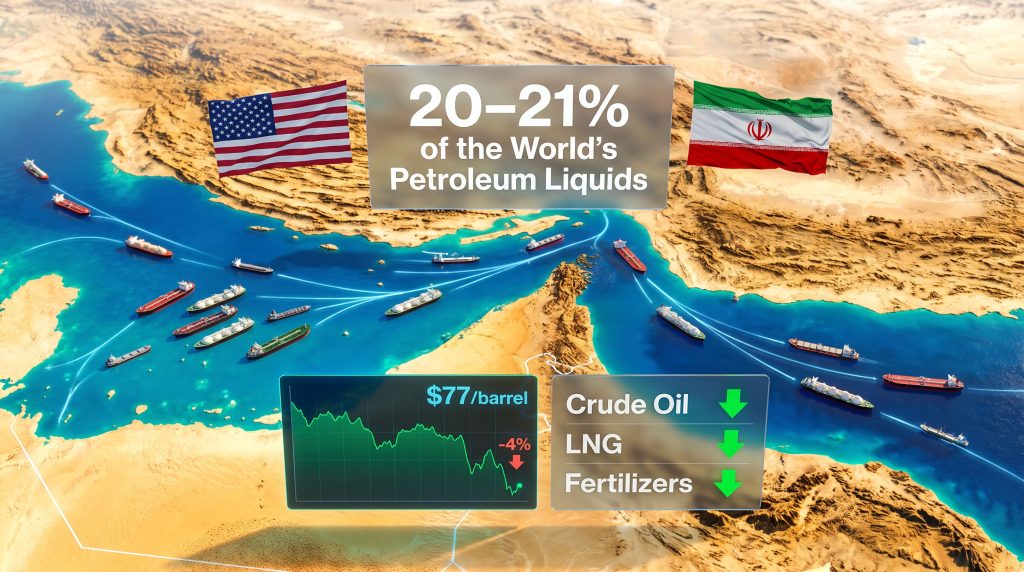
Few geographic features carry as much economic weight as a narrow strip of water separating the Omani coast from southern Iran. At its tightest point, the Strait of Hormuz measures just 33 kilometres across, with functional shipping lanes of only 3 kilometres in each direction. Yet through this remarkably confined passage flows roughly 20 to 21% of the world's total petroleum liquids every single year, along with significant volumes of liquefied natural gas, refined products, fertilizers, and industrial chemical feedstocks.
When that passage becomes contested, the consequences radiate outward into global energy markets, agricultural supply chains, and manufacturing operations simultaneously. That is precisely the situation that unfolded in mid-2026, and it is why a reported deal to open the Strait of Hormuz attracted immediate and intense attention from commodity traders, central bankers, and supply chain managers around the world.
When big ASX news breaks, our subscribers know first
Understanding the Reported Agreement: Structure and Scope
A Transitional Framework, Not a Final Settlement
The reported U.S.–Iran arrangement is best characterised as a structured de-escalation instrument rather than a comprehensive diplomatic resolution. Its primary function is to restore commercial shipping access while creating a defined negotiating window for deeper geopolitical issues to be addressed separately. Furthermore, the broader oil trade geopolitics driving this situation have been building for some time, making the framework's design all the more critical.
Based on available reporting, the framework's core terms can be summarised as follows:
| Reported Term | Detail |
|---|---|
| Waterway access | Full reopening to commercial shipping traffic |
| Toll arrangement | Toll-free passage for an initial 60-day period |
| Commercial targets | Restoration toward pre-conflict shipping volumes |
| Proposed venue | Neutral signing location (Switzerland/Geneva reported) |
| Follow-on agenda | Iran nuclear programme, sanctions relief, maritime governance |
| Regional coordination | Iran, Oman, and Gulf states to participate in future management discussions |
The explicit absence of passage fees is significant. U.S. Treasury Secretary Scott Bessent confirmed in remarks on CNBC's Squawk Box that the arrangement would constitute genuine freedom of movement for commercial vessels, without Iranian-controlled toll collection or inspection requirements as conditions of transit.
This distinction matters because it preserves the legal principle of unimpeded passage under international maritime law, while deferring the longer-term question of sovereignty and governance arrangements to follow-on talks. According to the Washington Post, the initial deal text revealed a framework specifically designed to reopen the strait under these conditions.
What the Deal Does Not Resolve
The 60-day toll-free framework leaves several foundational disputes entirely untouched:
- Iran's nuclear enrichment programme and the verification mechanisms required for any credible inspection regime
- The architecture and sequencing of sanctions relief measures
- Long-term governance of the strait under international law and the rights of Gulf Cooperation Council member states
- The broader question of Iranian regional influence and proxy network arrangements
Important framing: Investors and analysts should treat this agreement as a confidence-building measure with a defined expiration clock, not a resolution of the underlying geopolitical tensions. The 60-day window will generate renewed diplomatic pressure as it approaches its conclusion.
How Oman Became the Diplomatic Linchpin
Oman's role in facilitating U.S.–Iran back-channel communication is not new. Muscat has historically served as a trusted intermediary between Washington and Tehran precisely because of its carefully maintained neutrality within a deeply polarised regional environment. Gulf states with direct economic exposure to Hormuz disruption also applied quiet diplomatic pressure to accelerate a maritime access agreement, independent of progress on the more complex nuclear and sanctions dossiers.
The involvement of Switzerland as a potential signing venue follows a similar logic. Neutral third-party locations reduce the domestic political cost for both parties, allowing negotiators to reach agreement without the optics of either side appearing to capitulate on home territory. In addition, the geopolitical risk landscape across the broader region has made such neutral facilitation increasingly valuable in recent years.
The Market Signal: Why Oil Fell Before Any Deal Was Signed
One of the most analytically interesting dimensions of this episode is the timing of the market response relative to the confirmation of an actual agreement.
U.S. crude oil futures declined approximately 4%, falling below $77 per barrel, within hours of Bessent's public remarks on CNBC. Critically, this price movement occurred before any formal agreement had been signed or its text publicly released. Reuters reporting at the time noted significant remaining uncertainty around the deal's precise terms and whether it constituted a permanent arrangement.
This dynamic illustrates a well-established pattern in commodity market behaviour: credible forward guidance from authoritative sources moves prices independently of confirmed outcomes. Bessent's remarks were not a casual observation; they represented a deliberate Treasury strategy of using public communication to begin managing inflationary expectations in energy markets ahead of official announcements.
His additional observation that prices could fall significantly further once the strait formally reopens functioned as a direct intervention in market psychology, anchoring trader expectations around a relief-trade thesis before the physical supply shift had occurred.
The Scale of the Supply Backlog: A Multi-Sector Shock
Bessent's description of hundreds to potentially 1,000 or more commercial vessels waiting at anchor for passage clearance captures the true breadth of the supply disruption. This is not solely an oil market story. The backlog spans multiple commodity categories, each with distinct downstream consequences:
| Commodity Category | Strait Dependency | Expected Price Direction on Reopening |
|---|---|---|
| Crude Oil | Very High | Downward (short-term) |
| LNG | High | Downward (short-term) |
| Fertilizers (Urea, Ammonia) | Moderate to High | Softening |
| Refined Petroleum Products | High | Downward |
| Industrial Gases | Moderate | Marginal softening |
The fertilizer dimension is particularly underappreciated in mainstream energy market coverage. Significant volumes of urea and ammonia transit the strait from Gulf producers to import-dependent agricultural economies across South Asia, Southeast Asia, and parts of Africa. A reopening occurring in the mid-2026 window aligns with pre-harvest agricultural input procurement cycles, meaning the timing of any supply restoration carries direct relevance to planting season outcomes in some of the world's most food-insecure regions.
Industrial chemical feedstocks including ethylene, propylene, and specialty gases from Gulf producers also transit the waterway, creating downstream exposure for plastics manufacturing, pharmaceutical production, and electronics supply chains that had been drawing down inventories during the closure period.
Three Scenarios for What Comes Next
Scenario 1: Full Reopening Proceeds (Base Case)
Commercial shipping resumes within days of a formal signing. Crude benchmarks stabilise in the $70 to $75 per barrel range as the vessel backlog disperses to destination markets. The geopolitical risk premium embedded in crude pricing compresses by an estimated 15 to 25%. Follow-on nuclear and sanctions negotiations begin within the 60-day framework. However, the longer-term trajectory will depend heavily on OPEC's market influence and how Gulf producers respond to rapidly shifting supply dynamics.
Scenario 2: Deal Collapses Before Signing (Downside Case)
Negotiations break down, crude prices reassert above $85 per barrel, and shipping war risk insurance premiums are re-applied to Hormuz-transiting vessels. OPEC+ faces pressure to manage renewed price volatility through production policy adjustments. Consequently, inflationary consequences accelerate across energy-import-dependent economies, compounding existing global trade disruptions already weighing on markets.
Scenario 3: Partial Agreement With Contested Implementation
Shipping resumes at reduced volumes due to unresolved disputes over inspection rights or toll collection. Freight rates remain structurally elevated. Markets price in an ongoing geopolitical risk premium of approximately $5 to $10 per barrel above fundamental supply-demand value. The 60-day clock expires without a clear pathway to resolution, restarting diplomatic uncertainty.
The next major ASX story will hit our subscribers first
Who Gains Most From Restored Strait Access
Asia-Pacific Energy Importers
Japan, South Korea, India, and China collectively represent the largest beneficiaries of restored Hormuz access. Their dependence on Middle Eastern crude and LNG means any sustained closure imposes direct economic costs through elevated import prices and supply insecurity. For India in particular, the combination of crude oil, LNG, and fertilizer dependency through the strait creates a triple-channel vulnerability that a reopening would address simultaneously.
Shipping and Logistics Operators
Carriers that had been rerouting via the Cape of Good Hope to avoid the contested waterway were absorbing an additional 10 to 14 days of voyage time per round trip, plus significantly higher bunker fuel costs. A normalisation of Hormuz transit would immediately restore these vessels to their economically optimal routing, compressing freight rates and marine insurance surcharges.
European Energy Markets
European buyers still navigating the structural energy realignment that began in 2022 would benefit from restored LNG competition in Atlantic basin spot markets. The LNG supply implications for European buyers are considerable, as additional Gulf supply re-entering the global liquefaction export pool would introduce meaningful competitive pressure on spot pricing.
Assessing the Information Gap: What Remains Unverified
Responsible analysis of this situation requires acknowledging significant verification gaps that existed at the time of initial reporting:
- The full text of any agreement had not been publicly released as of initial announcements
- Reuters reporting described the arrangement as falling short of a permanent ceasefire or truce
- Different reporting streams described varying levels of deal maturity, suggesting parallel negotiating tracks with different degrees of progress
- The confirmed timing and location of any formal signing ceremony remained unverified across multiple sources
Verification note for investors: There is a material difference between deal signalling, where an authorised party publicly indicates proximity to an agreement, and deal confirmation, where a formally signed text is publicly released. Current market pricing reflects the former, not the latter. The remaining gap between these two stages carries real risk.
This divergence in reporting is consistent with how complex multilateral diplomacy typically unfolds. Parallel negotiating tracks produce different accounts of deal status depending on which source has visibility into which component. Selective disclosure of favourable terms before final commitment is a standard negotiating tool used by multiple parties simultaneously, generating conflicting narratives that only resolve upon formal signing.
The Broader Geopolitical Signal
Beyond its immediate commodity market implications, a deal to open the Strait of Hormuz carries strategic significance for how U.S.–Iran relations might evolve through the remainder of the decade. The pragmatic, interest-based structure of the reported arrangement suggests both parties are capable of reaching transactional agreements on specific issues even while fundamental disputes remain unresolved.
The use of established back-channel infrastructure — Oman as intermediary, Switzerland as neutral venue, and structured time-limited frameworks — reflects a diplomatic architecture that has historically enabled incremental progress between adversaries who cannot yet sustain comprehensive engagement. Whether this particular deal to open the Strait of Hormuz holds, and whether it generates momentum toward deeper resolution of the nuclear and sanctions questions, will define the geopolitical trajectory of the Middle East energy corridor through 2027 and beyond.
Disclaimer: This article contains forward-looking analysis, scenario modelling, and market projections based on publicly reported information available at the time of writing. None of the material in this article constitutes financial or investment advice. Commodity price forecasts are inherently uncertain and subject to rapid revision based on geopolitical developments. Readers should conduct independent research before making any investment decisions.
Want to Stay Ahead of the Next Major Commodity Market Shift?
When geopolitical events like the Strait of Hormuz disruption ripple across energy, fertiliser, and industrial supply chains, the knock-on effects for ASX-listed resource and commodity companies can be swift and significant. Discovery Alert's proprietary Discovery IQ model delivers real-time alerts on significant ASX mineral discoveries the moment they hit the exchange, transforming complex market signals into actionable investment opportunities — begin your 14-day free trial today and ensure you're positioned before the broader market catches on.