June 18, 2026
The Logistics Gap That Oil Markets Keep Ignoring
Every time a geopolitical crisis threatens a major energy chokepoint, financial markets respond before the physical world has a chance to catch up. This structural asymmetry between paper crude markets and real-world supply chains is not a new phenomenon, but the 2026 Strait of Hormuz oil prices disruption cycle has exposed it with unusual clarity. Understanding this gap is not just an academic exercise. For energy traders, sovereign fiscal planners, and long-term investors, it represents one of the most consequential mispricings in modern commodity markets.
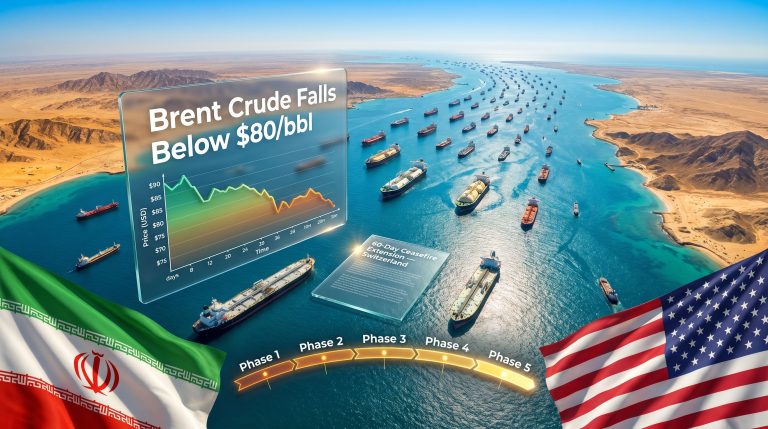
The pattern has repeated itself at least three times since February 2026: a diplomatic signal triggers a sharp drop in Brent crude futures, market participants unwind risk premiums, and then the physical reality of a still-constrained supply chain gradually reasserts itself. Each iteration has left traders caught between headline-driven positioning and the slower clock of maritime logistics, insurance underwriting, and refinery restart cycles. Understanding the crude oil volatility trends behind these swings is essential context for anyone tracking this market.
When big ASX news breaks, our subscribers know first
Why the Strait of Hormuz Is Unlike Any Other Energy Chokepoint
33 Miles That Move a Fifth of Global Oil Supply
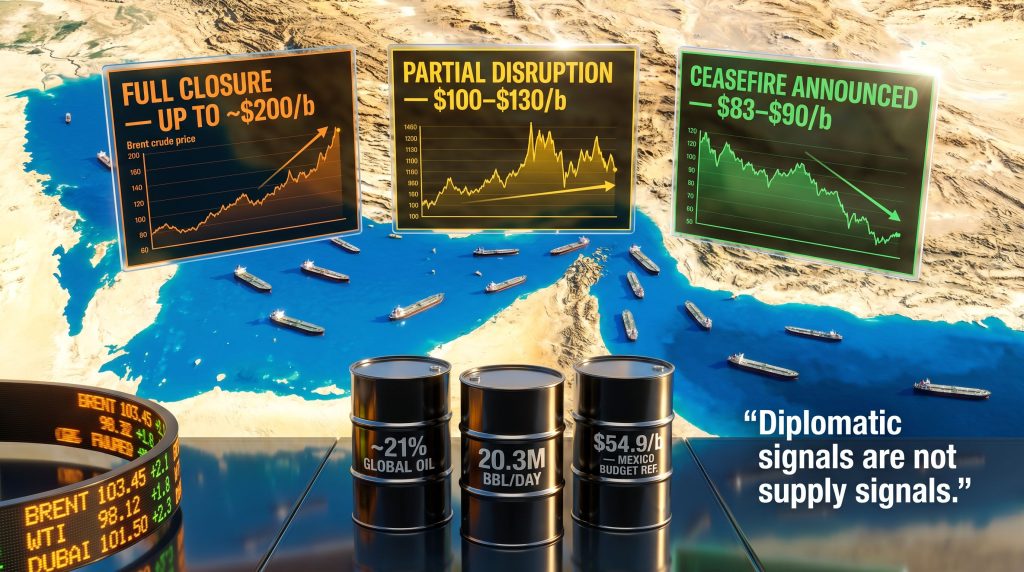
The Strait of Hormuz oil prices relationship is not merely a function of sentiment. It is grounded in the hard arithmetic of global energy infrastructure. Approximately 20.3 million barrels of petroleum, crude oil, condensate, LPG, and refined products transit this narrow passage every single day, representing roughly 20 to 21% of total global daily oil consumption. No single geographic feature on Earth carries a comparable weight in the architecture of energy supply.
The Strait serves as the only maritime exit point for crude exports from Saudi Arabia, Iraq, Iran, Kuwait, and the UAE. Unlike other chokepoints such as the Suez Canal or the Malacca Strait, where alternative routes exist at significant but manageable cost, the Arabian Gulf has no pipeline infrastructure operating at a scale sufficient to replace Strait-dependent seaborne volumes during a prolonged closure. The world's largest oil exporters are, in effect, geographically captive to a 33-mile-wide corridor.
This structural dependency means that disruption here does not create a regional inconvenience. It creates a systemic shock that propagates through refining margins, transport fuel costs, and sovereign budget revenues simultaneously across multiple continents. Furthermore, the oil market disruption risks that accompany any prolonged closure extend well beyond simple supply shortfalls.
How Energy Markets Price Chokepoint Risk Before It Materialises
Crude oil futures markets operate on anticipatory logic. Prices respond to expected supply disruption well before any physical shortage registers in inventory data. This forward-looking pricing mechanism creates a characteristic pattern around chokepoint events:
- Escalation phase: Risk premiums build rapidly into futures curves as traders price in potential supply loss.
- De-escalation signal: A diplomatic announcement, ceasefire, or negotiated agreement triggers immediate premium unwind, often producing a price drop of $10 to $15 per barrel within days.
- Physical lag phase: Actual tanker movements, port loadings, and refinery intake remain constrained for weeks or months after the political signal has resolved.
- Reversion phase: Physical market tightness eventually reasserts itself in premium structures, backwardation, and crack spreads.
The problem is that paper crude and physical crude exist on fundamentally different timescales. Futures contracts reprice within hours. Real barrels move on the timelines of mine-sweeping operations, P&I club actuarial assessments, and vessel repositioning schedules measured in weeks.
Scenario Modelling: What Strait of Hormuz Conditions Mean for Brent Crude
The table below outlines the principal price scenarios analysts have identified across the spectrum of Strait of Hormuz conditions:
| Scenario | Strait Status | Brent Price Range | Key Drivers |
|---|---|---|---|
| Full Closure | Blocked or mined | Up to ~$200/b by end-2026 | Total Arabian Gulf supply loss, no pipeline alternative, SPR drawdown |
| Partial Disruption | Restricted or insecure | $100 to $130/b | Insurance withdrawal, tanker rerouting, inventory depletion |
| Ceasefire Announced | Diplomatically signalled | $83 to $90/b (initial) | Paper market premium unwind, futures repositioning |
| Normalization Lag | Reopened but constrained | $90 to $100/b | Mine-sweeping delays, insurance re-entry, vessel backlog |
| Full Normalization | Fully restored | $75 to $85/b | Inventory rebuild, demand recovery, refinery restart |
The scenario that commodity analysts flag as most likely in the near term is not full closure or clean normalization. It is the normalization lag scenario, where headline prices have already repriced for a resolved crisis while the physical market remains months away from restored supply. For a broader trade and geopolitics analysis, these dynamics sit within a wider pattern of supply-side uncertainty that has defined 2025 and 2026.
The Three-Phase Logistics Barrier That Markets Consistently Underestimate
Phase 1: Maritime Safety Clearance
Before any commercial tonnage can safely transit Arabian Gulf shipping lanes, mine-sweeping operations must be completed across the relevant corridors. This is not a diplomatic process. It is a physical, time-intensive naval engineering operation conducted by specialised vessels with no shortcut available. Analysts assess the probability of full shipping lane clearance within two weeks of a deal signing as low, regardless of the political goodwill accompanying the agreement.
Phase 2: Insurance Market Re-Entry
Protection and Indemnity clubs, the primary underwriters of global tanker fleets for war-risk exposure, must independently assess and price coverage before shipowners commit vessels to the route. This actuarial process runs on its own timeline, separate from political developments. Until P&I clubs are comfortable, shipowners face an unappealing binary choice: self-insure at prohibitive cost or wait.
The practical consequence is that even after a deal is signed, tanker operators will be cautious about committing to Arabian Gulf transits until underwriting markets confirm coverage is available at workable rates.
Phase 3: Vessel Evacuation and Repositioning
Hundreds of vessels trapped or diverted during the disruption period must exit the Gulf before inbound ballasters (empty tankers positioning to load) can enter and complete cargo cycles. This creates what commodity analysts describe as a two-wave supply return dynamic:
- Wave 1 involves trapped vessel exit, which produces positive headline optics relatively quickly but does not represent new supply entering the market.
- Wave 2 involves inbound ballasters repositioning from global trade routes, loading at Arabian Gulf terminals, and delivering physical barrels to refineries. This process is measured in months, not days.
Analysts estimate that roughly the first half of lost Arabian Gulf supply returns once vessels are repositioned. The remainder involves a protracted recovery with multiple friction points including refinery restart timelines, crew certification requirements, port congestion, and ongoing political uncertainty. Refined products face an even longer normalisation timeline than crude oil because refinery restart cycles are inherently slower than tanker repositioning. Consequently, commodity volatility hedging strategies become especially relevant for market participants exposed to these extended lag periods.
The "Verbal Price SPR" Effect: How Official Signalling Has Suppressed Oil Prices
One of the more analytically interesting dynamics of the 2026 Hormuz disruption cycle is the role that sustained official diplomatic signalling has played in suppressing futures prices below what physical market fundamentals would otherwise support. Commodity analysts have characterised this pattern as a "Verbal Price SPR" effect, a reference to the Strategic Petroleum Reserve mechanism typically used by governments to physically inject barrels into the market to suppress prices.
In this case, the suppression mechanism was not physical barrels but the persistent dangling of a near-term deal. By consistently signalling the prospect of an imminent agreement throughout the conflict period, official communications discouraged traders from building long positions that would reflect the low-inventory physical reality. The result was a sustained gap between paper crude pricing and the actual tightness of physical supply availability. According to reporting from Al Jazeera, oil prices jumped sharply when the US and Iran exchanged fire in the Strait, illustrating precisely how quickly sentiment can reverse.
The critical implication for market participants is counterintuitive: once a firm deal path is established and the verbal suppression effect loses its novelty, the market may actually begin pricing real physical balances more aggressively, potentially driving prices back upward even as the political resolution is being celebrated.
This dynamic has direct relevance for energy traders and fiscal planners who treat ceasefire announcements as reliable forward signals of lower sustained prices. The evidence from the 2026 cycle suggests that the relationship between political resolution and price direction is considerably more complex.
Why Refined Products Carry Greater Residual Price Risk Than Crude Oil
A common analytical error in assessing post-disruption recovery is treating crude oil and refined product markets as synchronised in their normalisation timelines. The evidence suggests they are not. Several structural factors create a divergence:
- Tanker repositioning is faster than refinery restart cycles. Crude flows can resume at export terminals before downstream processing infrastructure is fully operational.
- End-user demand for refined products recovers quickly as retail prices fall. Transport fuel consumption, industrial energy use, and petrochemical feedstock demand respond relatively rapidly to lower retail prices.
- Refined product supply chains require continuous throughput. Unlike crude storage, which can absorb supply surges, product supply chains are more sensitive to interruptions in the continuous refining process.
The combination of rapid demand recovery and slow supply normalisation creates a window of elevated product crack spreads that may persist for months after crude prices have stabilised. Analysts have specifically identified diesel and jet fuel as carrying greater residual price spike risk than crude oil in the post-ceasefire environment. For energy market participants, this divergence represents a meaningful trading and hedging consideration that pure crude-focused analysis misses.
The next major ASX story will hit our subscribers first
Mexico's Fiscal Exposure to Strait of Hormuz Oil Price Volatility
A Budget Built on Conservative Price Assumptions
Mexico's 2026 federal budget provides an instructive case study in how sovereign fiscal frameworks interact with commodity price volatility driven by Strait of Hormuz oil prices dynamics. The original budget was constructed on a crude price reference of $54.9 per barrel, a conservative assumption that has provided substantial fiscal headroom throughout the disruption cycle. Mexico's Secretary of Finance (SHCP) subsequently revised its fiscal reference assumption to approximately $77.3 per barrel to reflect evolving market conditions.
Against these reference points, Mexico's export blend reached approximately $106 per barrel in mid-May 2026, roughly 93% above the original budget assumption. This extraordinary premium to budget references has generated significant windfall export revenues, providing the government with fiscal flexibility unavailable in budget cycles calibrated to higher baseline assumptions.
The Asymmetric Risk Profile for Oil-Exporting Budgets
The fiscal picture for oil-exporting sovereigns is not straightforwardly positive at elevated prices. A structural asymmetry operates across both sides of the price cycle:
- At high prices: Export revenues exceed budget references, generating windfall fiscal headroom, but fuel subsidy liabilities expand concurrently if domestic retail prices are regulated below international market levels.
- At normalising prices: Export revenues compress toward budget references, reducing the windfall buffer, while subsidy liabilities accumulated during the high-price period remain sticky and difficult to unwind quickly.
This asymmetry means that a rapid Hormuz normalisation scenario is not unambiguously positive for Mexico's fiscal position. If a $10 to $15 per barrel decline materialises on deal signing, Mexico's export blend would likely settle in the high $80s to low $90s per barrel range, still comfortably above both budget reference points. However, the subsidy liability question persists regardless of whether prices fall to that range or recover further.
If the physical normalisation lag scenario proves correct and prices recover within weeks as the verbal suppression effect unwinds, Mexico's fiscal planners face the same volatility management challenge for the third time since February 2026. Conservative budget reference assumptions provide a structural buffer against this cycle, but they do not eliminate the planning complexity created by $20 to $40 per barrel price swings within single fiscal quarters. The role of OPEC market influence in managing these swings adds another layer of uncertainty for sovereign planners working within fixed annual budget frameworks.
Probabilistic Framework: Where Prices Go From Here
Commodity analysts have constructed a probabilistic framework around the post-signing price trajectory, assigning rough probability weights to the principal scenarios:
| Probability | Scenario | Price Implication |
|---|---|---|
| ~50% | Hormuz shipping fails to normalise within weeks | Prices recover toward $90 to $100/b as physical tightness reasserts |
| ~40% | Gradual normalisation over 2 to 3 months | Brent stabilises in $85 to $92/b range with backwardation returning |
| ~10% | Rapid normalisation with stable Chinese demand and clean politics | Paper crude pushed toward $90+/b but physical premiums remain weak |
The re-escalation wildcard sits across all three scenarios. The current diplomatic framework carries unresolved structural risks: long-term nuclear framework questions remain open, and regional actors, particularly in Lebanon, represent potential re-ignition vectors that could collapse the deal before physical normalisation is complete.
Each prior ceasefire in the 2026 cycle collapsed within weeks of announcement. A re-escalation event before shipping lanes are cleared would produce a sharper upward price spike than the initial conflict, because global inventories would be lower and market positioning would be caught short following the ceasefire-driven unwind. Bloomberg's analysis of the Iran war Hormuz closure oil shock provides a detailed breakdown of just how severe this upside scenario could become.
Disclaimer: Price scenarios and probability assessments presented in this article reflect commodity analyst frameworks based on available information as of mid-June 2026. They represent forward-looking estimates subject to material uncertainty. Nothing in this article constitutes financial or investment advice. Readers should conduct independent research and consult qualified advisers before making any investment or trading decisions.
Key Structural Lessons From the 2026 Hormuz Disruption Cycle
The 2026 disruption cycle has generated several durable analytical insights that extend beyond the immediate price environment:
- Diplomatic signals are not supply signals. A ceasefire announcement compresses paper crude prices within hours. Only completed mine-sweeping, active P&I coverage, and physical tanker movements restore actual supply.
- The Verbal Price SPR effect is measurable and reversible. Sustained official signalling can suppress futures pricing below what physical fundamentals support, but this effect unwinds once a firm deal path is established, potentially driving prices back up at the moment of apparent resolution.
- Refined products carry longer-tail risk than crude. Post-disruption price spikes in diesel and jet fuel may outlast crude oil normalisation by several months due to the structural mismatch between rapid demand recovery and slow refinery restart cycles.
- Re-escalation risk does not disappear at signing. Unresolved structural tensions, nuclear framework questions, and regional proxy actors mean each ceasefire carries embedded re-ignition probability that traders should not assume away.
- Sovereign fiscal exposure is asymmetric. Conservative budget price references provide structural buffers against volatility, but the combination of windfall revenue periods and accumulated subsidy liabilities creates a complex fiscal optimisation problem regardless of price direction.
The broader lesson for anyone whose financial exposure runs through the Strait of Hormuz oil prices relationship is that the gap between market pricing and physical reality is not a temporary anomaly. It is a structural feature of how energy commodity markets process geopolitical information. Navigating it successfully requires distinguishing between what the paper market has priced and what the physical market can actually deliver — a distinction that has never been more consequential than it is in mid-2026.
Want to Stay Ahead of the Next Major Commodity Discovery?
While geopolitical disruptions reshape global energy markets, Discovery Alert's proprietary Discovery IQ model scans ASX announcements in real time, instantly identifying significant mineral discoveries and turning complex data into actionable investment opportunities — explore historic discoveries and their returns to see what early positioning can deliver, then begin your 14-day free trial at Discovery Alert to ensure you're never behind the market again.