July 24, 2026
The World's Most Pressurised Energy Corridor Just Reopened — Here Is What That Actually Means
Consider what it would take to physically block one-fifth of the world's entire oil trade. No pipeline rerouting, no emergency reserve drawdown, no diplomatic back-channel is fully prepared for that scenario. Yet that is precisely what the global energy system confronted when the Strait of Hormuz effectively closed to commercial tanker traffic following the outbreak of conflict in late February 2026. The Strait of Hormuz reopening and oil shipments resuming in June 2026 is not simply a geopolitical headline. It is the beginning of a complex, multi-month supply normalisation process with layered consequences for crude prices, tanker markets, LNG flows, refinery margins, and the long-term architecture of global energy security.
When big ASX news breaks, our subscribers know first
Why the Strait of Hormuz Remains Irreplaceable in Global Energy Trade
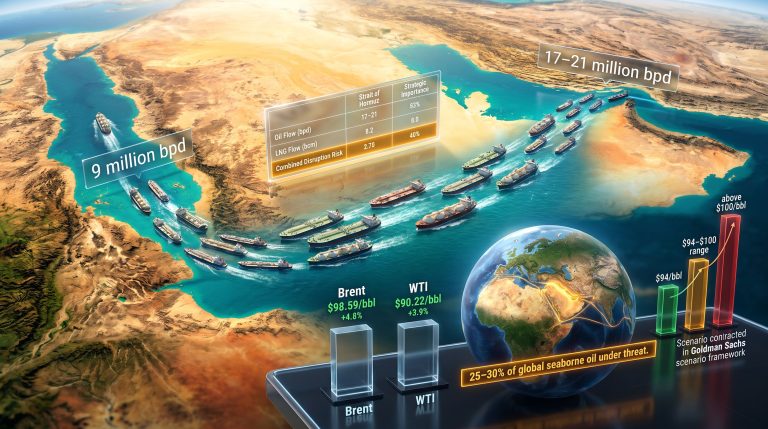
The Strait of Hormuz is a narrow waterway separating the Arabian Peninsula from Iran, connecting the Persian Gulf to the Gulf of Oman and the broader Indian Ocean. At its narrowest navigable point, the shipping lane is only about two miles wide in each direction. Despite this physical constriction, it carries approximately one-fifth of the world's total oil trade every single day, along with a substantial portion of global LNG shipments originating from Qatar and other Gulf exporters.
There is no realistic substitute. While alternative routes exist in theory, such as the Petroline pipeline across Saudi Arabia or the Habshan-Fujairah pipeline in the UAE, their combined throughput capacity falls far short of replacing full Hormuz volumes. The strait is not merely a convenience; it is a structural necessity for the global energy system as it currently exists. For broader context on current supply dynamics, the crude oil market overview provides useful background on how these pressures have been building.
Historical Disruptions and Why 2026 Was Different
The Hormuz corridor has faced geopolitical pressure before. During the Iran-Iraq War of the 1980s, the so-called Tanker War saw hundreds of vessels attacked, yet flows were never fully halted. The 2019 period of tanker seizures and drone strikes created significant volatility but again fell short of a full closure. What made the conflict beginning in late February 2026 categorically different was the effective cessation of commercial transit, something no prior episode had achieved at this scale.
The activation of strategic petroleum reserves (SPRs) across consuming nations and emergency rerouting through alternative corridors provided partial relief, but the structural gap was unavoidable. Furthermore, the geopolitical oil price factors at play throughout this period compounded the complexity of the market response considerably.
The 2026 Hormuz closure represented the most complete interruption of Persian Gulf oil exports in the modern history of the international energy trade, exceeding the severity of every prior geopolitical flashpoint in the waterway's commercial history.
Quantifying the Stranded Oil Backlog and Its Market Implications
Understanding the price dynamics of the Strait of Hormuz reopening and oil shipments requires grasping the sheer physical scale of the supply backlog that accumulated during the closure period.
| Metric | Estimated Figure |
|---|---|
| Non-Iranian stranded crude (Reuters estimate) | ~93 million barrels |
| Supertankers positioned inside the Gulf | ~54 vessels |
| Barrels aboard those supertankers | ~87 million barrels |
| Brent crude price as of reopening week | ~$80/bbl |
| Weekly Brent price decline on reopening news | ~8% |
| Kuwait projected output recovery | >2 MMbpd within days |
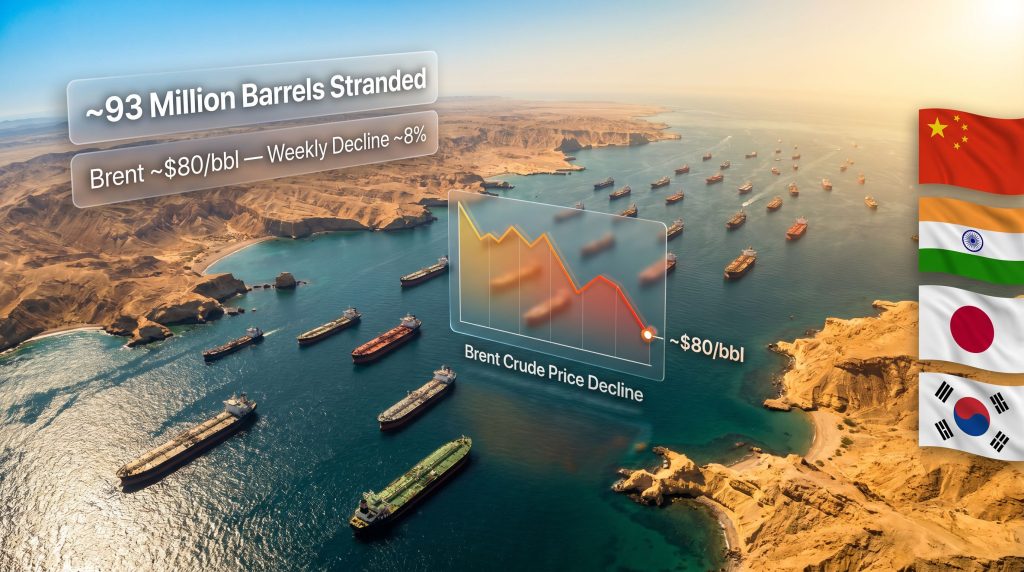
These are not abstract figures. Roughly 54 supertankers, each carrying cargoes averaging over 1.5 million barrels, were waiting inside the Gulf for the corridor to reopen. The aggregate volume approaches the equivalent of a full month of total U.S. crude oil imports at recent import rates. When that supply begins moving, it does not arrive in markets simultaneously. It arrives in waves, shaped by port scheduling, tanker repositioning logistics, and the pace at which receiving refineries can absorb incremental volumes.
Key Insight: The market-moving significance of the Hormuz reopening is not a single event. It is a sequenced release of supply pressure across weeks and potentially months, with each wave carrying distinct pricing implications for Brent, Dubai crude differentials, and regional refinery margins.
Why the Backlog Won't Clear Overnight
Several structural factors prevent the stranded barrel inventory from flushing into global markets in a rapid, simultaneous release:
- Shipping congestion within the Gulf itself creates a natural queuing effect, with vessels unable to exit at the pace they accumulated
- Port scheduling at receiving terminals in Asia, Europe, and elsewhere requires advance coordination that cannot be compressed
- Many Asian refiners pre-secured crude supply through alternative non-Gulf sources during the closure and are not immediately positioned to absorb a surge in Gulf-origin spot cargoes
- Crew change logistics, vessel inspections, and documentation requirements add additional lead time to each individual tanker movement
- Some supertankers may require mechanical inspection before undertaking laden voyages through a recently conflict-affected waterway
Industry analysts broadly expect full backlog normalisation to require a minimum of several weeks, with some estimates pointing to a two-to-three month timeline before the pre-conflict supply rhythm is re-established.
The Diplomatic Architecture Underneath the Reopening
The physical resumption of Strait of Hormuz oil shipments rests on an interim ceasefire-linked arrangement between Washington and Tehran rather than a concluded permanent agreement. This distinction carries substantial market significance. Planned negotiations toward a durable framework were postponed shortly after the interim agreement was reached, leaving the architecture underpinning current transit in an inherently provisional state.
Iran's Proposed Transit Insurance Framework
One of the most consequential and least widely understood elements of the current situation involves Iran's signalled intention to require vessels transiting Hormuz to carry mandatory insurance policies administered under a new Iranian-designed regulatory structure. This proposal creates a multi-layered problem for the international shipping industry:
- P&I clubs (Protection and Indemnity clubs, the mutual insurance associations that underwrite most of the world's merchant fleet) operate under international maritime law principles that may conflict with unilateral national transit insurance requirements
- Marine underwriters are already applying enhanced due diligence to Hormuz-transit coverage given residual conflict risk; an additional Iranian regulatory layer compounds the uncertainty
- Shipowners face potential double-insurance exposure if both their existing P&I cover and a new Iranian-mandated policy are required simultaneously
- U.S. officials have publicly maintained that international waterways must remain free of tolls or transit fees, setting up a fundamental tension with the Iranian proposal
This insurance ambiguity is functioning as an invisible barrier to fleet participation even where the physical and political obstacles have nominally been resolved.
The First-Mover Problem in Conflict-Adjacent Shipping
Jan Rindbo, chief executive of Danish shipping company D/S Norden, captured the prevailing commercial psychology accurately when he observed to Bloomberg in June 2026 that while every operator wants their vessels back in the Gulf, the dominant mood favours waiting for others to demonstrate safe passage first, with confidence building gradually as traffic resumes. This dynamic is well-documented in maritime risk literature and reflects rational behaviour under uncertainty.
However, it also means the physical reopening of the strait and the commercial reopening of the strait are two different events separated by a confidence-building timeline that no diplomatic agreement can fully compress. War risk surcharges for Hormuz-transiting vessels remain significantly elevated above pre-conflict baseline levels. Some shipowners are understood to be seeking government-backed insurance guarantees before committing vessels to Gulf routes, a requirement that adds yet another layer of coordination complexity.
How Oil Prices Are Responding: Three Forward Scenarios
Brent crude retreated to approximately $80 per barrel during the reopening week, declining nearly 8% across a single five-day trading period. This price movement reflects markets pricing in the gradual return of Middle Eastern supply rather than an immediate flood of new barrels. The war-risk premium embedded in crude prices during the closure period is unwinding, but the pace and depth of further price movement will depend heavily on which of three scenarios unfolds. In addition, oil market disruption risks stemming from broader geopolitical tensions continue to weigh on trader sentiment.
Scenario 1: Rapid Normalisation
In this pathway, tanker clearance is largely complete within four to six weeks. Kuwait exceeds its 2 MMbpd output target, ADNOC restores full terminal loadings, and the approximately 93 million barrels of stranded non-Iranian crude reaches global markets on an accelerated timeline. Brent crude faces meaningful further downside pressure, potentially testing the mid-$70s range. Asian refinery margins compress as spot crude availability surges. U.S. producers who captured market share during the disruption face increased competition.
Scenario 2: Gradual, Contested Reopening
Diplomatic delays around the insurance framework, unresolved mine-clearance concerns, and persistent shipowner caution slow vessel returns significantly. Only partial backlog clearance occurs over a two-to-three month window. Brent crude stabilises in a range, as incremental supply recovery is offset by an ongoing geopolitical uncertainty premium. Tanker freight rates remain above pre-conflict levels due to route risk and constrained fleet availability.
Scenario 3: Agreement Collapse
Permanent negotiations fail to materialise and the ceasefire breaks down. Hormuz becomes operationally unsafe for commercial transit once more. Crude prices reverse sharply, exceeding prior conflict highs. Emergency SPR releases are reactivated and alternative routing arrangements are reimplemented at significant logistical cost. This scenario, while not the consensus view, is assigned a non-trivial probability by risk analysts given that planned permanent talks have already been postponed once.
For investors and traders: The asymmetry of risk here is notable. The upside price scenario (further Brent decline toward $70s) requires multiple favourable developments to materialise simultaneously. The downside scenario (price spike from agreement collapse) requires only one significant adverse event. This asymmetry is rarely fully priced into short-dated crude options.
Regional Exposure: Who Benefits and Who Faces New Competition
Asia's Refiners: Primary Beneficiaries with Near-Term Complications
The nations with the greatest structural exposure to Hormuz supply normalisation are Asia's major energy importers: China, India, Japan, South Korea, and the broader Southeast Asian bloc. The Persian Gulf is the dominant source of crude oil and LNG for all of these economies. Restored flows represent a long-term positive for procurement costs and energy security.
However, the near-term picture is more nuanced. Asian refiners that pivoted to alternative suppliers during the closure now hold term contracts and spot commitments with non-Gulf producers. Absorbing a surge of returning Gulf crude on top of those existing commitments requires either cancellations, storage accumulation, or reduced run rates, none of which are costless. The practical demand-side response from Asian refiners is therefore likely to be measured rather than immediate.
Medium-term, the restoration of full Hormuz flows is expected to narrow Middle East crude differentials relative to alternative benchmarks, providing sustained cost benefits for price-sensitive Asian buyers operating on thin refining margins.
Middle East Producers: Export Momentum Rebuilding Unevenly
- Kuwait has set a near-term output target exceeding 2 MMbpd and has publicly committed to rapid production restoration
- ADNOC has instructed customers to resume liftings from Persian Gulf terminals, though infrastructure integrity assessments may be required at some facilities before full volumes flow
- Iranian crude has begun departing from storage and export facilities located outside the Gulf as restrictions ease, with vessel-tracking data confirming initial cargo movements in the days following the interim agreement
- Some production facilities across the region may require inspection and repair before export capacity reaches pre-conflict levels, particularly where infrastructure was exposed to conflict-related risk
European and North American Markets: Indirect Exposure with Structural Implications
European markets benefited from redirected LNG cargoes during the closure and may see spot LNG prices soften as Gulf volumes normalise and Qatar resumes full export schedules. U.S. producers and exporters who expanded market share during the disruption face a more competitive environment as Gulf supply returns. Consequently, the OPEC market influence on global benchmark pricing will reassert itself as Persian Gulf production recovery accelerates.
The next major ASX story will hit our subscribers first
The LNG Dimension: Qatar's Export Recovery
The Strait of Hormuz reopening and oil shipments discussion frequently underweights the LNG angle. Qatar, the world's largest LNG exporter by volume, routes a dominant share of its output through Hormuz. LNG tanker movements resumed alongside crude oil vessels following the interim agreement, but the commercial dynamics differ materially from the crude oil market. For a fuller picture, the LNG supply implications of this disruption extend well beyond the immediate reopening period.
LNG carriers predominantly operate under long-term charter arrangements rather than spot market contracts. This creates different commercial incentives. Charter parties who locked in supply through alternative sources during the closure may not immediately switch back to Gulf-origin LNG even once transit resumes. War risk surcharges on LNG vessels also add cost complexity for buyers operating under delivered-price contract structures.
The restoration of Qatar's full LNG export schedule represents a key benchmark for LNG market normalisation and will be closely tracked by European buyers who rely on Qatari volumes as a foundational component of their post-pipeline supply diversification strategies.
The Unresolved Operational Obstacles
Mine Clearance and Navigation Verification
Reports from multiple shipping industry organisations confirm that mines were deployed in the strait during the conflict period. The process of mine clearance and navigation safety verification is not instantaneous. It requires coordinated international naval operations, updated hydrographic surveys, and formal certification of safe transit corridors before commercial operators can reasonably assess their exposure. Several major shipping associations have formally flagged unresolved navigation safety concerns as a precondition for recommending full fleet participation.
Full Recovery Timeline: A Structured Projection
| Recovery Phase | Estimated Timeline | Key Dependencies |
|---|---|---|
| Initial tanker movements resume | Completed (June 2026) | Ceasefire agreement |
| Mine clearance and navigation verification | 2 to 6 weeks | Naval/international cooperation |
| Backlog clearance (stranded tankers) | 4 to 8 weeks | Shipowner confidence, insurance resolution |
| Full Gulf producer export restoration | 2 to 4 months | Infrastructure assessment, production ramp-up |
| Long-term security framework established | 6+ months | Permanent U.S.-Iran negotiations |
Frequently Asked Questions: Strait of Hormuz Reopening and Oil Shipments
How much oil passes through the Strait of Hormuz?
Approximately one-fifth of the world's total oil trade transits the Strait of Hormuz daily, making it the single most strategically significant energy chokepoint globally. This volume encompasses both crude oil and LNG shipments from Persian Gulf producers, with Qatar's LNG exports representing a particularly significant share.
How much crude oil was stranded during the closure?
Estimates based on vessel-tracking and Reuters reporting indicate approximately 87 to 93 million barrels of crude oil were stranded inside the Persian Gulf aboard roughly 54 supertankers during the conflict-related closure period.
Will oil prices keep falling after the reopening?
The pace of further price decline depends on how quickly the stranded barrel backlog clears and reaches consuming markets. Analysts broadly expect a gradual rather than immediate normalisation, which limits the speed and depth of sustained further price falls. The fragility of the underlying diplomatic framework also supports a residual risk premium in crude benchmarks.
What is the biggest risk that could reverse current progress?
A collapse in the U.S.-Iran diplomatic process represents the primary tail risk. Planned permanent negotiations were postponed following the interim agreement, leaving the ceasefire in a structurally provisional state. A breakdown could lead to renewed disruption and a sharp reversal of the price declines seen during the reopening week. Live Mint's analysis of Hormuz oil flows provides additional perspective on what resumed transit means for prices.
Which countries benefit most from restored Hormuz flows?
Asian energy importers, particularly China, India, Japan, and South Korea, are the primary structural beneficiaries, as the Persian Gulf supplies the majority of their crude oil and LNG requirements. Restored flows are expected to narrow Middle East crude differentials and reduce procurement costs for regional refiners over the medium term.
The Longer-Term Strategic Question: Can Hormuz Regain Its Pre-Conflict Role?
The 2026 Hormuz closure has delivered a lesson that energy policymakers and corporate risk managers will not quickly set aside. Even a temporary interruption of this corridor exposed the degree to which the global energy system remains structurally dependent on a two-mile-wide navigable channel. Several long-term consequences are now likely to reshape investment and policy decisions:
- Major energy importing nations are expected to review the adequacy of their strategic petroleum reserves in light of the duration and severity of the 2026 disruption
- Investment interest in alternative pipeline infrastructure, offshore LNG liquefaction capacity outside the Gulf region, and diversified crude supply arrangements is likely to increase
- Long-term energy contracts between Gulf producers and Asian buyers may increasingly include force majeure and alternative routing provisions that were previously considered unnecessary
- Geopolitical risk premiums embedded in long-cycle energy infrastructure investment decisions will be recalibrated upward across the sector
Structural Market Shift to Watch: The 2026 Hormuz closure has demonstrated that Persian Gulf supply concentration remains a live systemic vulnerability rather than a theoretical risk. Expect sustained policy and capital allocation focus on supply chain resilience, strategic reserve adequacy, and route diversification to be durable themes in energy markets for years beyond the immediate reopening.
Whether the Strait of Hormuz can fully reclaim its pre-conflict commercial role ultimately depends on factors that remain genuinely unresolved: the durability of the U.S.-Iran interim arrangement, the speed of mine clearance and insurance framework resolution, and the willingness of the international shipping community to gradually rebuild confidence in one of the world's most consequential energy corridors. The physical opening of the gate is only the first step. The operational, commercial, and diplomatic work of sustaining that opening is where the real complexity begins.
Want to Stay Ahead of the Next Major Market-Moving Discovery?
While geopolitical disruptions reshape global energy flows, Discovery Alert's proprietary Discovery IQ model scans ASX announcements in real time, delivering instant alerts on significant mineral discoveries so subscribers can act on actionable opportunities before the broader market reacts — explore historic discoveries that have generated extraordinary returns, or begin your 14-day free trial today and position yourself ahead of the next major find.