
June 27, 2026
The World's Most Dangerous Bottleneck Is Under Fire Again
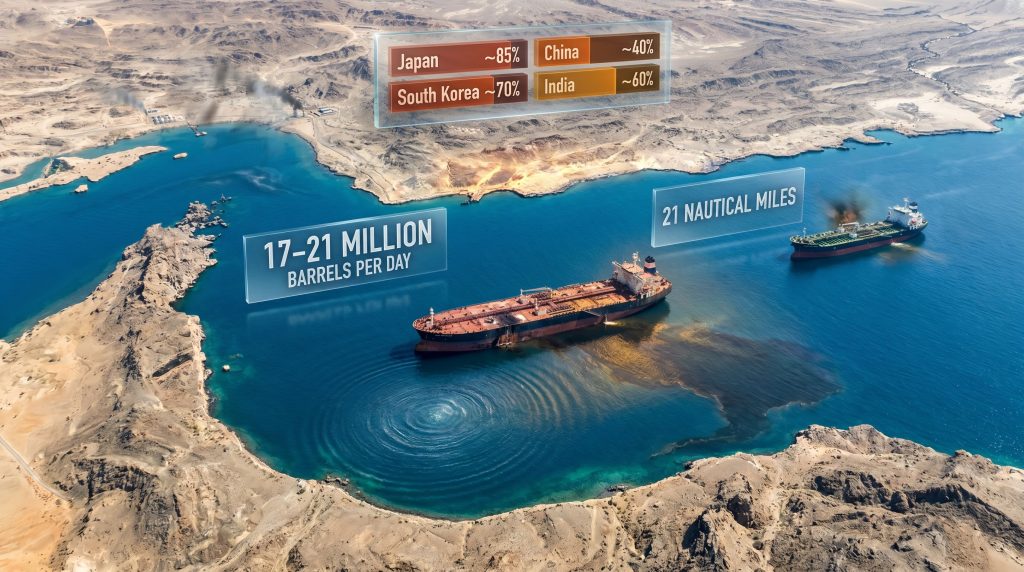
Few geographic features shape global energy security more profoundly than a strip of water measuring just 21 nautical miles at its narrowest navigable point. A tanker struck in Strait of Hormuz as U.S.-Iran tensions escalate has transformed this already critical passage into an active conflict zone. Roughly 17 to 21 million barrels of crude oil transit this passage every single day under normal conditions, representing approximately one-fifth of the world's entire daily oil supply. When that corridor comes under threat, the consequences reverberate from Tokyo to Frankfurt.
The events unfolding in late June 2026 are not simply a news cycle. They represent a structural stress test of the most consequential maritime chokepoint in modern energy history, and the implications for oil markets, regional security, and global inflation are substantial. Furthermore, these developments are deeply intertwined with crude oil trade geopolitics that have been building for years.
When big ASX news breaks, our subscribers know first
Why the Strait of Hormuz Has No Equal in Energy Geopolitics
The Mathematics of Irreplaceability
Understanding why the strait commands such outsized global attention requires grasping one uncomfortable arithmetic reality: there is no adequate substitute for its capacity.
Saudi Arabia's East-West Petroline pipeline carries approximately 5 million barrels per day. The UAE's Habshan-Fujairah pipeline adds around 1.5 million barrels per day. Combined, these alternative routing options deliver roughly 6.5 million barrels per day, a figure that covers less than 40% of normal strait throughput under even optimistic assumptions.
The nations most exposed to disruption are concentrated in East Asia, where energy import dependence on Gulf flows is structurally embedded:
| Region | Estimated Hormuz Dependency | Risk Profile |
|---|---|---|
| Japan | ~85% of crude imports | Extremely High |
| South Korea | ~70% of crude imports | Very High |
| India | ~60% of crude imports | High |
| China | ~40% of crude imports | High |
| Europe | ~10-15% of crude imports | Moderate |
For Japan and South Korea in particular, a sustained closure of the strait is not a manageable disruption. It is a near-existential energy security scenario, which explains why both nations maintain strategic petroleum reserves calibrated to multi-month supply interruptions.
Asymmetric Warfare Has Evolved Dramatically
The strait's history as a weaponised geography stretches back decades. During the Iran-Iraq War's so-called Tanker War period of the 1980s, hundreds of commercial vessels were attacked using conventional naval weaponry. What has changed dramatically since then is the toolkit available to a determined adversary.
Iran's Islamic Revolutionary Guard Corps Navy has developed a layered asymmetric maritime warfare doctrine that imposes disproportionate costs on technologically superior opponents. The current threat environment includes:
- Drone boats (unmanned surface vehicles): Low-cost, high-impact attack vectors that are difficult to intercept at scale
- Limpet mines: Magnetic explosive devices attached covertly to vessel hulls below the waterline, designed for delayed detonation with built-in attribution ambiguity
- Aerial drones: Medium-range strike capability against both vessels and coastal installations
- Selective interdiction: The IRGC's publicly described doctrine of firing warning shots at vessels deemed to be transiting routes not approved under Iranian-interpreted maritime agreements
The limpet mine deserves particular attention as an instrument of maritime coercion. Unlike conventional strikes, a limpet mine can be deployed by combat divers or submersible drones well in advance of detonation, making it exceptionally difficult to attribute with legal certainty. This ambiguity is strategically valuable to an actor seeking to impose costs while maintaining deniability.
Reconstructing What Happened: The June 2026 Incidents
Two Incidents, One Compressed Timeline
The escalation that crystallised in late June 2026 did not emerge without warning, but its acceleration has been striking. The sequence of events maps a rapid deterioration from diplomatic engagement to active kinetic exchange. Indeed, these geopolitical trade tensions have been intensifying across multiple fronts simultaneously.
The U.K. Maritime Trade Operations Centre (UKMTO) confirmed that a commercial vessel operating in the Strait of Hormuz was struck by what it characterised as an unidentified projectile, with confirmed damage to the vessel's bridge. All crew members were reported safe. A second incident approximately 60 nautical miles east of Muscat in the Gulf of Oman involved an external explosion that UKMTO assessed as potentially caused by either a drone boat or a limpet mine detonated near the vessel's waterline.
That vessel sustained confirmed structural damage to its hull and ballast tank, with bunker fuel leaking into surrounding waters. According to PBS NewsHour reporting on the incident, these are not isolated incidents. They represent the second tanker targeted within a compressed timeframe, which shifts the analytical framing from accident or miscalculation toward deliberate maritime interdiction as a policy instrument.
The Ever Lovely Attack and U.S. Retaliation
The immediate trigger for U.S. military action was an attack attributed by U.S. Central Command to Iranian forces against the Singapore-flagged cargo vessel Ever Lovely, struck by a drone in the strait off the Omani coast. The vessel sustained damage but continued its passage, a detail that matters for commercial shipping risk assessment: navigability does not equal safety.
Following that attack, CENTCOM confirmed its aircraft conducted retaliatory strikes against Iranian territory, targeting two categories of infrastructure:
- Iranian missile and drone storage facilities
- Coastal radar installations
The targeting of coastal radar sites carries particular strategic significance. By degrading Iran's maritime domain awareness infrastructure, U.S. forces reduced Tehran's ability to track vessel movements and coordinate future interdiction operations. This is a calculated escalation designed to impose operational costs without crossing into direct personnel targeting.
The Islamabad MOU: A Ceasefire Architecture Under Maximum Stress
What the Agreement Actually Says
The diplomatic backdrop to this military exchange is the memorandum of understanding signed by U.S. President Donald Trump and Iranian President Masoud Pezeshkian, which established a 60-day ceasefire as the foundation for developing a permanent peace framework. Vice President JD Vance travelled to Switzerland to advance these talks with Iranian counterparts, signalling initial momentum toward a durable agreement.
The clause now at the centre of the dispute is Clause 5 of the Islamabad MOU, which assigned responsibility for controlling passage through the Strait of Hormuz to Iran. The IRGC has interpreted this provision as granting Tehran authority over which vessels may transit specific routes, and has cited U.S. facilitation of commercial passage as a violation of this commitment. The United States flatly rejects this interpretation, asserting that supporting freedom of navigation for commercial shipping is categorically distinct from a ceasefire breach.
Competing Narratives: A Structural Deadlock
Both parties are simultaneously claiming ceasefire compliance and conducting military operations. This is not merely a public relations battle. It reflects a genuine interpretive deadlock over the MOU's core provisions.
| Party | Stated Position | Military Actions Taken |
|---|---|---|
| United States | Ceasefire honoured; Iran launched prohibited drone attacks on vessels | Airstrikes on Iranian missile/drone storage and radar sites |
| Iran (IRGC) | U.S. violated MOU by facilitating unauthorized ship passage | Warning shots at vessels; struck U.S. positions in the region |
| Bahrain | Condemned Iranian drone strike as a sovereignty violation | Formal diplomatic condemnation issued |
| Iran (Parliament) | U.S. attacked during active negotiations, constituting a ceasefire breach | Iranian parliamentary security commission issued public rebuke |
Vance stated publicly that Iran signed a ceasefire agreement and that the U.S. had honoured its commitments, adding that disagreements over MOU application should be resolved through diplomatic channels rather than violence. Iran's position, as articulated by IRGC statements and parliamentary figures, frames U.S. retaliatory strikes as an attack conducted during active negotiations, characterising Washington as having broken its negotiating commitments.
The core analytical problem: When both parties claim victim status and aggressor status simultaneously, the MOU's conflict resolution mechanism — presumably direct diplomatic communication — has already failed. The framework is not just under stress. It may be functionally inoperative.
The Dual Blockade Scenario: An Unprecedented Confrontation
Why This Configuration Is Historically Unusual
Current reporting indicates that the United States is enforcing a blockade on Iranian ports while Iran has simultaneously declared a closure of the Strait of Hormuz and is allegedly deploying naval mines to restrict passage. This creates what analysts are characterising as a dual blockade dynamic — a configuration in which two militarily capable adversaries are simultaneously enforcing competing maritime restrictions through the same chokepoint.
This specific scenario has no clean historical parallel in the modern era of Gulf maritime security. The 1980s Tanker War involved one primary belligerent with asymmetric naval capability. The current situation involves a nuclear-adjacent regional power and the world's most capable conventional military force engaged in overlapping interdiction operations within a 21-nautical-mile corridor. CNBC's coverage of the oil price and Iran war implications highlights just how rapidly market sentiment is shifting in response.
Strategic Warning: The probability of miscalculation-driven escalation increases substantially when competing blockades are enforced through the same physical passage. Historical analysis of maritime confrontations suggests this configuration rarely self-corrects without direct diplomatic intervention at the highest levels.
How Oil Markets Price Catastrophic Tail Risks
Historical Price Sensitivity as a Baseline
Energy markets have a well-documented pattern of rapid repricing when the strait faces credible interdiction threats. During the 2019 Gulf of Oman tanker attacks, Brent crude surged approximately 4% within 24 hours of confirmed incidents. That episode involved far less kinetic activity than the current situation. However, OPEC market influence remains a critical variable in determining how quickly supply-side responses can materialise.
The current scenario introduces several compounding factors that historical baselines do not fully capture:
- Active U.S. military strikes against Iranian sovereign territory
- Iranian mine deployment in the world's most critical oil corridor
- A ceasefire framework that both parties have already violated
- Bahrain's direct involvement as a third sovereign party drawing in U.S. Fifth Fleet exposure
The Supply Deficit Mathematics
A sustained or complete strait closure would remove up to 21 million barrels per day from global supply chains. With alternative pipeline bypass capacity capped at approximately 6.5 million barrels per day, the structural deficit would be roughly 14.5 million barrels per day. To place that in context, total OPEC production capacity across all member states is approximately 34 million barrels per day. No cartel-level response could fully offset a sustained Hormuz closure.
The cascading economic effects would extend well beyond crude oil prices. In addition, the disruption to global LNG supply deserves separate consideration, as Qatar's shipments also depend on this critical passage:
- Liquefied natural gas shipments from Qatar, the world's largest LNG exporter, also transit the strait, and a detailed assessment of global LNG supply risks underscores just how severe these flow disruptions could become
- Refined product flows to South and East Asian markets would be severely disrupted
- Freight insurance premiums for Gulf-region shipping would increase dramatically, adding to input cost inflation across import-dependent economies
- Central banks in energy-importing nations would face simultaneous inflationary pressure and growth risk, a stagflationary configuration that is exceptionally difficult to navigate with conventional monetary tools
Furthermore, global recession risks would intensify considerably under a prolonged closure scenario, adding another layer of complexity for policymakers already navigating fragile economic conditions.
The next major ASX story will hit our subscribers first
Three Scenarios for What Comes Next
Scenario 1: Negotiated De-escalation
Both parties return to the MOU framework, agree on a shared operational interpretation of Clause 5, and resume Swiss-format diplomatic engagement. Commercial shipping normalises and oil markets stabilise around pre-incident pricing.
Assessment: Low probability in the near term. Restoring mutual trust after direct kinetic exchanges between sovereign militaries typically requires weeks of back-channel engagement before formal talks can resume productively. The compressed 60-day ceasefire window makes this timeline extremely tight.
Scenario 2: Managed Escalation Equilibrium
Both sides continue calibrated military actions below the threshold of full-scale conflict. Commercial shipping faces a persistent risk premium. Oil prices remain structurally elevated. Diplomatic channels remain nominally open while military pressure continues as a negotiating instrument.
Assessment: Moderate probability. This pattern most closely resembles the Tanker War phase of the 1980–1988 Iran-Iraq War, during which global shipping adapted to elevated risk through convoy arrangements, insurance adjustments, and routing modifications. It is painful but manageable for most market participants.
Scenario 3: Strait Closure and Full Conflict Resumption
Iran's mine-laying campaign functionally closes the strait to commercial traffic. U.S. forces conduct broader military operations to restore freedom of navigation. Global oil markets enter a supply shock scenario. Consequently, a tanker struck in Strait of Hormuz as U.S.-Iran tensions escalate could prove to be the opening chapter of a far larger confrontation.
Assessment: Lower probability but highest impact. This scenario carries cascading effects across global inflation dynamics, central bank policy frameworks, and emerging market stability. Energy-dependent Asian economies would face acute pressure. The second-order effects on global supply chains, which remain deeply integrated with Gulf energy flows, would be severe.
Frequently Asked Questions
What is the Strait of Hormuz and why does it matter so much?
The Strait of Hormuz is a narrow maritime passage between Iran and Oman connecting the Persian Gulf to the Gulf of Oman and Arabian Sea. It carries approximately one-fifth of the world's daily oil supply, making it the single most consequential energy transit chokepoint on the planet.
Who is responsible for the June 2026 tanker strike?
No party has formally claimed responsibility for the unidentified projectile strike confirmed by UKMTO. Iran's IRGC acknowledged firing warning shots at vessels it characterised as transiting unauthorised routes but did not directly comment on specific attacks.
Is the U.S.-Iran ceasefire still operational?
Both parties claim the other has violated the 60-day ceasefire established under the Islamabad MOU. With the U.S. conducting airstrikes on Iranian infrastructure and Iran attacking commercial vessels and U.S. military positions, the ceasefire's operational status is functionally contested.
What is a limpet mine and why is it used?
A limpet mine is a magnetic explosive device attached covertly to a vessel's hull below the waterline, typically deployed by divers or submersible drones. Its primary strategic advantage is built-in attribution ambiguity, since it detonates after deployment and can be difficult to definitively attribute, creating legal and diplomatic uncertainty for responding parties.
What is Clause 5 of the Islamabad MOU?
Clause 5 of the memorandum of understanding assigns responsibility for controlling passage through the Strait of Hormuz to Iran. The IRGC interprets this as granting Tehran authority over vessel routing within the strait. The U.S. disputes this interpretation, arguing it does not override established freedom of navigation principles under international maritime law.
What would a full Hormuz closure mean for oil prices?
A sustained closure would remove up to 21 million barrels per day from global supply, with only approximately 6.5 million barrels per day of alternative pipeline capacity available. The resulting structural deficit would almost certainly drive significant and sustained oil price increases across global markets, with a tanker struck in Strait of Hormuz as U.S.-Iran tensions escalate serving as the critical inflection point that markets are now pricing.
This article contains forward-looking analysis and scenario modelling based on publicly available information as of late June 2026. Geopolitical situations are subject to rapid change. Nothing in this article constitutes financial advice. Investors should conduct their own due diligence before making decisions based on geopolitical risk assessments.
Want to Position Ahead of the Next Major Commodity Shock?
Discovery Alert's proprietary Discovery IQ model delivers real-time alerts on significant ASX mineral discoveries, cutting through market noise to surface actionable opportunities — including those driven by geopolitical disruptions like the Strait of Hormuz crisis. Explore how historic mineral discoveries have generated substantial returns and begin your 14-day free trial today to secure your market-leading edge.