August 25, 2026
The World's Most Critical Energy Chokepoint Is Fracturing Again
Few geographic features carry the economic weight of a narrow stretch of water between Oman and Iran. The Strait of Hormuz tanker transit plunge due to the US-Iran ceasefire fracture, at its narrowest point barely 33 kilometres wide, functions as the singular pressure valve through which roughly 20% of all globally traded oil passes under normal conditions. When that valve tightens, the consequences ripple outward across every energy-importing economy on the planet. What is unfolding in mid-2026 is not a routine shipping disruption. It is a systemic stress event with measurable consequences for oil pricing, inflation dynamics, and the long-term credibility of diplomatic frameworks in one of the world's most volatile regions.
When big ASX news breaks, our subscribers know first
From Cautious Recovery to Renewed Crisis: The Sequence of Events
Understanding the current disruption requires tracing a precise sequence of events rather than treating this as a single news cycle.
On June 17, 2026, Washington and Tehran formalised a memorandum of understanding that established a 60-day safe passage framework for commercial vessels transiting the strait. The immediate commercial response was measurable. According to maritime intelligence platform Veson Nautical, approximately 513 vessels transited the strait in the weeks following the agreement, a meaningful uptick from near-paralysis levels. Kpler, a separate commodity tracking platform, recorded 759 commodity-related vessel transits across the same period, with daily passages holding at around 37 at their peak.
That recovery, however tentative, was shattered on July 9, 2026, when Iranian forces struck three commercial vessels operating in the waterway. The attacks prompted President Trump to formally declare the ceasefire over. US airstrikes against Iran followed in two rounds, and Washington reimposed oil sanctions, dramatically reshaping the threat environment for commercial shipping operators overnight. Reuters reported that Iran fired missiles at commercial ships in the strait, confirming the severity of the escalation.
The tanker transit collapse was not simply the result of diplomatic erosion. It was precipitated by direct military action against commercial shipping, which then triggered a cascade of US responses that made continued transit operations untenable for most operators.
How Severe Is the Traffic Drop? The Numbers Tell a Clear Story
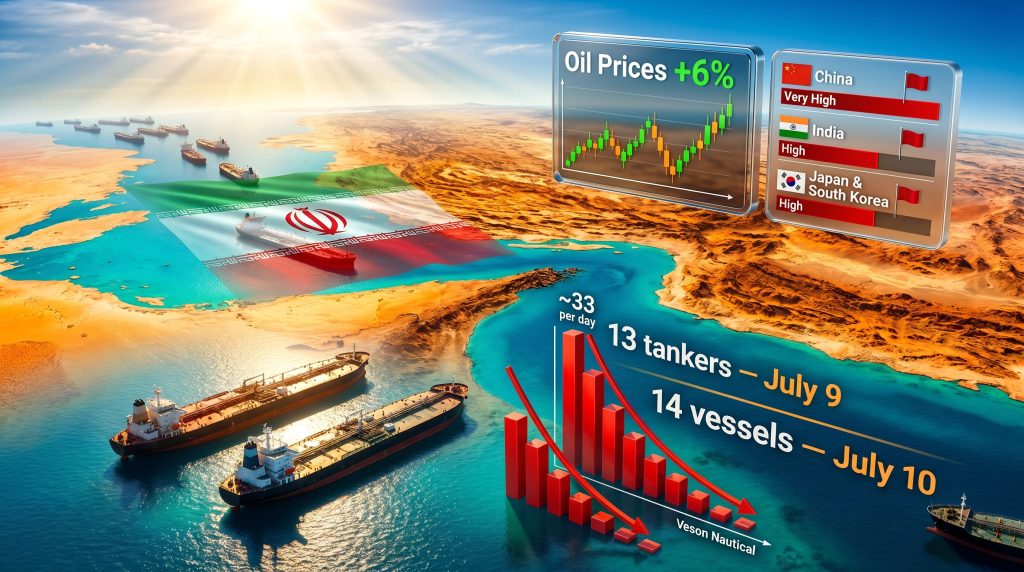
The statistical deterioration is stark. Under normal operating conditions, approximately 2,500 vessel transits would be recorded across a comparable measurement period. Even during the tentative post-ceasefire recovery, daily averages ran at roughly 33 transits per day, representing only about one-fifth of baseline activity.
Following the July 9 attacks, those figures collapsed further:
| Metric | Data Point | Source |
|---|---|---|
| Normal periodic transit volume | ~2,500 vessels | Veson Nautical |
| Average daily transits (post-ceasefire week) | ~33 per day | Veson Nautical |
| Transits on July 9 (Wednesday) | 13 tankers | Veson Nautical |
| Transits on July 10 (Thursday) | 14 vessels | Veson Nautical |
| Kpler daily commodity vessels (Tuesday) | 37 | Kpler |
| Kpler daily commodity vessels (Thursday) | 15 | Kpler |
| Total transits since June 17 (Veson) | ~513 vessels | Veson Nautical |
| Total transits since June 17 (Kpler) | ~759 commodity vessels | Kpler |
| Recovery rate vs. normal conditions | ~20% of baseline | Veson Nautical |
By Friday, July 11, real-time vessel-tracking data from MarineTraffic indicated that movements through the strait had largely come to a pause. The numbers paint a picture of a commercial shipping route that was already operating at deeply suppressed levels and then suffered a further acute collapse within 48 hours of the ceasefire fracture.
Sailing Dark: The Hidden Layer of Risk
Official transit data almost certainly understates the true scale of risk exposure. A growing number of vessels have been disabling their Automatic Identification System (AIS) transponders, a practice known in maritime circles as "sailing dark," to avoid detection and targeting. While this tactic offers individual vessels some degree of concealment, it creates serious downstream problems:
- Insurers cannot accurately assess exposure or price war risk surcharges without reliable tracking data
- Cargo owners and port operators face uncertainty around arrival times and vessel status
- Aggregate traffic statistics become less reliable as a measure of actual throughput
- The practice itself signals the depth of operator anxiety about transiting the strait
The "sailing dark" phenomenon means that any partial recovery in tracked transit numbers may overstate the true normalisation of commercial activity in the waterway. Furthermore, Al Jazeera has reported that shipping stalled dramatically after Iran declared the waterway shut, reinforcing the severity of the situation on the ground.
What Broke the Ceasefire? Understanding the Structural Fault Lines
The June 17 memorandum of understanding was a framework agreement, not a comprehensive treaty with detailed enforcement mechanisms. This distinction matters enormously. Alfredo Montufar-Helu, Managing Director at Ankura Consulting based in China, assessed that the agreement failed to address with adequate specificity what each party actually required and was prepared to accept. This ambiguity appears to have produced fundamentally incompatible interpretations of Iran's core position on strait control, a position that Washington was ultimately unwilling to accommodate.
At the heart of the disagreement is a geographic and strategic dispute over routing:
- Iran's position: Commercial vessels should use a northern corridor through the strait that falls within Iran's operational sphere of influence
- US position: The southern route, protected by US Naval forces operating under freedom-of-navigation principles, should remain accessible to all commercial shipping
- The consequence: Iranian forces targeted vessels using the US Navy-protected southern route, treating those transits as violations of Iran's red lines
This routing dispute represents the kind of irreconcilable difference that no amount of diplomatic goodwill can easily bridge. For Washington, conceding control of the southern route would represent an unprecedented retreat from decades of freedom-of-navigation doctrine in the Persian Gulf. For Tehran, the northern corridor dispute is framed as a matter of sovereign territorial control.
The ceasefire framework, by failing to resolve or even clearly acknowledge this fault line, effectively deferred a collision that was structurally inevitable. Consequently, the broader geopolitical risk landscape for energy and commodities markets has deteriorated sharply as a result.
Global Energy Markets: Counting the Cost
Oil Price Response and the Risk Premium Mechanism
Energy markets moved decisively in response to the ceasefire collapse. Oil prices surged more than 6% in the week following the fracture, as investors priced in the possibility that Gulf crude export volumes could decline to levels associated with peak conflict conditions. For broader context on crude oil price trends, the current spike represents one of the most abrupt risk-premium events in recent years.
What makes the current episode particularly concerning for market analysts is the possibility that this risk premium may not fully dissipate even if a new diplomatic agreement is reached. The failure of the June 17 framework has introduced a credibility deficit into the diplomatic process itself.
Which Economies Face the Greatest Exposure?
The distributional impact of a sustained Hormuz disruption is highly uneven across the global economy:
| Region | Hormuz Dependency | Risk Exposure Level |
|---|---|---|
| China | Major crude importer via Gulf | Very High |
| India | Significant Gulf energy reliance | Very High |
| Japan and South Korea | Heavy LNG and crude dependency | High |
| Europe | Moderate, diversified supply base | Medium |
| United States | Net exporter; indirect via pricing | Medium-Low |
Asian economies carry the heaviest structural vulnerability. China and India together account for a substantial share of Gulf crude imports, and both nations have limited short-term ability to fully substitute alternative supply routes. Japan and South Korea are critically exposed on the liquefied natural gas (LNG) dimension, as global LNG supply chains running through the Gulf are subject to the same disruption risks as crude flows.
Inflation Transmission: From Shipping Lanes to Consumer Prices
The pathway from tanker disruption to consumer-level inflation operates across several transmission channels:
- Immediate energy price spike as supply risk is priced into crude and LNG futures
- Freight rate surge as alternative routing adds 10 to 14 days to voyage times via the Cape of Good Hope, tightening tanker supply globally
- War risk insurance premium explosion on Gulf voyages, adding directly to cargo economics
- Industrial energy cost increases flowing through to manufacturing and logistics sectors
- Consumer price transmission arriving weeks to months after the initial disruption, complicating central bank policy decisions
This lag effect means the inflationary consequences of the current disruption are unlikely to be fully visible in headline price data for several weeks. However, market volatility reset dynamics are already visible across bond and gold markets as investors reposition for sustained uncertainty.
Shipping Operators: How the Industry Is Responding
The Economics of Rerouting
For tanker operators unwilling or unable to transit the strait, the primary alternative is rerouting around the Cape of Good Hope. This decision carries significant commercial consequences:
- Adds approximately 10 to 14 days to voyage times on key Gulf-to-Asia routes
- Increases bunker fuel consumption and vessel operating costs substantially
- Reduces effective tanker supply availability globally, driving charter rates higher across all vessel classes
- Creates secondary port congestion as delivery schedules shift and vessels queue at destination ports
The freight rate implications extend well beyond Gulf-focused operators. Tighter effective tanker supply in any major trade corridor tends to push charter rates upward across interconnected shipping markets globally.
Operational Decision-Making Under Acute Uncertainty
Real-time transit decisions for tanker operators currently involve weighing several intersecting variables:
- Availability and scope of naval escort coverage in the southern route corridor
- Current war risk insurance surcharge levels and whether coverage remains available at all
- Cargo owner instructions and contractual obligations regarding route selection
- Intelligence assessments of Iranian targeting patterns and vessel profiling criteria
The combination of these factors has produced a near-paralysis in voluntary transits, with most operators adopting a wait-and-assess posture while the military and diplomatic situation develops. In addition, this oil market disruption compounds pre-existing pressures from trade tensions that had already introduced volatility into global energy pricing.
The next major ASX story will hit our subscribers first
Scenario Analysis: Three Pathways Forward
Scenario 1: Rapid De-escalation and Partial Traffic Recovery
This scenario requires renewed diplomatic contact producing a revised framework that explicitly addresses the northern versus southern route dispute and establishes verifiable enforcement mechanisms. Given the current breakdown in trust and the US military posture following airstrikes, analysts regard this outcome as low probability in the near term. Even under optimistic assumptions, full traffic recovery to pre-crisis baseline levels would require sustained, verifiable compliance over weeks to months rather than days.
Scenario 2: Prolonged Standoff with Managed Disruption
A more probable near-term trajectory involves a sustained period of severely reduced transit volumes punctuated by intermittent incidents. Energy markets would adapt through accelerated strategic reserve drawdowns, demand-side adjustments, and a gradual build-out of alternative supply infrastructure. This scenario would likely cement the Cape of Good Hope rerouting as a semi-permanent feature of Gulf energy logistics rather than an emergency measure.
Scenario 3: Full Escalation and Extended Closure
The tail-risk scenario involves complete closure of the strait to commercial traffic for an extended period. Historical reference points include the 1980s Tanker War, during which Gulf shipping was severely disrupted across multiple years, though the economic and military context differed substantially from the current situation. A full closure scenario would trigger emergency strategic reserve releases across major consuming nations, GDP drag across import-dependent economies, and a fundamental reassessment of global energy infrastructure investment priorities.
The Credibility Problem: Why This Ceasefire's Failure Has Long-Term Consequences
Perhaps the most underappreciated dimension of the current crisis is the damage done to the diplomatic architecture itself. When a ceasefire agreement collapses within weeks of its announcement, followed by direct military action against commercial shipping, it introduces a structural problem for any future framework: markets and operators will attach a significant credibility discount to any subsequent agreement, regardless of its formal terms.
This credibility erosion has two compounding effects:
- Short-term: Operators and cargo owners will require longer periods of demonstrated compliance before resuming normal transit patterns, slowing any recovery even if a new agreement is reached
- Long-term: Energy markets may permanently embed a higher geopolitical risk premium into Gulf crude and LNG pricing, raising baseline energy costs for the global economy even during periods of apparent calm
Analysts have cautioned that the failure of the June 17 ceasefire framework may produce consequences that extend well beyond the immediate crisis period, potentially reshaping global energy risk pricing on a structural rather than cyclical basis.
Frequently Asked Questions: The Strait of Hormuz Crisis Explained
What percentage of global oil passes through the Strait of Hormuz?
Under normal conditions, approximately 20% of all globally traded oil transits the strait, making it the single most consequential energy chokepoint on Earth. No alternative route can absorb that volume without significant cost and time penalties.
Why did tanker traffic plunge so sharply after the ceasefire fracture?
The immediate trigger was Iranian military strikes on three commercial vessels on July 9, 2026. This caused President Trump to formally declare the ceasefire over, triggering US airstrikes and the reimposition of oil sanctions, creating a high-threat environment that prompted operators to halt or reroute transits within hours.
What is the northern versus southern route dispute?
Iran has maintained that commercial vessels should use a northern corridor through the strait that falls within its operational sphere. The US Navy has protected the southern route as an internationally accessible waterway. Iranian forces have targeted vessels using the southern route, treating those transits as violations of its position on strait control.
How much have oil prices moved in response to the crisis?
Oil prices surged more than 6% in the week following the ceasefire collapse as energy markets priced in the risk of sustained disruption to Gulf crude and LNG export flows.
Could a new ceasefire restore normal shipping traffic?
Analysts are broadly sceptical that a new agreement would produce rapid normalisation. The failure of the June 17 framework has damaged the credibility of future diplomatic arrangements, and operators are likely to require extended periods of demonstrated compliance before resuming normal transit patterns. Full recovery to pre-crisis volumes could take months under even optimistic assumptions.
The Long View: Structural Implications for Energy Security Architecture
Recurring Hormuz disruptions are accelerating several long-term structural conversations in global energy markets:
- Strategic reserve adequacy: Whether existing reserve levels across major consuming nations are sufficient to buffer an extended closure scenario is under renewed scrutiny
- Infrastructure investment redirection: Pressure is building for investment in alternative pipeline routes, floating storage capacity, and supply diversification infrastructure that reduces strait dependency
- Geopolitical risk repricing: Institutional investors and sovereign wealth funds with significant Gulf energy exposure are reassessing long-term portfolio construction in light of recurring disruption risk
- Energy transition dynamics: The paradox here is significant. Short-term disruptions boost fossil fuel prices and may slow transition economics by making alternatives comparatively less urgent commercially, even as they strengthen the strategic case for domestic renewable energy development
The Strait of Hormuz tanker transit plunge due to the US-Iran ceasefire fracture is not simply a shipping story or a regional geopolitical episode. It is a stress test of the assumptions embedded in global energy supply chain architecture, diplomatic credibility frameworks, and the risk models used by everyone from tanker operators to central banks. Furthermore, the data emerging from maritime intelligence platforms in real time suggests the stress test is delivering some deeply uncomfortable results.
Want to Know Which ASX Miners Stand to Gain From the Energy Crisis?
When geopolitical shocks reshape commodity markets this rapidly, identifying the right ASX discoveries before the broader market catches on becomes critical — Discovery Alert's proprietary Discovery IQ model scans ASX announcements in real time, delivering instant alerts on significant mineral discoveries so subscribers can act on actionable opportunities as they emerge. Explore historic discovery returns to understand the upside potential, then begin your 14-day free trial at Discovery Alert to position yourself ahead of the next major market move.