July 22, 2026
The Invisible Fleet: How Transponder Silence Is Reshaping Gulf Energy Trade
Imagine a system originally designed to prevent ships from colliding in foggy harbours becoming the world's primary tool for tracking billions of dollars in sanctioned oil flows. That is precisely the situation energy analysts, compliance teams, and policy makers now find themselves navigating. The Automatic Identification System, or AIS, was conceived as a maritime safety mechanism under the International Maritime Organization's SOLAS framework. Its transformation into a sanctions-enforcement and cargo-intelligence tool was never intended by its architects, and that design gap has become the central vulnerability in global energy supply chain transparency, especially as Strait of Hormuz tankers with transponders off become an increasingly routine feature of Gulf shipping in 2025.
When big ASX news breaks, our subscribers know first
The 33-Kilometre Bottleneck That Moves the World
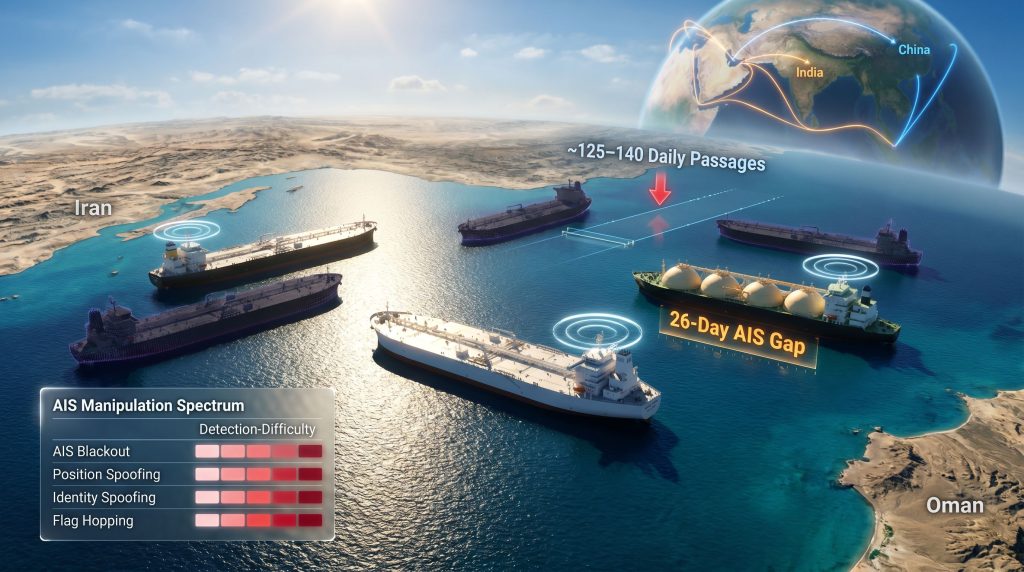
No single geographic feature exerts more leverage over global energy pricing than the Strait of Hormuz. At its narrowest, the passage measures roughly 33 kilometres across, yet it funnels approximately one-fifth of the world's combined oil and liquefied natural gas supply through its waters on any given day. Before the US-Israeli military campaign against Iran commenced on February 28, 2025, between 125 and 140 vessel passages transited the strait daily, according to shipping data compiled by LSEG and Kpler.
The cascading consequences of disruption extend far beyond the Gulf itself. Furthermore, the LNG supply outlook for the region adds another layer of complexity to what is already a fragile situation:
- Asian refining hubs in Fujian, Guangdong, and Visakhapatnam depend on uninterrupted crude feedstock from Gulf producers
- European spot LNG markets reprice sharply when Gulf supply signals become opaque
- Brent and Dubai crude spread relationships distort when significant cargo volumes disappear from visible tracking systems
- Energy-importing nations with minimal strategic reserve capacity, particularly smaller Asian economies, face acute procurement vulnerabilities
India and China occupy a structurally distinct position in this vulnerability hierarchy. India sources approximately 80% of its crude oil requirements through imports, with Gulf grades representing a historically significant share of that intake. China's Fujian and Guangdong refining clusters are among the highest-throughput processing centres on earth, requiring continuous crude supply regardless of the geopolitical backdrop. When Hormuz traffic collapses, neither economy has an immediately substitutable alternative supply chain.
What AIS Actually Does and Why Turning It Off Matters
The Automatic Identification System continuously broadcasts a vessel's identity number (MMSI), real-time geographic coordinates, speed, heading, and declared destination. Coastal receivers capture these signals within roughly 40 to 60 nautical miles of shorelines, while satellite AIS (S-AIS) providers extend this coverage into open ocean areas, though coverage density varies significantly across the Arabian Sea and Persian Gulf.
Commercial intelligence platforms including LSEG and Kpler aggregate this data in near real-time, feeding the cargo flow models that energy traders, refinery procurement teams, and sanctions compliance officers rely upon daily. The system was never designed with sanctions enforcement in mind. It was built to prevent collisions. That foundational purpose creates a structural exploitation opportunity that the maritime industry has been slow to close.
AIS manipulation exists across a spectrum of sophistication, each with distinct detection challenges. In addition, commodity market volatility is amplified significantly when these evasion tactics become widespread:
| Tactic | Core Mechanism | Detection Difficulty |
|---|---|---|
| AIS Blackout | Transponder fully deactivated | Moderate: gaps appear in tracking histories |
| Position Spoofing | False GPS coordinates transmitted | High: requires satellite imagery cross-referencing |
| Identity Spoofing | Another vessel's MMSI number broadcast | Very High: demands registry database cross-checking |
| Flag Hopping | Rapid re-registration under new national flags | High: requires continuous legal database monitoring |
Under SOLAS Chapter V, vessel masters are legally permitted to deactivate AIS when they determine that broadcasting position data creates a genuine security risk. In an active conflict corridor like the current Hormuz situation, that provision is unambiguously applicable. The critical complication is that legitimate safety-driven blackouts and sanctions-motivated concealment are externally indistinguishable in the moment they occur.
"The legal permission to go dark in conflict zones provides genuine cover for vessels that would otherwise face compliance scrutiny. Conflict and sanctions evasion share the same instrument of concealment, making the regulatory task of separating the two exceptionally difficult in real time."
Three Vessels, Four Cargoes, and a 26-Day Disappearance
Shipping intelligence data from LSEG and Kpler confirmed that in late May 2025, three significant vessels transited the Strait of Hormuz with AIS transponders deactivated. The cargo mix represented a cross-section of Gulf energy trade spanning Saudi crude, UAE crude, Kuwaiti naphtha, and LNG from Das Island.
| Vessel | Type | Cargo | Loading Origin | Volume | Destination Port | Estimated Arrival |
|---|---|---|---|---|---|---|
| Eagle Veracruz | VLCC | Saudi crude | Saudi Arabia | ~2 million barrels | Quanzhou, Fujian (China) | June 16 |
| Nissos Keros | VLCC | Das crude | UAE | ~1.8 million barrels | Visakhapatnam (India) | June 3 |
| Hua Lin Wan | Tanker | Naphtha | Kuwait | Undisclosed | Huizhou, Guangdong (China) | June 12 |
| Umm Al Ashtan | LNG Tanker | LNG | Das Island, UAE | Undisclosed | India (signalling) | TBC |
The Eagle Veracruz, a VLCC owned and managed by AET Tankers, loaded its approximately 2 million barrel Saudi crude cargo in late February before making its dark transit. Its destination is a Sinochem refinery at Quanzhou, one of China's most significant integrated processing complexes. The Nissos Keros, chartered by Vitol and managed by Kylades Maritime, carried roughly 1.8 million barrels of Das crude from the UAE toward Hindustan Petroleum Corporation's refinery at Visakhapatnam on India's eastern coast.
The Hua Lin Wan represents a particularly notable case from a compliance architecture perspective. As a Chinese-flagged vessel operated by COSCO, China's state-controlled shipping conglomerate, it carries a layer of structural insulation from Western sanctions enforcement that privately-flagged independent tankers do not possess. Its naphtha cargo, loaded from Kuwait in early March, was bound for Huizhou in Guangdong province. Sanctions on oil trade have historically struggled to penetrate state-operator supply chains of this kind.
The Umm Al Ashtan: A 26-Day Tracking Gap
The most analytically significant vessel in this cluster is the Umm Al Ashtan, an LNG tanker listed under ADNOC management. According to Kpler and LSEG data, the vessel was last recorded on public ship-tracking systems on approximately May 1, in ballast off the UAE coast. It reappeared on May 27, now laden with an LNG cargo from Das Island and sailing eastward toward India. The gap: approximately 26 days.
"What a 26-day blackout implies: A laden LNG tanker reappearing after nearly a month outside tracking systems represents one of the more operationally significant dark shipping events recorded in the current conflict period. The vessel either conducted a covert loading operation during this window, sheltered in a location outside both terrestrial and satellite AIS coverage, or maintained deliberate radio silence throughout the loading and departure sequence."
LNG cargo movements carry particular sensitivity because of the long-term contract structures and destination restriction clauses that typically govern LNG trade. Unlike crude oil, which can be redirected to spot markets with relative ease, LNG cargoes are often tied to specific buyers under contracts with diversion limitations. A vessel conducting a 26-day dark loading operation introduces opacity not just into cargo origin data but potentially into contract compliance records as well. Reports of tankers with disabled transponders exiting the strait have become increasingly frequent according to maritime monitoring sources.
Corporate Ownership, State Operators, and What Normalisation Looks Like
The operator profile of these four vessels is perhaps the most telling signal embedded in this cluster of dark transits. Dark shipping is not simply a feature of obscure, aging tankers operating under convenience flags for sanctioned entities. The current Hormuz pattern involves:
- AET Tankers, a major international tanker operator managing the Eagle Veracruz
- Vitol, one of the world's largest independent energy trading firms, chartering the Nissos Keros
- COSCO, China's state-controlled shipping conglomerate, operating the Chinese-flagged Hua Lin Wan
- ADNOC, Abu Dhabi National Oil Company, listed as manager of the Umm Al Ashtan
When state-affiliated entities of ADNOC's standing and globally recognised trading firms of Vitol's scale are conducting low-visibility transits through the same corridor as vessels commonly associated with sanctioned trade, a significant normalisation threshold has been crossed. The motivation for some of these operators is unambiguously legitimate: the Hormuz corridor is an active conflict zone, and SOLAS provisions permit AIS deactivation on that basis. However, the cumulative effect of normalised dark transits is the erosion of the supply chain visibility that sanctions enforcement depends upon.
India and China have maintained pragmatic energy procurement postures throughout the conflict period. Neither government has publicly indicated any intention to restrict Gulf crude or LNG sourcing in response to Western diplomatic signals, and the structural economics of their refining industries make rapid substitution toward West African, North Sea, or US grades both logistically complex and commercially expensive.
How Analysts Find Ships That Don't Want to Be Found
The detection challenge posed by Strait of Hormuz tankers with transponders off has accelerated investment in alternative vessel tracking methodologies. No single technique provides complete coverage, but the combination of several data streams allows analysts to reconstruct approximate voyage histories even during extended blackout periods.
The primary detection toolkit currently in use:
-
Synthetic Aperture Radar (SAR) imagery – SAR satellites detect vessel hull signatures using radar waves that penetrate cloud cover and darkness, entirely independent of transponder status. A vessel with a disabled AIS signal remains physically visible to SAR systems.
-
Optical satellite imagery – High-resolution commercial optical satellites can identify and in some cases classify vessels at sea, providing timestamped positional fixes.
-
Radio frequency detection – Some satellite operators capture radio frequency emissions from vessels even when AIS is disabled, providing partial tracking data.
-
Port call and draft analysis – Changes in vessel draft (the depth a hull sits in water) measured at port entry and departure confirm loading and discharge events independent of cargo declarations.
-
Fuel bunkering records – Commercial bunkering transactions create a financial and logistical paper trail that can anchor a vessel's approximate location at a given time.
-
Machine learning anomaly detection – Platforms increasingly deploy ML models trained to flag unusual vessel behaviour: abnormal speed changes, course deviations, and AIS gap signatures that follow patterns associated with previous sanctions-evasion voyages.
The emerging detection pattern for Gulf dark shipping in 2025 is what analysts informally describe as a bookend approach. A vessel deactivates AIS near the Hormuz chokepoint, conducts its transit in darkness, and reactivates its signal only when approaching Indian or Chinese coastal waters where terrestrial receiver coverage resumes. This operational signature leaves the origin port, the Hormuz transit, and the cargo loading sequence outside the public record, while the final destination leg remains visible. Analysts note that spoofed vessel identities add a further layer of complexity, making attribution considerably more difficult even for sophisticated tracking systems.
"Compliance alert: Western regulators, including the US Office of Foreign Assets Control (OFAC) and EU sanctions enforcement bodies, have issued advisories identifying AIS manipulation as a recognised indicator of potential sanctions evasion. Refiners and trading firms receiving cargoes from vessels with documented AIS gaps face escalating scrutiny under these frameworks."
The next major ASX story will hit our subscribers first
Oil Market Implications: When Supply Becomes Invisible
The oil market's price discovery mechanisms depend on the visibility of supply flows. When significant crude and LNG volumes transit through dark shipping channels, they are effectively removed from the data inputs that inform futures pricing. The practical consequence is a systematic undercounting of actual supply, which can generate artificial tightness signals in benchmark prices. Consequently, oil price movements can diverge meaningfully from what underlying physical supply fundamentals would otherwise justify, potentially inflating Brent and Dubai crude spreads.
For Asian spot LNG markets, the effect is compounded by the region's exposure to Gulf supply as a significant component of total import volumes. Opaque LNG flows introduce forecasting uncertainty that can widen spot price volatility in ways disconnected from underlying supply and demand balances. Moreover, oil market disruption of this scale creates ripple effects across global benchmark pricing structures that are difficult to isolate or contain.
Three scenarios bracket the likely market trajectory from this point:
| Scenario | Condition | Expected Market Impact |
|---|---|---|
| Gradual Reopening | Ceasefire or diplomatic resolution within 60 to 90 days | Normalisation of visible cargo flows; risk premiums dissipate |
| Prolonged Conflict | Hostilities continue beyond Q3 2025 | Dark fleet expansion; sustained supply opacity; elevated benchmark premiums |
| Escalation | Active tanker interdiction or strait closure | Acute supply shock; potential crude price spikes of 20 to 30%; LNG spot market crisis |
China's strategic petroleum reserve drawdown capacity provides a meaningful near-term buffer against supply disruption. However, sustained dark-fleet dependency introduces a more insidious long-term risk: systematic opacity in supply chain provenance that undermines the integrity of the energy market's foundational data infrastructure.
Frequently Asked Questions: Strait of Hormuz Tankers With Transponders Off
Why are tankers switching off transponders in the Strait of Hormuz?
The motivations are layered. Legitimate safety concerns in an active conflict zone provide a legally defensible basis under SOLAS provisions. Simultaneously, sanctions-sensitive cargo flows create commercial incentives for concealment that operate independently of conflict conditions. The current environment compresses both motivations into a single geography.
Is deactivating an AIS transponder illegal?
Not automatically. SOLAS Chapter V permits deactivation when a vessel master determines that broadcasting position data creates a security risk. However, deactivation that coincides with loading at sanctioned terminals, transit near restricted facilities, or evasion of compliance monitoring can constitute violations under US, EU, and UN sanctions frameworks.
How do tracking platforms reconstruct dark voyages?
By combining SAR satellite imagery, optical photography, radio frequency detection, port call records, draft change measurements, bunkering data, and machine learning anomaly models. No individual method is definitive, but their combination often reconstructs a plausible voyage history.
What does a 26-day AIS gap on an LNG tanker indicate?
A blackout of that duration on a laden LNG vessel suggests either a covert loading sequence conducted outside satellite coverage windows, deliberate radio silence maintained through the full loading and departure process, or sheltering in a location inaccessible to both terrestrial and satellite receivers. All three scenarios carry significant implications for cargo provenance and contract compliance.
How much traffic normally moves through Hormuz?
Prior to the current conflict, the strait processed between 125 and 140 vessel passages daily, representing approximately one-fifth of global combined oil and LNG supply. The conflict has severely curtailed this traffic, with only a limited number of vessels attempting transits, many doing so with transponders disabled. Approximately 20,000 seafarers currently remain stranded aboard hundreds of vessels anchored in Gulf waters.
This article is based on publicly available shipping data and intelligence reporting. It does not constitute financial or investment advice. Scenario projections and market impact estimates involve inherent uncertainty and should not be treated as forecasts. Readers should conduct independent due diligence before making decisions based on geopolitical or commodity market analysis.
Want to Stay Ahead of the Next Major Mineral Discovery Driving These Commodity Markets?
While geopolitical disruptions reshape global energy trade, Discovery Alert's proprietary Discovery IQ model scans the ASX daily to deliver real-time alerts on significant mineral discoveries — transforming complex data across 30+ commodities into clear, actionable insights for investors at every level. Explore how historic ASX discoveries have generated substantial returns and begin your 14-day free trial at Discovery Alert to position yourself ahead of the market.