June 7, 2026
The Chokepoint That Rules Global Energy: Inside the US-Iran Drone Confrontation Over the Strait of Hormuz
Geography has always been a form of power. For centuries, the nation or force that controls a critical waterway controls the economic fate of others far beyond its borders. Few places on the planet demonstrate this principle more starkly than the Strait of Hormuz — a sliver of ocean sitting between Iran and the Omani exclave of Musandam that functions as the singular valve regulating nearly a fifth of the world's entire oil supply.
When US Central Command confirmed on June 7, 2026 that US says it destroyed two Iran drones targeting Hormuz shipping, it was not merely a tactical military bulletin. It was a signal that one of the world's most consequential geographic flashpoints had moved from chronic tension into active, recurring armed exchange.
When big ASX news breaks, our subscribers know first
Why the Strait of Hormuz Is Functionally Irreplaceable
To understand why every drone downed and every radar site destroyed carries economic consequences far beyond the Persian Gulf, it helps to appreciate the sheer physical constraint at the heart of this crisis.
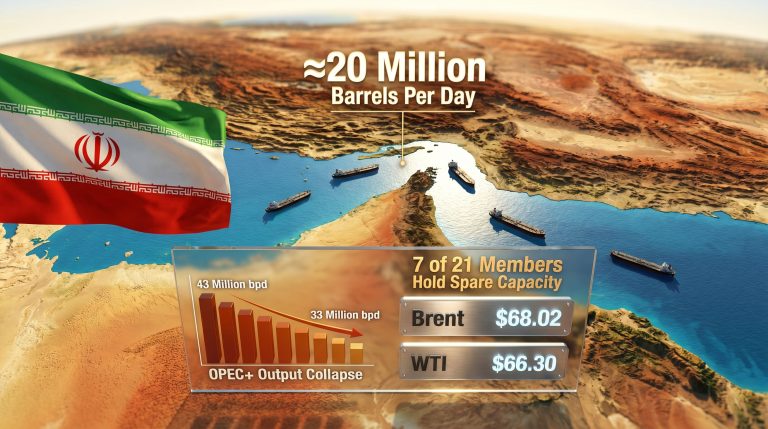
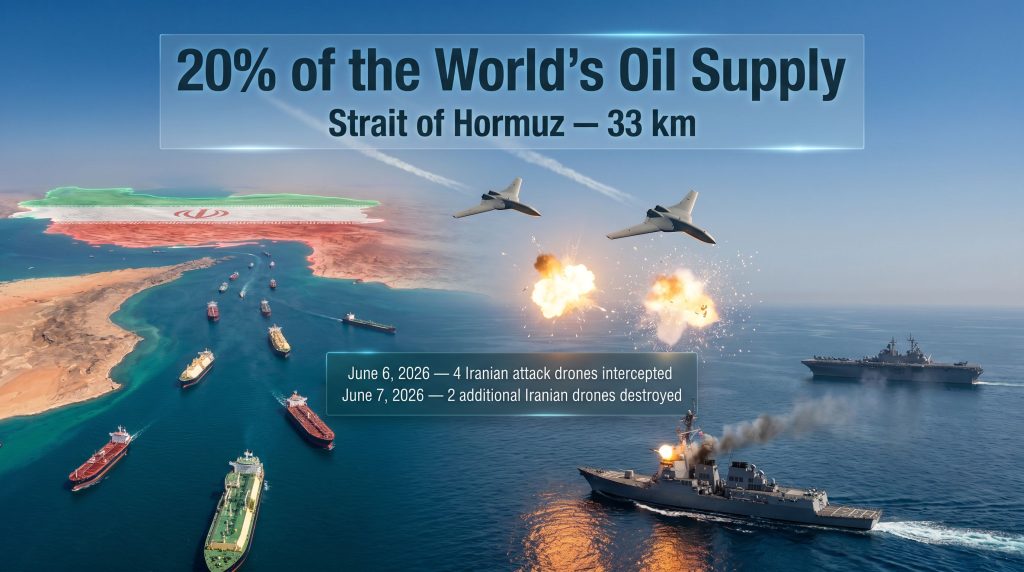
The Strait of Hormuz, at its narrowest, spans approximately 33 kilometres. Within that compressed geography, there are only two navigable shipping lanes, each measuring roughly 3.2 kilometres across. Through these channels, somewhere between 17 and 21 million barrels of crude oil transit every single day, representing close to 20% of global oil supply. No pipeline network on earth currently exists that could absorb even a fraction of that volume if transit were interrupted for an extended period.
Furthermore, the nations most exposed to any disruption of Hormuz passage are those with the heaviest dependence on Gulf crude and Qatari liquefied natural gas:
- Japan and South Korea, which rely on Middle Eastern suppliers for the majority of their crude oil imports
- India, whose rapidly expanding energy demand is tightly coupled to Gulf supply chains
- China, the world's largest crude importer and a primary destination for Persian Gulf barrels
- European buyers who source significant volumes of Qatari LNG through Hormuz-linked shipping corridors, a situation that directly affects global LNG supply dynamics worldwide
The strait connects the Persian Gulf to the Gulf of Oman and onward to the broader Arabian Sea. There is no functionally equivalent alternative route for Middle Eastern energy exporters. The Petroline pipeline running across Saudi Arabia carries roughly 5 million barrels per day, and the UAE's Habshan-Fujairah bypass pipeline adds further capacity, but combined, these alternatives fall far short of replacing normal Hormuz throughput in a closure scenario.
Structural reality: If Hormuz transit were suspended for more than 72 hours, nations across South Asia, East Africa, and Southeast Asia that lack strategic petroleum reserves would face immediate fuel shortages with no practical logistical substitute available at scale.
Reconstructing the June 6–7 Engagement Sequence
The events of early June 2026 did not emerge from a vacuum. They represent a compressed escalation cycle unfolding across back-to-back operational days, each action triggering a proportional or escalatory response from the other side.
| Date | Actor | Action | Target |
|---|---|---|---|
| June 6, 2026 | Iran | Launched four one-way attack drones | Strait of Hormuz corridor |
| June 6, 2026 | US (CENTCOM) | Intercepted all four drones; struck coastal radar sites | Iranian surveillance infrastructure |
| June 7, 2026 | Iran | Fired missile salvo | US allies Bahrain and Kuwait |
| June 7, 2026 | US (CENTCOM) | Intercepted and destroyed two additional Iranian drones | Strait of Hormuz corridor |
The June 6 response is particularly significant from a strategic standpoint. After intercepting the four Iranian attack drones, CENTCOM did not simply note the engagement and stand down. Instead, US forces conducted retaliatory strikes against Iranian coastal surveillance radar installations. This represents a meaningful doctrinal shift: moving from pure interception toward active degradation of Iran's maritime targeting architecture.
Destroying coastal radar does not just protect a single convoy. It degrades Iran's ability to track vessel movements, calculate intercept vectors, and coordinate future drone or missile launches. In electronic warfare doctrine, this approach is sometimes called suppression of enemy air and sea defences, and its application here suggests US planners are treating Hormuz as a sustained operational theatre rather than a series of isolated defensive incidents.
The following day, Iran responded with a missile salvo directed at Bahrain and Kuwait, two Gulf Cooperation Council member states that host significant US military infrastructure. Saudi Arabia subsequently led Arab League condemnation of the strikes, reflecting a regional solidarity response that carries its own escalatory implications under GCC collective defence frameworks. According to reporting from Gulf News, the engagement sequence underscores how rapidly incidents in the strait can escalate into broader regional flashpoints.
One-Way Attack Drones: The Asymmetric Weapon Reshaping Maritime Conflict
Understanding why Iran repeatedly deploys this specific weapon system requires looking at the underlying economics and tactical geometry of the strait.
One-way attack drones — also referred to as loitering munitions or kamikaze drones in defence literature — are unmanned aerial systems engineered for a single function: reaching a target and destroying themselves on impact. They carry no recovery mechanism and are not designed for return flight. Their tactical appeal lies not in sophistication but in cost asymmetry.
Consider the following comparison:
| Weapon System | Approximate Unit Cost |
|---|---|
| Iranian one-way attack drone (e.g., Shahed-series variants) | $10,000 to $50,000 USD |
| US interceptor missile (e.g., SM-2 or equivalent) | $2,000,000 to $4,000,000 USD |
This cost-exchange ratio is profoundly favourable for the attacker. For every interceptor missile fired to neutralise a drone, Iran expends a fraction of the economic cost it imposes on US defence systems. Deployed in saturation waves, these drones can overwhelm layered air defence systems not through technological superiority but through sheer volume economics.
Iran's domestically produced Shahed-series drones have appeared across multiple conflict theatres beyond the Gulf, demonstrating both the scalability of production and the transferability of the doctrine. Within the Hormuz corridor specifically, their deployment is optimised by the strait's narrow geography:
- Short flight distances from Iranian coastal positions reduce detection windows
- Predictable shipping lane corridors create a high-density target environment
- Even a near-miss or unconfirmed incident is sufficient to trigger war risk insurance surcharges and route diversions
The Information War Running Alongside the Kinetic One
One dimension of this conflict that receives insufficient analytical attention is the deliberate management of narrative between the two sides. A pattern has emerged across multiple incidents: the US provides specific, publicly attributed confirmation of drone intercepts through official CENTCOM channels, while Iranian authorities have historically disputed or denied the loss of any assets.
This was visible in an earlier, well-documented engagement involving an Iranian drone approaching the USS Boxer to within approximately 1,000 yards before being destroyed after ignoring multiple warnings. Iran's denial, as reported by Dawn, stated it had no information confirming the loss of any drone — a position structurally identical to denials issued in subsequent incidents.
Key analytical point: In active conflict zones, information asymmetry is not incidental. Both parties use competing narratives to shape domestic audiences, international perceptions, and the calculations of third-party actors like shipping insurers, neutral governments, and energy markets. The discrepancy between US and Iranian accounts is itself a strategic instrument.
Economic Anatomy of a Hormuz Crisis
The military exchanges described above do not stay within the operational domain. They transmit almost immediately into commercial and financial systems through several interconnected channels. Consequently, understanding these transmission mechanisms is essential for anyone monitoring current crude oil prices and energy market volatility.
War risk insurance is the first and most sensitive transmission mechanism. Lloyd's of London and the broader marine insurance market operate on real-time threat assessments for designated high-risk zones. During periods of active confrontation, war risk surcharges for vessels transiting the Strait of Hormuz can exceed 1% of hull value per voyage. For a very large crude carrier (VLCC) with a hull value in the hundreds of millions of dollars, this represents a material cost addition per transit.
When surcharges become prohibitive, tanker operators face a binary choice:
- Continue transiting and absorb escalating insurance costs, passing them through to cargo prices
- Divert around the Cape of Good Hope, adding approximately 15 to 20 additional sailing days and substantially higher fuel consumption
Either outcome feeds directly into crude oil price trends, LNG benchmark rates, and ultimately into retail energy costs for consumers from Seoul to Stuttgart.
The downstream effects on developing economies are particularly acute. Nations across South Asia, East Africa, and Southeast Asia without strategic petroleum reserves face an immediate supply and affordability shock when Hormuz transit is disrupted — conditions that translate with speed into domestic inflation and political instability.
The next major ASX story will hit our subscribers first
The Talk-and-Fight Paradox
Perhaps the most analytically puzzling dimension of the current situation is that Washington and Tehran are simultaneously engaged in weeks of indirect diplomatic negotiations aimed at de-escalating the broader conflict while conducting active kinetic operations against each other's military assets.
This parallel track dynamic is not without historical precedent. During the 1980s Tanker War, both the United States and Iran maintained back-channel communications even while conducting naval operations against each other's vessels and interests in the Persian Gulf. The existence of a diplomatic channel does not automatically suppress military activity when neither side has made a commitment to pause kinetic operations as a condition of talks.
How Does Regional Politics Complicate the Picture?
What the current situation adds is a regional dimension absent from the 1980s conflict. Iran's missile strikes targeting Bahrain and Kuwait — both GCC members hosting US military assets — represent a deliberate geographic expansion of the conflict beyond purely bilateral US-Iran exchanges. This places Gulf partner states directly inside the operational envelope and raises questions about the mutual defence obligations that underpin the GCC framework.
Reports have also emerged that US policymakers are examining the potential seizure of Iranian assets to fund reconstruction for Gulf allies affected by Iranian missile strikes, adding an economic pressure dimension layered on top of ongoing military deterrence operations. This, in turn, contributes to broader oil market disruption that reverberates across global energy systems.
Three Scenarios for What Comes Next
Assessing the forward trajectory of the Hormuz situation requires holding multiple plausible futures simultaneously, since the outcome is highly sensitive to decisions that could shift within hours.
Scenario 1: Controlled Escalation with Diplomatic Containment
Both parties continue exchanging drone intercepts and limited strikes at a managed intensity while indirect talks progress incrementally. Shipping disruption remains elevated but insurance markets continue functioning. This outcome depends on neither side miscalculating the other's red lines. Probability: Moderate.
Scenario 2: Accidental Escalation into Broader Conflict
A drone or missile strike causes significant casualties among US personnel or GCC civilians. Washington responds with a broader retaliatory campaign, Iran widens its target set to include additional Gulf infrastructure. Marine insurers suspend or dramatically restrict Hormuz coverage. Tanker operators halt transits. Probability: Lower but non-trivial given current operational tempo.
Scenario 3: Diplomatic Breakthrough Producing a Temporary Ceasefire
Indirect talks produce a framework that pauses kinetic activity on both sides. Shipping normalises, insurance surcharges ease. Structural tensions over Iran's nuclear programme, regional proxy networks, and maritime access rights remain unresolved beneath the surface. Probability: Possible, but historically difficult to sustain in US-Iran relations.
What Lasting Hormuz Security Would Actually Require
Short-term military deterrence addresses symptoms rather than the underlying architecture of vulnerability. For the strait to become structurally more stable over the medium term, several conditions would need to be met — and OPEC market influence over production decisions would inevitably intersect with any long-term resolution.
- A verifiable agreement limiting the deployment of attack drones and ballistic missiles in the Hormuz corridor by Iranian forces
- Strengthened GCC collective defence mechanisms that reduce the latency of regional threat response and decrease dependence on US intervention as the primary deterrent layer
- Investment in alternative transit infrastructure, including expansion of existing bypass pipelines, to reduce the strait's singular chokepoint status in the global energy supply architecture
- Clear diplomatic signalling frameworks that allow both Washington and Tehran to de-escalate specific incidents without each side interpreting restraint as weakness
Until those structural conditions are in place, the pattern of drone launches, intercepts, retaliatory strikes, and narrative contestation is likely to continue. The confirmation that US says it destroyed two Iran drones targeting Hormuz shipping is, in this context, not an isolated incident but the latest chapter in a long-running strategic contest. The Strait of Hormuz will remain what it has been for decades: the world's most strategically consequential 33 kilometres of water, and the most dangerous single point of failure in the global energy system.
This article is based on publicly confirmed statements from US Central Command and reporting from Arab News. Forward-looking scenario assessments are analytical projections and do not constitute financial or investment advice. Readers seeking further coverage of the War in Iran and regional security developments are encouraged to consult ongoing reporting at arabnews.com.
Want to Stay Ahead of the Commodity Market Moves Triggered by Geopolitical Flashpoints Like Hormuz?
When energy supply disruptions ripple through global markets, mineral and resource equities often follow — and Discovery Alert's proprietary Discovery IQ model scans ASX announcements in real time, delivering instant alerts on significant mineral discoveries so subscribers can identify actionable opportunities before the broader market reacts. Start your 14-day free trial at Discovery Alert today, or explore how historic mineral discoveries have generated substantial returns even amid periods of profound market uncertainty.