
August 25, 2026
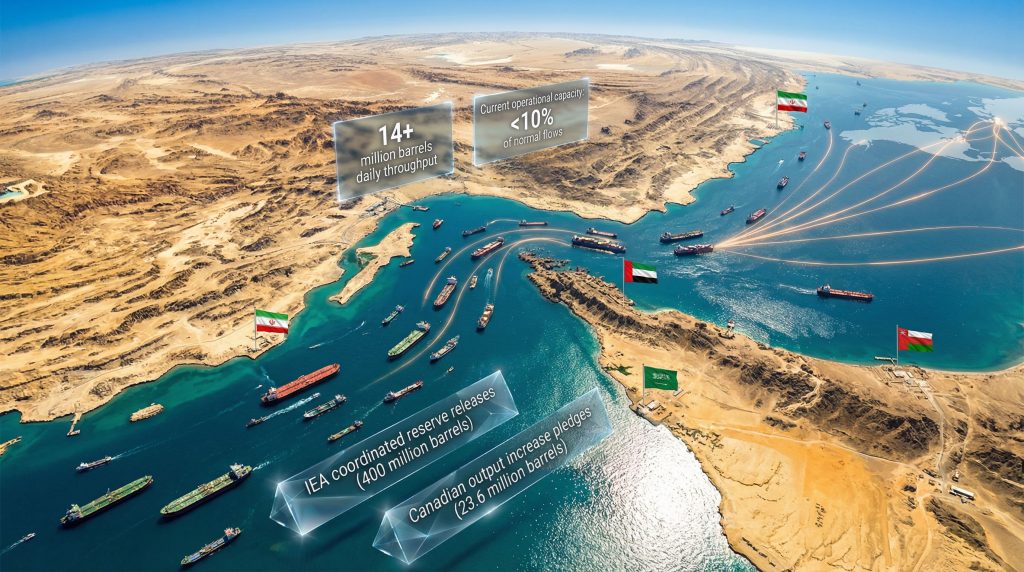
Global supply networks experience unprecedented strain when critical maritime passages face disruption, revealing the intricate dependencies that underpin modern economic systems. The vulnerability of energy infrastructure becomes particularly acute during periods of geopolitical tension, as interconnected markets respond to perceived threats with cascading price adjustments and strategic repositioning. Current Strait of Hormuz tensions demonstrate how chokepoint vulnerabilities can rapidly escalate into global economic challenges.
Understanding Critical Maritime Energy Infrastructure
Strategic maritime chokepoints represent fundamental vulnerabilities within global energy supply chains, with narrow waterways controlling disproportionate volumes of international trade. The concentration of energy flows through limited geographic passages creates systemic risks that extend far beyond immediate regional impacts.
Economic Leverage of Strategic Waterways
The 21-mile Strait of Hormuz historically facilitated the transit of over 25 million barrels per day of crude oil and refined products before current disruptions reduced flows to approximately 9.7 million barrels per day as of mid-March 2026. This 60% reduction in throughput demonstrates the immediate impact of chokepoint closures on global energy security frameworks.
The narrow passage creates inherent vulnerability to blockade operations, with limited maneuverability for large crude carriers and exposure to aerial and maritime interdiction capabilities. Current operational capacity remains below 10% of normal flows, highlighting the effectiveness of targeted disruption strategies.
Historical Context of Chokepoint Disruptions
Maritime energy disruptions follow established patterns of market response, typically involving diplomatic negotiations, alternative supply development, and demand adjustment mechanisms operating simultaneously. Previous chokepoint closures during the 1980s and 1990s established baseline expectations for resolution timelines, though current Strait of Hormuz tensions appear more complex than historical precedents.
Key Infrastructure Vulnerabilities:
- Limited bypass capacity relative to normal throughput volumes
- Concentrated energy flows through single transit routes
- Vulnerability of alternative infrastructure to targeted attacks
- Extended transit times via alternative shipping routes
Current Crisis Metrics and Market Response
Market pricing mechanisms reflect increasing concern about prolonged supply disruption rather than speculative excess. Furthermore, the OPEC production impact remains significant during these disruptions. As of March 17, 2026, Brent Crude traded at $101.20 per barrel (up 1.01%), WTI Crude at $94.19 per barrel (up 0.74%), and Murban Crude at $111.50 per barrel (up 4.48%).
These price levels, while elevated, remain substantially below the $200 per barrel scenarios being discussed in risk assessment frameworks, suggesting markets are pricing some probability of resolution or demand destruction mechanisms. The Strait of Hormuz crisis has highlighted the strategic importance of this maritime passage.
| Supply Disruption Impact Analysis |
|---|
| Pre-crisis daily throughput: 25+ million barrels |
| Current operational capacity: 9.7 million barrels (60% reduction) |
| Alternative route capacity: 6.5 million barrels combined |
| Price volatility range: $94-$111 per barrel across major benchmarks |
When big ASX news breaks, our subscribers know first
Cascading Effects Across Global Supply Networks
Energy supply disruptions propagate through interconnected systems, creating secondary and tertiary impacts that extend far beyond immediate commodity markets. The complexity of modern supply chains amplifies initial shocks, creating feedback loops that affect multiple economic sectors simultaneously.
Primary Energy Market Disruptions
Oil price movements shock transmission mechanisms operate through both physical supply constraints and financial market responses. US average retail diesel prices have exceeded $5 per gallon for the first time since December 2022, representing only the second occurrence in history. US gasoline prices rose to $3.062 per gallon, reflecting downstream supply chain stress.
LNG supply chain bottlenecks emerged following targeted attacks on infrastructure. The Shah gas field shutdown eliminated 1.28 billion cubic feet per day of gas production capacity and 4.2 million metric tons per annum of sulfur production, creating material constraints on global LNG supplies given limited spare capacity in Qatar and Australia.
Regional Price Premium Escalation
Middle Eastern crude differentials reached unprecedented levels, with both cash Dubai and cash Oman settling at a $62 per barrel premium to Dubai futures. This represents the first time premiums have exceeded the $60 per barrel threshold, reflecting acute supply shortage and logistical constraints in moving Middle Eastern crude to international markets.
These extreme premiums indicate fundamental supply-demand imbalances rather than speculative positioning, suggesting sustained pressure on energy markets until alternative supply sources can be activated.
Secondary Economic Ripple Effects
Freight cost escalation patterns emerge as shipping routes face disruption and insurance premiums expand substantially due to conflict risk. The forced rerouting via Cape of Good Hope adds 2-3 weeks of additional transit time, imposing substantial cost increases on energy importers globally.
Critical Supply Chain Dependencies
Fertilizer supply disruptions threaten global food security as petrochemical feedstock availability constraints impact industrial production. Strategic material transit vulnerabilities create additional pressure points across multiple commodity sectors.
Manufacturing input cost pressures cascade through supply networks as energy-intensive industries face dual challenges of higher energy costs and constrained feedstock availability. Aluminum smelting operations, petrochemical facilities, and energy-intensive manufacturing sectors experience the highest exposure to supply chain disruptions.
Gulf oil producers have already lost an estimated $15 billion since conflict initiation, reflecting volume losses and revenue impacts that create substantial fiscal pressure on government budgets dependent on energy exports.
Regional Adaptation Strategies and Energy Security Responses
Different economic regions demonstrate varying capabilities to respond to supply disruptions, reflecting diverse energy security frameworks, strategic reserve adequacy, and alternative sourcing flexibility. These responses reveal underlying strengths and vulnerabilities in national energy security architectures.
Asian Market Emergency Protocols
China's strategic positioning demonstrates sophisticated supply chain foresight, having built massive oil buffer capacity ahead of current tensions. Chinese state refiners Sinopec and CNPC resumed Russian crude imports after a four-month hiatus, acquiring 10 cargoes of Far Eastern ESPO in the May loading cycle, redirecting supplies away from traditional suppliers.
Japan's emergency response includes tapping emergency oil reserves and importing Russian Sakhalin crude for the first time in three years, having purchased only one cargo during the previous three-year period. This demonstrates willingness to change long-established sourcing patterns under supply stress.
India's market adaptations include suspension of fuel credit offerings by top refiners due to price shock impacts, indicating downstream stress propagation. India received 2 of the 5 breakthrough tankers that successfully penetrated Iranian blockade operations, suggesting ongoing negotiations for selective transit arrangements.
European Energy Security Coordination
The International Energy Agency coordinated a 400-million-barrel strategic petroleum reserve release, representing the largest joint release in history. IEA Executive Director Fatih Birol indicated readiness to double down on reserve releases if supply deteriorates further, suggesting potential for additional 400+ million barrel mobilisation.
The European Union is considering naval action to reopen strategic waterways, indicating political willingness to escalate beyond economic measures. EU industrial demand management protocols remain under development as member states assess manufacturing curtailment requirements.
North American Production Response Capabilities
Canada pledged to ramp up collective oil output by 23.6 million barrels as part of IEA coordinated response, with materialisation expected within 3-6 months given the absence of Canadian strategic petroleum reserves. This timeline reflects practical constraints on rapid production increases.
US shale producers remain on the sidelines despite elevated prices, suggesting capital discipline and concerns about price sustainability rather than mechanical production constraints. This contrasts with earlier crisis responses and may reflect industry learning from prior boom-bust cycles.
President Trump directed restart of the Santa Ynez offshore pipeline system in California, shut since 2015, through executive action via Sable Offshore Energy. This demonstrates political willingness to override previous environmental and regulatory constraints during supply emergencies.
| Regional Production Response Capabilities |
|---|
| US shale flexibility: Limited near-term response despite price incentives |
| Canadian output pledges: 23.6 million barrels over 3-6 months |
| Strategic reserve coordination: 400 million barrels released, potential doubling |
| Emergency infrastructure activation: California pipeline restart via executive order |
Alternative Trade Route Development and Capacity Constraints
Existing bypass infrastructure demonstrates critical limitations when primary transit routes face disruption. The combined capacity of alternative routes remains insufficient to replace normal throughput volumes, creating sustained pressure on global energy markets.
Primary Bypass Infrastructure Assessment
Saudi Arabia's East-West Pipeline operates at 5 million barrels per day capacity, while the UAE's Habshan-Fujairah conduit maintains 1.5 million barrels per day capacity. Combined, these two primary alternative routes handle only 6.5 million barrels per day, insufficient to replace the 15+ million barrels per day reduction in normal throughput.
Saudi Aramco accelerated loadings from its Red Sea coast to 3 million barrels per day, described as unprecedented levels but remaining substantially below the company's 7 million barrels per day export rate prior to conflict. This indicates maximum utilisation of existing Red Sea infrastructure with limited expansion capacity.
However, alternative infrastructure faces its own vulnerabilities. Iranian forces struck the Fujairah export terminal twice within two days, forcing ADNOC to suspend loadings. Similarly, one single strike could disrupt Red Sea flows, indicating fragility of bypass adaptations.
Cape of Good Hope Route Economics
The Cape of Good Hope alternative adds 2-3 weeks of additional transit time, creating substantial cost structure modifications for energy importers. This extended routing faces shipping capacity constraints and dramatically different economics compared to normal transit patterns.
Insurance market adjustments and risk premiums have expanded substantially, though specific percentage increases require verification from shipping industry sources. The combination of extended transit times and higher insurance costs creates sustained pressure on delivered energy prices globally.
Regional Pipeline Infrastructure Development
Iraq pursues restoration of the Kirkuk-Ceyhan pipeline to bypass Kurdish territory after failing to negotiate with the Kurdish Regional Government. This represents medium-term diversification of export infrastructure outside primary chokepoint vulnerabilities.
Pipeline capacity expansion remains limited in the near term, with most alternative infrastructure operating at maximum utilisation rates. New pipeline construction requires years rather than months, limiting immediate relief potential.
Current Infrastructure Utilisation:
- Saudi East-West Pipeline: Operating at full 5 million b/day capacity
- UAE Habshan-Fujairah: Maximum 1.5 million b/day, facing attack vulnerability
- Red Sea terminals: 3 million b/day vs. normal 7 million b/day capability
- Alternative shipping routes: 2-3 week transit time penalties
Financial Market Risk Pricing and Investment Implications
Energy futures markets demonstrate complex pricing dynamics as traders attempt to balance immediate supply constraints against longer-term resolution scenarios. The interaction between physical market tightness and financial market positioning creates unique opportunities and risks for different investor categories.
Energy Futures Market Dynamics
Contango versus backwardation patterns reflect market expectations about supply restoration timelines. Current pricing structures suggest markets are pricing some probability of near-term resolution while maintaining risk premiums for extended disruption scenarios.
Volatility premium calculations incorporate both immediate supply constraints and geopolitical risk factors. The gap between current pricing around $94-$111 per barrel and scenario pricing of $200 per barrel indicates significant upside risk pricing opportunities.
Hedge fund positioning analysis reveals divergent strategies, with some institutions positioning for continued disruption while others bet on resolution mechanisms. The diversity of positioning creates potential for significant price moves as events unfold.
Currency and Commodity Correlation Patterns
Petrodollar recycling faces disruption as Gulf oil producers lose $15 billion in revenue since conflict initiation. This revenue reduction affects currency markets and international capital flows, creating secondary effects beyond commodity markets.
Emerging market currency pressures intensify as energy importers face higher costs and reduced current account balances. Countries with significant energy import dependencies face particular vulnerability to sustained high energy prices.
Gold and safe-haven asset flows reflect investor flight to quality amid geopolitical uncertainty. Traditional correlations between energy prices and precious metals may strengthen during extended supply disruption periods.
Investment Strategy Framework During Energy Supply Crises
Energy sector equity positioning requires careful selection between upstream producers benefiting from higher prices and downstream refiners facing margin compression from feedstock costs and supply constraints.
Currency hedging mechanisms become critical for multinational corporations with energy-intensive operations or significant exposure to energy-importing economies. The interaction between energy costs and exchange rates creates complex hedging requirements.
Commodity diversification approaches should consider correlations between energy and other raw materials, as supply chain disruptions often affect multiple commodity sectors simultaneously.
Infrastructure investment priorities shift toward energy security and supply chain resilience, creating opportunities in storage, alternative transportation, and renewable energy sectors.
Key Investment Considerations:
- Energy futures positioning for extended disruption scenarios
- Currency exposure to energy-importing economies
- Infrastructure investments in alternative supply routes
- Renewable energy acceleration as energy security measure
Geopolitical Risk Assessment and Resolution Scenarios
Current Strait of Hormuz tensions demonstrate unique characteristics compared to historical precedents, with selective transit arrangements and regional negotiations suggesting potential pathways toward partial resolution. In addition, the trade war oil impact complicates global energy dynamics. The complexity of stakeholder interests creates multiple scenario possibilities rather than binary outcomes.
Probability-Weighted Outcome Analysis
Short-term resolution scenarios (1-3 months) require diplomatic breakthroughs and face-saving mechanisms for all parties involved. Market pricing suggests approximately 30-40% probability of near-term resolution based on current futures curves and options pricing.
Medium-term disruption scenarios (6-12 months) involve partial transit restoration through selective arrangements with regional partners. Iraq is reportedly in talks with Tehran regarding tanker passage, having already slashed 3 million barrels per day of production due to storage constraints.
Long-term structural changes could emerge if diplomatic resolution proves elusive, leading to permanent shifts in energy trade patterns and infrastructure investment priorities. This scenario carries the highest economic transformation potential but lower immediate probability.
| Scenario Planning Framework |
|---|
| Short-term resolution (1-3 months): Diplomatic breakthrough, face-saving arrangements |
| Medium-term disruption (6-12 months): Selective transit, regional negotiations |
| Long-term structural change: Permanent trade pattern shifts, infrastructure reallocation |
| Market probability assessment: 30-40% near-term resolution based on futures pricing |
Regional Security Architecture Evolution
Naval coalition formation patterns suggest coordinated international response capabilities, though specific vessel deployments and interception capabilities require verification from naval sources and defence ministry statements.
Defence spending reallocation priorities shift toward maritime security and chokepoint protection, creating opportunities in naval defence systems and maritime surveillance technologies.
Energy security partnerships develop as nations seek to reduce dependence on vulnerable supply routes through bilateral agreements and alternative sourcing arrangements. Thailand has turned to Russian oil supply as part of diversification strategies.
The next major ASX story will hit our subscribers first
Business Supply Chain Risk Management Adaptations
Corporate supply chain resilience faces unprecedented testing as energy costs and availability constraints force fundamental operational adjustments. Companies demonstrate varying degrees of preparedness and adaptive capacity based on prior risk assessment investments.
Immediate Operational Adjustments
Inventory buffer optimisation becomes critical as lead times extend and supply reliability decreases. Energy-intensive industries particularly require sophisticated inventory management to balance carrying costs against stockout risks.
Supplier diversification strategies accelerate as companies seek alternatives to traditional sourcing patterns. The return to Russian energy supplies by Asian refiners demonstrates willingness to activate previously excluded options under supply stress.
Contract renegotiation frameworks emerge as force majeure clauses face activation and pricing mechanisms require adjustment for sustained high energy costs. Legal departments experience increased workload managing supply agreement modifications.
Medium-Term Strategic Planning Requirements
Geographic risk mapping becomes essential for multinational operations as companies assess vulnerability to different chokepoint disruptions and regional conflict scenarios. Supply chain management evolves from cost optimisation toward resilience prioritisation.
Alternative supplier qualification accelerates as companies develop redundant sourcing capabilities. The qualification process for new suppliers typically requires months to years, creating pressure for immediate action.
Financial hedging instruments usage increases as companies seek protection against energy price volatility and currency fluctuations associated with alternative sourcing arrangements.
Supply Chain Resilience Checklist:
- Geographic risk mapping and vulnerability assessment
- Alternative supplier qualification and redundancy development
- Financial hedging instruments for energy and currency exposure
- Force majeure clause reviews and contract renegotiation frameworks
- Inventory optimisation balancing cost and security considerations
Long-Term Infrastructure Investment Priorities
Moreover, renewable energy solutions transition acceleration gains momentum as companies seek energy independence from volatile fossil fuel supply chains. Current disruptions provide business case justification for previously marginal renewable investments.
Storage capacity expansion becomes strategic priority as companies recognise inventory buffers as insurance against supply disruptions. The cost of additional storage capacity appears minimal compared to production halt risks.
Regional production capability development may justify previously uneconomic domestic production options as supply security considerations outweigh pure cost optimisation approaches.
Energy Transition Urgency and Investment Acceleration
Current energy supply vulnerabilities create powerful incentives for energy independence and renewable energy development. The business case for energy transition strengthens significantly when supply security considerations supplement environmental and regulatory drivers.
Renewable Energy Investment Catalysts
Solar and wind capacity expansion priorities accelerate as countries recognise domestic renewable resources provide energy security benefits beyond environmental considerations. The combination of energy independence and cost competitiveness creates compelling investment cases.
Battery storage infrastructure requirements become critical for renewable energy integration and grid stability during supply disruptions. Energy storage provides both renewable integration and emergency backup capabilities.
Grid modernisation investment needs expand as countries seek to optimise domestic energy production and reduce dependence on imported fossil fuels. Smart grid technologies enable better demand management during supply constraints.
Energy Independence Policy Framework Development
Domestic production capability assessments reveal varying degrees of energy self-sufficiency across different regions. Countries with limited domestic resources face the greatest vulnerability to supply disruptions and strongest incentives for renewable development.
Strategic reserve adequacy reviews examine current stockpile levels relative to consumption needs during extended supply disruptions. Most developed nations maintain 90-day import coverage, though actual duration depends on demand destruction and alternative supply activation.
International cooperation framework updates reflect changing geopolitical realities and energy security priorities. Traditional alliance structures may require modification to address new threat vectors and supply vulnerabilities.
Building Resilient Energy Security Frameworks
Current tensions expose fundamental vulnerabilities in global energy infrastructure while demonstrating the interconnected nature of modern economic systems. The scale of supply disruption and market response reveals both the fragility and adaptability of international energy markets. Furthermore, OPEC global influence continues to shape market dynamics during these critical periods.
Strategic Infrastructure Resilience Priorities
Chokepoint vulnerability mitigation requires systematic risk management approaches that balance cost considerations against security benefits. The concentration of energy flows through limited geographic passages creates inherent systemic risks that demand proactive management.
Economic diversification strategies reduce exposure to single-point-of-failure scenarios in energy supply chains. Countries and companies with diversified energy portfolios demonstrate greater resilience during supply disruptions.
International cooperation mechanisms enhance crisis response capabilities through coordinated reserve releases, alternative supply development, and demand management protocols. The IEA's 400-million-barrel coordinated release demonstrates effective multilateral response frameworks.
Forward-Looking Investment Framework
Infrastructure redundancy development emerges as critical strategic priority, with bypass pipeline capacity, alternative shipping routes, and distributed energy production providing resilience against disruption scenarios.
Technology innovation acceleration focuses on energy efficiency, storage systems, and renewable energy integration technologies that reduce dependence on vulnerable supply chains.
Regional energy security partnerships develop as nations recognise mutual benefits from coordinated energy security strategies and shared infrastructure investments.
The current crisis demonstrates that energy security requires comprehensive risk management approaches that extend beyond traditional supply and demand considerations. Successful navigation of energy supply disruptions requires combination of strategic reserves, alternative infrastructure, international cooperation, and long-term investment in energy independence capabilities.
Frequently Asked Questions:
How long can strategic petroleum reserves sustain normal consumption during supply disruptions?
Most developed nations maintain strategic reserves equivalent to 90 days of import coverage. However, actual duration depends on demand destruction mechanisms, alternative supply activation, and reserve drawdown coordination among multiple countries. The 400-million-barrel IEA release provides temporary supply buffer while alternative sources come online.
Which industries face the highest vulnerability during energy supply crises?
Transportation, petrochemicals, aluminium smelting, and energy-intensive manufacturing demonstrate the highest exposure to supply chain disruptions. These sectors face both direct energy cost increases and feedstock availability constraints that can force production curtailments.
What are typical resolution patterns for energy supply crises?
Historical energy crises typically resolve through diplomatic negotiations, alternative supply development, and demand adjustment mechanisms operating simultaneously. Resolution timelines vary significantly, but most crises involve partial restoration through selective arrangements before complete normalisation.
How do energy supply disruptions affect different regional economies?
Energy-importing regions face the greatest immediate impact through higher costs and supply constraints. Energy-exporting regions initially benefit from higher prices but may experience revenue losses if supply disruptions persist. Gulf oil producers have already lost $15 billion since current tensions began.
What investment strategies perform best during extended energy crises?
Successful strategies typically involve energy sector equity positioning, currency hedging for energy-intensive operations, commodity diversification, and infrastructure investments in alternative supply routes and renewable energy systems. The key is balancing immediate opportunities against long-term structural changes.
This analysis is based on available market information and expert assessments. Energy market conditions remain highly volatile, and investment decisions should incorporate comprehensive risk assessment and professional financial advice. Supply chain disruptions and geopolitical developments can significantly impact market outcomes and investment performance.
Looking to Diversify Your Portfolio During Energy Market Volatility?
Discovery Alert's proprietary Discovery IQ model delivers real-time alerts on significant ASX mineral discoveries, helping investors identify opportunities in critical materials sectors when traditional energy markets face uncertainty. With global supply chains under pressure and commodity markets responding to geopolitical tensions, explore Discovery Alert's dedicated discoveries page to understand how historic mineral discoveries have generated substantial returns during similar periods of market volatility.