August 5, 2026
Global energy systems face unprecedented vulnerability when critical maritime chokepoints experience disruption. The interconnected nature of modern petroleum supply chains means that even localised conflicts can cascade into worldwide market disruptions, challenging fundamental assumptions about energy security. Understanding these vulnerabilities requires examining how geographic bottlenecks transform from routine commercial passages into strategic leverage points that reshape global economic relationships and oil price movements.
The Geographic Foundation of Global Energy Dependency
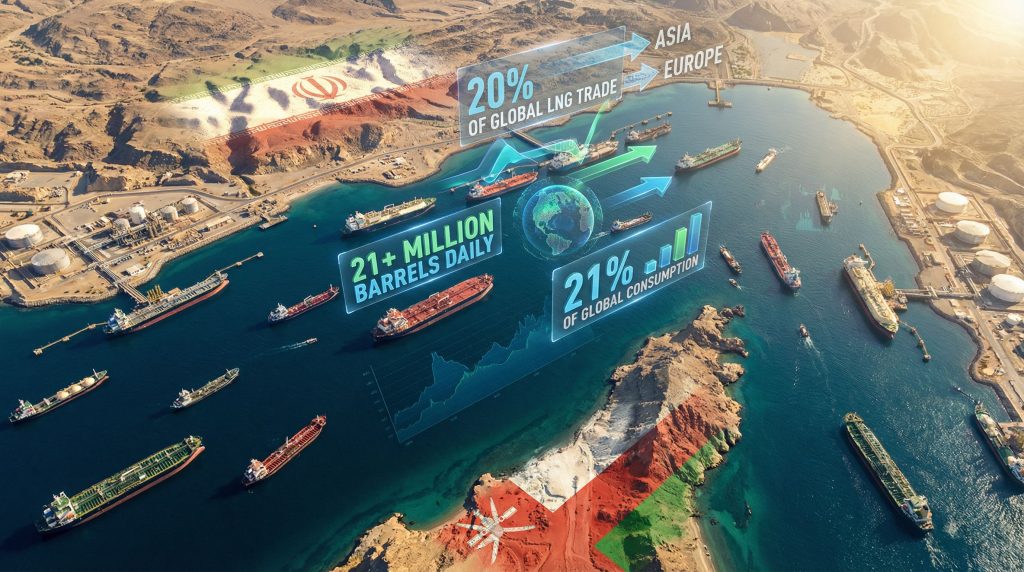
The blockade of the Strait of Hormuz represents the ultimate convergence of geography and geopolitics in international energy markets. This narrow waterway spans approximately 21 miles at its most constrained point, positioned between Iran's coastline and Oman's Musandam Peninsula. The geographic configuration creates an unavoidable bottleneck for petroleum shipments moving between Persian Gulf production centres and global consumption markets.
Current transit volumes through this corridor demonstrate extraordinary concentration of energy flows. According to the International Energy Agency's March 2026 assessment, the strait typically handles 21 million barrels daily of crude oil and refined petroleum products during normal operations. This volume represents approximately 21 percent of global crude oil consumption when measured against worldwide demand patterns.
The strait's strategic importance extends beyond crude oil movement. Approximately 20 percent of global liquefied natural gas trade passes through these waters, with particular concentration on Qatari LNG exports destined for Asian markets. For seaborne oil movements specifically, the blockade of the Strait of Hormuz accounts for 25 percent or greater of all internationally traded crude oil.
Maritime Transit Constraints and Navigation Challenges
The physical characteristics of the strait create operational complexities that extend beyond simple geographic width measurements. Fully-loaded supertankers require precise navigation through designated shipping lanes, with the deepest channels accommodating these vessels at reduced speeds for safety considerations.
Navigation challenges include:
- Channel depth limitations restricting maximum vessel size
- Traffic separation schemes requiring coordinated movement patterns
- Weather and visibility factors affecting transit scheduling
- Security protocols adding time and complexity to passage procedures
Furthermore, these operational constraints mean that even minor disruptions can create cascading delays throughout the global tanker fleet, affecting delivery schedules and inventory management systems worldwide.
When big ASX news breaks, our subscribers know first
Market Response Mechanisms During Transit Disruptions
The current blockade of the Strait of Hormuz, which commenced in late February 2026, illustrates how quickly energy market dynamics can shift from normal operations to crisis management. The International Energy Agency characterises this disruption as "the largest oil supply disruption in history," reflecting both absolute volume impacts and the unprecedented coordination of multiple shock factors occurring simultaneously.
By March 2026, global oil supply had fallen approximately 8 million barrels daily due to the blockade effects. This reduction represents roughly 8 percent of global petroleum demand, creating market tensions that extend far beyond simple supply arithmetic. Concurrently, Gulf producers implemented production cutbacks totaling at least 10 million barrels daily due to export route blockages causing inventory saturation at loading facilities.
Insurance Market Transformation and Risk Pricing
Maritime insurance markets serve as sensitive early-warning systems for supply chain disruption risks. During active blockade periods, insurance premiums for Gulf-bound vessels increase by 300-500 percent above baseline rates, fundamentally altering the economics of energy transport.
A typical voyage insurance premium of $50,000 on a $50 million cargo transforms to $150,000-$250,000 when premiums triple or quintuple. This increase adds $2-4 per barrel to effective delivered costs even before crude price movements occur. These cost pressures represent what the IEA describes as "additional cost pressures beyond direct supply disruptions."
Critical Market Insight: Insurance premium adjustments often precede and anticipate actual regulatory restrictions by days or weeks, as underwriters operate with real-time maritime intelligence that prices risk more quickly than regulatory bodies can formalise restrictions.
Emergency Response Coordination and Strategic Reserve Utilisation
The magnitude of the current crisis prompted coordinated emergency response protocols among consuming nations. The International Energy Agency ordered release of 400 million barrels from strategic petroleum reserves administered by member countries, representing unprecedented international coordination in emergency supply management.
Fatih Birol, the International Energy Agency's executive director, emphasised that this coordinated response had already demonstrated "strong impact" on markets during initial implementation stages. The messaging strategy signals consuming nations' willingness to deploy emergency reserves aggressively rather than allowing market mechanisms alone to address supply shortfalls.
Alternative Export Infrastructure and Bypass Capacity
When primary export routes become unavailable, regional producers must rely on alternative infrastructure with significant capacity constraints. Gulf states have invested in bypass systems, but these facilities cannot accommodate full production volumes during extended Hormuz closures. However, these limitations also affect critical minerals energy security as supply chain disruptions cascade across multiple commodity markets.
Pipeline Network Capabilities and Limitations
| Bypass Route | Maximum Capacity | Operational Status | Primary Constraints |
|---|---|---|---|
| Saudi East-West Pipeline | 5-7 million bpd | Previously utilised during regional disruptions | Insufficient for complete Gulf flows |
| UAE Pipeline Network | ~3.5 million bpd | Historically underutilised capacity | Regional distribution challenges |
| Iran Goreh-Jask Route | 0.3 million bpd | Minimal operational use | Political restrictions limit deployment |
Saudi Arabia's East-West pipeline system, originally constructed in the 1980s with 5 million barrels daily capacity and later expanded, can deliver crude to Red Sea terminals at Yanbu. However, this capacity represents only approximately one-third of Saudi Arabia's typical export volumes, creating significant constraints during extended disruptions.
The UAE operates pipeline networks connecting production areas to non-Gulf terminals, including the Habshan-Fujairah pipeline system. While this infrastructure provides 3.5 million barrels daily capacity, much historically remained underutilised due to economic and logistical considerations favouring Gulf terminal exports.
Maritime Rerouting Economics and Time Penalties
Alternative maritime routes involve substantial trade-offs between transit time, operational costs, and security considerations. Rerouting around the Arabian Peninsula adds approximately 2,500 nautical miles to typical Asia-bound shipments, translating to 10-14 additional transit days and proportional increases in shipping costs.
Extended routing impacts include:
- Fuel consumption increases proportional to additional distance
- Crew cost extensions for longer voyage durations
- Vessel utilisation reductions due to longer round-trip cycles
- Port congestion at alternative loading terminals
- Insurance premium adjustments for extended-route risks
Regional Producer Adaptation Strategies
Different Gulf producers experience varying degrees of impact based on their geographic positioning and infrastructure development. The current crisis reveals significant disparities in adaptive capacity among regional exporters and contributes to broader global trade impacts.
Saudi Arabia possesses the most extensive bypass infrastructure through its East-West pipeline system and Red Sea terminal facilities. However, even this infrastructure cannot accommodate full production volumes, forcing difficult production adjustment decisions during extended disruptions.
United Arab Emirates benefits from diverse port infrastructure and pipeline connections, offering greater operational flexibility compared to other regional producers. The UAE's geographic positioning provides access to both Gulf and non-Gulf export terminals.
Iraq faces the most severe constraints due to limited alternative export routes and heavy dependence on Gulf terminals for crude exports. Iraqi production adjustment requirements during Hormuz closures typically exceed other regional producers.
Kuwait and Qatar experience similar challenges, with minimal bypass capacity requiring significant production adjustments when primary export routes become unavailable.
Production Shut-in Mechanics and Restart Challenges
When export routes close, producers must balance inventory management with reservoir maintenance requirements. The IEA's March 2026 assessment notes that production shut down due to export constraints could require "weeks or even months" to restore to pre-crisis levels.
Complex offshore fields present particular challenges:
- Reservoir pressure maintenance requirements during shutdown periods
- Waterflooding system management to prevent formation damage
- Safety protocol compliance during restart procedures
- Gradual production ramp-up to prevent operational complications
For instance, a major offshore field producing 500,000 barrels daily might require 3-4 weeks of careful restart procedures, initially ramping at 50,000 barrels daily before reaching full capacity.
Global Consumer Adaptation and Demand Response
Extended supply disruptions trigger behavioural changes across energy-consuming sectors, creating what analysts term "demand destruction" effects. The March 2026 crisis demonstrates multiple transmission pathways through which supply constraints influence consumption patterns, similar to tariff market impacts.
Regional Vulnerability Assessment
Asia-Pacific Region faces the highest exposure to blockade of the Strait of Hormuz disruptions due to heavy reliance on Gulf crude imports. China, India, Japan, and South Korea collectively import over 60 percent of their crude requirements from Gulf producers, creating structural vulnerability to transit disruptions.
European Markets possess greater supply diversification through North Sea production and alternative suppliers, but remain exposed through global price mechanisms and refined product dependencies.
North American Markets demonstrate relative resilience due to domestic production capabilities, yet experience impacts through refined product markets and integrated global pricing systems. Nevertheless, the US oil production decline adds complexity to global supply dynamics during this crisis.
Consumption Adjustment Patterns
The current crisis has reduced demand by approximately 1 million barrels daily in March-April 2026 through multiple channels:
- Transportation sector: Reduced airline operations and freight activity
- Industrial production: Feedstock optimisation and scheduling adjustments
- Power generation: Fuel switching where alternatives exist
- Petrochemical operations: Production scheduling modifications
These demand reductions provide partial offset to supply disruptions but indicate broader economic stress from energy security concerns.
Financial Market Response and Risk Pricing Mechanisms
Energy derivative markets develop sophisticated instruments for managing chokepoint-related risks, with price movements reflecting both immediate supply impacts and longer-term uncertainty premiums. Moreover, these financial instruments increasingly reflect the complex interplay between energy security and geopolitical tensions.
Derivative Market Indicators
Brent-WTI Spreads widen during Gulf disruptions, reflecting regional supply-demand imbalances that favour more flexible North American production over constrained Gulf supplies.
Refining Margins expand as product availability constraints create processing bottlenecks and inventory management challenges throughout downstream systems.
Freight Derivatives capture escalating shipping costs and route premiums as vessel availability tightens and alternative routing requirements increase operational expenses.
Currency Hedging Activity intensifies as energy-importing economies face exchange rate volatility during crisis periods, requiring sophisticated financial risk management.
The next major ASX story will hit our subscribers first
Strategic Implications and Market Balance Projections
The International Energy Agency significantly revised its 2026 market balance projections following the Strait of Hormuz crisis. Before the February escalation, the organisation forecast a supply surplus of 3.73 million barrels daily for 2026. The March revision reduced this projected surplus to 2.46 million barrels daily, representing a 1.27 million barrel daily adjustment.
More dramatically, the agency reduced its 2026 global oil supply growth forecast to approximately 1.1 million barrels daily, reflecting both immediate crisis impacts and longer-term capacity constraints resulting from extended shutdown periods for regional production systems.
What Are the Key Scenario Pathways for Crisis Resolution?
Escalation Pathways that could intensify current disruptions include:
- Geographic expansion of restrictions to additional maritime zones
- Infrastructure targeting affecting port facilities and pipeline systems
- Alliance involvement broadening international participation in conflicts
- Economic warfare integration combining energy disruptions with trade restrictions
De-escalation Mechanisms typically involve:
- Diplomatic intervention through third-party mediation frameworks
- Economic incentives reducing conflict motivations through trade arrangements
- Security guarantees for neutral maritime transit operations
- Infrastructure agreements establishing neutral management of critical facilities
Long-term Infrastructure Investment Implications
Major chokepoint disruptions historically accelerate infrastructure development designed to reduce transit dependencies:
- Pipeline expansion increasing bypass route capacity
- Storage enhancement both strategic and commercial inventory systems
- Alternative energy acceleration reducing petroleum dependency
- Supply diversification geographic rebalancing of trade relationships
Consequently, the current crisis may catalyse infrastructure investments that persist long after immediate disruptions resolve, creating permanent shifts in global energy trade patterns and supply chain resilience.
Market Psychology and Investor Response Patterns
Energy markets exhibit predictable behavioural patterns when confronting chokepoint disruptions. Even threat-level communications can trigger significant price movements, while actual physical interference creates exponential market reactions that extend beyond fundamental supply-demand mathematics.
The coordination of strategic petroleum reserve releases serves multiple psychological functions: signalling intervention capacity, maintaining supply chain continuity, preventing cascading economic effects, and demonstrating international solidarity among consuming nations.
This crisis reinforces that global energy security depends not merely on production capacity but on the reliability of transit infrastructure connecting supply sources with consumption centres. The blockade of the Strait of Hormuz represents a fundamental challenge to assumptions about energy system resilience in an interconnected global economy.
According to CNN's analysis, the maritime shipping implications extend far beyond petroleum, affecting global supply chains for manufactured goods and creating widespread economic disruption patterns.
Investment Considerations: Investors should monitor bypass infrastructure development, strategic reserve utilisation patterns, and demand destruction trends as indicators of market adaptation to chokepoint vulnerabilities. The resolution timeline for current disruptions will significantly influence long-term energy trade relationship evolution and infrastructure investment priorities.
Considering Investment Opportunities During Energy Market Disruptions?
Discovery Alert's proprietary Discovery IQ model delivers real-time alerts on significant ASX mineral discoveries, instantly empowering subscribers to identify actionable opportunities ahead of the broader market during periods of energy sector volatility. Begin your 14-day free trial today and secure your market-leading advantage when energy disruptions create unexpected opportunities in critical minerals and commodity markets.