August 5, 2026
The Geography of Risk: Why One Narrow Waterway Controls the World's Energy Pulse
Energy markets have long operated in the shadow of a single geographic reality: a disproportionate share of the world's hydrocarbon supply must pass through a corridor barely wider than a mid-sized city. The Strait of Hormuz, stretching just 33 kilometres at its narrowest point, represents a structural vulnerability embedded into the architecture of global energy systems. When that vulnerability becomes activated by conflict, the consequences ripple far beyond oil prices, touching food supply chains, industrial manufacturing costs, and the fiscal positions of governments on every continent.
The events of 2026 have placed that vulnerability under maximum stress, transforming an abstract geopolitical risk into a live operational crisis. Understanding the mechanics of the proposed short-term US-Iran deal on the Strait of Hormuz requires looking beyond the diplomatic headlines and into the technical, economic, and strategic layers that will ultimately determine whether any agreement holds.
When big ASX news breaks, our subscribers know first
Why the Strait of Hormuz Is Irreplaceable in Global Energy Logistics
The Physical and Commercial Architecture of the Chokepoint
The strait's strategic importance cannot be overstated. Approximately 20% of the world's oil supply transits this passage daily, alongside enormous volumes of liquefied natural gas from Qatar and commodity shipments that underpin global agricultural systems. Qatar, the world's largest LNG exporter, routes a substantial portion of its output through the strait, meaning its closure affects gas buyers in Asia and Europe with equal severity to oil importers. Furthermore, the global LNG supply chain is particularly exposed to any prolonged disruption in this corridor.
Fertiliser markets represent a less-discussed but equally significant downstream impact. Ammonia and urea shipments, critical inputs for global food production, move through the strait in substantial quantities. Prolonged disruption to these flows transmits food price inflation across agricultural commodity markets, affecting consumer costs in countries far removed from the Persian Gulf.
The strait also functions as the exit point for petrochemical exports from the entire Gulf Cooperation Council region. When it closes, the economic damage is not linear but exponential, cascading through interconnected supply chains in ways that aggregate trade statistics struggle to capture.
What Market Behaviour Reveals About Hormuz's Pricing Power
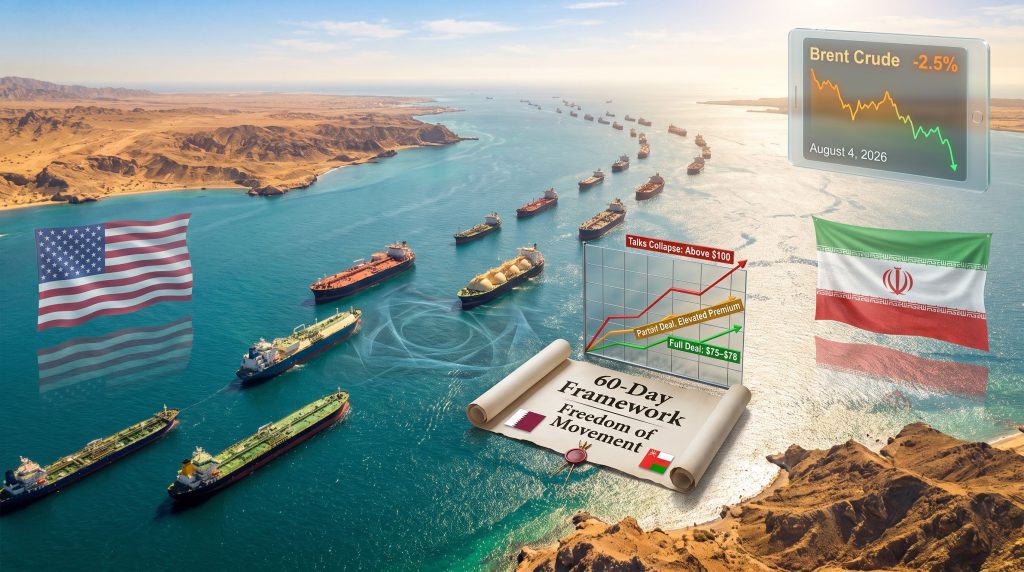
The market's sensitivity to developments in the strait has been on full display throughout the current conflict. Brent crude was trading near $82 per barrel in early August 2026, reflecting a substantial geopolitical risk premium built up since the onset of hostilities in late February 2026. When Treasury Secretary Scott Bessent publicly indicated that a deal could be reached within days, oil markets responded immediately, with Brent falling approximately 2.5% within a single session.
That magnitude of price movement on a single diplomatic statement carries a critical message: markets are tracking this negotiation with extreme precision, and they remain highly reactive to signals in either direction. A confirmed agreement would likely produce further downward pressure on oil, while any collapse in talks or escalation toward major military strikes could send Brent significantly above current levels. Indeed, oil market volatility of this nature has become a defining feature of the current geopolitical environment, with some scenario models placing the ceiling above $100 per barrel.
The speed and scale of Brent's reaction to Bessent's comments illustrates how much geopolitical risk premium has been baked into current oil pricing. Even partial diplomatic progress is now a market-moving event.
The Proposed Short-Term US-Iran Deal: Structure and Known Terms
Breaking Down the Interim Memorandum of Understanding
The arrangement being negotiated is explicitly described as a temporary memorandum of understanding, not a comprehensive peace treaty. Its core function is to pause active hostilities, restore minimum commercial functionality to the strait, and open a structured window for broader negotiations. The following table outlines the reported components of the proposed deal:
| Deal Component | Reported Detail |
|---|---|
| Strait Access | Commercial vessels permitted to transit without toll charges |
| Duration | Reported as either a two-week ceasefire or a 60-day MOU framework |
| Sanctions Relief | Partial waiver of existing sanctions; frozen Iranian assets potentially included |
| Naval Blockade | U.S. blockade of Iranian ports to be progressively lifted |
| Follow-On Talks | 60-day window for broader discussions including Iran's nuclear programme |
| Toll Structure | U.S. insists on toll-free access; Iran had previously demanded transit fees |
Reporting on the deal's duration varies between sources. Some characterise the arrangement as a two-week ceasefire tied to the physical reopening of the strait, while others describe a 60-day MOU with phased implementation milestones. Both framings treat the agreement as explicitly interim, with a follow-on negotiating process required to reach any durable settlement. According to reporting from the BBC, the framework text itself leaves several critical implementation details unresolved.
The Mine Problem: Why a Signed Deal Doesn't Equal an Open Strait
One of the least-discussed but most consequential obstacles to rapid normalisation is the physical condition of the strait itself. Iran has reportedly mined the so-called middle passage through Hormuz, the primary commercial shipping lane. Clearing these mines is a technical prerequisite for regular commercial transit, but the process involves significant complexity:
- Mine-clearance operations require specialised naval assets and considerable time to execute safely
- Iran may resist international involvement in clearance operations within what it regards as its sovereign maritime zone
- Shipping insurers will likely maintain war-risk surcharges until mine clearance is confirmed and independently verified
- Maritime safety concerns will suppress vessel confidence even after a political agreement is announced
A signed agreement does not equal an open strait. Mine clearance, insurance recalibration, and the gradual rebuilding of shipping operator confidence are independent variables that will determine how quickly traffic volumes actually recover.
A useful leading indicator for genuine implementation progress will be AIS transponder data. Currently, a significant proportion of vessels in the region are operating without active transponders, creating intelligence gaps for market analysts and insurance underwriters alike. Watch for rising AIS visibility as a real-time proxy for deal implementation and returning operator confidence.
The Diplomatic Architecture: Who Is Driving the Negotiation
Qatar's Role as Primary Intermediary
Qatar occupies a uniquely positioned role in this diplomatic process. Its foreign ministry confirmed in early August 2026 that a proposed de-escalation resolution was actively circulating between the parties, though Qatari officials declined to provide a timeline for finalisation. Qatar's combination of economic ties to both Washington and Tehran, its physical proximity to the Gulf dispute zone, and its established back-channel communications infrastructure make it the natural lead mediator.
Critically, Qatar's own LNG export interests give it a direct economic stake in resolution. Every week the strait remains closed represents meaningful revenue disruption for Qatari energy exports. This commercial alignment reinforces Qatar's diplomatic motivation.
Oman's Parallel Operational Track
Separate from the Qatar-led diplomatic channel, Oman has been conducting its own negotiations with Iran focused specifically on the middle passage through the strait. Oman's geographic proximity to the southern shipping lane gives it direct operational relevance that Qatar lacks. Reports from Bloomberg indicate that Muscat and Tehran have been in discussions about restarting shipping traffic through this specific corridor.
The relationship between these two negotiating tracks remains unclear, and the coordination risk between them is a genuine structural concern. A deal framework agreed through Qatar could have different operational implications than the routing arrangements being discussed through Oman, creating potential implementation ambiguity.
The U.S. and Iranian Positions in Detail
The U.S. position, articulated by Bessent on August 4, 2026, centres on two principles: that a deal was achievable within a very short timeframe, and that any access arrangement must guarantee freedom of movement without transit charges. The Trump administration's explicit rejection of toll-based access represents one of the most significant sticking points in the negotiation.
Iran's position is more complex than its public statements suggest. Tehran insists on its sovereign right to manage maritime traffic through the strait, including the authority to deny passage to vessels without Iranian authorisation. A senior Iranian official called on the U.S. to return to the terms of an interim peace agreement reached in June 2026, while military adviser Mohsen Rezaee stated publicly that U.S. naval assets and regional bases faced serious risk if the port blockade was not lifted. However, geopolitical trade disruption of this scale carries consequences for both parties that create mutual pressure to reach an accord.
How the Conflict Reached This Point: A Strategic Timeline
Understanding the current diplomatic moment requires understanding the trajectory that produced it. The following sequence outlines the key escalation milestones:
- Late February 2026: The U.S. initiates military action against Iran, triggering the conflict that drives sustained energy price inflation.
- June 2026: An interim peace agreement is reached between the U.S. and Iran, temporarily reducing tensions.
- July 2026: The June agreement breaks down or is contested, leading to renewed impasse over Hormuz access and Iranian mining of the middle passage.
- Late July 2026: Bloomberg reports active Oman-Iran talks focused on restarting shipping through the strait's middle passage.
- Weekend of August 2-3, 2026: The Trump administration holds back from launching what were described as potentially the largest U.S. strikes since World War II, with Israel reportedly prepared to participate.
- August 4, 2026: Bessent publicly signals deal optimism; Qatar confirms a de-escalation proposal is circulating; Brent crude drops 2.5%.
The Midterm Election Factor
A dimension of this negotiation that deserves more analytical attention than it typically receives is the U.S. domestic political calendar. The November 2026 midterm elections create a structural deadline that is directly shaping the administration's negotiating urgency. Elevated energy prices resulting from the Hormuz closure have translated into tangible economic pain for American consumers, undermining Republican electoral positioning in a way that economic data makes difficult to obscure.
This political pressure compresses the diplomatic timeline and may explain both Bessent's unusually public optimism and the administration's apparent willingness to signal concessions. The risk, however, is that political deadlines produce agreements optimised for announcement value rather than durability. Consequently, the oil price crash dynamics already experienced in recent years add further electoral urgency to reaching a viable resolution.
Scenario Analysis: Three Pathways and Their Market Implications
Mapping the Possible Outcomes
| Scenario | Brent Crude Trajectory | LNG Market Impact | Normalisation Timeline |
|---|---|---|---|
| Full deal signed, strait reopens | Retracement toward $75-$78 range | Moderate easing over 4-8 weeks | 4-8 weeks post-clearance |
| Talks collapse, major U.S. strikes | Potential spike above $100 | Severe disruption, acute pressure | Indefinite |
| Partial deal, restricted reopening | Elevated with reduced premium | Partial relief, surcharges persist | 8-16 weeks |
Scenario 1 represents the base case that markets are partially pricing. Even under this outcome, investors should anticipate volatility during the transition period rather than an immediate price normalisation, given the mine-clearance requirements and shipping confidence rebuilding that must occur independently of any political agreement.
Scenario 2 carries the most severe market implications, with Gulf Arab energy infrastructure facing direct risk that could compound supply disruptions beyond the strait itself. Iran has demonstrated throughout the conflict that it possesses both the capability and the willingness to cause significant damage to Gulf Arab states including Kuwait, Bahrain, Saudi Arabia, and the UAE.
Scenario 3 is arguably the most underappreciated risk. A narrow or ambiguous deal that provides only partial access would sustain an elevated risk premium in oil markets while creating false confidence that could be rapidly reversed by any implementation failure. In addition, geopolitical oil risks of this nature have historically proven far more persistent than initial diplomatic optimism suggests.
The next major ASX story will hit our subscribers first
The Unresolved Fault Lines That Could Derail Any Agreement
Four Structural Obstacles to a Durable Deal
The transit fee dispute remains the most publicly visible sticking point. Iran's insistence on toll-based access versus the U.S. commitment to toll-free movement represents a fundamental disagreement about the economic architecture of strait governance, not merely a negotiating position that can be split down the middle.
Mine clearance logistics introduce a technical complexity that diplomacy alone cannot resolve. The middle passage cannot safely reopen without a physical clearance operation, and Iran's probable resistance to international involvement in that process creates a timeline problem that persists even after a political agreement is reached.
Sanctions architecture introduces U.S. domestic political complexity. Any meaningful sanctions relief for Iran will require navigating Congressional opposition, and the scope of any partial waiver remains undefined in public reporting. Iran needs to understand precisely what it receives in exchange for strait access, and that clarity has not yet been established.
Nuclear programme linkage is the deepest structural problem. The 60-day follow-on negotiating framework is explicitly connected to Iran's nuclear activities, historically one of the most intractable issues in U.S.-Iran relations. As detailed analysis from the Council on Foreign Relations makes clear, historical precedent from the JCPOA negotiations demonstrates that nuclear-related frameworks typically require years, not weeks, to finalise. A 60-day window is extraordinarily compressed for issues of this complexity.
Frequently Asked Questions: The Short-Term US-Iran Deal on the Strait of Hormuz
What exactly is the proposed short-term US-Iran deal on the Strait of Hormuz?
The proposed arrangement is a temporary memorandum of understanding designed to reopen the strait to commercial shipping, pause active hostilities, and create a structured 60-day window for broader negotiations. It functions as a conflict pause mechanism rather than a comprehensive resolution framework.
Why do oil prices react so sharply to Hormuz developments?
The strait channels approximately 20% of global oil supply and major LNG flows. Its effective closure embeds a structural risk premium into global energy pricing. Even partial diplomatic signals are sufficient to move Brent crude by multiple percentage points within a single session.
What is Qatar's specific role in the negotiations?
Qatar is serving as the primary diplomatic intermediary between Washington and Tehran, leveraging its established back-channel communications and its neutral Gulf state positioning. Its foreign ministry confirmed in early August 2026 that a de-escalation proposal was being circulated between the parties.
Could the strait reopen immediately after a deal is signed?
No. Mine clearance of the middle passage, insurance market recalibration, and the gradual rebuilding of shipping operator confidence are all independent variables that operate on timelines separate from any political agreement. Full traffic normalisation is likely to take four to eight weeks at minimum even under an optimistic scenario.
What happens to the deal after the initial period expires?
The interim arrangement is explicitly designed to create space for a 60-day follow-on negotiation covering Iran's nuclear programme and broader security architecture. Whether those talks can produce a durable framework is the central strategic question, and historical precedent from U.S.-Iran diplomacy does not provide strong grounds for optimism over such a compressed timeline.
The Strategic Assessment: A Pause, Not a Resolution
The proposed short-term US-Iran deal on the Strait of Hormuz is best understood as a conflict management instrument rather than a conflict resolution mechanism. Its value lies in preventing immediate military escalation and creating diplomatic space. Its limitations lie in the depth of the unresolved issues it defers.
For energy markets, the critical distinction is between price movements driven by genuine supply normalisation and those driven by diplomatic sentiment. The former requires physical reopening, mine clearance, insurance market recovery, and sustained shipping confidence. The latter can reverse as quickly as it develops.
The 60-day negotiating window for nuclear and broader security issues is structurally insufficient for issues of this complexity. The most historically grounded assessment is that the short-term deal, if signed, buys time and reduces immediate escalation risk, but leaves the fundamental drivers of U.S.-Iran tension unresolved. Whether that time is used productively will determine whether 2026 marks the beginning of genuine de-escalation or merely an interlude before the next phase of a protracted conflict.
Disclaimer: This article contains forward-looking analysis, scenario projections, and market assessments that involve significant uncertainty. Energy price forecasts and diplomatic outcome scenarios are not guarantees of future events. Readers should conduct independent research before making any investment or commercial decisions based on geopolitical developments.
Want to Capitalise on the Next Major Commodity Discovery Before the Market Moves?
While geopolitical events like the Strait of Hormuz crisis dominate energy market headlines, significant mineral discoveries on the ASX can offer compelling opportunities entirely independent of oil price volatility — and Discovery Alert's proprietary Discovery IQ model delivers real-time alerts the moment these discoveries are announced, turning complex data across more than 30 commodities into clear, actionable insights. Explore how historic discoveries have generated substantial returns by visiting Discovery Alert's dedicated discoveries page, and begin your 14-day free trial today to position yourself ahead of the broader market.