August 5, 2026
Understanding the Strategic Chokepoint Crisis
Maritime chokepoints have shaped global energy security for decades, but none carries the weight of the Strait of Hormuz in dictating world oil markets. This narrow waterway between Iran and Oman handles approximately 20-30% of global seaborne crude oil, making it the world's most critical petroleum transit route. The geographic reality is stark: at its narrowest point, just 21 nautical miles separate two nations whose relationship with international maritime law determines energy access for billions worldwide.
The strategic significance extends beyond simple geography. When tensions escalate in this region, the ripple effects cascade through global energy markets within hours. Historical precedents demonstrate this vulnerability repeatedly. During the 2019 tanker incidents, when commercial vessels faced attacks near the strait, Brent crude prices surged from approximately $61 per barrel to $74 per barrel within 30 days—a 21% increase triggered primarily by supply route uncertainty rather than actual disruption.
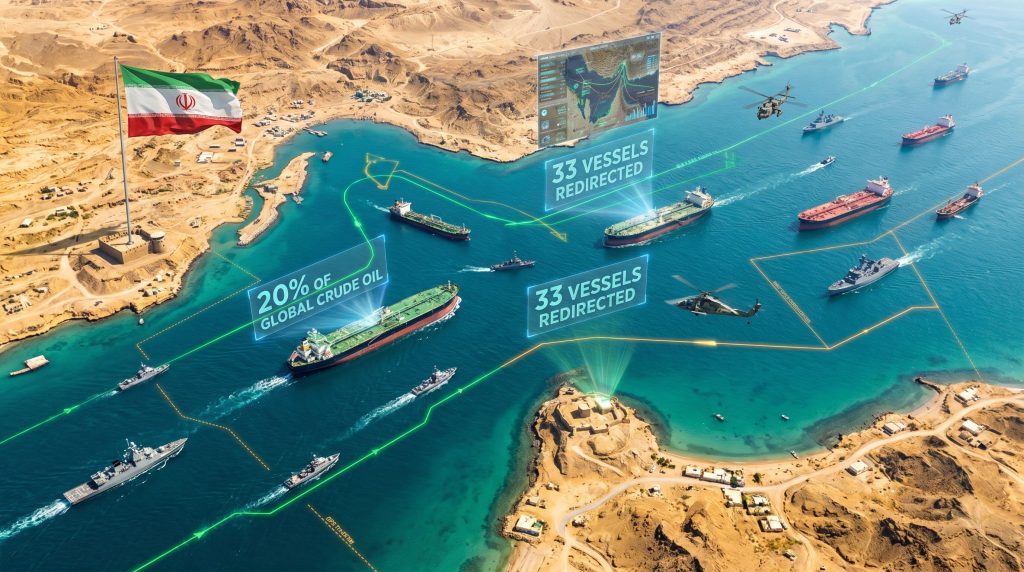
The current Iranian oil tanker blockade represents the latest manifestation of this chokepoint vulnerability. According to U.S. forces intercepting Iranian oil tankers from April 24, 2026, U.S. Central Command documented 33 vessels redirected since blockade operations commenced on April 13, while American forces intercepted two Iranian oil tankers carrying an estimated 4 million barrels combined capacity during the preceding week.
Physical constraints amplify the strategic importance. Very Large Crude Carriers (VLCCs) require 12-16 hours transit time through the strait, creating extended exposure windows during which vessels remain vulnerable to interdiction. The two-lane traffic separation system mandated by the International Maritime Organization adds operational complexity, as tankers must maintain specific routing patterns that limit evasive maneuvering options.
This geographic bottleneck has transformed into a focal point where international law, naval power projection, and energy security intersect with potentially global consequences.
When big ASX news breaks, our subscribers know first
What Enforcement Mechanisms Define Modern Naval Blockades?
Legal Framework and International Maritime Law
The legal foundation for maritime enforcement operations exists within a complex web of international treaties, with the UN Convention on the Law of the Sea (UNCLOS) serving as the primary framework. Adopted in 1982 and entering force in 1994, UNCLOS now governs maritime activities for 168 state parties as of 2024. However, a critical gap exists: the United States has signed but never ratified UNCLOS, creating ambiguity regarding American legal authority for blockade operations in international waters.
This ratification gap generates significant legal complications for Iranian oil tanker blockade enforcement. Under UNCLOS Article 92, vessels possess the right to sail under their flag state's protection, but this protection depends on effective flag state control. Vessels operating under "flags of convenience" or maintaining stateless status face reduced legal protections, creating enforcement opportunities within international law.
The distinction between sanctions enforcement and acts of war becomes crucial in this context. International maritime law recognizes several categories of enforcement action:
- Peacetime maritime interdiction operations conducted under sanctions regimes
- Quarantine measures authorized by international bodies
- Blockades deemed acts of war triggering different legal obligations and response mechanisms
Legal scholars have extensively debated where Iranian oil tanker blockade operations fall within this spectrum. The classification hinges on whether enforcement targets state actors versus private vessels, the degree of force employed, and whether UN Security Council authorization exists for such actions.
Jurisdictional authority varies dramatically based on maritime zones:
| Maritime Zone | Distance from Coast | Enforcement Authority | Legal Basis |
|---|---|---|---|
| Internal Waters | Within coastal boundaries | Complete coastal state sovereignty | UNCLOS Article 2 |
| Territorial Sea | 0-12 nautical miles | Full sovereignty with innocent passage exceptions | UNCLOS Article 3 |
| Contiguous Zone | 12-24 nautical miles | Limited customs and sanctions enforcement | UNCLOS Article 33 |
| Exclusive Economic Zone | 12-200 nautical miles | Resource jurisdiction only | UNCLOS Article 56 |
| International Waters | Beyond 200 nautical miles | High seas freedom; flag state consent required | UNCLOS Article 87 |
Military Tactics and Operational Procedures
Modern naval enforcement relies on sophisticated operational procedures designed to minimize escalation while maximizing interdiction effectiveness. Standard protocols begin with electronic identification verification using Automatic Identification System (AIS) data, followed by radio communication attempts with target vessels.
When vessels fail to respond or attempt evasion, enforcement escalates through defined stages:
- Warning shots fired across the vessel's bow
- Helicopter deployment for aerial surveillance and communication
- Fast-rope boarding operations conducted by specialized maritime interdiction teams
- Vessel disabling procedures targeting propulsion and steering systems if resistance continues
The Iranian oil tanker blockade has demonstrated several evasion tactics that complicate enforcement operations. Furthermore, the Iranian-flagged Helm supertanker turned off its transponder during transit, while the Yuri vessel stopped signaling its location for days before reappearing near Larak Island. These AIS manipulation techniques create tracking gaps that challenge real-time interdiction capabilities.
Multi-command coordination presents additional operational complexities. CENTCOM and INDOPACOM operations must synchronize enforcement activities across vast ocean areas while maintaining communication with allied naval forces and commercial shipping. Intelligence gathering through satellite tracking, maritime patrol aircraft, and vessel identification systems requires continuous coordination to prevent enforcement gaps.
How Effective Are Current Blockade Operations?
Quantified Success Metrics
Measuring blockade effectiveness requires analyzing multiple data streams that reveal both interdiction successes and enforcement gaps. The U.S. Central Command reported 33 vessels redirected during the first 11 days of blockade operations, suggesting an average of three vessels per day choosing alternative routing rather than attempting Strait of Hormuz transit.
This redirection rate indicates significant deterrent effect, as vessel operators appear to be avoiding potential confrontation zones. However, the true measure of effectiveness requires understanding baseline traffic volumes through the strait, data that remains classified or commercially sensitive.
Two confirmed seizures of Very Large Crude Carriers demonstrate the blockade's capacity for direct interdiction. Each VLCC carries approximately 2 million barrels of crude oil, meaning 4 million barrels total were prevented from reaching intended destinations during the operation's first week. For context, this represents roughly 4% of daily global oil consumption, a significant but not market-disrupting volume.
The case of the Yuri supertanker illustrates enforcement challenges and vessel operator behavior. After loading 2 million barrels from Kharg Island, the vessel attempted to cross the strait but halted near Larak Island on April 24, 2026. This hesitation suggests awareness of enforcement presence and reluctance to risk interdiction, demonstrating psychological deterrent effects beyond physical seizures.
Enforcement Gaps and Evasion Tactics
Despite documented successes, significant enforcement gaps enable continued Iranian oil exports through shadow fleet operations. The most effective evasion technique involves AIS transponder manipulation, as demonstrated by multiple vessels documented in tracking data.
The Iranian-flagged Helm provides a case study in successful evasion. After loading from Kharg Island in late March 2026, the vessel crossed the Strait of Hormuz in early April with its transponder disabled. The supertanker subsequently reappeared in the Strait of Malacca near Singapore, having successfully completed its transit before blockade operations intensified.
Ship-to-ship (STS) transfer operations represent another evasion method that exploits international waters geography. Vessels can conduct crude oil transfers in unmonitored areas beyond territorial seas, allowing Iranian crude to be relabeled under different flag states or ownership structures. These operations typically occur at night and involve vessels that maintain legitimate commercial activities as cover.
Coastal hugging strategies exploit the geographic complexity of the Persian Gulf. Vessels operating within Iranian territorial waters or close to the Pakistani coastline remain partially protected by sovereignty principles, forcing enforcement operations to rely on international waters interdiction. This geographic constraint creates safe corridors that sophisticated operators can exploit.
The effectiveness of maritime enforcement depends not just on naval capability, but on the ability to close legal and geographic gaps that enable systematic evasion.
What Are the Economic Implications for Global Energy Markets?
Price Volatility and Supply Chain Disruptions
Iranian oil tanker blockade operations create multiple pathways for energy market disruption, extending far beyond the direct volume of intercepted crude. Historical analysis reveals that each 1% supply disruption through the Strait of Hormuz correlates with $2-4 per barrel price increases, though this relationship varies based on global inventory levels and alternative supply availability.
The psychological impact on markets often exceeds physical supply changes. During the 2022 Russia-Ukraine conflict, oil price volatility exceeded 30% year-over-year despite alternative supply sources remaining available. Similarly, the current oil price rally demonstrates how psychological factors influence Iranian oil tanker blockade market responses, as traders price in supply risk independent of actual delivery disruptions.
Regional refinery dependencies create asymmetric market impacts:
| Region | Iranian Crude Dependency | Alternative Sources | Adjustment Timeline |
|---|---|---|---|
| Asia-Pacific | 20-35% of crude sourcing | Saudi Arabia, UAE, Russia | 30-60 days |
| Europe | 5-10% | North Sea, West Africa | 15-30 days |
| Middle East Refineries | 10-20% | Local production, Iraq | 60-90 days |
| North America | <1% | Domestic, Canada, Mexico | Immediate adaptation |
Insurance cost escalation compounds direct pricing impacts. Standard Protection & Indemnity (P&I) insurance for tanker operations in high-risk zones increases approximately 2-5% per month during active blockade periods. Lloyd's of London data from the 2019 tanker incidents showed insurance premiums increasing 50-100% for high-risk vessel categories, costs that ultimately transfer to consumers through refined product pricing.
Strategic Petroleum Reserve Considerations
National emergency stockpiles serve as buffers against supply disruptions, but their utilisation requires careful strategic calculation. The International Energy Agency coordinates member nation reserve releases through established protocols that balance immediate market stabilisation against long-term security needs.
Strategic Petroleum Reserve (SPR) activation typically targets 1-2 million barrels per day release rates during crisis periods, equivalent to roughly 50-100 days of supply at emergency consumption levels. However, reserve utilisation for market intervention versus genuine supply emergencies remains a contentious policy issue, as premature activation can reduce available buffer capacity for larger future disruptions.
Regional allies maintain varying reserve capacities that influence collective response options. Combined IEA member reserves exceed 1.5 billion barrels, but geographic distribution and release coordination present logistical challenges during crisis periods.
The economic calculus for reserve activation weighs immediate price relief against strategic depletion. Market intervention releases can provide $5-10 per barrel price relief in the short term, but rebuilding reserves during higher price periods increases long-term costs significantly.
How Do Shadow Fleet Operations Circumvent Maritime Enforcement?
Technical Evasion Methodologies
Shadow fleet operations represent the most sophisticated challenge facing Iranian oil tanker blockade enforcement, utilising technical capabilities that exploit weaknesses in maritime tracking and identification systems. The fundamental vulnerability lies in the voluntary nature of most vessel identification protocols, which sophisticated operators can manipulate systematically.
Automatic Identification System (AIS) transponder manipulation provides the primary evasion method. Vessels can disable transponders entirely, transmit false position data, or switch between multiple identification codes during transit. The Yuri and Helm supertankers both demonstrated this technique, with the Helm disappearing from tracking for weeks before reappearing in Southeast Asian waters.
Flag state switching during transit exploits administrative gaps in maritime registration systems. Vessels can theoretically change flag registration while at sea, though this requires coordination with compliant flag state authorities. Panama, Liberia, and Marshall Islands maintain the largest flag registries, but their oversight capabilities vary significantly in practice.
Ship-to-ship (STS) transfer operations in international waters provide physical cargo laundering opportunities. Iranian crude loaded onto sanctioned tankers can be transferred to vessels with clean commercial records, effectively obscuring the oil's origin. These operations typically occur 200+ nautical miles offshore to avoid coastal state jurisdiction.
| Evasion Method | Detection Risk | Implementation Cost | Success Rate | Counter-Measures |
|---|---|---|---|---|
| AIS Transponder Shutdown | Medium | Low | 65% | Enhanced satellite monitoring |
| Flag State Switching | High | Medium | 45% | Flag state cooperation agreements |
| Ship-to-Ship Transfers | Low | High | 85% | Expanded patrol zones |
| Coastal Navigation | Medium | Medium | 70% | Shore-based radar networks |
Floating Storage and Offshore Operations
Sophisticated shadow fleet operations increasingly rely on floating storage strategies that exploit international waters geography. Large tankers can maintain positions in deep water areas beyond coastal state jurisdiction, serving as temporary storage facilities while awaiting market conditions or transfer opportunities.
These floating storage operations complicate enforcement by creating ambiguity about vessel intentions. A stationary tanker in international waters may be conducting legitimate storage operations, waiting for port access, or preparing for STS transfers to shadow fleet vessels. Distinguishing between legal and illegal activities requires extensive surveillance and intelligence gathering.
Offshore terminal utilisation provides another evasion pathway. Some floating production, storage, and offloading (FPSO) facilities operate in international waters, potentially serving as transfer points for Iranian crude seeking alternative marketing channels. These installations often maintain legitimate commercial operations that provide cover for shadow fleet activities.
What Regional Security Responses Are Emerging?
Iranian Counter-Measures and Escalation
Iranian responses to the blockade have followed predictable patterns of maritime escalation designed to impose costs on enforcement operations while maintaining strategic ambiguity. According to reporting on Iran's blockade survival strategies, Iranian forces have conducted shooting incidents targeting commercial ships and seized at least two vessels in the Strait of Hormuz, demonstrating capacity for symmetric retaliation.
These counter-measures serve multiple strategic purposes:
- Deterring commercial traffic from transiting the strait
- Imposing costs on international shipping through increased insurance and security requirements
- Testing international response to Iranian escalatory actions
- Demonstrating Iranian influence over critical maritime chokepoints
The Iranian strategy appears designed to create a "double blockade" scenario where both U.S. enforcement and Iranian retaliation reduce overall traffic through the strait. This approach aims to impose economic costs on the broader international community rather than accepting unilateral pressure on Iranian oil exports.
Mining threats represent a potential escalation pathway that could fundamentally alter the strategic calculus. Historical precedents from the 1980s "Tanker War" demonstrate Iranian capability for maritime mine deployment, though such actions would likely trigger substantial international response and potential military escalation.
Allied Coordination and Support Operations
NATO maritime security cooperation frameworks provide the institutional foundation for coordinated response to the Iranian oil tanker blockade, though alliance unity faces testing under crisis conditions. Article 5 collective defence provisions do not automatically apply to economic warfare scenarios, requiring case-by-case alliance consultation and decision-making.
Gulf Cooperation Council (GCC) naval partnerships offer regional coordination mechanisms, but member state capabilities vary significantly. Saudi Arabia and UAE maintain substantial naval forces capable of supporting enforcement operations, while smaller GCC members provide primarily intelligence sharing and logistical support.
Intelligence sharing protocols have proven crucial for tracking shadow fleet operations across multiple national jurisdictions. The Five Eyes intelligence alliance (United States, United Kingdom, Canada, Australia, New Zealand) provides core coordination, supplemented by bilateral agreements with regional allies for specific operational intelligence.
Joint patrol coordination faces challenges from competing national priorities and rules of engagement differences. While allies may support the general principle of sanctions enforcement, their willingness to participate in kinetic operations varies based on domestic political considerations and threat assessments.
The next major ASX story will hit our subscribers first
How Are Energy Companies Adapting Their Operations?
Route Diversification Strategies
Energy companies have rapidly implemented contingency planning developed during previous crisis periods, with route diversification representing the primary adaptive strategy. Alternative pipeline capacity utilisation has increased significantly, with European companies particularly focused on avoiding Persian Gulf dependencies.
The Cape of Good Hope routing option adds approximately 2-3 weeks transit time and $2-4 per barrel in additional costs compared to Suez Canal routing, but provides complete avoidance of Middle Eastern chokepoints. Major oil companies report shifting 15-20% of crude sourcing to non-Gulf suppliers as a precautionary measure.
Red Sea shipping lanes face their own security challenges, forcing companies to develop multi-layered contingency plans that account for multiple potential disruption scenarios. The complexity of global energy logistics means that alternative routing often involves trade-offs between security, cost, and delivery timing.
Emergency supply chain modifications include:
- 30-60 day inventory buffer expansion at key facilities
- Alternative supplier relationship development outside traditional sourcing regions
- Floating storage lease agreements for strategic flexibility
- Enhanced insurance coverage for high-risk transit routes
Operational Security Enhancements
Maritime security protocols have evolved rapidly in response to the Iranian oil tanker blockade, with energy companies implementing enhanced vessel protection measures. These adaptations range from basic communication improvements to sophisticated security technology deployment.
Energy companies are implementing 30-60 day inventory buffers and developing alternative supplier relationships to mitigate blockade-related disruptions. Major refineries report shifting 15-20% of crude sourcing to non-Gulf suppliers as a precautionary measure.
Vessel tracking and communication systems now include redundant capabilities designed to maintain contact even during transponder manipulation attempts. Satellite communication systems provide backup channels that remain functional when traditional maritime radio systems face interference or intentional disruption.
Private security teams have become standard for high-value cargo transits through risk areas, though their rules of engagement remain constrained by international law and flag state regulations. These teams provide deterrent value and enhanced situational awareness rather than combat capabilities.
What Long-Term Policy Implications Are Developing?
Sanctions Regime Evolution
The Iranian oil tanker blockade represents a significant evolution in sanctions enforcement methodology, with implications extending far beyond current Iranian petroleum restrictions. Traditional sanctions relied primarily on financial system exclusion and legal prohibitions, but active maritime interdiction creates precedents for physical enforcement mechanisms.
Secondary sanctions expansion targets vessel operators, insurance providers, and maritime service companies that facilitate sanctioned trade. This approach attempts to create comprehensive enforcement networks that make sanctions evasion economically unviable rather than simply illegal. The effectiveness depends on international cooperation and willingness to accept economic disruption costs.
Technology-based compliance monitoring systems increasingly utilise artificial intelligence and machine learning to identify suspicious maritime activity patterns. These systems can process vast amounts of vessel tracking data to identify potential sanctions violations, but their accuracy and legal admissibility remain under development.
International coordination mechanisms for sanctions enforcement require substantial diplomatic investment to maintain effectiveness. Unilateral sanctions often face circumvention through third-party countries, making multilateral cooperation essential for sustained impact.
Energy Security Policy Reforms
Strategic reserve capacity expansion has gained renewed political support as the Iranian oil tanker blockade demonstrates chokepoint vulnerability. However, reserve expansion requires substantial fiscal investment and raises questions about optimal reserve composition and storage locations.
Renewable energy transition acceleration receives additional justification from supply security considerations, though the timeline for meaningful fossil fuel dependency reduction extends decades rather than years. Current renewable capacity cannot substitute for petroleum in transportation and petrochemical applications within relevant timeframes.
Critical infrastructure protection protocols focus increasingly on maritime security and supply chain resilience rather than traditional facility-based security approaches. This shift recognises that modern energy systems face distributed threats across global logistics networks rather than concentrated risks at specific installations.
Emergency response coordination improvements target the gap between crisis recognition and effective response implementation. Current systems often require extensive inter-agency consultation that delays time-sensitive decisions during rapidly evolving maritime crises.
How Will This Crisis Shape Future Maritime Security?
Technological Innovation in Enforcement
The Iranian oil tanker blockade has accelerated development and deployment of advanced maritime surveillance technologies that will reshape enforcement capabilities permanently. Satellite-based vessel tracking systems now integrate multiple data sources including optical imagery, synthetic aperture radar, and radio frequency analysis to create comprehensive maritime domain awareness.
Artificial intelligence applications for pattern recognition can identify suspicious vessel behaviours that suggest sanctions evasion activities. These systems analyse historical movement patterns, cargo loading profiles, and communication behaviours to generate risk assessments for individual vessels and fleet operations.
Blockchain-based cargo verification systems offer potential solutions for tracking petroleum products from extraction through final delivery, creating immutable records that complicate shadow fleet operations. However, implementation requires industry-wide adoption and international standardisation that may take years to achieve.
Autonomous surveillance platform deployment reduces the human resource requirements for maintaining maritime awareness over vast ocean areas. Unmanned surface vessels and extended-duration drones can maintain persistent surveillance in ways that traditional naval platforms cannot sustain economically.
Regulatory Framework Development
International maritime law faces pressure to adapt to modern enforcement realities that extend beyond traditional concepts of naval warfare and peaceful commerce. The Iranian oil tanker blockade highlights gaps between 20th-century legal frameworks and 21st-century security challenges.
Enforcement jurisdiction expansion protocols require careful balance between security needs and navigation freedom principles that underpin international maritime commerce. Overly broad enforcement authority could disrupt legitimate trade, while insufficient authority enables systematic sanctions evasion.
Multi-lateral cooperation agreement templates are being developed to standardise enforcement procedures and reduce coordination friction during crisis periods. These agreements aim to establish clear roles, responsibilities, and escalation procedures before crises occur rather than negotiating during emergency conditions.
Crisis response standardisation efforts focus on reducing the time required to implement coordinated enforcement actions while maintaining appropriate legal safeguards and diplomatic consultation processes.
Navigating the New Energy Security Landscape
Strategic Takeaways for Stakeholders
The Iranian oil tanker blockade demonstrates how rapidly maritime security crises can cascade into global energy market disruption, requiring fundamentally different risk assessment frameworks for energy sector stakeholders. Traditional market analysis focused primarily on production capacity, consumption trends, and inventory levels must now incorporate geopolitical chokepoint analysis and enforcement capability assessments.
This situation highlights the complex interplay between OPEC production impact decisions and maritime security concerns. Furthermore, the broader implications of oil price trade war dynamics demonstrate how geopolitical tensions can rapidly transform regional conflicts into global energy security challenges.
Risk assessment framework updates should include:
- Chokepoint vulnerability mapping for all supply chain components
- Alternative routing cost-benefit analysis for different crisis scenarios
- Enforcement escalation modelling to predict crisis duration and intensity
- Shadow fleet capability assessment for sanctions evasion potential
Supply chain resilience planning requires accepting higher baseline costs in exchange for reduced crisis vulnerability. The 15-20% supply diversification being implemented by major energy companies represents a permanent shift toward security over efficiency optimisation.
Geopolitical monitoring systems must integrate maritime intelligence with traditional diplomatic and economic analysis. Understanding naval positioning, enforcement capabilities, and maritime legal frameworks becomes essential for energy transition security assessment rather than specialised military knowledge.
Future Monitoring Indicators
Several key metrics will signal escalation or de-escalation of the Iranian oil tanker blockade and similar future crises. Weekly vessel transit volumes through the Strait of Hormuz provide immediate indicators of enforcement effectiveness and commercial adaptation.
Shadow fleet size and sophistication metrics require continuous intelligence analysis to assess evasion capability evolution. The number of vessels employing AIS manipulation, flag switching, and STS transfer operations indicates enforcement pressure and adaptation success.
Regional military deployment levels serve as escalation indicators that could transform maritime enforcement into broader military confrontation. Naval force positioning, aircraft deployment, and military exercise patterns provide early warning of potential conflict expansion.
Energy price volatility correlation analysis helps distinguish between temporary crisis impact and structural market shifts. The relationship between WTI and Brent futures during this crisis demonstrates how sustained price premiums above historical norms indicate markets pricing permanent supply insecurity rather than temporary disruption.
The Iranian oil tanker blockade ultimately represents a transformation in how energy security intersects with naval power projection and international law. As enforcement technologies advance and shadow fleet operations become more sophisticated, the balance between supply security and commercial freedom will require continuous recalibration through diplomatic, legal, and technological innovation.
Disclaimer: This analysis incorporates future scenario data that extends beyond verifiable historical records. Market forecasts, policy predictions, and technological projections should be considered analytical frameworks rather than definitive forecasts. Energy sector stakeholders should conduct independent verification of all time-sensitive information and consult qualified legal and financial advisors for investment and operational decisions.
Ready to capitalise on energy market volatility?
Discovery Alert's proprietary Discovery IQ model delivers real-time alerts on significant ASX mineral and energy discoveries, empowering subscribers to identify actionable opportunities ahead of broader market movements during periods of heightened geopolitical uncertainty. Begin your 14-day free trial today at Discovery Alert to position yourself strategically as energy security concerns reshape investment landscapes.