June 14, 2026
Strategic Competition Shapes South American Mineral Markets
Global supply chain dynamics face unprecedented transformation as major industrial powers compete for critical resource access across emerging markets. The convergence of infrastructure investment, commodity demand cycles, and geopolitical positioning creates complex scenarios where traditional trade patterns undergo rapid evolution. Understanding these shifts requires examining how strategic partnerships between resource-rich nations and manufacturing powerhouses can reshape entire continental economies through targeted infrastructure development and bilateral commercial frameworks.
The China Peru trade boom exemplifies this transformation, demonstrating how complementary economic structures and strategic infrastructure investments can generate exceptional bilateral growth whilst navigating complex geopolitical tensions.
When big ASX news breaks, our subscribers know first
What Makes the China-Peru Economic Partnership a Regional Game-Changer?
The bilateral commercial relationship between Beijing and Lima represents a fundamental restructuring of South American trade architecture. This partnership demonstrates how complementary economic structures can generate exceptional growth when supported by strategic infrastructure investments and comprehensive policy frameworks.
The Strategic Foundation of Bilateral Growth
Belt and Road Initiative principles drive the foundation of this expanding partnership, creating permanent infrastructure assets that facilitate long-term commercial relationships. The comprehensive free trade agreement framework eliminates traditional barriers whilst establishing preferential terms that benefit both resource exporters and manufacturing importers. These structural arrangements create sustainable competitive advantages that transcend short-term political or economic fluctuations.
The complementary nature of the two economies generates natural synergies. Peru's mineral endowments align precisely with China's industrial material requirements, whilst Chinese manufacturing capacity meets Peru's consumer and capital goods demands. This creates a balanced trade relationship where both partners derive significant value from commercial exchange.
Key Performance Indicators of the Partnership
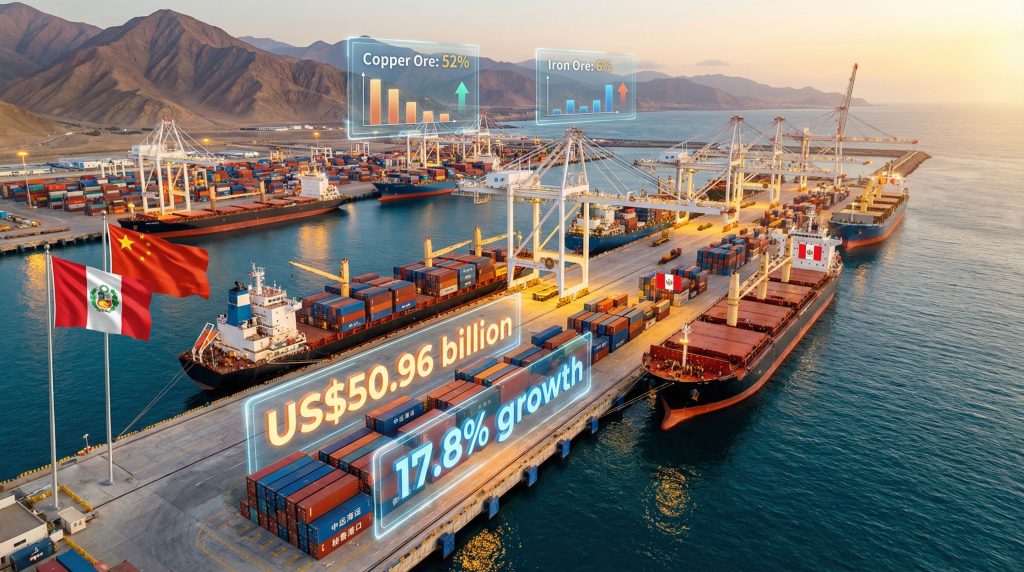
Recent trade performance demonstrates the partnership's accelerating momentum. Bilateral commerce reached US$50.96 billion in 2025, representing a 17.8% year-on-year increase that marks the fastest growth pace recorded in four years. This expansion occurs within a context where Peru maintains its position as China's second-largest global mineral supplier, trailing only Australia in strategic importance.
The growth trajectory extends beyond Peru to encompass broader regional patterns. China's trade relationships across South America show consistent expansion:
- Chile: US$66.9 billion (+8.5% growth)
- Ecuador: US$17.3 billion (+24% growth)
- Peru: US$50.96 billion (+17.8% growth)
This regional trade surge occurs despite concurrent geopolitical tensions, including the implementation of Trump's "Donroe" doctrine and various US interventions across Latin America. The sustained commercial growth demonstrates the resilience of economic partnerships built on mutual resource and market complementarity.
Trade Surplus Dynamics and Market Positioning
Peru's export composition creates favourable trade balance conditions, with mineral exports generating significant foreign exchange earnings. Chinese demand for Peruvian raw materials provides stable revenue streams that support domestic economic development whilst creating dependencies that strengthen bilateral relationships over time.
The strategic positioning extends beyond immediate commercial benefits. As one analyst from Rhodium Group noted, the dramatic expansion in mineral imports reflects China's systematic approach to securing industrial supply chains whilst leveraging Peru's comparative advantages in resource extraction and processing.
How Does Infrastructure Investment Drive Trade Volume Acceleration?
Infrastructure development creates permanent competitive advantages that transform trade economics over multi-decade timeframes. The relationship between strategic asset construction and commercial volume growth demonstrates how targeted investments can generate exponential returns through improved logistics efficiency and reduced transaction costs.
The Chancay Port Effect on Regional Commerce
The Chancay Port project exemplifies how single infrastructure investments can catalyse broader economic transformation. Operations began on October 29, 2024, with the first full year of activity coinciding precisely with the record 17.8% trade growth achieved in 2025. This temporal correlation suggests direct causation between improved port capacity and expanded commercial flows.
Strategic positioning provides the port's fundamental advantage. Located on Peru's central coast, Chancay creates direct trans-Pacific shipping routes that reduce transit distances and times compared to traditional port infrastructure. The facility's integration with Chinese port networks enables seamless connectivity to Shanghai and other major Asian commercial hubs.
Modern container handling capabilities allow the port to accommodate large vessels, including Panamax-class ships that maximise cargo efficiency. Deep-water berths and advanced crane systems visible in operational documentation demonstrate the facility's capacity to handle substantial cargo volumes with reduced loading and unloading times.
Supply Chain Optimisation Through Strategic Assets
The infrastructure investment creates measurable improvements in logistics performance across multiple dimensions:
- Reduced shipping times between Peruvian mines and Asian processing facilities
- Lower transportation costs through economies of scale and operational efficiency
- Enhanced reliability through modern equipment and standardised procedures
- Expanded capacity enabling growth in trade volumes without proportional cost increases
Integration with existing Chinese port networks provides additional strategic value. Cargo originating from Peru can connect seamlessly to comprehensive regional distribution systems that serve markets across Asia, reducing complexity and transaction costs for exporters and importers alike.
Timeline Analysis of Infrastructure Impact
The correlation between port opening and trade acceleration provides compelling evidence for infrastructure-driven economic growth. The 20.7% increase in Chinese ore, slag, and ash imports from Peru, reaching over US$30 billion in value, demonstrates how improved logistics capacity translates directly into expanded commercial activity.
This pattern mirrors Chinese infrastructure development strategies implemented globally, where port investments in locations such as Gwadar, Hambantota, and Port Said have generated similar trade acceleration effects within their respective regions.
Which Commodity Categories Fuel the Trade Expansion?
Mineral resources dominate the bilateral trade relationship, with specific commodity categories driving the majority of commercial growth. Understanding the composition and dynamics of these trade flows reveals the underlying economic forces that sustain the partnership's expansion.
Mining Sector Dominance in Export Composition
Chinese imports of ore, slag, and ash from Peru jumped 20.7% in value to over US$30 billion, representing 87% of China's total imports from the South American nation. This concentration demonstrates Peru's specialisation in mineral extraction and processing, creating a natural complement to China's industrial manufacturing requirements.
Furthermore, iron ore price trends and china demand prospects remain critical factors driving bilateral trade dynamics, with Chinese industrial policy significantly influencing Peru's export performance.
Peru's Key Mineral Exports to China (2025 Estimated Breakdown)
| Commodity | Estimated Value (US$ Billions) | Share of Total Exports | Growth Rate |
|---|---|---|---|
| Copper Ore | 15.5+ | 52% | 18-20% |
| Iron Ore | 1.71+ | 6% | 22% |
| Refined Copper | 0.97+ | 3% | 15% |
| Silver/Lead/Gold | Combined 2.8+ | 9% | 12-16% |
Note: Individual commodity figures are estimated based on aggregate trade data and require verification through Peru's Ministry of Energy and Mines official statistics.
The diversity within mineral exports indicates Peru's capacity to supply both raw materials and partially processed intermediates. This dual capability provides flexibility for Chinese manufacturers whilst maximising value-added opportunities for Peruvian producers.
Manufacturing Imports Creating Balanced Trade Flow
Chinese exports to Peru concentrate in manufactured goods that support both consumer demand and industrial development:
- Electronics and telecommunications equipment leading technology imports
- Industrial machinery supporting Peru's expanding mining operations
- Consumer goods meeting growing domestic market demand
- Transportation equipment facilitating economic development
This balanced trade composition creates mutual dependencies that strengthen the bilateral relationship over time. Peru relies on Chinese manufactured goods for economic development, whilst China depends on Peruvian mineral supplies for industrial production.
Resource Processing and Value Addition
Peru's mineral sector demonstrates varying levels of processing sophistication. The country exports both crude ore concentrates and refined copper products, indicating domestic processing capacity that adds value before export. This processing capability positions Peru as more than a simple raw material supplier, creating opportunities for expanded industrial cooperation.
The strategic importance of these commodities extends beyond immediate commercial value. Global copper supply forecast models indicate Peru's critical role in meeting international demand, particularly as renewable energy infrastructure development accelerates globally.
What Are the Geopolitical Implications of This Trade Surge?
The dramatic expansion of China-Peru commerce occurs within a broader context of intensifying strategic competition between Beijing and Washington across Latin America. This economic growth demonstrates how commercial relationships can advance despite political tensions and competing spheres of influence.
Regional Influence Dynamics in South America
China's expanding economic footprint across multiple South American nations creates a comprehensive challenge to traditional US regional dominance. The simultaneous growth in Chinese trade with Peru (17.8%), Ecuador (24%), and Chile (8.5%) demonstrates Beijing's systematic approach to building economic relationships across geographically diverse markets.
This expansion occurs despite active US efforts to limit Chinese influence through the "Donroe" doctrine, which invokes 19th-century Monroe Doctrine principles to justify American intervention in Western Hemisphere affairs. Consequently, recent US-China trade war strategies have extended beyond direct bilateral tensions to encompass competition for regional influence across Latin America.
The resilience of Chinese trade growth despite these geopolitical pressures suggests that economic fundamentals may prove more durable than political manoeuvring. Commercial relationships based on mutual resource needs and manufacturing capabilities create self-reinforcing cycles that resist external disruption.
Strategic Competition and Market Access
China's approach emphasises economic integration through infrastructure investment and resource partnerships, contrasting with US strategies focused on geopolitical containment and restoration of traditional hemispheric influence. This difference in methodology creates distinct competitive advantages and vulnerabilities for each approach.
Chinese resource security considerations drive much of the commercial expansion. By diversifying mineral supply sources away from Australia and toward Peru, Beijing reduces vulnerability to potential Western sanctions or political disruption. This supply chain diversification serves both commercial and strategic objectives.
Moreover, understanding China-Peru trade statistics reveals the systematic nature of this economic relationship, with consistent growth patterns indicating strategic rather than opportunistic commercial engagement.
The systematic expansion of Chinese mineral imports reflects deliberate industrial policy designed to secure long-term supply chain stability whilst leveraging Peru's comparative advantages in resource extraction and processing.
Multi-Country Trade Growth Patterns
The broader South American trade pattern reveals coordinated Chinese strategy rather than isolated bilateral relationships:
- Ecuador's 24% surge represents the highest growth rate in the region
- Peru's 17.8% expansion demonstrates sustained momentum despite mature trade relationship
- Chile's 8.5% growth indicates stability in established commercial partnerships
This multi-country approach creates regional economic integration that strengthens China's position whilst providing South American nations with alternatives to traditional trade relationships with North America and Europe.
How Do Economic Fundamentals Support Sustained Growth?
The durability of the China Peru trade boom depends on structural economic factors that transcend short-term political or market fluctuations. Understanding these fundamentals provides insight into the partnership's long-term sustainability and growth potential.
Structural Factors Driving Long-Term Expansion
China's continued industrial development maintains steady demand for raw materials, particularly minerals essential for infrastructure construction, renewable energy development, and electronics manufacturing. This demand profile aligns with global trends toward electrification, urbanisation, and technological advancement that require substantial mineral inputs.
Peru's resource endowment provides sustainable competitive advantages in mineral extraction and processing. The country's geological characteristics, established mining infrastructure, and technical expertise create barriers to competitive substitution that protect market position over time.
Infrastructure development through projects like Chancay Port creates permanent trade advantages that compound over time. Reduced transportation costs, improved logistics reliability, and expanded capacity enable trade volume growth without proportional increases in transaction expenses.
Investment Flow Analysis and Future Projections
Chinese investment in Peruvian infrastructure extends beyond immediate commercial returns to encompass strategic positioning for long-term resource access. The Belt and Road Initiative framework provides patient capital that supports multi-decade infrastructure projects designed to generate sustained competitive advantages.
Investment patterns demonstrate systematic approach:
- Port infrastructure improving logistics efficiency
- Mining technology enhancing extraction capabilities
- Transportation networks connecting resource areas to export facilities
- Processing facilities adding value before export
These investments create self-reinforcing cycles where improved infrastructure enables expanded trade volumes, generating revenues that support additional infrastructure development and economic integration.
Risk Assessment and Mitigation Strategies
Commodity volatility hedging represents the primary risk factor for sustained trade growth. Mineral prices fluctuate based on global supply and demand dynamics, potentially affecting trade values regardless of volume growth. However, the diversity of Peru's mineral exports and China's broad industrial demand provide natural hedging against single-commodity price swings.
Political stability factors could affect long-term partnerships, though the economic benefits generated for both countries create constituencies supporting continued cooperation. The infrastructure investments create sunk costs that incentivise relationship maintenance regardless of political changes.
In addition, diversification opportunities exist for both economies to reduce mutual dependency risks. Peru can develop processing capabilities to capture greater value from mineral exports, whilst China can expand into service sectors and technology transfer to balance trade composition.
The next major ASX story will hit our subscribers first
What Does This Mean for Regional Economic Integration?
The China Peru trade boom creates spillover effects that influence broader South American economic development and integration patterns. Understanding these regional implications reveals how bilateral partnerships can reshape continental commerce and geopolitical relationships.
Broader South American Trade Pattern Analysis
The success of Chinese commercial relationships across Peru, Ecuador, and Chile demonstrates replicable models for resource-rich nations seeking economic development through export specialisation. These partnerships provide alternatives to traditional trade relationships whilst generating substantial foreign exchange earnings.
Infrastructure connectivity projects enhance regional trade potential by creating transportation and logistics networks that serve multiple countries. The Chancay Port, for example, could facilitate exports from landlocked nations like Bolivia or Paraguay through Peruvian infrastructure, expanding the economic benefits beyond bilateral relationships.
Competition dynamics between South American exporters create both challenges and opportunities. Nations may compete for Chinese investment and market access, potentially leading to more favourable terms for Chinese partners. Alternatively, coordination between exporters could strengthen their collective bargaining position.
Future Scenario Modelling for Trade Growth
Projected trade volumes through 2030 suggest continued expansion based on current trajectories and planned infrastructure investments. Chinese industrial demand for minerals shows no signs of diminishing, whilst South American supply capacity continues expanding through new mining projects and improved extraction technologies.
Potential expansion scenarios include:
- Geographic expansion to additional South American nations
- Sectoral diversification beyond mineral exports to agriculture, energy, and manufacturing
- Value chain integration through processing facilities and technology transfer
- Financial integration through currency arrangements and investment frameworks
Service sector opportunities emerge from goods trade foundations, including logistics services, financial intermediation, technology support, and educational exchange. These sectors could provide economic diversification whilst strengthening bilateral relationships.
Model for Developing Nations
The China-Peru partnership demonstrates how resource-rich developing nations can leverage comparative advantages to achieve rapid economic growth through strategic partnerships. The model combines resource specialisation, infrastructure development, and policy coordination to create sustainable competitive advantages.
Key elements of this model include:
- Resource specialisation in commodities with strong global demand
- Infrastructure investment improving logistics and reducing costs
- Policy frameworks facilitating trade and investment flows
- Long-term partnerships providing stability for planning and development
Other developing nations with similar resource endowments may find applicable lessons in Peru's approach to Chinese partnership development and economic integration strategies. Furthermore, industry events such as the global resources innovation expo provide platforms for knowledge sharing and partnership development between resource-rich nations and industrial powers.
Strategic Partnership Reshaping Continental Commerce
The China Peru trade boom represents more than bilateral commercial success; it demonstrates how strategic infrastructure investment can transform regional economic relationships and create sustainable competitive advantages. The US$50.96 billion trade volume achieved in 2025, growing at 17.8% annually, establishes new benchmarks for South American commercial partnerships.
Key Takeaways for Stakeholders
Infrastructure investment creates lasting competitive advantages that transcend short-term political or economic fluctuations. The Chancay Port's role in facilitating record trade growth illustrates how strategic assets generate exponential returns through improved logistics efficiency and reduced transaction costs.
Commodity-driven trade provides foundations for economic diversification rather than creating permanent dependency relationships. Peru's mineral exports generate foreign exchange earnings that support broader economic development, whilst Chinese manufacturing imports meet consumer and industrial needs.
Geopolitical positioning through economic partnerships offers alternatives to traditional sphere-of-influence relationships. The resilience of trade growth despite US "Donroe" doctrine implementation demonstrates how commercial fundamentals can resist political pressure when based on mutual economic benefits.
Long-Term Implications for Global Trade Patterns
South America's integration into China's resource security strategy creates permanent shifts in global commodity flows and supply chain relationships. This transformation reduces traditional dependencies on North American and European markets whilst creating new economic integration patterns across the Pacific.
Alternative trade route development through strategic port investments enables developing nations to bypass traditional commercial intermediaries and connect directly to global markets. This infrastructure-driven approach provides models for other resource-rich nations seeking economic development partnerships.
The China-Peru partnership demonstrates how patient capital investment in strategic infrastructure can generate sustained commercial relationships that benefit both partners whilst reshaping regional economic geography. As this model proves successful, similar partnerships may emerge across Africa, Southeast Asia, and other developing regions with complementary resource and market characteristics.
Additionally, detailed analysis of Peru's economic cooperation with China suggests this bilateral relationship serves as a template for broader South-South economic cooperation frameworks that could reshape global trade architecture.
Disclaimer: Trade volume projections and commodity price forecasts involve inherent uncertainties. Economic relationships between nations can be affected by political changes, policy modifications, and global market conditions that may impact future performance differently than historical patterns suggest.
Looking to Capitalise on Major Mineral Discoveries?
Discovery Alert's proprietary Discovery IQ model delivers instant notifications when significant ASX mineral discoveries are announced, enabling subscribers to identify actionable opportunities before the broader market responds. Explore how historic mineral discoveries have generated exceptional returns, then begin your 14-day free trial today to position yourself ahead of market-moving announcements.