June 4, 2026
Strategic Dependencies in Global LPG Markets
Global energy security frameworks increasingly recognise the systemic vulnerabilities embedded within specialised commodity supply chains, particularly those involving liquefied petroleum gas markets across developing economies. India's LPG imports face disruption on Mideast conflict scenarios that highlight fundamental structural weaknesses within current procurement strategies. Unlike diversified crude oil procurement strategies that benefit from multiple sourcing options and extensive spot market mechanisms, LPG distribution networks operate within fundamentally constrained parameters that amplify geopolitical exposure and create cascading economic risks.
The structural architecture of LPG supply chains reveals critical differences from conventional energy import strategies. While crude oil markets maintain approximately 40-50% spot market availability with geographic supplier diversity spanning multiple continents, LPG procurement operates predominantly through bilateral long-term contracts representing 70-80% of market volume. This contractual dominance limits rapid supply reallocation during crisis periods and creates operational dependencies on specialised transportation infrastructure.
Furthermore, recent developments in global trade dynamics, including potential tariff-driven market impacts, compound these structural vulnerabilities by introducing additional layers of complexity to international procurement arrangements.
When big ASX news breaks, our subscribers know first
India's Critical LPG Import Architecture
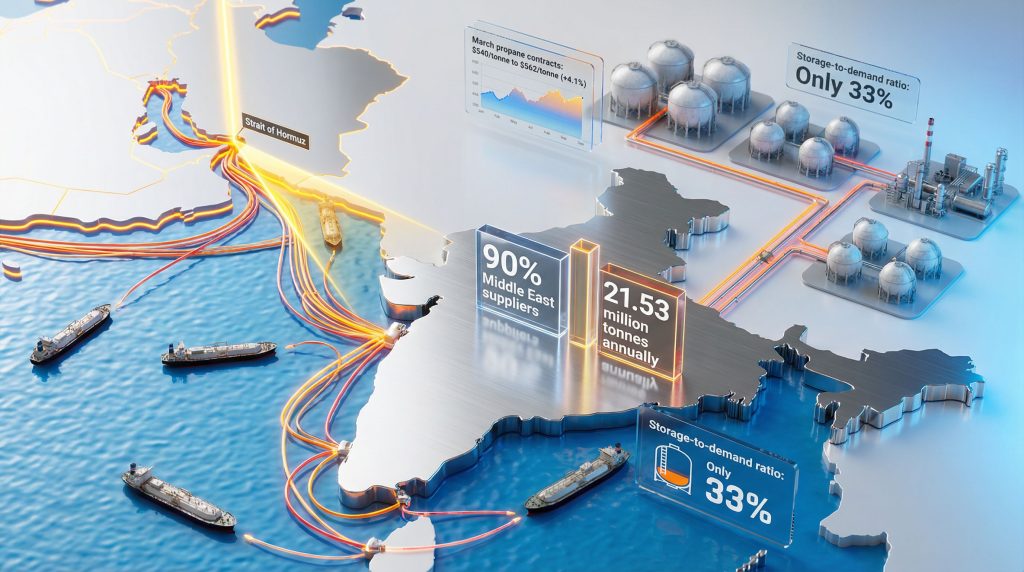
India's LPG supply framework demonstrates extreme geographic concentration that fundamentally differs from diversified energy security models employed by developed economies. The country imports approximately 21.53 million tonnes of LPG annually, with Middle Eastern suppliers accounting for 90% of total import volume. This concentration creates a singular vulnerability point where disruptions to regional supply chains can immediately affect the vast majority of domestic LPG availability.
The Strait of Hormuz represents a critical chokepoint for Indian LPG security, with 95% of Middle Eastern LPG supplies transiting through this narrow maritime corridor. According to satellite tracking data from Vortexa, multiple Very Large Gas Carriers (VLGCs) including state-owned vessels Shivalik, Nanda Devi, and Jag Vasant primarily operate on Middle East-India routes, creating operational inflexibility when alternative sourcing becomes necessary.
Moreover, the situation becomes more complex when considering broader geopolitical tensions, as highlighted by recent analysis of India's strategic energy procurement options during regional conflicts.
Storage Infrastructure Inadequacy
India maintains approximately 1 million tonnes of LPG storage capacity against monthly domestic demand of 3 million tonnes, resulting in a storage-to-demand ratio of only 33%. This compares unfavourably with developed economy standards of 60-90% storage coverage, creating insufficient buffer capacity for supply disruptions exceeding 7-10 days.
The limited strategic reserve infrastructure contrasts sharply with crude oil storage capabilities, where India maintains over 40 days of demand coverage through strategic petroleum reserves. The absence of comparable LPG reserve infrastructure amplifies vulnerability during geopolitical crises or transportation disruptions.
In addition, these structural limitations intersect with broader energy transition challenges that many nations face when balancing security of supply with long-term sustainability objectives.
Fundamental Market Structure Differences
The LPG market operates under distinctly different parameters compared to crude oil procurement, creating unique vulnerability profiles that require specialised risk mitigation strategies.
| Supply Factor | LPG Market Characteristics | Crude Oil Market Comparison |
|---|---|---|
| Contract flexibility | 70-80% long-term bilateral agreements | 40-50% spot market availability |
| Transportation requirements | Specialised VLGC vessels with refrigeration | Diverse tanker fleet options |
| Storage complexity | Pressurised/refrigerated systems required | Standard tank farm storage |
| Geographic diversity | Concentrated Middle East sourcing | Global supplier distribution |
| Emergency procurement | Limited spot cargo availability | Extensive spot market liquidity |
The specialised nature of LPG transportation requires Very Large Gas Carriers equipped with advanced refrigeration systems capable of maintaining temperatures at -42°C or pressurised containment systems. This technical requirement limits vessel availability and creates logistical bottlenecks during crisis scenarios when rapid supply reallocation becomes necessary.
However, these market dynamics also intersect with broader global trends, including the ongoing US–China trade war impact on commodity flows and supply chain configurations.
Regional Supply Concentration Analysis
The extreme geographic concentration of India's LPG imports creates systemic risk exposure that extends beyond typical commodity market volatility. Saudi Arabian facilities alone contribute approximately 15% of India's total LPG imports through the Juaymah natural gas liquids facility, which forms part of the larger Ras Tanura complex.
Critical Infrastructure Dependencies
Recent disruptions demonstrate the immediate impact of concentrated supply sources. When Saudi Aramco declared force majeure on Juaymah facility loadings in February 2026, market analysts anticipated LPG export losses of 400,000 tonnes between late February and March. This single facility disruption resulted in immediate price volatility:
- March propane contracts increased from $540/tonne to $562/tonne (+4.1%)
- Far East Index swaps rose from $566.5/tonne to $611/tonne (+7.9%)
- Regional spot premiums increased by $20-30/tonne above baseline levels
The concentration risk extends beyond Saudi facilities to encompass the broader Middle Eastern production base, including Qatar Petroleum, Abu Dhabi National Oil Company, and other regional suppliers. This geographic clustering means that regional conflicts or transportation disruptions can simultaneously affect multiple supply sources.
Consequently, these vulnerabilities become particularly acute when viewed alongside oil price rally insights that demonstrate how geopolitical tensions can rapidly translate into energy market volatility.
Industrial Cluster Vulnerability Assessment
Regional industrial concentrations face disproportionate exposure to LPG supply disruptions due to their dependence on immediate delivery schedules and limited fuel substitution capabilities. The Morbi industrial cluster in Gujarat exemplifies this concentrated vulnerability.
Morbi Cluster Case Analysis
The Morbi industrial cluster demonstrates how supply chain disruptions translate into immediate operational constraints:
- Daily propane demand: 8 million m³
- Available supply during disruptions: 2 million m³
- Operational shortfall: 75% capacity reduction
- Alternative fuel capacity: Limited piped natural gas substitution through Gujarat Gas infrastructure
Industrial operations in ceramics manufacturing, textile processing, and chemical production within the cluster depend on consistent propane availability for high-temperature processes. The limited storage infrastructure and just-in-time delivery models amplify vulnerability during supply disruptions.
Emergency mitigation strategies include temporary operational shutdowns during festival periods such as Holi (March 3-4) and emergency LNG spot cargo procurement. Gujarat State Petroleum Corporation (GSPC) secured three emergency LNG cargoes for February 2026 delivery to address supply gaps, though this represents costly emergency procurement rather than systematic resilience planning.
Economic Impact Cascade Analysis
LPG supply disruptions create immediate price impacts that cascade through multiple economic sectors, affecting both industrial operations and household energy costs. For instance, the situation reflects broader patterns seen in global markets, where supply chain disruptions compound challenges already present from factors such as US oil production decline.
Direct Pricing Effects
Market analysis reveals immediate price transmission mechanisms during supply disruptions:
| Pricing Benchmark | Pre-Crisis Level | Crisis Peak | Percentage Increase |
|---|---|---|---|
| March propane contracts | $540/tonne | $562/tonne | +4.1% |
| Argus Far East Index swaps | $566.5/tonne | $611/tonne | +7.9% |
| Regional spot premiums | Baseline | +$20-30/tonne | +5-8% |
Downstream Economic Consequences
The economic impacts extend through multiple industry sectors:
Energy Distribution Companies:
- City gas distributors (Indraprastha Gas Limited, Mahanagar Gas Limited, Gujarat Gas)
- Increased procurement costs affecting margin structures
- Consumer price pass-through mechanisms activated
Industrial Manufacturing:
- Fertiliser production cost escalation
- Petrochemical feedstock price increases
- Industrial heating cost pressures across manufacturing sectors
Consumer Impact Channels:
- Residential cooking fuel affordability constraints
- Rural household budget pressures from LPG cylinder price increases
- Urban commercial kitchen operational cost increases
The next major ASX story will hit our subscribers first
Current Mitigation Strategy Limitations
Government response mechanisms demonstrate both immediate crisis management capabilities and structural limitations in long-term resilience planning.
Emergency Response Protocols
The Ministry of Commerce and Industry coordinates emergency responses through:
- Direct engagement with LPG exporters and shipping companies
- Alternative supply route evaluation and procurement
- Emergency vessel chartering arrangements
- Potential revival of Russian crude procurement relationships
However, these measures represent reactive crisis management rather than proactive resilience infrastructure. The absence of strategic LPG reserves comparable to crude oil storage facilities limits emergency response effectiveness to short-term supply diversification rather than sustained crisis management.
Furthermore, detailed analysis of India's LPG imports face disruption on Mideast conflict scenarios reveals the depth of structural vulnerabilities within current response frameworks.
Alternative Sourcing Strategy Development
India's current supply diversification efforts focus on expanding procurement from non-Middle Eastern sources, though significant challenges limit rapid implementation.
United States Supply Expansion
US shale gas-derived LPG production offers significant supply potential, currently representing less than 10% of Indian LPG imports. Expansion challenges include:
- Extended shipping distances: 25-30 day voyage times compared to 12-15 days from Middle East sources
- Higher transportation costs: Increased freight rates affect delivered pricing competitiveness
- Infrastructure constraints: Limited US Gulf Coast export terminal capacity during peak demand periods
African Supplier Development
Nigeria and Algeria represent potential alternative sources with shorter shipping routes than US supplies, though production capacity limitations and infrastructure constraints restrict immediate availability. Current African LPG production focuses primarily on domestic consumption and European export markets.
Domestic Production Enhancement
Domestic LPG production enhancement strategies include:
- Associated gas utilisation optimisation from existing oil field operations
- Refinery LPG recovery process improvements
- New gas processing facility development
Implementation timelines for significant domestic production increases range from 3-5 years, requiring substantial infrastructure investment and regulatory framework development.
Strategic Infrastructure Requirements
Long-term LPG security requires comprehensive infrastructure development addressing both storage capacity and supply chain resilience.
Strategic Reserve Development
Recommended strategic reserve infrastructure includes:
- Target capacity: 90-day demand coverage (approximately 9 million tonnes)
- Storage technology: Underground cavern storage in coastal regions
- Investment requirements: Estimated $2-3 billion over five-year development period
- Geographic distribution: Multiple storage sites to ensure regional supply security
Supply Chain Diversification Framework
Systematic diversification targets should include:
- Reduce Middle East dependency to below 70% by 2030
- Increase Americas (US/Canada) supply share to 20-25%
- Develop 2-3 alternative supplier relationships in Africa and Asia-Pacific regions
- Establish pre-positioned emergency contracts with multiple suppliers
Long-Term Energy Transition Considerations
India's LPG security challenges intersect with broader energy transition objectives, creating opportunities for structural vulnerability reduction through alternative energy adoption.
Natural Gas Infrastructure Expansion
Accelerated pipeline network development and city gas distribution expansion can provide industrial fuel switching capabilities, reducing LPG dependency in specific sectors. However, natural gas imports create different geopolitical dependencies that require careful evaluation.
Renewable Energy Integration Pathways
Long-term structural changes include:
- Electric cooking promotion in urban areas through subsidised induction cooktop programs
- Biogas development for rural communities using agricultural waste and organic materials
- Implementation timeline: 10-15 years for significant impact on LPG demand patterns
Regional Cooperation Frameworks
South Asian energy security cooperation could include:
- Regional LPG procurement coordination mechanisms
- Shared strategic reserve facility development
- Emergency supply sharing agreements during crisis periods
Building Comprehensive Energy Security Architecture
India's LPG supply vulnerability represents a critical component of broader energy security challenges requiring integrated policy responses and infrastructure development. The current 90% dependence on Middle Eastern suppliers, combined with minimal strategic reserves and concentrated shipping routes, creates systemic risks that extend beyond typical commodity market dynamics.
Immediate Priority Actions:
- Emergency diversification acceleration through expanded US and alternative supplier contract negotiations
- Strategic reserve development targeting 90-day storage capacity within five years
- Infrastructure resilience enhancement through domestic production expansion and alternative fuel infrastructure
- Regional cooperation framework development for South Asian energy security coordination
The objective should focus on reducing Middle East LPG dependency to below 70% within five years while developing comprehensive crisis response capabilities that protect industrial operations and household energy access. Success requires coordinated policy implementation across procurement diversification, infrastructure development, and regional cooperation initiatives.
In conclusion, addressing India's LPG imports face disruption on Mideast conflict scenarios demands both immediate tactical responses and long-term strategic infrastructure development to ensure sustainable energy security for the world's most populous democracy.
Investment decisions in LPG supply chain infrastructure involve significant capital commitments and long-term market forecasting. Readers should conduct independent analysis of supply security risks and mitigation strategies appropriate to their specific operational requirements and risk tolerance levels.
Ready to Position Yourself Ahead of Energy Market Volatility?
As geopolitical tensions continue reshaping global energy supply chains, Discovery Alert's proprietary Discovery IQ model delivers real-time alerts on significant ASX mineral and energy discoveries, helping investors identify actionable opportunities before broader market recognition. Begin your 14-day free trial today and secure your market-leading advantage in navigating complex energy transition investments.