
June 20, 2026
Strategic Dependencies and the Race for Mineral Security
Western nations find themselves at a critical juncture where technological advancement and national security increasingly depend on access to processed critical minerals. The US-Australia minerals agreement represents a pivotal response to these vulnerabilities, as concentration of global processing capabilities in a single region has created dependencies that extend far beyond traditional supply and demand economics.
Why Western Nations Are Racing to Secure Mineral Independence
The scale of dependency on Chinese processing infrastructure reveals the depth of strategic vulnerability facing developed economies. China controls approximately 85-90% of global rare earth processing capacity, according to the U.S. Geological Survey, while maintaining 60% of lithium refining capacity and 65% of cobalt processing as documented by the International Energy Agency.
These dependencies became starkly apparent during the 2010 rare earth export restrictions, when China temporarily reduced available supplies by 30-40% during diplomatic tensions with Japan. Global prices spiked 300-600%, demonstrating how quickly supply chain concentration can translate into economic leverage and market disruption.
The technical barriers protecting these market positions are substantial. Rare earth processing involves sophisticated hydrometallurgical and solvent extraction technologies, requiring specialised equipment and generating hazardous waste streams containing naturally occurring radioactive elements like thorium and uranium. This combination of technical complexity, environmental burden, and accumulated infrastructure investment creates what industry analysts describe as structural competitive advantages that cannot be rapidly replicated.
Defense sectors face particular exposure to these dependencies. Modern military platforms require specific rare earth elements: radar systems depend on dysprosium, weapons systems incorporate samarium, and advanced electronics rely on multiple processed rare earth compounds. Between 60-100% of processed gallium, tungsten, vanadium, and magnesium originate from or flow through China-centric supply chains, creating potential single points of failure for critical defense technologies.
The Investment Architecture Behind Mineral Independence
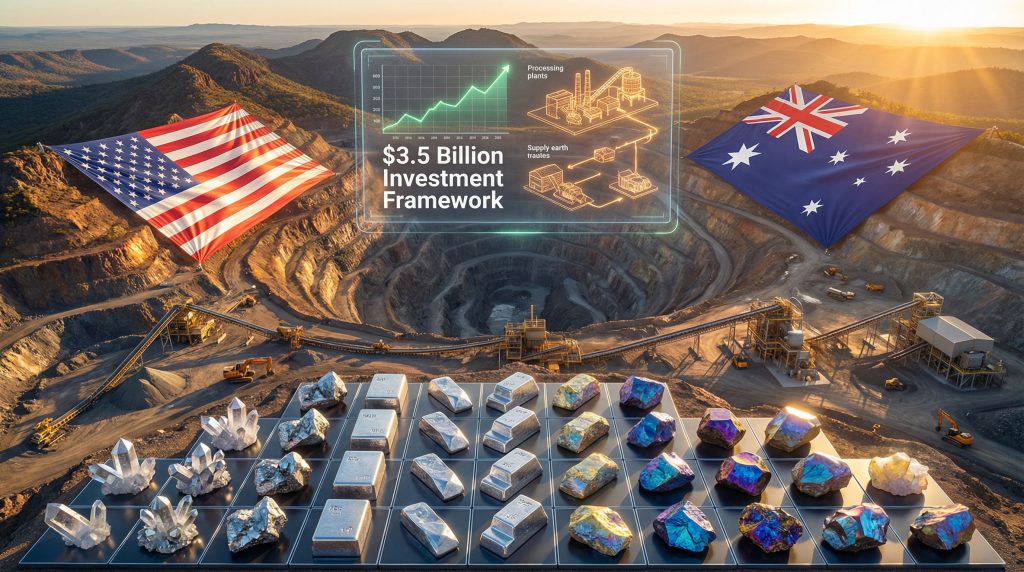
The US-Australia minerals agreement represents a fundamental shift in bilateral resource cooperation, moving beyond traditional raw material extraction toward integrated processing and supply chain development. The framework commits USD $3.5 billion through Export Finance Australia and the U.S. Export-Import Bank, nearly doubling previous cooperation commitments established six months prior.
This financing structure differs markedly from conventional mining agreements that typically focus on exploration rights, royalty arrangements, and environmental compliance. The current partnership integrates technology transfer protocols, downstream manufacturing linkages, and defense sector coordination within a comprehensive supply chain resilience framework.
Furthermore, this development aligns with broader energy transition security initiatives that recognise the critical role of mineral resources in achieving renewable energy objectives.
The investment timeline spans multiple phases:
- Short-term (2-3 years): Project commissioning and initial production capacity
- Medium-term (5-7 years): Market share gains and processing capacity expansion
- Long-term (10+ years): Integrated supply chain autonomy across critical mineral categories
Unlike China's Belt and Road mineral investments, which typically emphasise raw material extraction and export infrastructure, this partnership explicitly targets value-added processing and manufacturing integration within allied economies.
When big ASX news breaks, our subscribers know first
Transforming Australia's Strategic Position
Australia's transition from raw material exporter to processed goods producer represents one of the most significant shifts in the nation's resource economy since the iron ore boom. The country possesses substantial critical mineral reserves but has historically exported unprocessed ore while China captured the higher-value processing stages.
Beyond Traditional Resource Extraction Models
The technical complexity and environmental considerations of rare earth processing have created natural barriers that allowed Chinese facilities to establish dominant market positions. Processing rare earth ores requires multiple stages: mining, concentration, acid leaching, solvent extraction, separation, and purification. Each stage demands specialised equipment and generates substantial waste streams that require sophisticated environmental management.
Australia's approach integrates processing development with existing industrial capabilities. The framework supports projects that leverage established mining operations, existing infrastructure, and proven technological partnerships rather than attempting to replicate entire value chains from scratch.
Regional development implications extend beyond individual projects. Western Australia and Northern Territory stand to benefit from job creation across mining and manufacturing sectors, while the integration of processing facilities creates opportunities for technical skill development and industrial diversification.
Additionally, this strategic pivot reflects broader mining evolution trends that emphasise technological sophistication and environmental responsibility in resource development.
The Technology Transfer Component
Technology sharing agreements within the partnership framework address critical knowledge gaps in advanced mineral processing. These arrangements facilitate:
- Shared research and development initiatives focusing on processing efficiency and environmental impact reduction
- Intellectual property frameworks enabling joint ventures while protecting proprietary technologies
- Workforce development programs building technical expertise across both nations
The bilateral approach allows for coordinated technology development that addresses both nations' strategic objectives while maintaining competitive advantages over alternative suppliers.
Critical Mineral Priorities and Strategic Applications
Rare Earth Elements: The Foundation of Modern Technology
The Tronox Holdings rare earth refinement hub exemplifies the partnership's processing-focused approach. With AUD $849 million in combined support from Export Finance Australia and the U.S. Export-Import Bank, the project will leverage existing Western Australian and U.S. operations to produce mixed rare earth carbonate containing both light and heavy rare earth elements.
Rare earth processing represents one of the most technically challenging aspects of critical mineral development. The separation of individual rare earth elements requires sophisticated solvent extraction processes, with each element demanding specific chemical conditions and purification protocols. Heavy rare earth elements, including dysprosium, terbium, and yttrium, face particularly acute supply constraints and command premium pricing typically 10-50 times higher than light rare earth counterparts.
Current global rare earth processing capacity remains heavily concentrated in China, where accumulated technical expertise and tolerance for environmental impacts have created substantial competitive advantages. The Tronox project aims to establish alternative processing capacity outside this concentrated system, though achieving commercial-scale production will require overcoming significant technical and environmental challenges.
Processing complexity extends beyond separation technologies. Rare earth refinement generates substantial waste streams and requires sophisticated environmental management systems to handle radioactive byproducts. Australian environmental standards and regulatory frameworks differ significantly from those applied in existing processing jurisdictions, potentially creating both challenges and competitive advantages in long-term market positioning.
Strategic Metals for Advanced Applications
Beyond rare earth elements, the partnership addresses critical dependencies across multiple mineral categories vital for defense, aerospace, and advanced manufacturing applications.
The Ardea Resources Kalgoorlie Nickel Project receives support of up to AUD $1 billion, recognising nickel's central role in battery supply chains and stainless steel production. Nickel laterite deposits often contain cobalt and other battery minerals, creating opportunities for integrated extraction and processing across multiple commodity streams.
Alcoa's Gallium Recovery Initiative represents a strategic approach to semiconductor supply security. Gallium extraction from aluminium refining byproducts offers a cost-effective pathway to domestic gallium production, addressing critical dependencies in radar systems, communications equipment, and advanced computing applications.
The framework's scope extends to graphite, magnesium, tungsten, vanadium, and scandium projects, reflecting recognition that supply chain resilience requires diversification across the full spectrum of critical minerals rather than focusing on individual commodity streams.
| Mineral | Strategic Applications | Current Supply Concentration | Processing Complexity |
|---|---|---|---|
| Rare Earth Elements | Permanent magnets, electronics, defense systems | 85-90% China | Very High |
| Nickel | Battery cathodes, stainless steel | Moderate concentration | Medium |
| Gallium | Semiconductors, radar systems | High China concentration | High |
| Tungsten | High-temperature alloys, defense | High China concentration | High |
| Vanadium | Steel alloys, energy storage | Moderate concentration | Medium |
Market Dynamics and Competitive Positioning
Challenging China's Processing Dominance
China's current processing monopoly stems from decades of investment in specialised infrastructure, accumulated technical expertise, and regulatory frameworks that prioritise industrial development over environmental considerations. This combination has created substantial barriers to entry that cannot be rapidly overcome through financial investment alone.
The technical sophistication required for rare earth processing involves:
- Hydrometallurgical expertise in acid leaching and solution chemistry
- Solvent extraction technologies for element separation and purification
- Environmental management systems for radioactive waste handling
- Quality control protocols ensuring specification-grade purity levels
Historical precedent suggests that establishing alternative processing capacity requires sustained investment over multiple market cycles. Japan's response to the 2010 rare earth crisis involved stockpiling programs, recycling initiatives, and alternative supply negotiations that took 3-5 years to implement and provide only partial supply diversification.
However, recent political developments, including Trump's critical minerals order, have accelerated Western efforts to establish supply chain independence and reduce reliance on Chinese processing infrastructure.
Market disruption risks include potential Chinese responses such as competitive pricing strategies, export quota adjustments, or accelerated capacity expansion. China's demonstrated willingness to use export restrictions as diplomatic leverage creates ongoing uncertainty for Western supply chain planners.
Investment Capital Redirection and Global Implications
The partnership's scale and bilateral structure signal broader shifts in global mining investment patterns. Resource-rich nations including Canada, Brazil, and various African countries face strategic choices regarding technology partnerships and processing development priorities.
Alternative supplier positioning strategies must consider:
- Infrastructure development timelines and capital requirements
- Environmental regulatory frameworks affecting project permitting and operation
- Technical expertise availability for advanced processing operations
- Market access arrangements ensuring long-term offtake security
The integration with Indo-Pacific Economic Framework initiatives and potential expansion to include other allied nations suggests evolving models for resource diplomacy that prioritise supply chain resilience over purely economic considerations.
Nevertheless, broader economic policies, including the potential tariffs' market impact, could significantly influence the commercial viability and competitive positioning of these new processing facilities.
Risk Assessment and Implementation Challenges
Technical and Environmental Hurdles
Rare earth processing faces inherent environmental challenges that have historically concentrated production in jurisdictions with more permissive regulatory frameworks. Australian environmental standards require sophisticated waste management systems and environmental impact mitigation that add complexity and cost to processing operations.
Regulatory approval timelines for processing facilities typically extend 3-5 years in developed economies, compared to shorter timelines in less regulated jurisdictions. Community acceptance for facilities handling radioactive materials requires extensive consultation and ongoing environmental monitoring that may affect project economics.
Infrastructure development requirements extend beyond individual processing facilities. Supporting infrastructure for waste management, transportation, and utilities must be developed in parallel with processing capacity, creating coordination challenges and capital requirements that exceed direct project investment.
Market and Financial Risk Factors
Commodity price volatility creates significant risks for processing projects that require substantial upfront capital investment and long payback periods. Rare earth prices have historically shown extreme volatility, with price swings of 300-600% during supply disruptions.
Competition from established Asian processing facilities benefits from:
- Amortised infrastructure costs from facilities developed over multiple decades
- Accumulated operational expertise reducing processing costs and improving yields
- Integrated supply chains linking processing to downstream manufacturing
Currency fluctuation impacts on bilateral investments create additional complexity for projects spanning multiple jurisdictions. Exchange rate movements between Australian dollars, U.S. dollars, and Chinese yuan affect competitive positioning and project economics over multi-year development timelines.
Success Metrics and Future Scenarios
Measuring Strategic Independence Progress
Key performance indicators for the partnership extend beyond traditional mining metrics to encompass supply chain resilience and strategic autonomy measures:
Market Share Targets:
- Non-Chinese rare earth processing capacity reaching 25-30% of global demand by 2035
- Alternative gallium supply sources providing 40-50% of semiconductor industry requirements
- Integrated nickel-cobalt processing supporting 20-25% of Western battery supply chains
Supply Chain Resilience Metrics:
- Inventory buffer capacity during potential supply disruptions
- Processing redundancy across multiple geographic regions
- Technology transfer progress enabling additional processing development
Economic Impact Measurements:
- Job creation across mining, processing, and advanced manufacturing sectors
- Regional development progress in Western Australia and Northern Territory
- Bilateral trade balance improvements through value-added exports
Timeline for Strategic Autonomy
The pathway to strategic independence requires coordinated development across multiple project phases:
2-3 Year Milestones:
- Project commissioning for rare earth processing facilities
- Initial gallium recovery operations achieving commercial scale
- Nickel processing capacity expansion completing environmental approvals
5-7 Year Objectives:
- Market share gains demonstrating viable alternatives to Chinese processing
- Technology transfer programs producing qualified technical workforce
- Integrated supply chain linkages connecting processing to manufacturing
10+ Year Vision:
- Complete supply chain autonomy for critical defense applications
- Competitive processing costs enabling sustained market competition
- Expansion potential for additional critical mineral processing capacity
The next major ASX story will hit our subscribers first
Global Resource Diplomacy Evolution
Partnership Models and Strategic Expansion
The bilateral framework establishes precedent for resource partnerships that prioritise strategic considerations alongside commercial objectives. Potential expansion to include other Five Eyes nations would create broader alliance-based supply chain networks spanning multiple continents.
Technology sharing agreements with European allies could accelerate processing development while distributing strategic risks across allied economies. The European CRM facility initiatives and similar programs in Japan and South Korea create opportunities for coordinated development that reduces individual nation dependencies.
Integration challenges include:
- Standardising technical specifications across multiple processing jurisdictions
- Coordinating investment timelines to avoid overcapacity or supply gaps
- Managing competitive dynamics between allied nations developing similar capabilities
- Ensuring technology security while promoting collaborative development
What Are the Future Scenarios for Critical Mineral Markets?
Three primary scenarios emerge for critical mineral market evolution over the next decade:
Scenario 1: Successful Diversification
Alternative processing capacity reaches sufficient scale to provide genuine supply security, reducing Chinese market leverage and enabling competitive pricing across multiple suppliers.
Scenario 2: Partial Success with Continued Dependencies
Western processing develops for specific high-priority applications while broader dependencies persist, creating a two-tier market with secure supply for defense applications but continued vulnerabilities in commercial sectors.
Scenario 3: Chinese Counter-Response Limiting Progress
Aggressive Chinese pricing strategies and capacity expansion limit the commercial viability of alternative processing, resulting in continued supply chain concentration despite significant investment in alternative capabilities.
The outcome depends substantially on sustained political commitment, technological development success, and market dynamics that extend beyond the direct control of any single bilateral partnership.
Strategic Outcomes and Market Transformation
The US-Australia minerals agreement represents more than bilateral resource cooperation; it signals fundamental shifts in how developed economies approach strategic material security. Success requires overcoming substantial technical, environmental, and economic challenges while competing against established processing infrastructure developed over multiple decades.
Market transformation depends on achieving sufficient scale and cost competitiveness to provide genuine alternatives during both normal market conditions and supply disruptions. The partnership's integrated approach, combining processing development with technology transfer and defense sector coordination, offers advantages over purely commercial development models.
Long-term implications extend to broader resource diplomacy frameworks and alliance-based supply chain development. The US-Australia Critical Minerals Agreement precedent established by this partnership may influence similar arrangements across other critical material categories and allied nation groupings.
Disclaimer: This analysis involves forward-looking assessments of market conditions, project development timelines, and geopolitical dynamics that are subject to significant uncertainty. Commodity markets, technological development, and international relations may evolve differently than projected. Investment decisions should consider comprehensive due diligence beyond the scope of this strategic overview.
Looking to Capitalise on Critical Minerals Investment Opportunities?
Discovery Alert's proprietary Discovery IQ model delivers real-time notifications on significant ASX mineral discoveries, instantly empowering subscribers to identify actionable opportunities in critical minerals and exploration ahead of the broader market. Begin your 14-day free trial today and secure your market-leading advantage in this rapidly evolving sector.