August 7, 2026
The Supply Chain War Nobody Is Talking About
The scramble for mineral dominance rarely announces itself with fanfare. It unfolds through technical working groups, bilateral investment frameworks, and quietly scheduled meetings in major resource capitals. The clean energy transition has fundamentally rewritten the calculus of national security, transforming geological endowments into strategic assets and turning mining agreements into instruments of geopolitical competition. Nowhere is this dynamic more visible than in Southern Africa, where the world's most diversified mineral portfolio sits at the intersection of competing great-power interests.
Against this backdrop, preliminary US and South Africa mining deals talks that took place in Johannesburg in early May 2026 carry significance well beyond what the initial news coverage suggests.
When big ASX news breaks, our subscribers know first
South Africa's Mineral Endowment: Understanding What Is Actually at Stake
Before examining the diplomatic mechanics, it is worth grounding the discussion in geology. South Africa's mineral wealth is not merely impressive in scale — it is strategically irreplaceable across multiple categories simultaneously.
| Mineral | Global Significance | Primary Strategic Use |
|---|---|---|
| Platinum Group Metals (PGMs) | ~70% of global reserves | Hydrogen fuel cells, catalytic converters, defence |
| Rare Earth Elements (REEs) | Emerging reserve base in Limpopo | EV motors, defence systems, wind turbines |
| Chrome | World's largest reserves | Aerospace alloys, stainless steel |
| Manganese | Major global exporter | Battery technology, steel production |
| Gold | Historically top-5 producer | Monetary reserves, electronics |
| Coal | Significant thermal coal base | Regional energy security |
Few nations on earth offer this breadth of strategically significant commodities under a single investment framework. For any government seeking to reduce dependence on Chinese-controlled supply chains, South Africa represents one of the most efficient entry points available.
The rare earth supply chains in South Africa's Limpopo Province deserve particular attention. Unlike the well-publicised rare earth belts of Australia or the Mountain Pass deposit in California, South Africa's rare earth potential has historically been underexplored. The Phalaborwa complex in Limpopo, already a historic centre of phosphate and copper production, contains rare earth mineralisation within its phosphogypsum waste streams — a resource type that most conventional mining frameworks would have classified as a liability rather than an asset.
Why Phosphogypsum Changes the Economics of Rare Earth Development
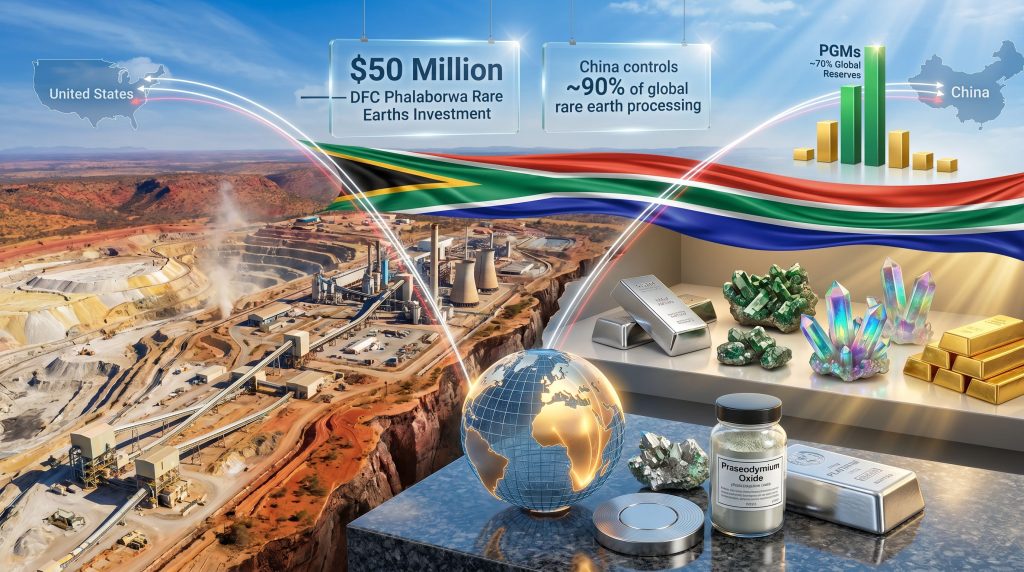
One of the least understood dimensions of the Phalaborwa investment story is the specific extraction methodology involved. Phosphogypsum is a byproduct of phosphoric acid production, and it accumulates in vast quantities at phosphate processing sites. Traditionally, it represents an environmental management challenge. The Phalaborwa project, backed by a $50 million commitment from the US International Development Finance Corporation (DFC), is designed to extract rare earth elements from this industrial waste.
This approach matters for several reasons that conventional mining analysis tends to underweight:
- Capital efficiency: There is no requirement to build an entirely new mine. The primary extraction infrastructure already exists, reducing upfront capital intensity significantly compared to greenfield rare earth projects.
- Timeline compression: Conventional rare earth mines typically require eight to fifteen years from discovery to first production. Projects that leverage existing industrial infrastructure can compress this timeline substantially.
- Environmental positioning: Extracting value from what would otherwise be a waste stream addresses environmental concerns simultaneously with production goals — a dual benefit that strengthens social licence and regulatory positioning.
- Supply chain credibility: The explicit design objective of a China-free supply chain makes the output attractive to US manufacturers and government agencies seeking verified provenance for critical mineral inputs.
The phosphogypsum extraction model at Phalaborwa could serve as a replicable template across other Southern African industrial sites where legacy phosphate or chemical processing operations have generated decades of mineralised waste stockpiles.
This is a meaningful distinction from standard mining investment. The DFC is not simply financing a new mine. It is funding a waste-to-resource conversion project with built-in strategic supply chain positioning — a model that could be applied at scale across the continent if it proves commercially viable.
The Diplomatic Backdrop: How Two Estranged Governments Ended Up in the Same Room
The Johannesburg meeting of May 6–7, 2026, which the Financial Times reported involved approximately 25 officials from both governments, did not emerge from a comfortable relationship. US–South Africa ties had experienced notable strain throughout 2025 and into 2026, driven by South Africa's non-aligned foreign policy posture, its deepening BRICS integration, and its historical ties to both China and Russia.
South Africa's approach to foreign policy has long been shaped by what Pretoria describes as a philosophy of strategic autonomy — a refusal to anchor the country's external relationships to any single power bloc. In practice, this has meant maintaining active economic and diplomatic relationships with Beijing and Moscow while simultaneously seeking investment capital from Washington and Brussels.
Prior to the May 2026 talks, President Cyril Ramaphosa had reportedly identified up to nine critical minerals of mutual interest during earlier engagements with the US administration, establishing a technical working framework even amid frosty diplomatic conditions at the political level. This compartmentalisation of resource cooperation from broader geopolitical tensions is increasingly characteristic of 21st-century minerals diplomacy.
What makes this separation possible is the mutual urgency of the underlying economics. The US has a structural problem in critical minerals demand that no amount of diplomatic displeasure with Pretoria's foreign policy can resolve. South Africa has a structural problem with mining sector investment, infrastructure, and electricity supply that no amount of solidarity with BRICS partners can fully address with capital. These complementary vulnerabilities create negotiating space even where political alignment is absent.
The China Variable: Why 60% and 90% Are the Numbers That Drive Everything
Understanding the urgency behind the US and South Africa mining deals talks requires understanding the scale of China's dominance in rare earth supply chains. China currently accounts for approximately 60% of global rare earth production and an estimated 90% of global rare earth processing and refining capacity, according to data cited by the US Geological Survey and the International Energy Agency.
The production concentration is concerning. The processing concentration, however, is the more acute strategic vulnerability.
Even where rare earth minerals are physically extracted outside China — in Australia, the United States, or Myanmar — the overwhelming majority of that material is currently shipped to Chinese processing facilities for separation and refining. This means that a nation could mine rare earths domestically and still be functionally dependent on Chinese industrial capacity to convert them into usable inputs for EV motors, wind turbine generators, or defence guidance systems.
This is the structural gap that US critical minerals policy is attempting to address. Investment in mining alone is insufficient without parallel investment in processing and separation capacity. The Phalaborwa project's positioning as an integrated, China-free supply chain reflects an understanding of this more complete picture.
Building Western-aligned rare earth supply chains requires solving the processing problem, not just the mining problem. Nations that invest only in extraction without addressing refining capacity remain structurally dependent on Chinese industrial infrastructure regardless of where the ore originates.
Mapping US Minerals Engagement Across Africa
The Johannesburg talks sit within a broader pattern of accelerating US minerals engagement across the African continent. Understanding South Africa's position within this framework helps clarify both the strategic logic and the relative priority assigned by Washington.
| Country | Key Minerals | US Engagement Status | Strategic Priority |
|---|---|---|---|
| Democratic Republic of Congo | Cobalt, coltan, copper | Active deal framework (late 2025) | Very High |
| South Africa | PGMs, rare earths, gold, chrome | Preliminary talks (May 2026) | High |
| Zambia | Copper, cobalt | DFC investment discussions | High |
| Zimbabwe | Lithium, platinum | Early-stage engagement | Medium |
| Namibia | Uranium, rare earths | Exploration-stage interest | Medium |
South Africa's Mining Minister Gwede Mantashe publicly expressed concern about the nature of US–DRC minerals engagement at the Mining Indaba held in Cape Town in February 2026, warning that external approaches to securing African resources risked bypassing intra-African economic development frameworks. This tension between Pretoria's pan-African economic philosophy and its practical need for Western investment capital represents one of the defining fault lines in the bilateral relationship.
Mantashe's criticism is worth taking seriously as an analytical input, not just as political rhetoric. Furthermore, South Africa has long sought to position itself as an advocate for value-addition within Africa, pushing back against extraction-focused investment models that remove raw materials for processing elsewhere. Any US investment framework that replicates a pure extraction model is likely to encounter political resistance from within the South African government itself.
The next major ASX story will hit our subscribers first
The Structural Obstacles That Could Slow Progress
Several factors make a rapid formalisation of the US–South Africa minerals relationship unlikely, regardless of the strategic logic underpinning it.
Broad-Based Black Economic Empowerment (BBBEE) Requirements
South Africa's mining sector operates under the Mineral and Petroleum Resources Development Act (MPRDA), which mandates meaningful ownership participation by historically disadvantaged South Africans. Any US investment vehicle seeking to acquire mineral rights or project stakes must navigate these requirements, which can significantly alter deal structures, timelines, and return profiles compared to mining investments in jurisdictions with simpler ownership frameworks.
The Electricity Supply Problem
South Africa's ongoing load-shedding challenges — periods of scheduled power outages driven by state utility Eskom's constrained generation capacity — represent a material operational risk for mining investment. Large-scale mining and mineral processing operations require reliable, high-volume power supply. Any serious US capital commitment to South African mineral projects will consequently need to incorporate parallel investment in dedicated power generation or energy infrastructure to be commercially viable.
The BRICS Balancing Act
China is not only a geopolitical competitor of the US in the minerals space — it is also one of South Africa's largest trading partners and a significant buyer of South African mineral output. The geopolitics of mineral supply creates potential friction with Beijing at the trade relationship level, a calculation Pretoria's policymakers will weigh carefully against the benefits of US investment capital.
Verification and Timeline Realism
As of the reporting date, Reuters noted it could not independently verify the details of the FT's reporting on the Johannesburg meeting. Preliminary discussions of this nature, even when representing the highest-level bilateral engagement of the year, typically require twelve to twenty-four months of technical and legal work before formal investment frameworks are established, let alone funded and operational.
Benchmarking Against Established US Critical Minerals Partnerships
Comparing the current US–South Africa engagement against more mature US critical minerals partnerships helps calibrate realistic expectations for timeline and depth.
| Partnership | Minerals Focus | Investment Committed | Status |
|---|---|---|---|
| US-Australia | Lithium, cobalt, rare earths | Multiple DFC investments | Active |
| US-Canada | Rare earths, cobalt, nickel | Joint Action Plan | Active |
| US-DRC | Cobalt, coltan, copper | Framework announced | Early implementation |
| US-South Africa | REEs, PGMs, gold | $50M DFC (Phalaborwa) | Preliminary talks |
| US-Japan | Processing technology | Technology agreements | Active |
If the US–South Africa dialogue matures into a formal agreement, it would represent the first major US critical minerals framework with a Sub-Saharan African nation outside of the DRC context — a meaningful milestone in the architecture of Western mineral security. The energy security implications of such a framework would extend well beyond the bilateral relationship itself.
Commodity Market Context: What the Numbers Reveal
Current commodity pricing provides important context for evaluating the commercial stakes of this diplomatic engagement.
Platinum is currently trading at $1,973.85 per troy ounce, reflecting a 4.22% gain, while palladium sits at $1,496.50 per troy ounce, up 5.39%. Gold futures are trading near $4,713 per troy ounce, representing a 3.84% move — levels that underscore the sustained investor appetite for precious and critical metals in the current macro environment. Silver futures have also posted a 7.47% gain, trading at approximately $75.50 per troy ounce.
These price dynamics have several implications for the bilateral talks:
- PGM pricing: Elevated platinum and palladium prices strengthen the commercial case for US investment in South African PGM projects, improving the returns profile for DFC-style development finance.
- Gold market relevance: With gold futures near historic highs, South Africa's gold sector retains commercial significance despite decades of production decline from peak output levels, adding another layer of potential bilateral interest.
- Rare earth premium: Growing Western demand for verified, non-Chinese rare earth supply is generating a pricing premium for allied-nation provenance — a premium that South African production could capture if the processing infrastructure can be established.
What a Formal Deal Could Actually Look Like
Several potential frameworks could structure a formalised US–South Africa minerals agreement, each with different risk and reward profiles for both parties:
- Government-to-government offtake commitments: Guaranteed US purchase arrangements for specified mineral volumes in exchange for US-funded infrastructure development.
- DFC project finance expansion: Additional development finance beyond the existing Phalaborwa commitment, directed toward processing and refining capacity rather than just extraction.
- Technology transfer arrangements: US rare earth separation and processing technology provided to South African entities in exchange for preferential supply agreements, addressing the processing gap without requiring full Chinese-supply-chain replacement immediately.
- A bilateral critical minerals trade framework: A broader structured agreement modelled on US partnerships with Australia and Canada, establishing rules of origin, investment protections, and supply chain verification protocols.
The Phalaborwa DFC investment can be read as a proof-of-concept deployment. If the waste-stream extraction model delivers commercial rare earth production with verified supply chain integrity, it establishes a replicable blueprint and a political demonstration that the partnership works in practice, not just in principle. Indeed, reporting from African news sources confirms the US was willing to set aside diplomatic rifts to pursue this investment — a strong signal of Washington's strategic intent.
Frequently Asked Questions: US and South Africa Mining Deals Talks
What minerals are central to the US and South Africa mining deals talks?
The discussions are centred on rare earth elements, particularly neodymium and praseodymium for EV and wind turbine magnets, platinum group metals, gold, chrome, and manganese.
What is the current status of negotiations?
As of May 2026, the talks remain at a preliminary stage. The Johannesburg meeting of May 6–7, 2026, as reported by the Financial Times, involved approximately 25 officials and was described as the highest-level bilateral engagement of the year. No formal agreements have been publicly announced.
What is the DFC's role in US–South Africa mineral engagement?
The US International Development Finance Corporation has committed $50 million to the Phalaborwa Rare Earths Project in Limpopo Province, which extracts rare earth elements from phosphogypsum industrial waste. This represents the most concrete expression of US minerals investment interest in South Africa to date.
Why does China's processing dominance matter for these talks?
China controls an estimated 90% of global rare earth processing capacity. Even where minerals are mined outside China, they often require Chinese facilities for separation and refining. US investment in South African projects explicitly designed around China-free processing addresses this structural vulnerability.
Could South Africa's BRICS membership complicate a formal agreement?
Yes. China is a major buyer of South African mineral exports and a significant bilateral partner. Deepening formal US mineral ties consequently creates a geopolitical balancing challenge that Pretoria must manage carefully.
Disclaimer: This article contains forward-looking analysis and references to preliminary diplomatic discussions. The May 2026 Johannesburg meeting details were reported by the Financial Times and cited by Reuters, which noted it could not immediately verify the report. Commodity price data referenced reflects market levels at the time of publication. Nothing in this article constitutes investment advice. Readers should conduct independent research before making investment decisions.
Want to Stay Ahead of the Next Major Critical Minerals Discovery?
Discovery Alert's proprietary Discovery IQ model scans ASX announcements in real time, instantly identifying significant mineral discoveries across critical commodities — including rare earths, platinum group metals, and gold — and delivering actionable alerts before the broader market reacts. Explore historic examples of what major mineral discoveries can return and begin your 14-day free trial today to secure a market-leading edge.