May 13, 2026
Strategic Energy Independence Through Market Transformation
The global energy landscape increasingly rewards nations that prioritise domestic resource security over export revenue optimisation. As international commodity markets experience heightened volatility, Australia's consideration of an east coast gas reserve policy represents more than regulatory adjustment—it signals a fundamental shift toward energy sovereignty that could reshape the nation's industrial competitiveness for decades.
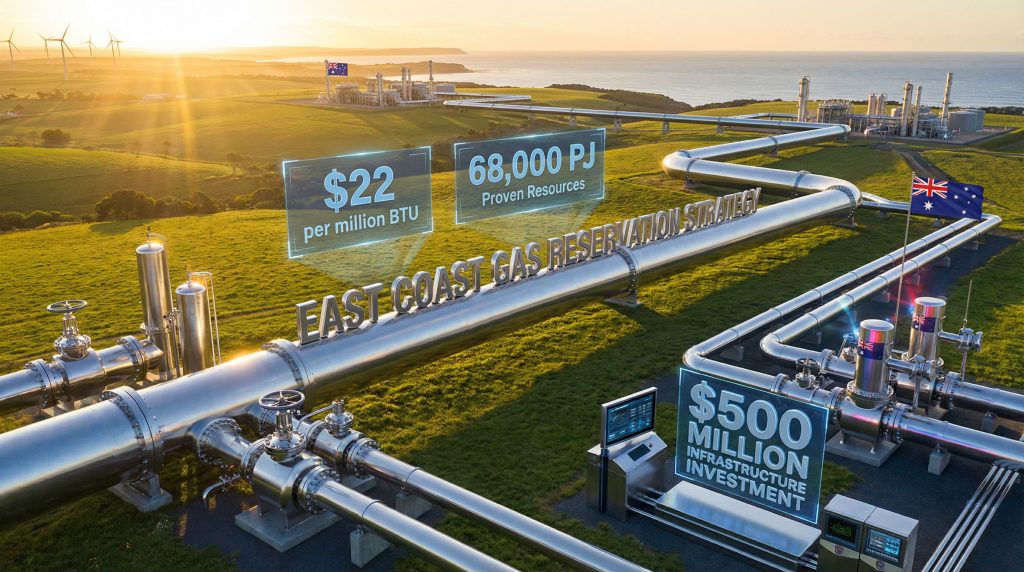
Traditional energy security models rely heavily on market mechanisms and international trade relationships. However, recent geopolitical tensions have demonstrated the vulnerability of export-dependent economies to external supply shocks. Furthermore, Australia's abundant gas reserves, estimated at over 68,000 petajoules of proven and contingent resources in eastern regions, provide a strategic foundation for domestic energy independence that few nations possess.
When big ASX news breaks, our subscribers know first
Domestic Gas Allocation Framework Analysis
The proposed reservation mechanism operates through a structured allocation system that designates specific percentages of production for domestic consumption, creating market separation between local industrial users and volatile international pricing. This approach builds on Western Australia's successful implementation, where domestic gas pricing has maintained stability below export parity for over a decade.
Industry analysis suggests that reservation policies consistently deliver measurable domestic price benefits across multiple jurisdictions. For instance, Western Australia's 15% reservation requirement has resulted in domestic gas prices approximately 23% below export parity, while Indonesia's 25% domestic allocation has achieved 18% price reductions compared to international markets.
Key Benefits of Reservation Systems:
- Price Stability: Protection from international commodity volatility
- Industrial Competitiveness: Lower energy costs for manufacturing sectors
- Supply Security: Guaranteed domestic availability during global disruptions
- Investment Certainty: Predictable pricing for long-term industrial planning
The framework requires sophisticated regulatory mechanisms to balance domestic protection with export market competitiveness. Implementation involves establishing quota systems, pricing protocols, and enforcement procedures that ensure adequate domestic supply whilst maintaining investment incentives for continued resource development.
Infrastructure Investment Acceleration Dynamics
Major pipeline operators have identified significant capital deployment opportunities following policy clarification around domestic gas reservation. Consequently, APA Group's proposed $500 million investment in east coast transmission capacity represents the scale of infrastructure development that supportive regulatory frameworks can unlock.
Strategic Infrastructure Corridors Under Development:
| Corridor | Investment Focus | Capacity Impact |
|---|---|---|
| Northern Queensland to Southern Markets | Enhanced compression and looping | +150 PJ/year transmission |
| Bass Strait to Mainland Integration | Expanded interconnection capabilities | +50 PJ/year import capacity |
| Storage Expansion Programs | Underground facility development | +25 PJ seasonal storage |
The acceleration of infrastructure investment reflects industry confidence in policy stability and long-term demand security. Moreover, compression upgrades and pipeline looping represent cost-effective methods for increasing transmission capacity without constructing entirely new corridor infrastructure.
Storage facility development focuses on underground gas storage capabilities that provide seasonal balancing and emergency supply security. These projects utilise depleted gas fields, salt caverns, and aquifer formations to create strategic reserves that enhance overall system reliability.
Resource Base Sustainability Assessment
Australia's east coast gas reserves demonstrate substantial long-term availability relative to domestic consumption requirements. Current proven and contingent resources of approximately 68,000 petajoules serve an annual domestic market consuming around 500 petajoules, creating a resource-to-demand ratio exceeding 130:1.
Resource Availability Projections:
- Current Annual Demand: 500 PJ
- 2030 Projected Demand: 580 PJ
- Available Resources: 68,000 PJ (proven/contingent)
- Reserve Life Index: 112+ years at projected consumption rates
Resource depletion modelling indicates minimal impact on long-term availability, with projected reserves declining to approximately 65,000 petajoules by 2030. This reduction accounts for production consumption offset by new discoveries and field development activities across major gas basins.
The Bowen and Surat Basins contain the majority of east coast coal seam gas resources, whilst conventional reserves in the Gippsland and Cooper Basins provide additional supply diversity. This geographic distribution enhances supply security through multiple production regions and transportation pathways.
International Price Volatility Impact Analysis
Global energy crisis events have demonstrated the vulnerability of domestic markets linked to international commodity pricing. However, recent Middle Eastern geopolitical tensions resulted in North Asian LNG spot prices exceeding $22 per million British thermal units, representing significant volatility from historical trading ranges.
Traditional gas pricing mechanisms in Australia's east coast markets maintain direct correlation with Asian LNG spot prices through contractual linkage clauses. This creates immediate transmission of international price shocks to domestic industrial users, affecting manufacturing competitiveness and energy-intensive operations. Additionally, these trade war energy impacts continue to influence market dynamics across the region.
The reservation policy framework creates a bifurcated market structure that maintains export competitiveness whilst providing domestic price protection:
Export Market Segment:
- Maintains international LNG competitiveness
- Captures global price premiums during supply shortages
- Supports export revenue optimisation
Domestic Market Segment:
- Receives price protection through reservation allocation
- Provides manufacturing sector cost stability
- Ensures energy security during international disruptions
Historical analysis reveals that geopolitical events affecting major LNG suppliers create immediate price spikes in international markets. Qatar's position as the world's second-largest LNG supplier makes Middle Eastern stability crucial for global supply security, highlighting the importance of domestic energy security strategies.
Regulatory Framework Enhancement Requirements
Investment certainty requires regulatory frameworks that balance market efficiency with infrastructure development incentives. Recent regulatory changes affecting gas pipeline operations have created uncertainty around long-term investment returns, prompting calls for enhanced regulatory stability mechanisms.
Proposed Framework Improvements:
- Greenfield Protection Extensions: New projects receive regulatory certainty for initial investment recovery periods
- Brownfield Expansion Incentives: Existing infrastructure upgrades benefit from streamlined approval processes
- Foundation Contract Facilitation: Policy support for long-term gas supply agreements that underpin infrastructure financing
The March 2023 regulatory reforms expanded regulator powers to impose heavier regulation on pipelines after capital commitment, creating risk-reward imbalances for large-scale infrastructure projects. Consequently, industry stakeholders argue these changes have delayed major expansion decisions and complicated financing arrangements.
Regulatory uncertainty particularly affects projects with long development horizons, where investors require confidence in future regulatory treatment to justify initial capital commitments. Enhanced regulatory certainty mechanisms would provide investment protection whilst maintaining appropriate market oversight.
The next major ASX story will hit our subscribers first
Global Energy Security Model Comparisons
International experience with domestic gas reservation policies demonstrates consistent price benefits across diverse implementation approaches. Comparative analysis reveals significant variation in reservation rates and resulting domestic price impacts across different regulatory frameworks. Furthermore, these policies align with broader renewable energy transformations occurring globally.
International Reservation Policy Comparison:
| Country | Reservation Rate | Implementation Period | Domestic Price Impact |
|---|---|---|---|
| Australia (WA) | 15% | 2006-Present | -23% vs Export Parity |
| Indonesia | 25% | 2012-Present | -18% vs Export Parity |
| Russia (Pre-2022) | 60% | 2000-2022 | -45% vs Export Parity |
| Norway | 0% (Market-Based) | N/A | Export Parity |
Western Australia's implementation provides the most relevant model for east coast policy development, demonstrating effective balance between domestic protection and export market participation. The 15% reservation rate has maintained industrial competitiveness whilst supporting continued resource development and export revenue generation.
Indonesia's higher 25% reservation rate reflects greater emphasis on domestic industrial development and energy security objectives. However, implementation challenges around enforcement and pricing mechanisms have created periodic supply disruptions and regulatory disputes.
Norway's market-based approach relies on abundant domestic production and sophisticated pipeline infrastructure to maintain energy security without explicit reservation requirements. This model requires extensive interconnection and storage capabilities that may not be immediately available in other jurisdictions.
Manufacturing Competitiveness Enhancement Effects
Domestic gas price reductions through reservation policies create cascading economic benefits across energy-intensive manufacturing sectors. Industrial operations particularly sensitive to gas pricing include aluminium smelting, chemical processing, food manufacturing, and glass production, where energy costs represent 30-40% of total production expenses.
Manufacturing Sector Gas Exposure:
- Aluminium Smelting: Primary energy input for electrolysis processes
- Chemical Processing: Feedstock and thermal processing requirements
- Food Processing: Thermal processing, refrigeration, and packaging operations
- Glass Manufacturing: High-temperature furnace operations requiring consistent supply
Economic modelling indicates that domestic gas price reductions of 15-20% below export parity could support approximately 15,000-20,000 additional manufacturing jobs across these energy-intensive sectors. Lower energy costs enhance international competitiveness and support industrial expansion investments.
The multiplier effects extend beyond direct energy users to supporting industries, logistics operations, and regional economic development. Manufacturing sector growth generates demand for specialised services, equipment suppliers, and skilled workforce development programmes.
Pipeline Infrastructure Optimisation Strategies
Current transmission infrastructure creates regional supply imbalances that require coordinated development to optimise reservation policy implementation. Queensland's gas production surplus of over 150 petajoules annually must reach southern markets experiencing combined deficits of approximately 26 petajoules.
Regional Supply-Demand Analysis:
- Queensland: 150+ PJ annual surplus available for interstate transfer
- Victoria/NSW/SA Combined: 26 PJ deficit requiring imported gas
- Current Pipeline Capacity: Adequate for required transfers with minimal spare capacity
- Expansion Requirements: Additional compression and looping capacity needed
Infrastructure bottlenecks limit the ability to efficiently distribute reserved gas from production regions to consumption centres. Priority development focuses on enhancing north-south transmission capacity and developing strategic storage facilities for seasonal demand management.
Compression station upgrades represent the most cost-effective method for increasing pipeline capacity, typically delivering 15-25% throughput increases at significantly lower cost than new pipeline construction. Looping involves installing parallel pipeline sections in high-demand corridors to reduce pressure drop and increase flow capacity.
Energy Transition Integration Framework
Gas reservation policy supports Australia's renewable energy transition by ensuring reliable backup power generation remains economically viable during periods of variable renewable output. As wind and solar penetration increases, gas-fired generation provides essential grid stability services and dispatchable capacity. These developments align with emerging energy transition challenges faced globally.
The policy framework anticipates evolving energy system requirements through several mechanisms:
Flexible Generation Support:
- Maintaining economic gas supply for peaking power plants
- Supporting rapid-start generation capabilities
- Providing frequency regulation services
Industrial Transition Assistance:
- Stable gas pricing during manufacturing sector decarbonisation
- Supporting process efficiency improvements
- Enabling industrial heat pump deployment
Hydrogen Production Enablement:
- Domestic gas availability for blue hydrogen development
- Feedstock security for hydrogen production facilities
- Supporting carbon capture and storage integration
Gas-fired generation flexibility becomes increasingly valuable as renewable energy comprises larger portions of electricity supply. The ability to rapidly adjust output in response to wind and solar variability provides critical system stability services that support renewable energy integration objectives.
Investment Considerations and Market Dynamics
The global energy crisis and east coast gas reserve policy intersection has highlighted the strategic importance of domestic energy security, making reservation frameworks increasingly attractive to investors and policymakers. Market dynamics suggest that reservation frameworks provide stability benefits that outweigh potential export revenue limitations, particularly during periods of international commodity volatility.
However, the federal government's commitment to gas policy reform demonstrates the political will to address these challenges. In addition, analysis from The Conversation regarding gas reservation effectiveness suggests positive outcomes when properly implemented.
Long-term success requires maintaining investment incentives for continued resource development whilst ensuring adequate infrastructure capacity supports domestic market requirements. The balance between domestic protection and export competitiveness will determine the policy's effectiveness in achieving energy security and industrial competitiveness objectives. Furthermore, these considerations must account for natural gas price forecasts that influence long-term planning decisions.
Regulatory refinement opportunities include streamlined environmental approvals for reservation-supporting infrastructure, enhanced interconnection standards for new pipeline developments, and targeted incentives for strategic storage facility development. These adjustments would optimise investment outcomes whilst maintaining competitive market dynamics essential for efficient resource allocation.
Ready to Capitalise on Energy Sector Transformations?
Discovery Alert's proprietary Discovery IQ model delivers real-time alerts on significant ASX mineral discoveries, including critical energy transition materials and infrastructure opportunities, instantly empowering subscribers to identify actionable investments ahead of the broader market. Explore why major mineral discoveries can generate substantial returns by visiting Discovery Alert's discoveries page and begin your 14-day free trial today to position yourself strategically as energy markets evolve.