August 1, 2026
Strategic Energy Positioning Reshapes Middle Eastern Power Dynamics
Resource-rich nations increasingly find themselves at the center of complex geopolitical calculations where energy sovereignty intersects with global power projection. The convergence of technological advancement, shifting alliance structures, and evolving investment philosophies creates unprecedented opportunities for countries to leverage their natural endowments in pursuit of broader strategic objectives. This dynamic particularly manifests in regions where historical colonial influences compete with emerging economic partnerships, creating multi-layered decision frameworks that extend far beyond traditional commercial considerations. Furthermore, Iraq as a battleground for China and Western oil giants exemplifies these complex dynamics where geopolitical rivalry shapes energy sector development.
Contemporary energy geopolitics reflects a fundamental transformation from purely transactional relationships toward comprehensive strategic partnerships that encompass infrastructure development, security cooperation, and long-term economic integration. Nations possessing significant hydrocarbon reserves now navigate between competing models of international engagement, each offering distinct advantages and requiring different forms of sovereignty trade-offs.
When big ASX news breaks, our subscribers know first
What Makes Iraq the Ultimate Prize in Modern Energy Geopolitics?
The Strategic Geography That Defines Middle Eastern Power
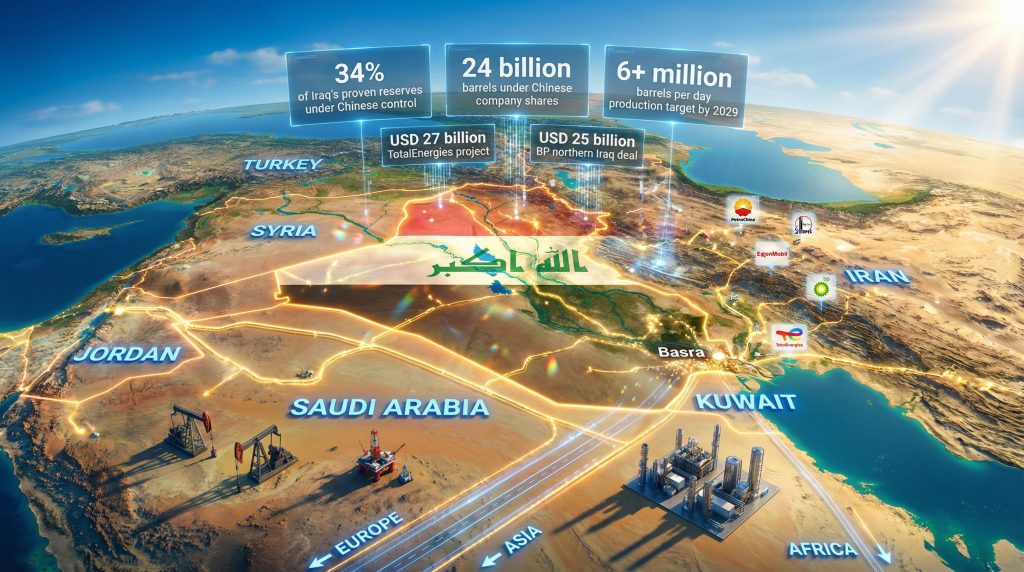
Iraq's geographic positioning creates extraordinary strategic value that extends far beyond its substantial hydrocarbon reserves. The country occupies 1,648 kilometers of shared borders with six nations, including major energy producers Iran, Saudi Arabia, and Kuwait, while providing critical access corridors connecting Asia, Europe, and Africa. This positioning places Iraq at the intersection of multiple transportation networks that facilitate both energy exports and broader commercial trade flows.
The Shatt al-Arab waterway, stretching 193 kilometres to the Persian Gulf, represents one of the world's most strategically significant energy transit routes. Approximately 21% of global seaborne oil trade transits through the Persian Gulf region, making control or influence over Iraqi territory a crucial component of any comprehensive energy security strategy.
Border Relationships and Strategic Corridors:
- Iran border: 1,458 km (longest shared boundary)
- Saudi Arabia border: 811 km (southern energy corridor)
- Turkey border: 367 km (European export access)
- Syria border: 605 km (Mediterranean route potential)
- Kuwait border: 240 km (Gulf cooperation zone)
- Jordan border: 181 km (alternative logistics pathway)
Iraq's position within the broader Shia Crescent of Power connecting Iran through Iraq, Syria, and Lebanon creates additional geopolitical significance. This arc enables coordinated regional influence strategies that extend from the Persian Gulf to the Mediterranean Sea, offering participating nations enhanced leverage over global energy markets and regional security dynamics.
Resource Fundamentals That Attract Global Superpowers
Iraq maintains the world's fourth-largest proven oil reserves at approximately 145 billion barrels, representing 8.5% of global reserves according to U.S. Energy Information Administration data. However, the country's true strategic value emerges from its exceptional production economics, with average lifting costs of $2-4 per barrel ranking among the world's lowest.
Comparative Production Cost Analysis:
| Region | Average Lifting Cost | Technical Complexity |
|---|---|---|
| Iraq | $2-4 per barrel | Moderate |
| U.S. Shale | $40-60 per barrel | High |
| North Sea | $15-25 per barrel | Very High |
| Brazilian Deepwater | $25-35 per barrel | Extreme |
| Saudi Arabia | $7-9 per barrel | Low |
Current Iraqi oil production stands at approximately 4.5-4.7 million barrels per day, with government targets calling for expansion to 6+ million barrels per day by 2029. This 27-30% production increase would require substantial infrastructure investment and technological deployment, creating opportunities for international partnerships across multiple operational domains.
Iraq's natural gas reserves of approximately 3.7 trillion cubic metres rank tenth globally, yet remain significantly underutilised due to infrastructure limitations. Industry analysts estimate that 12-15 billion cubic metres annually are currently flared, representing approximately 2.5% of daily oil production value lost through inadequate gas handling systems. Consequently, the natural gas price forecast becomes increasingly relevant for understanding Iraq's potential value creation.
Underexplored Reserve Potential and Geological Advantages
Approximately 70% of Iraq's prospective acreage remains underexplored due to historical conflicts, regulatory uncertainty, and limited access to advanced extraction technologies. World Bank assessments suggest that comprehensive geological surveys could add 50-100 billion barrels to proven reserves under favourable exploration conditions.
Major Iraqi Oil Fields and Strategic Significance:
- Rumaila Field: 17+ billion barrels recoverable (world's 4th-largest producing field)
- Majnoon Field: 13 billion barrels (Shell-operated with 70% stake)
- West Qurna Complex: 14+ billion barrels across two distinct formations
- Kirkuk Field: Historical production centre with substantial remaining reserves
The geological composition of Iraqi formations offers particular advantages for international operators seeking predictable production profiles. Associated gas production accompanies crude extraction from major fields, providing dual revenue streams for companies capable of developing integrated processing infrastructure.
How Has China Secured Its Dominant Position in Iraq's Energy Sector?
The Blueprint: Learning from Iran-China Strategic Partnerships
China's approach to Iraqi energy sector engagement reflects sophisticated adaptation of previously developed partnership frameworks. The foundational Iran-China 25-Year Comprehensive Cooperation Agreement, first revealed publicly in September 2019, provided the architectural template for subsequent Iraqi arrangements.
This framework emphasises oil-for-reconstruction financing mechanisms that enable China to secure discounted energy supplies while simultaneously developing strategic infrastructure projects. The model diverges fundamentally from traditional Western commercial partnerships by explicitly linking energy access to broader regional influence objectives.
The 2019 Oil for Reconstruction and Investment agreement between China and Iraq established preferential bidding rights for Chinese firms alongside substantial oil pricing discounts ranging 20-30% depending on field development complexity. This framework was subsequently expanded through the 2021 Iraq-China Framework Agreement, which broadened Chinese operational authority and infrastructure development rights.
Key Framework Components:
- Production Sharing Elements: Extended contract terms (20-25 years vs. standard 10-15 years)
- Infrastructure Development Rights: Authority to construct ports, airports, rail networks
- Security Provisions: Permission to station security personnel in development areas
- Economic Zone Creation: Development of supporting business and logistics facilities
Infrastructure Investment as Energy Security Strategy
Chinese infrastructure investment in Iraq operates on multiple integrated levels designed to create comprehensive logistical networks supporting both immediate energy extraction and long-term strategic positioning.
Al-Zubair Infrastructure Projects in the Basra oil hub received USD 700 million in Phase 2 development funding through oil-for-reconstruction mechanisms. These projects include expanded port facilities, warehouse complexes, and administrative centres strategically positioned to control logistics for southern Iraq oil exports.
Al-Sadr City Development near Baghdad represents a USD 7-8 billion investment encompassing residential, commercial, and infrastructure components. This project creates a substantial Chinese-controlled economic zone within proximity to Iraq's political and administrative centre.
The Dhi Qar civilian airport project demonstrates China's systematic approach to dual-use infrastructure development. Located in the capital of the oil-rich Dhi Qar governorate, this facility serves both civilian transportation needs and cargo logistics for the Gharraf and Nassiriya oil fields.
Chinese Infrastructure Investment Categories:
| Project Type | Investment Value | Strategic Function |
|---|---|---|
| Port Facilities | $2-3 billion | Export control |
| Transportation Networks | $4-5 billion | Logistics integration |
| Processing Infrastructure | $3-4 billion | Value-added operations |
| Support Facilities | $1-2 billion | Workforce accommodation |
Current Chinese Market Dominance Metrics
Chinese companies currently control 34% of Iraq's proven reserves and manage two-thirds of current production, representing approximately 2.8-3.1 million barrels per day of Iraq's total 4.5 million barrel daily output. Direct Chinese shareholdings encompass 24 billion barrels of proven reserves with production responsibility for 3 million barrels per day.
Primary Chinese Operating Companies:
- China National Petroleum Corporation (CNPC): Primary operator for Ahdab, Halfaya, and Suba fields
- China National Offshore Oil Corporation (CNOOC): Secondary stakes in Basra region operations
- Sinopec: Partial ownership positions across multiple field developments
The oil-for-reconstruction payment structure enables China to finance infrastructure development through discounted oil deliveries, with industry estimates suggesting 80-120 million barrels annually at average 25% discounts, creating USD 1.2-2.0 billion annual financial advantage based on recent oil price trends. Moreover, this arrangement significantly influences the broader OPEC production impact on global energy markets.
Production and Financial Control Metrics:
- Total Chinese production management: 67% of Iraqi output
- Average oil pricing discount: 20-30% below market rates
- Annual Chinese oil imports from Iraq: 180-220 million barrels
- Estimated annual financial benefit to China: $1.5-2.5 billion
Why Are Western Energy Giants Making Their Comeback Now?
The Catalyst: Geopolitical Shifts and Strategic Vulnerabilities
The February 2022 Western sanctions on Russian energy companies created immediate market disruption that fundamentally altered Iraq's partnership landscape. Lukoil's forced withdrawal from West Qurna 2 operations represented the most significant shift, removing a major Russian presence from one of Iraq's largest producing fields.
This geopolitical transformation coincided with broader trade war oil price volatility challenges as Russia's reduced global market access increased Western focus on alternative Middle Eastern sourcing arrangements. Iraq's strategic positioning as a swing producer outside direct sanctions frameworks made it particularly attractive for Western energy security planners.
The timing proved advantageous for Western re-entry as Iraq's government simultaneously sought to diversify its international partnerships while maintaining production growth trajectories. Prime Minister Mohammed Shia' al-Sudani's administration has demonstrated willingness to balance Chinese agreements with renewed Western engagement, creating competitive bidding environments.
Timeline of Western Re-engagement:
- March 2022: Lukoil announces withdrawal from Iraqi operations
- June 2022: First Western companies submit renewed bid proposals
- September 2022: TotalEnergies activates expanded Iraqi operations
- December 2022: BP formalises northern Iraq development agreements
- 2023-2024: U.S. companies receive preferential West Qurna 2 access
Major Western Re-entry Strategies and Investments
France's TotalEnergies represents the most comprehensive Western re-entry through its USD 27 billion Common Seawater Supply Project. This initiative addresses critical infrastructure bottlenecks that limit Iraq's ability to achieve 6+ million barrel daily production targets while providing TotalEnergies with preferential access to expanded field development opportunities.
United Kingdom's BP secured strategic positioning through its USD 25 billion five-field development agreement covering northern Iraqi operations. This arrangement provides BP with operational control over fields containing estimated 8-12 billion barrels of recoverable reserves while establishing British influence in Iraq's Kurdish region.
Western Investment Comparison Table:
| Company | Country | Investment Value | Primary Focus |
|---|---|---|---|
| TotalEnergies | France | $27 billion | Infrastructure integration |
| BP | United Kingdom | $25 billion | Northern field development |
| ExxonMobil | United States | $15-20 billion | Advanced extraction technology |
| Chevron | United States | $8-12 billion | Strategic field positions |
The West Qurna 2 transition exemplifies Iraq's shifting partnership approach. Following Lukoil's departure, Iraqi officials specifically invited U.S. firms for exclusive bidding rounds, representing a marked departure from previous open international competition formats.
Technology Transfer vs. Cost Efficiency Trade-offs
Western companies emphasise technology-intensive development approaches that prioritise efficiency maximisation and environmental compliance over rapid deployment timelines. This contrasts sharply with Chinese strategies that focus on accelerated project completion and infrastructure integration.
Technological Differentiation Factors:
- Western Approach: Advanced extraction technologies, environmental monitoring systems, workforce development programmes
- Chinese Approach: Proven technology rapid deployment, integrated logistics networks, security force integration
Comparative Development Timelines:
- Western project completion: 7-9 year typical cycles
- Chinese project completion: 5-6 year accelerated timelines
- Technology transfer requirements: 40-60% higher for Western partnerships
- Infrastructure integration: 30-40% faster Chinese delivery
Western firms typically require USD 3.00-5.00 investment per barrel of reserves compared to Chinese average investments of USD 1.50-2.50 per barrel. However, Western operations generally achieve 15-25% higher production efficiency rates and significantly lower environmental impact metrics.
What Role Does Iraq's Political Landscape Play in Energy Partnerships?
Post-Election Dynamics and Leadership Uncertainty
Iraq's recent electoral outcomes have created extended government formation negotiations that directly impact international energy partnership continuity. Current Prime Minister Mohammed Shia' al-Sudani's position remains subject to coalition-building dynamics that could fundamentally alter Iraq's international energy relationship priorities.
Political uncertainty creates both opportunities and risks for international partners. Chinese officials have maintained active diplomatic engagement during the transition period, conducting high-level talks with Iraqi officials to discuss Belt and Road Initiative expansion and deeper infrastructure cooperation frameworks.
Political Risk Factors:
- Coalition Stability: Multi-party government formation requirements
- Regional Proxy Influence: Iranian-backed groups vs. Western alliance pressures
- Economic Performance: Oil revenue distribution and development priorities
- Security Considerations: Military cooperation and foreign force presence
Balancing Act: Managing Competing International Interests
Iraq's political leadership faces complex trade-offs between maintaining Chinese economic advantages while rebuilding Western security and technological partnerships. This balancing act requires sophisticated diplomatic management to avoid triggering retaliatory responses from either strategic bloc. Additionally, escalating tensions from the US‑China trade war further complicate Iraq's diplomatic positioning.
Iranian influence through proxy groups provides leverage over Iraqi political decisions, particularly regarding Chinese partnership agreements that align with broader regional resistance to Western presence. Conversely, U.S. security cooperation frameworks offer protection against regional threats while requiring compliance with Western sanctions regimes.
Iraq's Foreign Minister described China as a pivotal strategic partner and the largest market for Iraqi oil, while simultaneously maintaining that Iraq welcomes diverse international investment across all sectors.
Strategic Balancing Mechanisms:
- Parallel Partnership Development: Simultaneous Western and Chinese engagement
- Sector Specialisation: Different international partners for distinct operational areas
- Timeline Management: Staged implementation reducing direct competition
- Risk Distribution: Multiple partnerships preventing over-dependence
Regional Power Dynamics and the Shia Crescent Strategy
Iraq's positioning within the Shia Crescent of Power connecting Iran, Iraq, Syria, and Lebanon creates additional complexity for international energy partnerships. This regional framework enables coordinated resistance to Western influence while facilitating Chinese and Russian strategic positioning.
Saudi Arabian concerns about Iranian expansion through Iraqi territory influence regional energy cooperation possibilities. Saudi investment in Iraqi infrastructure could provide alternative partnership models that compete with both Chinese and Western approaches.
Turkish strategic positioning as a European energy gateway creates opportunities for Iraq to access alternative export routes while reducing dependence on Persian Gulf shipping corridors. Turkish-Iraqi cooperation could provide leverage in negotiations with other international partners.
Regional Influence Networks:
- Iran-Iraq Axis: Religious and political coordination
- Saudi-Iraq Competition: Sunni-Shia regional balance
- Turkey-Iraq Cooperation: European market access
- Kurdish Regional Autonomy: Internal political dynamics
How Do Investment Models Differ Between Eastern and Western Approaches?
Chinese State-Backed Long-Term Investment Philosophy
Chinese energy investment in Iraq operates through state-owned enterprise coordination that prioritises strategic positioning over immediate profit maximisation. This approach enables acceptance of lower profit margins in exchange for long-term resource access guarantees and regional influence expansion.
Chinese Investment Characteristics:
- 20-25 year contract terms vs. Western 10-15 year standards
- Integrated security arrangements including personnel deployment rights
- Infrastructure bundling connecting energy projects to broader development initiatives
- Sovereign financing reducing dependence on commercial lending markets
Chinese firms receive oil pricing discounts ranging 20-30% depending on field complexity and development requirements. These discounts are partially offset by Chinese infrastructure investment commitments that create dual-use facilities serving both civilian and strategic purposes.
Financial Flow Analysis:
- Annual Chinese oil imports from Iraq: 180-220 million barrels
- Average pricing discount: 25% below market rates
- Infrastructure investment requirement: $2-3 billion annually
- Net Chinese advantage: $1.2-2.0 billion annually
Western Private Sector Profit-Maximisation Models
Western energy companies operate under shareholder value maximisation requirements that prioritise risk-adjusted returns and quarterly performance metrics. This creates different investment criteria emphasising technology deployment, operational efficiency, and environmental compliance.
Western Investment Framework:
- Market-rate pricing with performance-based incentives
- Technology transfer requirements and workforce development
- Environmental monitoring and compliance systems
- Transparent governance and audit requirements
Western firms typically demand 15-20% annual returns on invested capital compared to Chinese acceptance of 8-12% returns when strategic objectives are achieved. This difference reflects distinct organisational priorities and funding source requirements. Meanwhile, broader concerns about tariffs impact markets influence Western companies' global investment calculations.
Comparative Investment Models:
| Investment Aspect | Chinese Approach | Western Approach |
|---|---|---|
| Contract Duration | 20-25 years | 10-15 years |
| Profit Expectations | 8-12% annually | 15-20% annually |
| Technology Focus | Rapid deployment | Advanced innovation |
| Infrastructure Integration | Comprehensive | Project-specific |
Iraq's Preference Evolution: Service Contracts to Profit-Sharing
Iraq's historical experience with nationalised energy sector management following 2003 regime change created preference for partnership models that maximise Iraqi control while accessing international capital and technology.
Technical Service Agreements dominated early post-2003 arrangements, providing international companies with fixed fees for production enhancement services. However, these structures limited upside potential for both Iraqi revenues and international partner returns.
Current Iraqi preference emphasises profit-sharing arrangements that align international partner incentives with long-term field development and production optimisation. This shift enables Iraq to benefit from commodity price increases while providing partners with scalable returns.
Contract Evolution Timeline:
- 2003-2010: Technical service agreements dominate
- 2010-2015: Transition toward production sharing contracts
- 2015-2020: Profit-sharing frameworks emerge
- 2020-present: Integrated development partnerships
The next major ASX story will hit our subscribers first
What Are the Global Implications of Iraq's Energy Partnership Choices?
Supply Chain Security and Global Energy Markets
Iraq's partnership decisions directly impact global oil price stability through production capacity allocation and export route control. Chinese dominance over Iraqi production could create supply chain vulnerabilities for Western economies during geopolitical tensions.
Strategic Petroleum Reserve implications become critical as Western nations assess long-term energy security positioning. Reduced access to Iraqi production capacity could require increased stockpiling and alternative supplier development, impacting global market dynamics.
Global Market Impact Analysis:
- Iraqi production represents 5-6% of global oil supply
- Pricing influence extends to broader OPEC decision-making
- Export route control affects regional transportation costs
- Alternative supplier development drives investment allocation
Iraq's production capacity expansion to 6+ million barrels daily could provide crucial swing production capabilities during supply disruptions elsewhere. Partnership structures determine whether this capacity serves global market stabilisation or strategic bloc advantages.
Technology Transfer and Industrial Development Consequences
Western technology transfer approaches emphasise local capacity building and workforce development that creates sustainable industrial capabilities. This contrasts with Chinese rapid deployment strategies that prioritise immediate production increases over long-term skill development.
Skills Transfer Comparison:
- Western Model: University partnerships, technical training programmes, research facility development
- Chinese Model: Operational training, infrastructure construction skills, project management
Iraq's long-term energy independence depends significantly on domestic technical capability development. Western partnerships typically require 40-60% local content and comprehensive workforce development programmes compared to Chinese emphasis on rapid project delivery with limited technology transfer requirements.
Industrial Development Pathways:
- Technology Absorption: Local engineering capability development
- Manufacturing Integration: Supporting industry creation
- Research Capacity: University and technical institute enhancement
- Human Capital: Advanced skill development programmes
Regional Stability and Conflict Prevention
Energy partnerships function as diplomatic influence tools that can either stabilise or destabilise regional relationships. Chinese-Iraqi cooperation that excludes Western participation could exacerbate regional tensions and military competition. In particular, Iraq becomes a battleground for China and Western oil giants, highlighting how energy investments intersect with broader geopolitical competition.
Economic interdependence through energy partnerships typically reduces military conflict risks by creating mutual economic vulnerabilities. However, exclusive partnership arrangements can increase conflict potential by creating winner-take-all scenarios.
Stability Risk Assessment:
- Inclusive Partnerships: Reduced conflict probability through shared interests
- Exclusive Arrangements: Increased competition and potential confrontation
- Regional Balance: Multiple partnership models supporting stability
- Strategic Competition: Zero-sum dynamics increasing tension risks
How Will Iraq's Energy Strategy Evolve Through 2030?
Production Targets and Infrastructure Requirements
Iraq's 6+ million barrel daily production target by 2029 requires substantial infrastructure investment across multiple operational domains. Current production capacity limitations stem from processing bottlenecks, transportation constraints, and gas handling inefficiencies.
Infrastructure Investment Requirements:
- Processing Facilities: $8-12 billion for capacity expansion
- Transportation Networks: $5-8 billion for pipeline and port development
- Gas Handling Systems: $6-10 billion to reduce flaring and maximise utilisation
- Support Infrastructure: $3-5 billion for workforce and logistics facilities
Total estimated investment requirement: USD 25-35 billion across all infrastructure categories. Current international partnership commitments provide 60-70% of required funding, creating opportunities for additional international engagement.
Production Capacity Timeline:
- 2025: 5.2-5.4 million barrels daily
- 2027: 5.8-6.0 million barrels daily
- 2029: 6.2-6.5 million barrels daily
- 2030+: 7.0+ million barrels daily potential
Diversification Strategy: Balancing Multiple Partners
Iraq's experience with over-reliance on individual international partners during various historical periods has created institutional preference for geographic and technological diversification. This approach reduces political vulnerabilities while maximising technological and financial advantages.
Optimal Partner Portfolio Strategy:
- Asian Partners (40-50%): Cost efficiency and rapid deployment
- Western Partners (30-40%): Advanced technology and governance standards
- Regional Partners (10-20%): Transportation access and political stability
Risk Mitigation Framework:
- Geographic Distribution: Multiple partner countries reducing political dependence
- Sectoral Specialisation: Different partners for distinct operational requirements
- Timeline Staggering: Phased development reducing single-partner exposure
- Technology Diversification: Multiple technical approaches enhancing capabilities
Emerging Technologies and Energy Transition Considerations
Iraq's 3.7 trillion cubic metre natural gas reserves provide substantial opportunities for domestic energy generation and export market development. Integrated oil and gas development could enhance overall project economics while reducing environmental impact. Furthermore, evidence suggests that China is here to stay in Iraq's energy sector, making technological cooperation agreements increasingly important.
Renewable energy integration with fossil fuel production offers long-term sustainability advantages. Solar power potential for oil field operations and wind resources for processing facilities could reduce operational costs while meeting international environmental standards.
Technology Integration Opportunities:
- Enhanced Oil Recovery: CO2 injection and water flooding systems
- Gas Processing: Associated gas capture and monetisation
- Renewable Integration: Solar and wind power for operations
- Digital Optimisation: AI and IoT for production optimisation
What Does This Mean for Global Energy Investors?
Investment Opportunities and Risk Assessment
Direct investment in Iraqi energy projects offers substantial potential returns balanced against significant geopolitical and operational risks. Risk-adjusted return expectations range from 12-18% annually depending on project scope and partnership structure.
Investment Opportunity Categories:
| Investment Type | Expected Return | Risk Level | Time Horizon |
|---|---|---|---|
| Direct Field Development | 15-20% | High | 15-25 years |
| Infrastructure Projects | 10-15% | Medium | 10-20 years |
| Service Contracts | 8-12% | Medium | 5-15 years |
| Technology Licensing | 12-18% | Low-Medium | 3-10 years |
Indirect exposure through multinational energy companies provides portfolio diversification while reducing direct political risk exposure. Companies with established Iraqi operations offer immediate market access without direct investment requirements.
Geopolitical Risk Factors for Energy Portfolios
Sanctions compliance requirements create ongoing regulatory complexities for international investors. U.S. secondary sanctions could impact companies with Iraqi operations if geopolitical relationships deteriorate.
Currency and political stability concerns require sophisticated risk management approaches. Iraqi dinar volatility and government continuity uncertainties impact long-term investment planning and return calculations.
Risk Matrix Assessment:
| Risk Factor | Probability | Impact | Mitigation Strategy |
|---|---|---|---|
| Political Instability | Medium | High | Diversified partnerships |
| Sanctions Expansion | Low-Medium | Very High | Compliance programmes |
| Regional Conflict | Low | Very High | Insurance and hedging |
| Currency Volatility | High | Medium | USD-denominated contracts |
Long-term Strategic Positioning for Energy Security
Portfolio diversification across different geopolitical alignments enables investors to benefit from multiple strategic partnerships while reducing exposure to single-country political risks.
Technology vs. resource access investment strategies offer distinct risk-return profiles. Technology-focused investments provide higher margins but require greater capital intensity, while resource access strategies offer volume-based returns with lower technology requirements.
Strategic Investment Framework:
- Geographic Diversification: Multiple country exposure reducing political concentration
- Partnership Variety: Western and Eastern company exposure
- Sectoral Balance: Upstream, midstream, and downstream positioning
- Timeline Management: Short, medium, and long-term investment horizons
Iraq's energy development represents a bellwether for future energy geopolitics where resource access, technology deployment, and strategic positioning converge to create transformational investment opportunities alongside substantial political and operational risks. Success requires sophisticated risk management, diversified partnership approaches, and long-term strategic patience as Iraq as a battleground for China and Western oil giants continues to evolve through 2030 and beyond.
Want to position yourself ahead of major energy sector movements?
Discovery Alert's proprietary Discovery IQ model delivers real-time insights on significant ASX mineral and energy discoveries, including critical metals that power the global energy transition. Stay ahead of major geopolitical shifts in energy markets by securing immediate alerts when Australian companies announce breakthrough discoveries that could reshape supply chains. Begin your 30-day free trial today to gain the market edge you need in these rapidly evolving energy dynamics.