June 7, 2026
Strategic Foundations of Cross-Border Energy Interdependence
Eastern Mediterranean energy markets face unprecedented transformation as regional powers establish long-term supply arrangements that transcend traditional diplomatic boundaries. The evolving landscape reflects fundamental shifts in energy security strategies, where offshore hydrocarbon discoveries create opportunities for bilateral cooperation that extend far beyond immediate commercial considerations. Market participants increasingly recognise that sustainable energy partnerships require sophisticated risk management frameworks addressing both technical execution challenges and geopolitical uncertainties inherent in cross-border infrastructure investments.
Modern energy diplomacy operates through multiple strategic layers, encompassing supply security, infrastructure development, and regional stability considerations. Countries with significant offshore discoveries must balance domestic energy requirements against export revenue opportunities, while import-dependent nations seek reliable alternatives to volatile global liquefied natural gas markets. These dynamics create complex optimisation problems where traditional commercial frameworks intersect with sovereign resource management policies and long-term economic development objectives.
When big ASX news breaks, our subscribers know first
Market Dynamics Driving the Israel Egypt Natural Gas Deal Framework
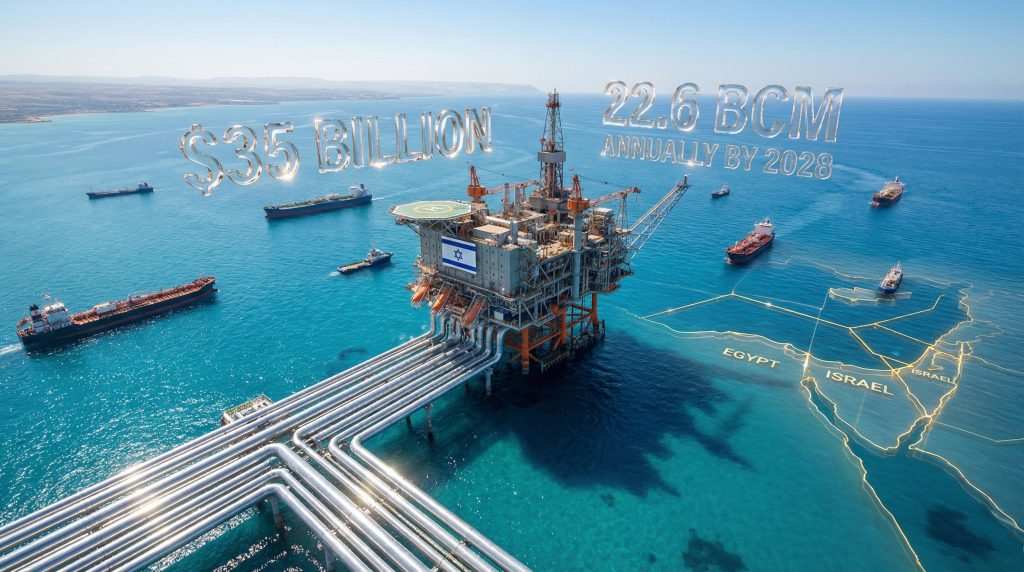
The $35 billion Israel Egypt natural gas deal announced in August 2025 represents a fundamental reconfiguration of Eastern Mediterranean energy trade relationships. Egypt will significantly increase contracted purchases from Israel's Leviathan field beginning in 2026, creating unprecedented supply interdependence between two historically complex regional partners. This arrangement reflects broader market forces where offshore production capacity exceeds domestic consumption requirements in Israel while Egypt experiences rising industrial energy demand alongside declining production from mature domestic fields.
Regional supply-demand imbalances create natural arbitrage opportunities that drive commercial cooperation. Israel's Leviathan field, operated by Chevron on behalf of the partnership consortium, resumed full operations following ceasefire agreements in June 2025 after temporary production suspensions. The field's production capacity substantially exceeds Israeli domestic consumption, generating exportable surplus volumes that align with Egypt's growing import requirements for industrial and power generation applications.
Key market fundamentals supporting the framework include:
• Israel's offshore discoveries providing 15-20 years of exportable surplus beyond domestic needs
• Egypt's mature field decline rates creating annual import requirement increases
• Pipeline gas cost advantages versus spot LNG procurement during normal market conditions
• Regional infrastructure development enabling efficient cross-border transmission
• Long-term contract pricing providing stability against volatile global energy markets
Turkey's recent $30 billion Black Sea gas discovery at the Goktepe 3 field, announced in May 2025 following 49 days of drilling operations, demonstrates the scale of regional hydrocarbon potential. This 75 billion cubic metre discovery reinforces Eastern Mediterranean emergence as a significant global gas province, while creating additional competitive dynamics for regional supply arrangements and export market access.
Furthermore, geopolitical risk strategies must account for energy interdependence as a diplomatic stabilisation mechanism. Long-term supply contracts create mutual economic incentives for political cooperation and conflict avoidance, as supply disruptions would impose substantial costs on both exporting and importing parties. However, these arrangements also create vulnerability to political tensions that could affect infrastructure security and contract performance over multi-decade timeframes.
Egypt's Strategic Energy Import Portfolio Optimisation
Egypt's energy import strategy demonstrates sophisticated portfolio diversification aimed at reducing dependency on volatile global LNG markets whilst supporting industrial competitiveness objectives. The expanded Israel Egypt natural gas deal complements domestic production enhancement initiatives, including BP's five-well drilling programme announced in September 2025. BP's memorandum of understanding with the Egyptian government targets production increases to 2.3-2.5 million barrels of oil equivalent per day by 2030, with additional capacity expansion potential through 2035.
Import dependency analysis reveals strategic considerations:
• Current Israeli gas representing approximately 20% of total Egyptian consumption prior to expansion
• Projected industrial sector demand growth supporting manufacturing export competitiveness
• Foreign exchange savings from reduced spot LNG procurement requirements
• Energy security enhancement through geographic supply diversification
• Price stability benefits for energy-intensive industrial sectors including petrochemicals and fertilisers
Pipeline gas imports typically provide 20-40% cost advantages compared to spot LNG during normal market conditions, based on historical price differentials between pipeline and LNG benchmarks. This cost differential directly enhances industrial sector competitiveness, particularly for energy-intensive manufacturing that generates foreign exchange revenues through exports.
Egypt's petrochemical and fertiliser industries represent significant foreign exchange generators where stable energy input costs translate directly to export margin improvements. Fertiliser production, heavily dependent on natural gas feedstock for ammonia synthesis, benefits substantially from predictable supply pricing and volume availability. Energy costs typically represent 40-60% of total fertiliser production expenses, making reliable gas supply arrangements critical for export competitiveness.
The integration of increased Israeli pipeline imports with BP's domestic production enhancement creates a balanced portfolio approach addressing multiple supply security objectives. Domestic production provides sovereign control and emergency supply flexibility, whilst pipeline imports offer cost optimisation and volume scalability. This combination reduces reliance on spot LNG markets whilst maintaining procurement flexibility during peak demand periods or supply disruptions.
Disclaimer: Energy demand projections and industrial growth assumptions involve significant uncertainty and may be affected by economic conditions, policy changes, and technological developments not currently anticipated.
Infrastructure Development and Investment Requirements
The Israel Egypt natural gas deal requires sophisticated infrastructure development to support planned export volumes reaching 22.6 billion cubic metres annually by 2028. The Nitzana pipeline system serves as the primary transmission infrastructure, requiring expansion phases and capacity optimisation to accommodate increased throughput requirements. Total infrastructure investment includes $610 million in engineering, procurement, and construction contracts, with financing structures combining private sector equity, debt arrangements, and potential government guarantees.
Cross-border pipeline infrastructure development involves multiple technical and regulatory complexities. Subsea export systems from Israeli offshore fields require advanced engineering specifications accounting for Mediterranean marine environments, seismic activity considerations, and international maritime jurisdiction requirements. Modern offshore gas export pipelines typically feature steel construction with concrete weight coating or pipe-in-pipe systems for thermal and structural efficiency.
Infrastructure specifications include:
• Subsea isolation valves at defined intervals for sectional pressure control
• Pipeline protection systems against fishing activities and anchoring hazards
• Cathodic protection systems for long-term corrosion prevention
• Centrifugal compression stations maintaining export pressure requirements
• Receiving terminal facilities with metering and custody transfer equipment
Regional infrastructure development patterns demonstrate the capital intensity required for comparable projects. Turkey's Sakarya field Phase 3 development involves major contracts including Subsea7's subsea systems installation and Baker Hughes' subsea production systems and intelligent completions. In addition, Turkish state company TPAO's $4 billion debt issuance programme announced in November 2025 for Black Sea gas expansion indicates infrastructure investment scales exceeding single-digit billions for significant regional developments.
Compression infrastructure represents critical technical requirements for maintaining pipeline throughput capacity. Export volumes of 22.6 bcm annually require compression staging at multiple points along transmission systems, with centrifugal compressors providing pressure maintenance. Power consumption for compressor drive systems represents ongoing operational costs and environmental considerations for carbon footprint management.
Egyptian receiving infrastructure must accommodate increased import volumes through expanded inlet manifolds, pressure reduction systems, and distribution network interconnections. Storage tank provisions provide surge capacity management during demand fluctuations, whilst quality assurance systems ensure compliance with Egyptian gas specifications and distribution network requirements.
Domestic Market Protection Mechanisms and Export Economics
The Israel Egypt natural gas deal incorporates domestic market protection provisions ensuring Israeli energy security whilst optimising export revenue generation. Supply priority protocols guarantee domestic consumption receives allocation preference during production disruptions, preventing export commitments from compromising national energy security requirements. These mechanisms balance commercial optimisation objectives with sovereign resource management responsibilities.
Government revenue structures from the expanded arrangement include royalty payments, typically 12.5-16.67% of gross sales value for Israeli offshore production based on standard international practice. Corporate income tax on operator profits, royalty and licence fee payments, and upstream capital allowances create predictable government revenue streams extending across budget planning horizons. The Israel-Egypt $35 billion gas deal provides revenue certainty supporting long-term infrastructure investment and economic development planning.
Revenue optimisation strategies encompass:
• Government royalty structures from increased production volumes
• Tax implications of long-term export commitments
• Economic multiplier effects from upstream investment
• Regional development impacts in southern Israel border areas
• Foreign exchange generation supporting balance of payments
Contract price mechanisms typically employ indexed pricing tied to external benchmarks such as Brent crude, LNG spot prices, or regional gas pricing indices. This provides market exposure whilst maintaining pricing predictability through formula-based adjustments. Hybrid pricing formulas may combine fixed components with indexed elements, balancing revenue certainty against market opportunity optimisation.
Furthermore, regulatory compliance requirements may reduce export profitability compared to unrestricted export scenarios, but provide political legitimacy for export authorisation and protection against future supply crises. Mandatory domestic supply guarantees create negotiating leverage with international buyers whilst ensuring continued public support for offshore resource development programmes.
Regional Competition and Market Evolution Scenarios
Eastern Mediterranean gas market dynamics reflect increasing competition as multiple countries develop offshore hydrocarbon resources and establish regional supply arrangements. Cyprus and Lebanon advance offshore development timelines whilst Turkey's Black Sea discoveries affect regional supply balance calculations. These developments create competitive pressures for market share and infrastructure utilisation whilst potentially benefiting consumers through increased supply availability.
Croatia's recent offshore confirmation adds to regional supply diversity. INA confirmed new offshore gas reserves in Croatia's Northern Adriatic following early production testing delivering 120,000 cubic metres per day from a new development well in December 2025. This discovery represents additional European Union domestic production capacity, reducing regional import requirements and affecting demand for Eastern Mediterranean export volumes.
Regional competition scenarios include:
• Cyprus and Lebanon offshore development affecting supply availability
• Turkish Black Sea production timeline and export capacity
• Egyptian LNG export facility utilisation competing for domestic gas supply
• European import demand evolution and supply source diversification
• North African pipeline gas competition from Algeria and Libya
Greece's energy expansion strategy demonstrates regional market development patterns. Chevron, in partnership with Helleniq Energy, submitted bids to explore four offshore gas blocks near Crete and the Peloponnese in September 2025. This initiative aligns with Greece's domestic resource development objectives whilst supporting European energy security diversification away from traditional Russian supply sources.
Regional energy integration creates opportunities for interconnection projects linking multiple national gas networks. Pipeline interconnections could enable supply flexibility during maintenance periods, emergency situations, or demand fluctuations. However, these arrangements require complex bilateral agreements addressing operational protocols, capacity allocation, and cost sharing mechanisms.
For instance, competition with North African and Russian pipeline gas to European markets affects long-term demand projections for Eastern Mediterranean exports. Libya's eastern parliament potential approval for Turkish energy exploration, reported in August 2025, could create additional supply competition whilst strengthening Turkey's regional energy position through diversified resource access.
The next major ASX story will hit our subscribers first
Geopolitical Risk Management and Contract Performance
Long-term energy agreements in geopolitically sensitive regions require comprehensive risk mitigation frameworks addressing potential conflicts, infrastructure security concerns, and diplomatic relationship changes. The Israel Egypt natural gas deal incorporates force majeure clauses covering security disruptions, international arbitration mechanisms for dispute resolution, and insurance coverage for political and operational risks throughout the contract duration.
Risk mitigation strategies encompass:
• Force majeure provisions protecting against military conflicts and security disruptions
• International arbitration mechanisms ensuring neutral dispute resolution
• Political risk insurance coverage through multilateral development banks
• Alternative supply arrangements during extended crisis periods
• Emergency response protocols for infrastructure protection and repair
Energy interdependence creates both stabilisation incentives and vulnerability concerns. Supply disruptions impose substantial economic costs on both countries, creating mutual interests in maintaining operational continuity and political cooperation. However, infrastructure assets remain vulnerable to security threats, requiring ongoing protection measures and contingency planning for various disruption scenarios.
Regional security arrangements supporting energy infrastructure may involve multilateral cooperation including international monitoring, maritime security coordination, and diplomatic mediation capabilities. According to advanced strategic analysis, the United States historically plays mediation roles in maintaining commercial relationships between regional partners, providing diplomatic support for economic cooperation arrangements that enhance regional stability.
Insurance markets provide specialised coverage for political risks, operational disruptions, and infrastructure damage in complex geopolitical environments. Premium costs reflect assessed risk levels whilst providing financial protection against various contingency scenarios. Multilateral development bank guarantees may reduce insurance costs whilst providing additional political risk protection through international institution involvement.
Market Scenarios and Pricing Evolution Dynamics
Future market conditions affecting the Israel Egypt natural gas deal performance include European energy transition timelines, regional LNG market price volatility, and Egyptian industrial growth scenarios. Climate policy developments may influence long-term gas demand projections whilst technological advances in renewable energy could affect the relative competitiveness of natural gas in power generation applications.
Demand projection variables include:
• Egyptian industrial expansion rates affecting gas consumption growth
• European Union energy transition policies influencing import demand
• Regional LNG market price volatility impacts on contract pricing formulas
• Climate policy implications for long-term fossil fuel demand
• Technology developments affecting gas-fired power generation competitiveness
Supply-side contingency considerations encompass additional Israeli offshore discoveries expanding exportable reserve bases, production optimisation through enhanced recovery techniques, and alternative supply source development for Egyptian market diversification. The Leviathan field may achieve production increases through technology upgrades and enhanced extraction methods, potentially exceeding initial capacity projections.
Regional pipeline interconnection possibilities could create supply flexibility and market access optimisation opportunities. Connections between Egyptian, Israeli, Cypriot, and potentially Turkish gas networks might enable supply routing optimisation based on seasonal demand patterns and infrastructure availability. However, these arrangements require complex multinational agreements and substantial infrastructure investments.
Azerbaijan's partnership with Israel through offshore gas exploration agreements, signed in March 2025, demonstrates evolving regional cooperation patterns. A consortium including Azerbaijan's Socar, BP Plc, and Israel's NewMed Energy LP received exploration rights for one offshore block, creating potential additional supply sources for regional markets whilst strengthening bilateral relationships.
Long-term Energy Security and Regional Integration Implications
The Israel Egypt natural gas deal positions both countries within broader energy transition scenarios whilst maintaining fossil fuel supply security through regional cooperation. Energy security enhancement through reduced dependency on volatile global markets provides economic stability supporting industrial development and export competitiveness objectives. Infrastructure development attracts additional foreign investment whilst deepening bilateral economic relationships beyond energy sector cooperation.
Strategic positioning benefits encompass:
• Reduced exposure to global LNG market price volatility through pipeline supply diversity
• Regional supply chain resilience building through infrastructure interconnection
• Technology development opportunities in offshore production optimisation
• International energy company confidence enhancement in regional political stability
• Long-term economic partnership deepening across multiple commercial sectors
Investment climate improvements result from successful implementation of complex cross-border energy projects demonstrating regulatory predictability and dispute resolution effectiveness. International energy companies assess regional political risk based on historical contract performance and government cooperation in commercial arrangements. Successful execution creates precedent encouraging additional foreign investment in offshore exploration and development projects.
Regional energy hub development potential emerges from infrastructure investments supporting multiple bilateral supply arrangements. Egypt's geographic position enables potential interconnection with North African pipeline systems, creating opportunities for transit revenue generation and supply flexibility enhancement. However, hub development requires substantial additional infrastructure investments and multinational coordination agreements.
Consequently, technology transfer opportunities arise through international operator involvement in complex offshore development projects. Advanced subsea production systems, enhanced recovery techniques, and infrastructure monitoring technologies provide capabilities applicable to future domestic and regional energy projects. Knowledge transfer through joint venture arrangements and technical service contracts builds domestic technical capabilities supporting long-term energy sector development.
Moreover, the success of this framework will significantly influence broader oil price dynamics in the region, whilst demonstrating how regional partnerships can adapt to evolving US natural gas forecast trends. These developments showcase how strategic energy alliances can help navigate complex global oil market influence patterns effectively.
Investment Disclaimer: Energy sector investments involve substantial risks including commodity price volatility, regulatory changes, geopolitical developments, and technological disruptions. Past performance does not guarantee future results, and investors should conduct thorough due diligence before making investment decisions.
Key Strategic Implications:
This comprehensive energy partnership represents a fundamental transformation in Eastern Mediterranean energy architecture, establishing new frameworks for regional cooperation whilst addressing immediate supply security requirements. The arrangement's success will influence future bilateral energy cooperation models and international investment patterns in offshore development projects across strategically important regions worldwide. Market participants should monitor implementation progress, infrastructure development timelines, and regional competitive responses when evaluating investment opportunities and supply chain strategies in Eastern Mediterranean energy markets.
Looking to Capitalise on Energy Market Transformations?
Discovery Alert's proprietary Discovery IQ model instantly identifies significant ASX mineral discoveries across critical energy transition commodities, delivering real-time insights that help investors position ahead of major market movements. Start your 30-day free trial at Discovery Alert today to gain the market-leading advantage needed in rapidly evolving energy and commodities sectors.