June 6, 2026
Strategic Infrastructure Development Reshaping Global Trade Networks
Global supply chains face unprecedented vulnerability as geopolitical tensions intensify around critical maritime chokepoints. Traditional shipping routes that have facilitated international commerce for decades now represent single points of failure capable of disrupting trillions of dollars in annual trade flows. Against this backdrop of supply chain fragility, a transformative infrastructure initiative emerges to fundamentally restructure how goods, energy, and data move between Asia, the Middle East, and Europe.
The convergence of technological advancement, strategic necessity, and multilateral cooperation has created conditions for the most ambitious connectivity project since the Suez Canal's construction. This initiative represents more than infrastructure development; it embodies a strategic response to chokepoint dependencies that have left global commerce exposed to regional instability and geopolitical leverage.
When big ASX news breaks, our subscribers know first
Understanding IMEC's Comprehensive Infrastructure Framework
The India-Middle East-Europe Economic Corridor emerged from the G20 Summit in New Delhi on September 9, 2023, as a multilateral initiative spanning three continents and eight participating nations. Unlike traditional bilateral arrangements, this corridor establishes a rules-based framework emphasizing democratic governance principles and transparent procurement processes across all participating jurisdictions.
The corridor's architecture encompasses four integrated infrastructure layers designed to create redundancy and resilience across multiple transport modalities:
- Maritime Networks: Advanced port facilities connecting Mumbai, Mundra, Jebel Ali, and Mediterranean terminals
- Railway Connectivity: Standard gauge rail systems spanning Saudi Arabia, Jordan, and potential Israeli integration points
- Energy Infrastructure: Clean hydrogen production facilities and integrated electricity grids
- Digital Backbone: Submarine fiber optic cables and terrestrial telecommunications networks
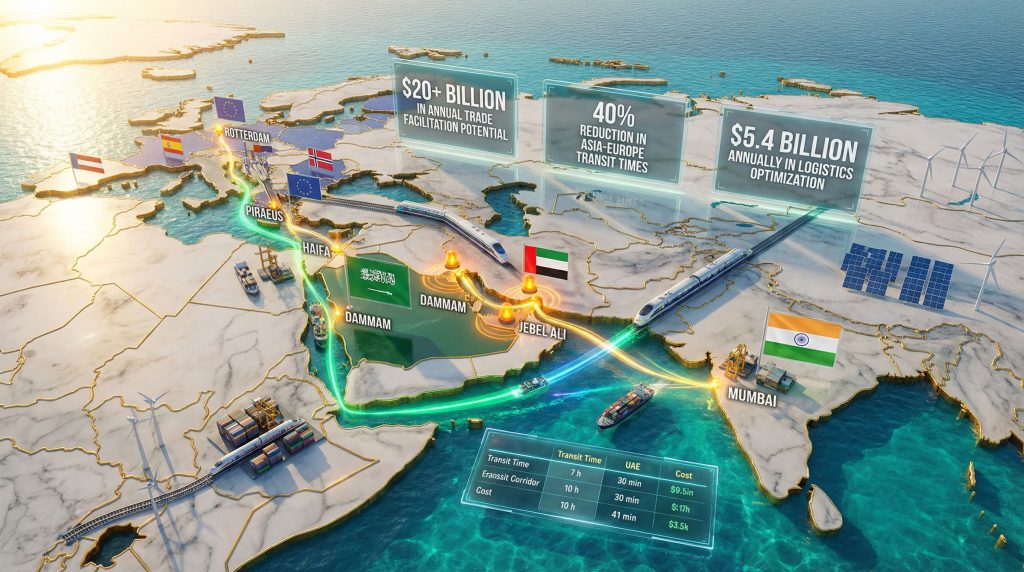
Geographic scope extends approximately 8,000 kilometers across Asia, the Middle East, and Europe, creating the world's most extensive multi-modal trade corridor. The initiative targets $20 billion in annual trade facilitation potential while reducing Asia-Europe transit times by 40%, from current 20-day averages to projected 12-day delivery schedules.
Core participating nations include India, the United States, Saudi Arabia, UAE, Israel, France, Germany, and Italy, with additional European Union integration planned through Mediterranean gateway ports. This broad coalition represents $45 trillion in combined GDP and encompasses critical energy producers, manufacturing centers, and consumer markets.
Critical Vulnerabilities Exposing Traditional Shipping Routes
Contemporary global trade infrastructure suffers from dangerous concentration risks that have materialized into sustained supply chain disruptions. The Strait of Hormuz, through which 21% of global petroleum liquids transit annually, represents the world's most critical energy chokepoint. This narrow waterway, measuring just 34 miles at its widest point, constrains shipping lanes to 3 miles in each direction, creating mandatory routing for all westbound Middle Eastern energy exports.
Annual trade volume of approximately $3.4 trillion flows through the Strait of Hormuz, making any disruption capable of triggering immediate global energy price volatility. Iran's geographic position enables significant leverage over international energy markets, with military or political escalation potentially disrupting supplies within hours rather than days.
Red Sea Disruption Patterns and Economic Impact
The ongoing Red Sea crisis, now extending into its 18th month as of April 2026, demonstrates the cascading effects of chokepoint vulnerabilities. Maritime attacks have resulted in:
- Insurance premium increases of 300-500% for Suez Canal transit routes
- Container shipping delays averaging 2-3 weeks additional transit time
- Cape of Good Hope diversions adding 14-20 days and increasing logistics costs by 15-20%
- Major shipping line suspensions including Maersk, MSC, and CMA CGM announcing Red Sea route cancellations
| Route | Transit Time | Annual Volume | Risk Level | Cost Premium |
|---|---|---|---|---|
| Suez Canal | 8-12 days | $1 trillion | High | Baseline |
| Cape of Good Hope | 14-20 days | Diverted traffic | Medium | +15-20% |
| IMEC Corridor | 10-14 days | Projected $500B | Low-Medium | -10-15% |
Historical disruption analysis reveals consistent patterns of chokepoint vulnerability dating back to the 1973 Yom Kippur War oil embargo, the 1979 Iran Revolution creating 5.7 million barrels per day production loss, and the 1980-1988 Iran-Iraq War tanker conflicts. Most recently, the 2019 Aramco facility attacks demonstrated how single incidents can temporarily disrupt 5.7 million barrels per day of global oil supply.
Lloyd's of London war risk coverage has surged from baseline rates of approximately £0.10-0.20 per $100 insured value to £2.00-3.50 per $100 value for Suez transit, representing a 1,000-1,750% increase in insurance costs for affected shipping routes.
Multi-Modal Infrastructure Design Addressing Regional Vulnerabilities
The India-Middle East-Europe Economic Corridor employs sophisticated risk mitigation strategies through diversified infrastructure networks that eliminate single-point-of-failure dependencies. Each corridor component operates independently while maintaining integrated connectivity, ensuring that disruptions in one modality do not cascade into system-wide failures.
Eastern Maritime Corridor Development
Port capacity expansion represents the corridor's foundation, with Mumbai targeting 400+ million tonnes annually and Mundra aiming for 300+ million tonnes capacity through $8 billion in modernization investments. These facilities incorporate automated container handling systems reducing dwell times from 3-4 days to 24-36 hours, significantly improving supply chain velocity.
TEU (Twenty-foot Equivalent Unit) capacity of 3 million annually for India-UAE maritime links provides substantial throughput for containerized cargo. Jebel Ali port enhancement in Dubai serves as the regional trans-shipment hub, currently handling 15+ million TEU annually with expansion potential to 25+ million TEU within the next decade.
Advanced port technologies include:
- Real-time cargo tracking and manifest management systems
- Intermodal transfer facilities enabling seamless port-rail-pipeline transitions
- Cold chain infrastructure for perishable goods maintaining temperature integrity
- Automated gate systems reducing truck processing times to under 30 minutes
Northern Rail Network Integration
Railway connectivity employs standard gauge (1,435mm) specifications aligning with European systems, facilitating seamless cross-border operations. The network targets 200+ million tonnes annual cargo capacity through dual-track configurations enabling bi-directional traffic optimization.
Technical specifications include:
- Electrified locomotive systems reducing operational costs by 30-40%
- Automated signaling and traffic management systems
- Container handling equipment at strategic junction points
- Integration with existing Gulf Cooperation Council rail networks
Saudi Arabia's existing rail infrastructure provides the backbone for regional connectivity, while Jordan requires significant capacity expansion to accommodate projected throughput volumes. Potential Israeli rail integration would create direct Mediterranean access, though political alignment remains under negotiation.
Energy Infrastructure Transformation
Clean hydrogen production leverages Gulf states' 35% share of global natural gas reserves, positioning the region as an ideal hydrogen hub for European green transition requirements. High-pressure hydrogen pipelines operating at 40-100 bar pressure would parallel existing oil and gas infrastructure corridors, minimizing construction costs and environmental impact.
Electricity grid interconnection builds upon the existing Gulf Cooperation Council electrical grid serving 150+ million people since 2001. Expansion potential includes Mediterranean integration enabling renewable energy trading across three continents.
Pipeline technical requirements encompass:
- Corrosion-resistant materials and safety redundancy systems
- Compressor stations at 200-300 kilometer intervals for hydrogen networks
- Integration points with existing natural gas infrastructure
- Emergency shutdown systems and leak detection technologies
Digital Connectivity Infrastructure
Submarine cable systems provide the corridor's digital backbone, with proposed 400+ terabits per second capacity through new Mediterranean-Red Sea-Indian Ocean fiber optic connectivity. Existing SEA-ME-WE (Southeast Asia–Middle East–Western Europe) undersea cable systems already connect portions of this corridor, providing foundation infrastructure for expansion.
The digital infrastructure layer ensures that data flows seamlessly across the corridor, enabling real-time tracking, automated customs processing, and integrated supply chain management across multiple jurisdictions.
Economic Opportunities Across Participating Regions
India's Manufacturing Competitiveness Enhancement
Projected annual export increases of $21.85 billion represent potential 5-8% growth in India's total export performance, primarily through logistics cost reductions of 10-15%. Enhanced access to the $18 trillion European Union market positions Indian manufacturers to compete more effectively against Asian competitors currently benefiting from shorter supply chains.
Current India-EU trade of approximately $120 billion annually faces projected 15-20% increases within five years through corridor operations. Furthermore, how tariffs impact markets affects trade dynamics across these routes, making alternative corridors increasingly valuable. Key sectors benefiting include:
- Pharmaceutical products: Reduced cold chain costs and faster delivery times
- Textile and apparel: Competitive transportation costs improving margin structures
- Information technology services: Enhanced digital connectivity supporting service delivery
- Automotive components: Just-in-time manufacturing support through reliable logistics
Middle Eastern Economic Transformation
UAE logistics hub positioning capitalizes on Dubai's current 15+ million TEU annual port operations, with corridor-related expansion targeting 25+ million TEU capacity within the decade. This growth supports Vision 2030 objectives for economic diversification beyond oil dependency.
Saudi Arabia's Vision 2030 alignment allocates $500+ billion across transportation, ports, and energy sectors, with IMEC integration providing strategic focus for infrastructure investments. Regional transit revenue potential of $8-12 billion annually from corridor operations creates sustainable income streams supporting economic transformation objectives.
The Kingdom's East-West Pipeline serves as an operational model, demonstrating successful Strait of Hormuz bypass capabilities since 1981 with 0.5 million barrels per day capacity. Energy sector executives describe this infrastructure as strategic foresight that enables continued exports during regional tensions.
European Supply Chain Resilience
China dependency reduction represents a critical strategic objective, with current European supply chains maintaining 35-45% dependency on routes controlled or influenced by Chinese infrastructure. In addition, US‑China trade tensions continue to complicate global supply chain arrangements. IMEC diversification could reduce this dependency to 15-20% within a decade, enhancing strategic autonomy for European nations.
Energy security enhancement through diversified Middle Eastern connections reduces European gas and oil import concentration from single suppliers. Critical minerals access for green transition initiatives addresses current challenges where 60%+ rare earth processing remains dominated by Chinese operations.
European benefits include:
- Reduced transportation costs: 10-15% logistics savings across multiple industries
- Faster delivery times: 40% reduction in Asia-Europe transit schedules
- Supply chain diversification: Multiple routing options reducing disruption risks
- Green transition support: Clean hydrogen access supporting carbon neutrality objectives
IMEC Comparison with China's Belt and Road Initiative
Governance Framework Differentiation
The India-Middle East-Europe Economic Corridor operates through multilateral governance structures emphasizing democratic oversight and transparent decision-making processes. Unlike bilateral arrangements common in alternative infrastructure initiatives, IMEC employs rules-based frameworks with standardized procurement procedures and environmental compliance requirements.
Financial structure analysis reveals fundamental differences in funding approaches:
| Aspect | IMEC Framework | Alternative Approaches |
|---|---|---|
| Financing | Multilateral development banks | State lending mechanisms |
| Governance | Democratic oversight | Bilateral agreements |
| Standards | Environmental compliance | Project-specific requirements |
| Transparency | Open procurement | Closed tender processes |
Debt sustainability focus ensures participating nations maintain fiscal health while developing infrastructure capacity. This approach contrasts with concerns about debt-trap diplomacy associated with alternative infrastructure financing models.
Strategic Implications
Western alliance strengthening occurs through economic integration rather than military cooperation, creating durable partnerships based on mutual economic benefit. Democratic values promotion through connectivity projects establishes precedents for rules-based international infrastructure development.
The corridor provides a counter-narrative to authoritarian infrastructure influence, demonstrating that democratic nations can deliver large-scale infrastructure projects while maintaining transparency and environmental standards.
The next major ASX story will hit our subscribers first
Technical Implementation Challenges and Solutions
Cross-Border Regulatory Harmonization
Customs procedures standardization across 8+ participating countries requires extensive coordination to establish unified documentation and inspection processes. Digital trade facilitation platforms must integrate with existing national systems while maintaining cybersecurity standards and data sovereignty requirements.
Mutual recognition agreements for goods and services streamline border crossings while maintaining quality and safety standards. Key harmonization areas include:
- Technical standards alignment: Product specifications and testing procedures
- Certification processes: Mutual recognition of inspection and approval systems
- Documentation requirements: Standardized shipping and customs paperwork
- Digital integration: Interconnected tracking and manifest systems
Infrastructure Integration Complexities
Rail gauge compatibility across different national systems requires careful coordination, with standard gauge (1,435mm) specifications providing consistency across most corridor segments. Port capacity coordination ensures balanced throughput across multiple facilities, preventing bottlenecks that could constrain overall corridor performance.
Energy grid interconnection demands sophisticated technical specifications for cross-border electricity trading and hydrogen pipeline operations. Emergency response coordination mechanisms establish protocols for incident management across multiple jurisdictions.
Security and Operational Considerations
Cybersecurity frameworks for digital infrastructure protect against state and non-state actor threats targeting critical corridor operations. Physical security protocols for critical segments establish protection standards while maintaining operational efficiency.
Security measures encompass:
- Threat assessment protocols: Regular evaluation of regional security environments
- Incident response procedures: Coordinated crisis management across participating nations
- Information sharing mechanisms: Intelligence cooperation supporting corridor protection
- Backup system activation: Alternative routing during security incidents
Energy Market Transformation Through IMEC
Hydrogen Economy Development
Clean hydrogen production facilities in Gulf states leverage abundant natural gas reserves and increasing renewable energy capacity to establish cost-competitive hydrogen supply chains. Pipeline infrastructure for European green transition creates dedicated pathways for clean energy exports, supporting carbon neutrality objectives across participating regions.
Cost competitiveness analysis indicates Gulf-produced hydrogen could achieve $2-3 per kilogram delivered costs to European markets by 2030, competing favorably with domestic European production costs exceeding $4-5 per kilogram.
Renewable Energy Integration
Solar and wind capacity expansion in corridor countries provides foundation energy for hydrogen production and grid interconnection systems. Furthermore, pumped hydro projects across European nations complement renewable energy development by providing essential storage capacity. Storage solutions for intermittent renewable sources ensure reliable energy delivery across the integrated corridor network.
Regional renewable energy potential includes:
- Saudi Arabia: 40+ gigawatts planned solar capacity by 2030
- UAE: 25+ gigawatts renewable capacity targets
- Jordan: 3+ gigawatts renewable energy development programs
- India: 500+ gigawatts renewable capacity objectives by 2030
Traditional Energy Route Diversification
Oil and gas pipeline alternatives to Strait of Hormuz shipping reduce chokepoint dependencies while maintaining export capacity. LNG terminal development creates flexible supply options adapting to market demand fluctuations.
Strategic petroleum reserve coordination between partners enhances collective energy security, enabling rapid response to supply disruptions while maintaining market stability.
Investment Opportunities and Financial Requirements
Infrastructure Investment Scale
Total project financing needs exceed $100 billion across all corridor components, requiring sophisticated public-private partnership structures to mobilize necessary capital. Multilateral development bank participation provides patient capital and technical expertise supporting long-term infrastructure development.
Investment categories include:
- Port development: $25-30 billion for facility expansion and modernization
- Railway construction: $40-50 billion for new track and equipment
- Energy infrastructure: $20-25 billion for pipelines and production facilities
- Digital systems: $5-8 billion for telecommunications and data networks
Sector-Specific Investment Opportunities
Logistics and technology sectors benefit from port automation requirements, digital platform development, and integrated tracking systems. Rail technology and rolling stock manufacturing support corridor connectivity requirements while building regional industrial capacity.
Telecommunications infrastructure and 5G deployment enable real-time corridor management and digital trade facilitation across multiple jurisdictions.
Energy Transition Investments
Renewable energy project development opportunities span all corridor countries, supporting both domestic energy needs and export capacity development. Hydrogen production and distribution infrastructure creates new industrial sectors while supporting global decarbonization objectives.
Carbon capture and storage technology deployment enhances environmental performance across energy-intensive corridor operations, supporting climate commitments while maintaining economic competitiveness.
Regional Geopolitical Dynamics Reshaping
Israel-Arab Economic Integration
Economic interdependence benefits through joint infrastructure projects foster cooperation across traditional political divisions. Technology transfer and innovation ecosystem development create shared interests supporting long-term regional stability.
The corridor's success depends partly on sustained cooperation between Israel and Arab partner nations, with economic incentives potentially strengthening diplomatic normalization processes initiated through Abraham Accords frameworks. Additionally, understanding trump tariffs effects on regional trade relationships helps inform strategic planning across participating nations.
Strategic Alignment with Allied Interests
US strategic interests align with corridor development through countering Chinese influence in critical regions while strengthening democratic partnerships. Energy security enhancement for allied nations reduces dependency on potentially hostile actors and unreliable supply chains.
The initiative supports broader Western strategic objectives of maintaining rules-based international systems while providing economic alternatives to authoritarian infrastructure initiatives.
Iran's Strategic Position
Reduced leverage over regional energy flows through alternative routing diminishes Iran's ability to threaten global energy supplies through Strait of Hormuz disruption. Economic pressure through successful alternative route development could influence Iranian strategic calculations regarding regional confrontation costs.
Diplomatic implications of corridor success demonstrate that regional isolation can result from aggressive policies threatening international commerce and energy security.
Implementation Timeline and Strategic Milestones
Phase 1: Foundation Building (2024-2026)
Memoranda of Understanding finalization establishes legal frameworks for cross-border cooperation and investment coordination. Initial infrastructure project launches begin with port expansion and railway planning initiatives.
Regulatory framework establishment creates harmonized standards for operations, environmental protection, and cross-border commerce facilitation.
Phase 2: Core Infrastructure Development (2026-2030)
Major port and rail construction completion delivers operational capacity for initial corridor segments. Energy pipeline commissioning establishes hydrogen and electricity connectivity between participating regions.
Digital connectivity platform deployment enables integrated cargo tracking, customs processing, and supply chain management across all corridor segments.
Phase 3: Full Operational Capacity (2030-2035)
Complete corridor functionality achievement realizes full multi-modal connectivity across all participating regions. Trade volume targets realization demonstrates corridor success through measurable economic impact metrics.
Economic integration deepening creates sustained partnerships extending beyond infrastructure cooperation into broader trade, investment, and technological collaboration frameworks.
Strategic Implications for Global Trade Architecture
The India-Middle East-Europe Economic Corridor represents a fundamental transformation in global trade infrastructure, establishing resilient alternatives to vulnerable chokepoints while promoting democratic governance principles through economic integration. Success requires sustained political commitment across multiple sovereign jurisdictions, coordinated investment mobilization, and effective risk management strategies addressing security, technical, and financial challenges.
The corridor's development could reshape global trade patterns for decades, reducing dependency on single chokepoints while creating new economic opportunities across three continents. However, US economy tariffs and evolving protectionist policies worldwide could influence corridor trade dynamics and investment attractiveness. Its ultimate impact will depend on participating nations' ability to maintain cooperation despite changing political circumstances and regional tensions.
By establishing precedents for multilateral, rules-based infrastructure development, IMEC may influence future international cooperation frameworks while demonstrating that democratic nations can deliver large-scale connectivity projects maintaining transparency and sustainability standards.
Investment Disclaimer: Infrastructure development projects of this scale involve significant political, technical, and financial risks. Projected economic benefits, timeline estimates, and cost figures represent current planning assumptions that may change based on implementation experiences, political developments, and market conditions. Potential investors should conduct independent due diligence and risk assessment before making investment decisions related to corridor development opportunities.
The India-Middle East-Europe Economic Corridor represents a significant step towards creating alternative trade routes that bypass traditional chokepoints. According to the Atlantic Council's assessment, this corridor provides critical infrastructure diversification during a period of increasing geopolitical uncertainty, offering participating nations enhanced energy security and economic resilience.
Looking to Capitalise on Infrastructure Development Opportunities?
Discovery Alert's proprietary Discovery IQ model delivers real-time alerts on significant ASX mineral discoveries, including critical infrastructure minerals essential for global connectivity projects like IMEC. Stay ahead of infrastructure transformation trends by exploring Discovery Alert's dedicated discoveries page, showcasing historic examples of exceptional returns from major mineral discoveries.