
July 27, 2026
Strategic Investment Framework for America's Geothermal Future
Energy independence represents more than policy rhetoric in 2026. As global supply chains face unprecedented disruption and climate commitments accelerate renewable deployment timelines, the United States confronts a fundamental question about baseload power generation. Traditional renewable sources deliver intermittent capacity, creating grid stability challenges that require either fossil fuel backup systems or expensive storage infrastructure. This dynamic has shifted federal energy investment toward dispatchable renewable technologies capable of providing continuous, controllable power generation.
Enhanced geothermal systems emerge as the technological solution bridging this reliability gap. Unlike conventional geothermal development limited to naturally occurring hydrothermal resources, EGS creates artificial reservoirs through engineered fracturing techniques. This breakthrough potentially unlocks geothermal development across diverse geological formations, expanding deployment opportunities beyond traditional high-heat-flow regions concentrated in western states.
When big ASX news breaks, our subscribers know first
Federal Geothermal Initiative Transforms Clean Energy Investment Landscape
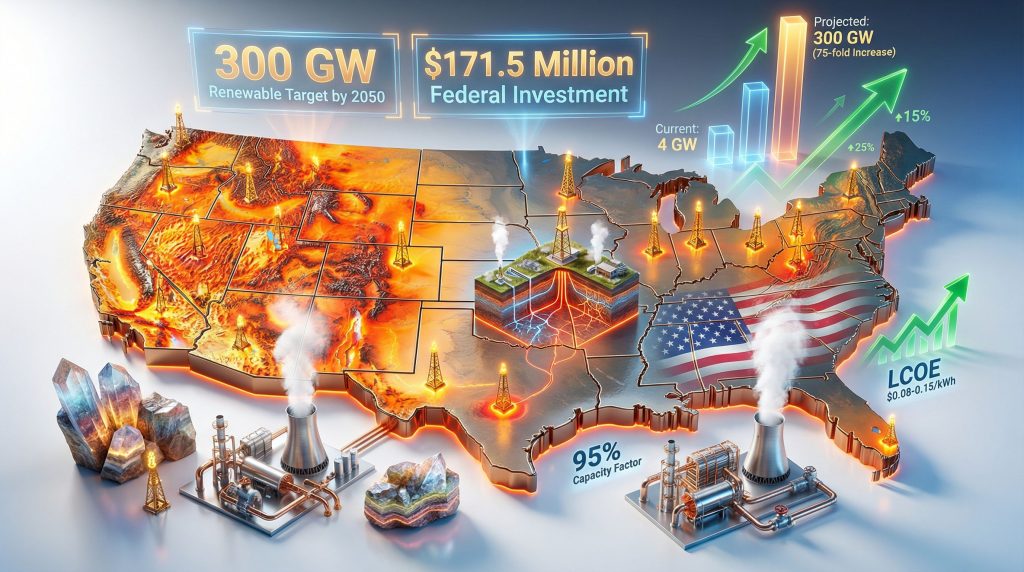
The Department of Energy's recent $171.5 million funding opportunity for geothermal energy expansion represents a strategic pivot toward domestic energy security through enhanced geothermal systems and exploration drilling programs. The Energy Department announces $171.5 million to expand US geothermal energy initiative signals unprecedented government confidence in geothermal technology's capacity to deliver baseload renewable power at industrial scale.
Strategic Investment Allocation Framework:
- Field-Scale EGS Testing: $50-80 million targeting technology validation
- Exploration Drilling Programs: $40-60 million for resource confirmation
- Characterization Studies: $20-30 million focused on risk reduction
- Innovation Partnerships: $10-20 million supporting technology transfer
Current U.S. geothermal capacity of approximately 3.7-4.0 gigawatts positions America as the global leader in geothermal electricity production. However, U.S. Geological Survey assessments indicate vast untapped potential across multiple geological formations. The federal investment strategy targets this resource base through systematic exploration and technology demonstration programs.
Enhanced geothermal systems offer distinct advantages over variable renewable sources. Where solar photovoltaic systems typically achieve 15-25% capacity factors and onshore wind reaches 35-45%, geothermal facilities consistently operate at 70-90% capacity factors. This reliability differential translates directly into grid stability value and reduced infrastructure requirements for backup power systems.
Table: Renewable Energy Capacity Factor Comparison
| Technology | Typical Capacity Factor | Grid Services | Deployment Constraints |
|---|---|---|---|
| Geothermal EGS | 70-90% | Baseload + frequency regulation | Geological assessment required |
| Solar PV | 15-25% | Energy only | Weather dependent |
| Onshore Wind | 35-45% | Variable generation | Wind resource dependent |
| Offshore Wind | 45-55% | Higher capacity factor | Transmission infrastructure |
Enhanced Geothermal Systems Address Critical Baseload Renewable Gap
America's renewable energy targets require dispatchable generation sources capable of providing continuous power without fossil fuel backup. Enhanced geothermal systems create engineered reservoirs in low-permeability rock formations through hydraulic stimulation techniques. This approach potentially enables geothermal development across broader geographic areas compared to traditional hydrothermal resources. Furthermore, these energy transition and security considerations drive federal investment priorities.
The Department of Energy's FORGE (Frontier Observatory for Research in Geothermal Energy) program demonstrates field-scale EGS principles through multiple active research sites. These demonstration projects validate engineering approaches for reservoir creation, fluid circulation optimization, and heat extraction efficiency. Success in these controlled environments provides the technical foundation for commercial-scale deployment.
Geographic Deployment Advantages:
- Resource Accessibility: EGS technology potentially applicable across diverse geological settings
- Transmission Integration: Geothermal plants provide grid stabilisation services during renewable intermittency
- Industrial Applications: Direct heat utilisation for manufacturing processes and data centre operations
- Rural Economic Development: Job creation in areas with suitable geological characteristics
Baseload renewable resources address fundamental grid reliability challenges that emerge with high renewable penetration. Unlike variable sources requiring extensive storage or backup generation, dispatchable renewables provide operators with controllable generation capacity. This characteristic proves essential for maintaining grid frequency and voltage stability during rapid demand fluctuations.
Strategic Insight: Grids with higher baseload renewable content demonstrate improved stability metrics and reduced cycling costs for thermal generation units.
International examples demonstrate geothermal's industrial integration potential. Iceland's geothermal infrastructure supports aluminium smelting operations and district heating systems serving major population centres. New Zealand utilises geothermal resources for both electricity generation and direct industrial heat applications. These models provide frameworks for expanded U.S. geothermal deployment.
Federal Funding Opportunities Deliver Multiple Investment Pathways
The funding opportunity for geothermal energy expansion encompasses diverse program structures targeting different development stages and project scales. Understanding these options enables developers to optimise capital structures and risk profiles according to specific project characteristics and organisational capabilities. In addition, these programs support broader industry evolution trends across the renewable energy sector.
DOE FORGE Initiative represents field-scale technology validation through enhanced geothermal systems in diverse geological settings. This program bridges the gap between laboratory research and commercial deployment through controlled field demonstrations. Projects target $0.10/kWh levelised cost of electricity through optimised reservoir engineering and extraction technologies.
Community Geothermal Heating Programs address distributed energy applications serving local heating demands. District heating systems utilising geothermal resources can provide cost-effective thermal energy for residential, commercial, and institutional users. These projects typically require lower capital investment compared to utility-scale electricity generation whilst delivering immediate economic benefits to participating communities.
State-Level Investment Coordination:
- Pennsylvania REP Grants: Renewable energy projects with cost-sharing requirements
- California GRDA Program: Project funding integration with state renewable energy goals
- Minnesota Planning Grants: Early-stage development support for geothermal feasibility studies
- USDA REAP Program: Rural area renewable energy development with loan guarantee options
Table: Federal Program Application Timeline
| Phase | Deadline | Requirements | Selection Criteria |
|---|---|---|---|
| Letter of Intent | March 27, 2026 | Project concept and preliminary data | Technical merit and team qualifications |
| Full Application | April 30, 2026 | Comprehensive proposal | Financial viability and environmental compliance |
| Review Period | Q3 2026 | Expert panel evaluation | Competitive scoring across multiple criteria |
| Award Notification | Q4 2026 | Contract negotiation | Final due diligence and compliance verification |
Application success correlates strongly with demonstrated private sector commitment and technical readiness. Projects showing substantial cost-sharing from private investors typically receive higher evaluation scores compared to grant-dependent proposals. This preference reflects federal policy objectives of leveraging public investment to attract private capital whilst ensuring commercial viability.
Project Success Factors Optimise Federal Funding Application Outcomes
Successful geothermal project funding requires systematic approach to technical, financial, and organisational preparation. Federal evaluation processes emphasise resource confirmation, technology maturity, environmental compliance, and financial soundness across all program categories. However, avoiding investment risk signals remains crucial throughout the application process.
Technical Readiness Assessment Framework:
- Resource Confirmation: Detailed geological surveys with temperature and flow rate documentation
- Technology Maturity: Proven drilling methodologies and extraction system specifications
- Environmental Compliance: Completed National Environmental Policy Act assessments
- Grid Integration: Interconnection studies and utility partnership agreements
Resource documentation requires third-party geological assessment validating temperature profiles, permeability characteristics, and fluid chemistry. Enhanced geothermal systems demand additional analysis of fracture potential and stress field orientation. This technical foundation enables accurate cost estimation and performance projection for both drilling operations and long-term production.
Financial Structure Optimisation Strategies:
- Cost-Share Maximisation: Leverage multiple funding sources reducing federal grant dependency
- Private Investment Commitment: Demonstrate equity and debt financing from qualified investors
- Revenue Security: Execute long-term power purchase agreements with creditworthy utilities
- Risk Mitigation: Secure insurance coverage for geological and technical development risks
Projects demonstrating substantial private funding commitment show significantly higher approval rates in federal competition. This correlation reflects both investor due diligence validation and federal preference for market-driven deployment. Private investment signals indicate independent verification of technical feasibility and commercial viability.
Documentation Requirements:
- Geological resource assessments with independent third-party validation
- Engineering feasibility studies including comprehensive drilling cost estimates
- Environmental impact assessments with detailed mitigation strategies
- Financial projections incorporating sensitivity analysis for key variables
- Community engagement documentation demonstrating local stakeholder support
Investment Tax Incentives Enhance Geothermal Project Economics
Federal tax credit structures provide substantial financial benefits for geothermal development whilst supporting broader renewable energy deployment objectives. Understanding credit mechanics and optimisation strategies enables developers to maximise project returns and improve competitive positioning. Consequently, these incentives complement effective asset allocation strategies for portfolio diversification.
Investment Tax Credit (ITC) Analysis:
- Current Rate: 30% through December 31, 2025
- Step-Down Schedule: 26% (2026), 22% (2027), 10% (2028 and beyond)
- Eligible Systems: Both electricity generation facilities and geothermal heat pump installations
- Credit Basis: Total project costs including equipment, installation, and interconnection
The Production Tax Credit (PTC) offers an alternative structure providing $0.028/kWh for the first ten years of commercial operation. This option particularly benefits projects with high-capacity factors and long-term revenue certainty. Developers must elect either ITC or PTC at project initiation, requiring careful financial modelling to optimise selection.
State and Local Incentive Integration:
- Property Tax Exemptions: 10-20 year abatements on geothermal generation equipment
- Sales Tax Exemptions: Equipment purchases and construction materials
- Renewable Energy Credits: Additional revenue streams ranging $5-15/MWh
- Accelerated Depreciation: Modified Accelerated Cost Recovery System five-year schedule
Table: Combined Incentive Impact Analysis
| Incentive Category | Value Range | Duration | Project Impact |
|---|---|---|---|
| Federal ITC | 22-30% of project cost | One-time credit | 15-25% IRR improvement |
| State Property Tax Exemption | 10-20% annual savings | 10-20 years | 2-4% IRR improvement |
| Renewable Energy Credits | $5-15/MWh | Contract dependent | 1-3% IRR improvement |
| Federal PTC Alternative | $0.028/kWh | 10 years | Comparable to ITC |
Projects combining federal tax credits with state grants and local property tax exemptions can achieve 50-60% total project cost reduction. This incentive stacking requires careful coordination to ensure compliance with program requirements and maximise cumulative benefits.
The next major ASX story will hit our subscribers first
Geothermal Investment Risk-Return Profiles Guide Capital Allocation
Investment evaluation for geothermal projects requires systematic assessment of technical, financial, and market risks across development phases. Different project types and geological settings present distinct risk-return profiles demanding tailored due diligence approaches and capital structures. For instance, comprehensive investment strategies risk returns analysis becomes essential for optimal portfolio construction.
Technical Risk Assessment Categories:
- Resource Validation: Temperature confirmation and sustainable flow rate demonstration
- Drilling Success Probability: Historical performance data for similar geological conditions
- Technology Maturity: Proven versus experimental extraction and power generation methods
- Operational Experience: Development team track record and technical expertise
Financial Risk Analysis Framework:
- Capital Cost Certainty: Fixed-price engineering, procurement, and construction contracts
- Revenue Security: Long-term power purchase agreements with investment-grade counterparties
- Operating Cost Predictability: Maintenance, staffing, and resource royalty obligations
- Market Exit Strategy: Asset transferability and strategic buyer identification
Table: Geothermal Investment Risk-Return Matrix
| Risk Category | Low Risk Profile | Medium Risk Profile | High Risk Profile |
|---|---|---|---|
| Resource Type | Proven hydrothermal | Enhanced systems | Greenfield exploration |
| Technology Application | Conventional binary cycle | Advanced binary systems | Experimental closed-loop |
| Market Access | Existing transmission | Planned infrastructure | New transmission required |
| Regulatory Status | Fully permitted | Pending approvals | Early permitting stage |
| Expected IRR Range | 8-12% | 12-18% | 18-25%+ |
Enhanced geothermal systems occupy the medium-to-high risk category due to reservoir engineering uncertainties and limited commercial operating history. However, successful EGS deployment offers substantial return potential through access to previously unavailable geothermal resources and premium pricing for dispatchable renewable generation.
Investment Insight: Institutional investors increasingly recognise geothermal's portfolio diversification benefits, combining renewable energy exposure with baseload generation characteristics.
Long-Term Market Transformation Through Strategic Geothermal Investment
Federal geothermal investment initiatives catalyse broader energy market transformation extending beyond immediate project deployment. Technology development, supply chain establishment, and workforce training create sustainable competitive advantages positioning America for global geothermal technology leadership. Furthermore, comprehensive ARENA funding programs demonstrate international commitment to clean energy innovation.
Accelerated Deployment Scenario (2026-2030):
- Capacity Addition: 15-20 GW of new geothermal generation capacity
- Market Impact: 5-8% reduction in wholesale electricity prices across Western interconnection
- Grid Benefits: $2-3 billion annual savings from reduced thermal generator cycling costs
- Employment Creation: 150,000+ direct and indirect jobs throughout geothermal value chain
Technology Breakthrough Pathway (2030-2035):
- EGS Commercialisation: Levelised cost of electricity achieving parity with combined-cycle natural gas
- Geographic Expansion: Commercial deployment across 40+ states with suitable geological characteristics
- Industrial Integration: Direct heat applications serving manufacturing facilities and data centres
- Export Leadership: U.S. technology dominance in expanding global geothermal markets
Countries achieving early geothermal technology leadership historically capture 60-70% market share in global equipment export markets. This first-mover advantage creates sustainable competitive benefits through intellectual property development, manufacturing scale economies, and established international partnerships.
U.S. Strategic Competitive Position:
- Geological Diversity: Wide range of resource types supporting comprehensive technology development
- Innovation Infrastructure: Research universities and national laboratories providing technical expertise
- Capital Market Depth: Sophisticated financing capabilities for large-scale renewable deployment
- Regulatory Framework: Established permitting processes and grid interconnection standards
Table: Global Geothermal Market Projections
| Region | 2025 Capacity (GW) | 2035 Projection (GW) | Technology Focus | U.S. Export Opportunity |
|---|---|---|---|---|
| Asia-Pacific | 6.2 | 25-35 | Enhanced systems | High-temperature drilling |
| Europe | 3.1 | 12-18 | District heating integration | Heat pump systems |
| Latin America | 2.8 | 15-20 | Volcanic resources | Binary cycle technology |
| Africa | 0.9 | 8-12 | Rift valley development | Exploration services |
The funding opportunity for geothermal energy expansion positions American companies to capture significant portions of international market growth through technology demonstration, workforce development, and supply chain establishment. Early investment in enhanced geothermal systems creates exportable intellectual property and manufacturing capabilities supporting long-term economic competitiveness.
Federal geothermal investment represents strategic positioning for America's energy independence objectives whilst creating sustainable economic advantages in expanding global clean energy markets. Success requires coordinated private sector engagement, systematic technology development, and sustained policy commitment across multiple election cycles.
Ready to Capitalise on the Next Generation of Energy Discoveries?
Discovery Alert's proprietary Discovery IQ model delivers real-time alerts on significant ASX mineral discoveries, instantly empowering subscribers to identify actionable opportunities in the rapidly evolving energy transition sector ahead of the broader market. Understand why major mineral discoveries can lead to substantial market returns by exploring Discovery Alert's dedicated discoveries page, showcasing historic examples of exceptional outcomes, then begin your 14-day free trial today to position yourself ahead of the market.