June 20, 2026
Strategic Market Positioning Creates Silver's Competitive Advantage
The current macroeconomic landscape presents a unique convergence of factors that position silver as a compelling alternative to traditional asset classes. While equity markets trade at historically elevated valuations, precious metals occupy an entirely different risk-reward spectrum. This positioning stems from decades of underperformance that has created substantial value opportunities for strategic investors.
Understanding silver's investment potential requires examining its fundamental market structure. Unlike purely speculative assets, silver combines monetary characteristics with essential industrial applications, creating multiple demand drivers that support price appreciation across different economic scenarios.
Supply Constraints Drive Market Fundamentals
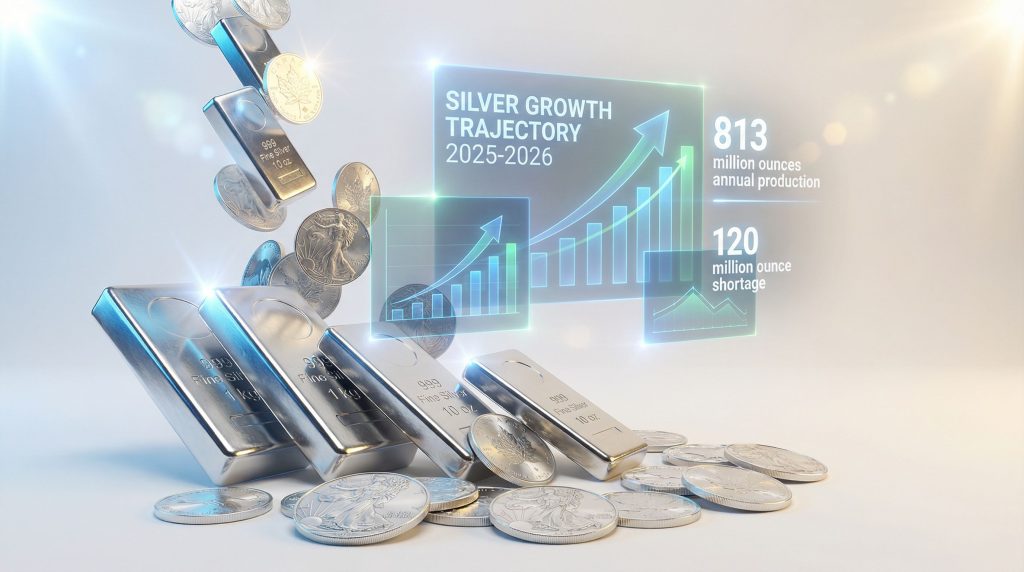
Global silver production faces significant structural limitations that differentiate it from other commodity markets. Mine production has remained relatively stagnant at approximately 813 million ounces annually, while demand continues expanding across multiple sectors. This imbalance has created seven consecutive years of global market deficits, with silver supply deficits projected to indicate a shortage of 120 million ounces in 2025.
The supply constraint situation becomes more pronounced when considering that most silver production comes as a byproduct of other mining operations. Primary silver mines represent only a small percentage of total output, meaning silver supply cannot easily respond to price increases through expanded production capacity.
Investment markets have historically overlooked these fundamental supply dynamics. Technical analysis reveals that silver has experienced unprecedented underperformance since the dollar's decoupling from gold in 1971. This systematic undervaluation created conditions where silver underperformed not just equity markets, but even basic consumer goods over a 54-year period.
Market Psychology Shifts Create Investment Opportunities
Professional market analysis indicates that silver's prolonged bear markets from 1980 to 2001 and 2011 to 2020 created deeply embedded negative sentiment among both institutional and retail investors. These extended periods of price decline, including drops exceeding 90% and 70% respectively, established silver as a "hated investment" in the minds of many market participants.
This psychological barrier represents a significant opportunity for contrarian investors. When assets become fundamentally undervalued due to sentiment rather than economic factors, the potential for substantial appreciation increases dramatically. Current market behaviour suggests this psychological shift is already beginning, with silver advancing 50% from late November 2025 levels while receiving minimal public attention.
The disconnect between price performance and public awareness indicates that institutional money recognises silver's investment potential while retail investors remain largely unengaged. This dynamic typically precedes broader market recognition and sustained price appreciation.
When big ASX news breaks, our subscribers know first
Industrial Applications Transform Silver's Investment Characteristics
Modern silver consumption patterns differ fundamentally from historical monetary demand, with industrial applications now representing 59% of total consumption. This transformation creates price support mechanisms that operate independently of speculative trading activity, providing a foundation for sustained appreciation.
Photovoltaic Manufacturing Creates Structural Demand Growth
Solar energy expansion represents the most significant driver of new silver demand, with photovoltaic panel manufacturing requiring substantial silver content for electrical conductivity. Industry data indicates a 25% increase in solar-related silver consumption during 2024, with potential annual requirements reaching 300 million ounces by 2030.
Each standard solar panel contains approximately 15-20 grams of silver paste for conductor formation in silicon cells. With global solar installations expanding at compound annual growth rates exceeding 20%, the cumulative demand trajectory creates sustained consumption growth independent of investment demand fluctuations.
Government renewable energy policies worldwide accelerate this demand pattern through mandated solar deployment targets. Unlike cyclical industrial applications, solar demand represents a structural shift in energy infrastructure that cannot be easily reversed or substituted.
Electric Vehicle Integration Multiplies Consumption Requirements
Automotive electrification creates another substantial demand driver, with modern electric vehicles utilising 2-3 times more silver than traditional combustion engines. Silver applications in EVs include battery management systems, onboard charging electronics, power distribution components, and electromagnetic shielding systems.
Global EV production scaling presents exponential growth potential for silver consumption. As major automotive manufacturers transition production capacity toward electric platforms, the cumulative silver requirements increase proportionally with vehicle production volumes. Furthermore, this silver market squeeze could significantly impact global financial markets.
This industrial demand foundation distinguishes silver from purely monetary assets like gold. While gold functions primarily as a store of value and portfolio hedge, silver's dual role as both monetary metal and essential industrial material creates multiple price support mechanisms.
Technology Sector Expansion Drives Additional Applications
Beyond renewable energy and automotive applications, silver's unique properties make it irreplaceable in numerous high-technology manufacturing processes. Electronics manufacturing, semiconductor production, RFID systems, and medical devices all require silver's superior electrical conductivity and antimicrobial properties.
Artificial intelligence infrastructure development and data centre expansion create additional silver demand through server manufacturing and electronic component requirements. These technology-driven applications tend to be price-inelastic, meaning demand continues even during precious metals price appreciation.
The diversification of industrial applications reduces silver's dependence on any single sector while creating multiple growth vectors that operate simultaneously across different economic conditions.
Is Silver's Volatility Actually an Advantage?
Silver's volatility profile, while creating short-term price fluctuations, actually enhances long-term return potential for strategic investors who understand proper position sizing and timing methodologies. Historical analysis demonstrates that silver's higher volatility translates to superior bull market performance compared to gold's steadier appreciation patterns.
Historical Performance Analysis Reveals Asymmetric Opportunities
Comprehensive 98-year analysis comparing precious metals performance shows distinct risk-reward characteristics:
| Asset Class | Annual Return | Volatility Profile | Bull Market Characteristics |
|---|---|---|---|
| Gold | 4.81% | Lower volatility | Steady appreciation |
| Silver | 3.71% | Higher volatility | Superior bull market gains |
Despite lower average annual returns, silver's volatility creates opportunities for substantial gains during favourable market cycles. The 1969-1980 precious metals bull market demonstrated silver's investment potential to dramatically outperform gold when fundamental conditions align with investment demand.
Current technical analysis suggests similar conditions may be developing. Mining company valuations have surged to new all-time highs with minimal public awareness, indicating professional recognition of fundamental improvements in precious metals markets.
Accessibility Advantages Support Portfolio Integration
Silver's current pricing structure ($35-64 per ounce versus gold's $4,217) enables more granular position management and dollar-cost averaging strategies. This accessibility allows investors to implement sophisticated allocation methodologies without requiring substantial capital commitments.
Lower per-ounce costs also facilitate tactical rebalancing and position adjustments based on changing market conditions. Investors can more easily increase or decrease exposure without the large capital requirements associated with gold position modifications.
The price differential also enables silver to serve as an entry point for investors new to precious metals, potentially creating broader participation as awareness of silver's investment potential increases.
Comparative Analysis: Silver Versus Gold Investment Strategies
Strategic asset allocation decisions between silver and gold depend on investor objectives, risk tolerance, and economic outlook assumptions. Each metal serves distinct portfolio functions while providing complementary hedging characteristics.
Silver's Growth-Oriented Investment Profile
Current market conditions favour silver's growth-oriented characteristics over gold's stability-focused profile. Silver's 25% outperformance relative to gold during recent precious metals appreciation reflects market recognition of its dual monetary and industrial demand drivers.
Industrial demand growth provides fundamental support that operates independently of monetary policy changes or currency devaluation concerns. This dual-demand structure creates more diverse price appreciation catalysts compared to gold's primarily monetary functions.
However, silver's historical underperformance since 1971 also suggests greater potential for mean reversion and catch-up performance relative to other asset classes. Gold–silver ratio analysis indicates silver requires an advance to approximately $185 per ounce to achieve historical parity with gold performance ratios.
What Makes Gold's Approach Different?
Gold maintains advantages in portfolio stability and crisis hedging applications. During periods of financial system stress, gold's superior liquidity and central bank recognition provide more reliable wealth preservation characteristics.
Gold's lower volatility suits conservative investors seeking inflation protection without significant price fluctuations. Institutional investors often prefer gold's stability for large-scale allocation decisions and systematic portfolio hedging strategies.
Central bank purchasing patterns also provide fundamental demand support for gold that operates independently of industrial or retail investment demand fluctuations. For more insights on these dynamics, investors should examine how gold and silver markets respond to central bank policies.
Portfolio Allocation Framework Development
Strategic precious metals allocation typically represents 5-10% of total portfolio value, with specific silver-to-gold ratios determined by individual risk profiles and investment objectives:
- Conservative Allocation: 70% gold, 30% silver
- Balanced Allocation: 50% gold, 50% silver
- Growth-Oriented Allocation: 30% gold, 70% silver
These allocation frameworks can be adjusted based on economic cycle analysis, relative price performance, and changing market conditions while maintaining overall precious metals exposure within prudent risk management parameters.
How Much Upside Potential Does Silver Really Have?
Silver's recent price advancement to current levels represents significant movement from multi-year lows, yet historical analysis suggests substantial additional appreciation potential based on various valuation methodologies.
Technical Recovery From Historical Undervaluation
Silver's advance beginning in late 2023 represents the first sustained bull market recognition after decades of bear market conditions. Technical analysis reveals that silver endured two separate bear markets since 1980, with declines exceeding 90% (1980-2001) and 70% (2011-2020).
These profound bear markets created valuation extremes that exceeded even the equity market declines during the Great Depression. Such extended underperformance typically precedes substantial mean reversion movements as fundamental values reassert themselves.
Current price levels, while representing significant gains from recent lows, remain well below inflation-adjusted historical highs achieved during previous bull markets.
Professional Price Forecasting Analysis
Investment banking analysis suggests silver price targets reflecting both conservative and optimistic scenarios:
- Conservative Target: $42-47/ounce by mid-2026
- Historical Parity Target: $185/ounce (gold performance parity)
- Speculative Target: $200+/ounce (accounting for industrial demand acceleration)
These projections incorporate various factors including supply constraints, industrial demand growth, monetary policy implications, and historical performance patterns. The range reflects uncertainty regarding timing and magnitude of potential appreciation.
Investment professionals emphasise that silver's potential for significant appreciation exists alongside correspondingly higher volatility and risk compared to more stable asset classes.
Long-Term Valuation Considerations
Inflation-adjusted analysis reveals that silver remains substantially below its 1980 peak when measured in constant dollar terms. This historical context suggests current price levels may not yet reflect silver's full value potential relative to monetary debasement over the past four decades.
Industrial demand fundamentals also support higher long-term valuations as technology adoption accelerates and renewable energy deployment expands globally. These structural demand increases operate independently of monetary factors and investment demand cycles.
Economic Scenarios Supporting Silver Investment Strategies
Multiple economic pathways support silver's investment case, providing diverse scenarios under which appreciation could accelerate beyond current levels.
Inflationary Environment Benefits
Rising inflation typically enhances precious metals appeal as monetary hedges, with silver offering additional industrial demand support during economic expansion phases. Unlike purely monetary assets, silver benefits from both inflation hedging demand and increased industrial consumption during economic growth periods.
Manufacturing expansion during inflationary periods increases silver consumption across multiple applications while simultaneously driving investment demand for inflation protection assets. Consequently, implementing effective silver squeeze strategies becomes essential for navigating these market conditions.
Green Energy Transition Acceleration
Government policies promoting renewable energy adoption directly increase silver consumption through solar panel manufacturing requirements, creating sustained demand growth independent of monetary factors.
The global commitment to carbon emission reduction targets ensures continued renewable energy deployment regardless of short-term economic fluctuations or policy changes. Furthermore, silver investment guidance shows how these trends are reshaping traditional investment approaches.
Technology Infrastructure Development
Artificial intelligence expansion, data centre growth, and electronics manufacturing increases drive incremental silver demand through essential industrial applications.
These technology-driven demand sources tend to be price-inelastic, supporting silver prices even during economic uncertainty or market volatility periods.
Currency Devaluation Scenarios
Continued monetary policy accommodation and fiscal expansion create conditions favouring hard asset appreciation as currency purchasing power declines relative to tangible commodities. Additionally, understanding the future of silver investing provides valuable context for long-term strategic positioning.
Silver's dual role as both monetary metal and industrial commodity provides hedging benefits across different devaluation scenarios and economic conditions.
The next major ASX story will hit our subscribers first
What's the Best Way to Invest in Silver?
Effective silver investment requires careful consideration of implementation methods, risk management protocols, and portfolio integration strategies.
Physical Silver Investment Approaches
Direct ownership through bullion coins and bars provides maximum exposure to silver price movements while ensuring physical possession of the asset:
- Advantages: Direct ownership, no counterparty risk, crisis hedge
- Considerations: Storage requirements, insurance costs, liquidity limitations
- Optimal Applications: Long-term holding, wealth preservation, crisis preparation
Financial Instrument Alternatives
Exchange-traded funds and mining company equities offer portfolio integration advantages with enhanced liquidity:
Silver ETFs:
- Provide easy portfolio integration and liquidity
- Eliminate storage and insurance requirements
- Enable precise position sizing and tactical adjustments
Mining Company Equities:
- Offer leveraged exposure to silver price movements
- Provide potential for operational improvements and dividend income
- Include additional risks related to company management and operations
Risk Management Protocols
Successful silver investment requires systematic risk management approaches:
- Position Sizing: Limit exposure to 5-10% of total portfolio value
- Diversification: Balance across physical silver, ETFs, and mining stocks
- Rebalancing: Regular adjustment based on performance and allocation targets
- Volatility Management: Dollar-cost averaging during accumulation phases
When Should Investors Consider Silver?
While market timing remains challenging for all asset classes, certain technical and fundamental indicators suggest favourable conditions for silver investment positioning.
Current Market Cycle Analysis
Technical analysis indicates silver has completed a multi-year accumulation phase and entered the early stages of a potential bull market cycle. Mining company valuations reaching new all-time highs while public awareness remains minimal suggests professional recognition preceding broader market participation.
Historical patterns indicate that precious metals bull markets typically last several years once fundamental conditions align with investment demand recognition.
Strategic Entry Methodologies
Effective entry strategies account for silver's volatility characteristics while capitalising on fundamental improvements:
Dollar-Cost Averaging:
- Systematic purchasing over time reduces volatility impact
- Enables accumulation during temporary price corrections
- Suitable for long-term investment horizons
Tactical Allocation:
- Position increases during technical oversold conditions
- Correlation analysis with broader portfolio holdings
- Economic cycle timing considerations
Fundamental Analysis Integration:
- Industrial demand trend monitoring
- Supply constraint development tracking
- Monetary policy impact assessment
This analysis incorporates insights from precious metals technical analysis and market research. Readers seeking additional perspectives on precious metals investing and market cycles can explore educational content from established market analysts and precious metals research organisations.
Disclaimer: This article contains speculative elements regarding future precious metals prices and economic scenarios. Silver investment involves significant volatility and risk. Historical performance does not guarantee future results. Investors should conduct thorough due diligence and consider professional financial advice before making investment decisions. Price projections and market analysis represent opinions based on current available information and are subject to change based on evolving market conditions.
Considering Silver Investment Opportunities This Year?
Discovery Alert's proprietary Discovery IQ model delivers instant notifications on significant ASX silver and mineral discoveries, empowering investors to identify actionable opportunities ahead of the broader market. Begin your 30-day free trial today at Discovery Alert and explore how historic discoveries have generated substantial returns for informed investors.