June 20, 2026
Why Nickel Sulphide Projects Demand a Different Kind of Capital Architecture
The global mining finance landscape has undergone a quiet but fundamental transformation over the past decade. As greenfield critical minerals projects have grown in scale and complexity, the traditional model of securing a single lead lender or anchor equity partner has become structurally inadequate. The economics simply do not support it. Projects exceeding half a billion dollars in total development cost carry risk profiles that no single institution can absorb comfortably, and the consequence of over-concentration in one financing relationship is fragility at every stage of execution.
This dynamic is particularly acute in the nickel sulphide sector. Unlike laterite nickel deposits, which are far more abundant but require energy-intensive processing, sulphide deposits produce ore that can be upgraded into high-purity concentrate at comparatively lower cost and with a significantly better environmental footprint. That processing advantage makes sulphide nickel the preferred feedstock for battery-grade refining, but it also means the world's undeveloped sulphide deposits are few, large, and capital-hungry. Bringing one into production requires a financing structure built not around a single bet, but around multiple complementary layers of capital.
The Lifezone Metals Kabanga financing tracks model currently being advanced for the Kabanga Nickel Project in Tanzania represents one of the most closely observed applications of this multi-layer approach in the current critical minerals cycle. Furthermore, it offers a revealing window into how the battery metals investment landscape is evolving for large-scale development projects.
When big ASX news breaks, our subscribers know first
What Makes Kabanga Geologically and Commercially Distinctive
Before examining how Kabanga is being financed, it is worth understanding why the project commands the attention of major miners, sovereign investors, and institutional lenders simultaneously.
Kabanga sits in the Kagera region of northwestern Tanzania and is widely considered one of the highest-grade undeveloped nickel sulphide deposits in the world. The ore body contains nickel, copper, and cobalt in a mineralogical configuration that lends itself well to hydrometallurgical processing. Lifezone Metals has developed a proprietary hydromet technology that can extract these metals with lower energy consumption and reduced carbon intensity compared to conventional smelting routes. This characteristic carries increasing commercial relevance as battery supply chains face pressure to demonstrate upstream ESG credentials.
Lifezone Metals (NYSE: LZM) holds the development mandate for Kabanga and is targeting a Final Investment Decision in 2026. A July 2025 Feasibility Study established the project's baseline economics, and as of early 2026, spot prices for nickel, copper, and cobalt all sit above the commodity price assumptions embedded in that study. In practical terms, this means the published project economics are now conservative relative to prevailing market conditions, which improves both lender confidence and the attractiveness of the equity story.
The Three-Track Financing Architecture: How Each Layer Functions
The Lifezone Metals Kabanga financing tracks strategy operates across three distinct but interconnected capital layers. Understanding the function of each track, and why all three are being advanced in parallel, is essential for assessing the probability of financial close.
Track 1: The Taurus Bridge Facility
The most immediately operational component is a $60 million senior secured bridge loan from Taurus Mining Finance. This facility is not project finance in the traditional sense. It is a liquidity instrument designed to fund pre-FID activities, early works, and the internal workstreams required to advance the longer-term financing processes.
As of March 31, 2026, $25 million had been drawn. A further draw of $16.7 million was received on April 29, 2026, leaving $18.3 million in undrawn capacity.
| Facility Component | Amount |
|---|---|
| Total Taurus Bridge Facility | $60 million |
| Drawn as of March 31, 2026 | $25 million |
| Additional draw (April 29, 2026) | $16.7 million |
| Remaining undrawn capacity | $18.3 million |
Bridge facilities in mining project finance serve a specific and often underappreciated function. They allow a development company to maintain operational momentum and preserve institutional relationships during the lengthy period between feasibility completion and formal financial close. Without bridge liquidity, development teams face the risk of losing technical staff, allowing contractor relationships to lapse, and losing their place in DFI and ECA lending queues. Understanding the broader nickel financing architecture helps contextualise why this instrument is so strategically important.
Track 2: The Société Générale Project Finance Process
The debt financing track is being led by Société Générale, one of Europe's largest infrastructure and commodity lending institutions. This process targets a structured debt facility raised from a combination of Development Finance Institutions, Export Credit Agencies, and commercial banks.
Key milestones already achieved in this track include:
- Roadshows targeting international DFIs and ECAs have been largely completed
- Independent engineers and lender consultants have submitted final technical, logistical, environmental, social, and commodity-market reports
- The US International Development Finance Corporation completed its due diligence, with further workstreams continuing
- Bankability review of the feasibility study is complete
- Debt sizing and lender financial modelling frameworks have been agreed
The submission of final independent lender reports is a material credibility signal. Lenders commission these assessments at significant cost and only when genuine credit appetite exists. Their completion marks a clear institutional threshold.
Track 3: The Standard Chartered Strategic Investment Process
The equity component is being managed through a formal strategic investment process led by Standard Chartered Bank. As of the Q1 2026 reporting period, this process had advanced to the term sheet stage, with multiple offers received from a pool spanning major mining companies, sovereign wealth funds, and private equity.
Critically, management has confirmed that all strategic options remain under active consideration, including a potential asset-level change of control. This language is significant. An asset-level transaction would bring in a partner at the project entity level rather than at the Lifezone corporate level, potentially introducing an operator or offtaker with the balance-sheet depth and technical credibility to anchor the debt financing process.
| Investor Type | Primary Motivation | Capital Characteristic |
|---|---|---|
| Major mining companies | Reserve acquisition, operational control | Large balance sheet, mine-building expertise |
| Sovereign wealth funds | Long-term resource security | Patient capital, lower return thresholds |
| Private equity | Financial return optimisation | Structured returns, defined exit horizon |
| Battery supply chain offtakers | Upstream product security | Willing to accept below-market financial returns for access |
Equity Is the Remaining Critical Path Variable
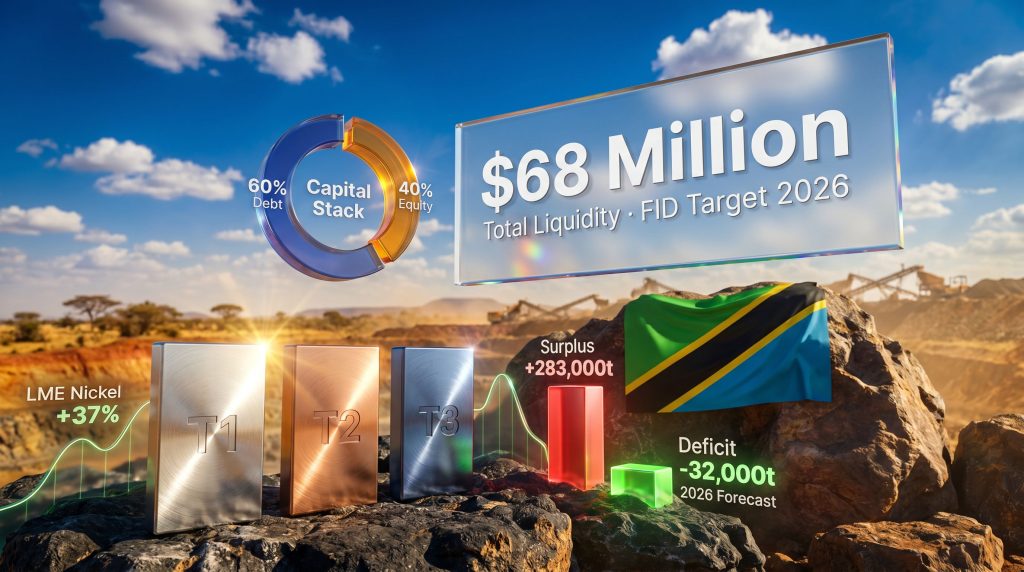
Management has described the anticipated project financing structure as approximately 60% debt and 40% equity. At Kabanga's scale, this ratio is broadly consistent with DFI-supported greenfield mining finance benchmarks globally.
The debt component is increasingly visible. Independent reports are complete, DFC diligence has concluded, and lenders are finalising their own financial models. What remains unresolved is the equity commitment, and this sequencing matters enormously for how debt terms ultimately crystallise.
Debt lenders in structured project finance do not finalise credit approvals or lock in pricing until equity co-investors are identified, committed, and credible. The identity and balance-sheet quality of the equity partner directly influences the debt terms available to the project. A strategic equity partner with a track record of operating mines of comparable scale may unlock materially better debt pricing than a purely financial sponsor, because it reduces the operational risk premium embedded in lender assumptions.
This is why the Standard Chartered process is the most consequential near-term catalyst for Lifezone shareholders. Its outcome will determine not just the equity quantum but the overall weighted cost of capital for the entire Kabanga development.
Lifezone's Liquidity Position: Reading the Numbers Carefully
In parallel with the three financing tracks, Lifezone closed a $25 million registered direct offering on April 23, 2026, issuing 5.7 million ordinary shares at $4.40 per share and generating net proceeds of $23.3 million.
| Liquidity Source | Amount |
|---|---|
| Cash on hand | ~$50 million |
| Undrawn Taurus bridge capacity | $18.3 million |
| Total liquidity (April 29, 2026) | ~$68 million |
As of April 29, 2026, Lifezone's basic market capitalisation stood at $435.2 million, based on a share price of $4.84 and 89.9 million basic shares outstanding. The $68 million liquidity position represents approximately 15.6% of total market capitalisation, which provides a meaningful pre-FID runway but underscores that financial close of the broader capital package remains essential. The bridge and equity raise cover operational continuity; they do not fund construction.
The Nickel Market Shift: Why Timing Matters for Lender Confidence
Commodity markets rarely cooperate with financing timelines, but in Kabanga's case the macro backdrop has shifted in a constructive direction during the financing process itself. Consequently, this shift has meaningfully improved the conditions under which Lifezone Metals Kabanga financing tracks are progressing.
LME nickel prices rose 37% from their late 2025 low through Q1 2026. The driver was largely supply-side rather than demand-led, centred on Indonesia, which accounts for the majority of global nickel ore production. The Indonesian nickel price trends have been particularly influential here. The Indonesian government reduced its 2026 mining quota to 270 wet metric tonnes, down from 375 wet metric tonnes in 2025, against domestic industry demand expectations of 345 wet metric tonnes. A revised benchmark pricing mechanism added further tightening pressure.
The market balance consequences of these restrictions are stark:
| Year | Market Balance | Volume |
|---|---|---|
| 2025 | Surplus | +283,000 tonnes |
| 2026 (INSG forecast) | Deficit | -32,000 tonnes |
Source: International Nickel Study Group (INSG)
The reversal from a 283,000-tonne surplus to a forecast 32,000-tonne deficit in a single year represents one of the sharpest commodity balance swings in recent nickel market history. When spot prices exceed feasibility study assumptions, as they now do for nickel, copper, and cobalt simultaneously, project NPV improves and debt service coverage ratios widen. Both effects reduce lender risk and can improve the pricing terms available to development projects entering formal credit approval processes.
When a feasibility study's commodity price deck becomes the floor rather than the base case, the published project economics become a conservative starting point rather than a ceiling, which is a materially different investment proposition.
The next major ASX story will hit our subscribers first
Procurement Readiness as a Lender Risk Signal
One aspect of project readiness that receives less attention than commodity prices but carries substantial weight in lender due diligence is procurement advancement. Lenders assess construction execution risk partly by examining how far along a project is in its contracting process before FID.
Kabanga's procurement readiness metrics are notable:
- 45 of 52 critical path Expressions of Interest approved by the Mining Commission have been released to market, representing 87% of the critical path
- These contracts cover an aggregate value of approximately $380 million
- The dual-train milling technical note has been completed, confirming processing plant design readiness
- An ISO-compliant Life Cycle Assessment confirmed low climate change emission impact for nickel concentrate production
- Zero health, safety, environmental, or security incidents were recorded during the quarter
- More than 2.7 million hours worked without a lost-time injury
Execution Readiness Scorecard:
| Metric | Status |
|---|---|
| Critical path EOIs released to market | 45 of 52 (87%) |
| Total contract value covered | ~$380 million |
| Dual-train milling technical note | Complete |
| ISO Life Cycle Assessment | Complete, low emissions confirmed |
| Lost-time injury rate | Zero across 2.7M+ hours worked |
The ISO Life Cycle Assessment result is particularly relevant for DFIs and ECAs operating under ESG investment mandates. These institutions increasingly require documented upstream emissions data as part of their credit approval processes, and Kabanga's confirmed low-impact profile removes a potential obstacle from the DFI lending pathway. This is broadly consistent with the growing importance of critical minerals and energy security in shaping how institutional lenders approach project risk.
Key Risks Between Here and Financial Close
No transaction across any of the three tracks has yet formally closed. Investors should weigh the following risk dimensions when assessing Lifezone's path to FID:
- Equity timing risk: The Standard Chartered process is at term sheet stage, but binding commitments remain outstanding. Any extension of the strategic process compresses the timeline to FID and increases liquidity pressure.
- Ownership structure risk: A potential asset-level change of control could materially alter existing shareholders' proportional economic exposure to Kabanga's upside. The terms negotiated will determine how much of the project's economics flows to Lifezone's public shareholders.
- Commodity price risk: The current nickel market recovery has improved the financing backdrop, but a sustained reversal would compress project NPV, tighten debt service coverage ratios, and potentially affect equity valuation in the strategic process.
- Debt approval risk: Lenders are finalising financial models but formal credit approval has not been publicly confirmed. Final terms depend on equity partner identification.
| Scenario | Equity Outcome | Debt Outcome | FID Probability |
|---|---|---|---|
| Strategic partner closes at asset level | Partial dilution, strong balance sheet anchor | Improved terms via partner credibility | High |
| Financial investor closes equity | Moderate dilution, no operational anchor | Moderate, depends on investor profile | Moderate-High |
| Strategic process extends materially | No dilution short-term, liquidity pressure builds | Delayed, lenders await equity commitment | Lower |
| Nickel price reversal | Equity valuation compressed | Coverage ratios tighten, terms worsen | Low |
What the Architecture Signals for Critical Minerals Project Development Broadly
The Lifezone Metals Kabanga financing tracks model offers a template that extends beyond this individual project. As the global energy transition drives demand for battery-relevant metals, the pipeline of large-scale greenfield development projects will expand, and with it the question of how to finance them efficiently. Indeed, understanding the role of Indonesian nickel in the energy transition further illustrates how supply-side dynamics are reshaping capital allocation decisions across the sector.
Several structural lessons emerge from Kabanga's approach:
- Parallel tracks reduce single-point failure risk. Running three simultaneous processes means the overall programme can survive setbacks in any one track without collapsing the timeline.
- Bridge liquidity is a strategic tool, not just a stopgap. Maintaining operational momentum during long financing processes preserves institutional relationships that are difficult and costly to rebuild.
- Independent technical validation is a prerequisite, not a formality. The completion of lender-commissioned independent reports is the institutional world's way of signalling genuine credit appetite.
- ESG credentials are now a financing variable, not a reputational add-on. ISO-compliant lifecycle assessments and safety records directly influence DFI and ECA lending eligibility.
- Commodity market timing affects cost of capital, not just project economics. Entering lender credit approval processes during a commodity price recovery materially affects the terms available to borrowers.
This article is intended for informational purposes only and does not constitute financial advice. Forecasts, market projections, and scenario analyses involve inherent uncertainty. Investors should conduct their own due diligence before making investment decisions. For additional institutional-grade analysis on Lifezone Metals and the broader nickel development landscape, visit Crux Investor.
Want to Track the Next Major Nickel or Battery Metals Discovery Before the Market Moves?
Discovery Alert's proprietary Discovery IQ model scans ASX announcements in real time, instantly identifying significant mineral discoveries across nickel, copper, cobalt, and more than 30 other commodities — turning complex data into actionable investment insights. Explore historic discoveries and the substantial returns they generated, then begin a 14-day free trial at Discovery Alert to position yourself ahead of the broader market.