
June 20, 2026
The Hidden Cost of Extraction: Why Verifiable Emissions Frameworks Are Reshaping Mining's Investment Landscape
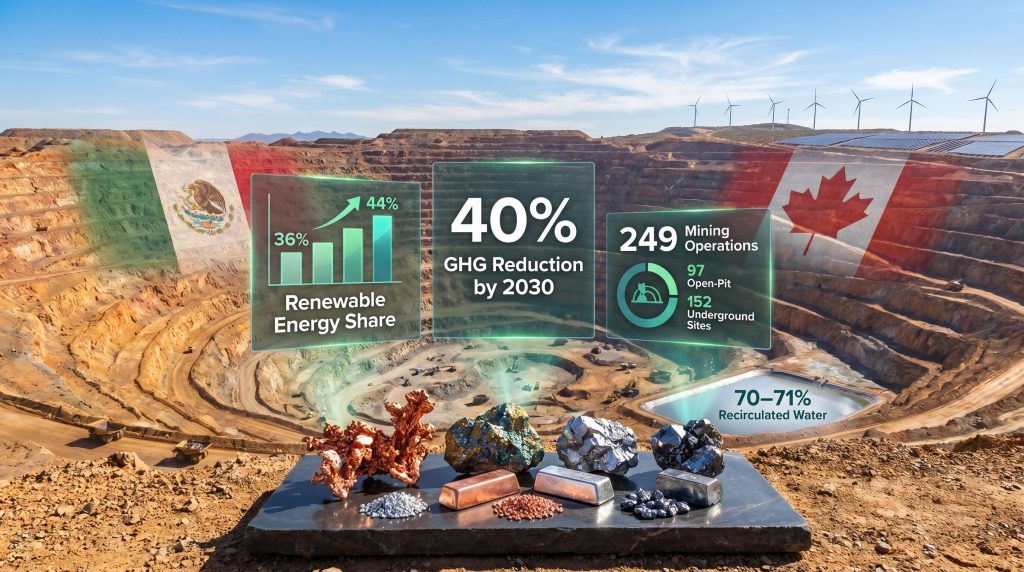
The global mining industry has spent decades operating under a relatively simple social contract: extract resources, pay royalties, and comply with minimum regulatory standards. That contract is now being rewritten. Institutional capital, bilateral trade architecture, and the insatiable raw material demands of the energy transition have collectively elevated environmental accountability from a reputational nicety to a hard market access condition. Nowhere is this transformation more visible right now than in Mexico, where the Cámara Minera de México (CAMIMEX) has adopted the Towards Sustainable Mining (TSM) standard and committed to reducing the sector's greenhouse gas emissions by 40% before the end of 2030.
Understanding why this matters requires looking beyond the headline figure. The CAMIMEX TSM standard emissions cut is not simply a sustainability pledge. It is a structural repositioning of an entire national extractive sector within a rapidly shifting capital allocation environment. Furthermore, the critical minerals energy transition dynamic is accelerating the urgency behind these commitments.
When big ASX news breaks, our subscribers know first
Understanding What TSM Actually Requires
The Towards Sustainable Mining framework was created by the Mining Association of Canada (MAC) and launched in 2004, emerging from a recognition that voluntary corporate ESG disclosures were insufficient for meaningful accountability. The framework was designed from the outset to be facility-specific rather than aggregated at the corporate level, a distinction that carries significant weight in capital markets.
TSM operates across three core pillars, each containing measurable performance protocols:
| TSM Pillar | Core Focus Areas |
|---|---|
| Communities and People | Indigenous engagement, Community Advisory Panels, labour relations |
| Environmental Stewardship | Water stewardship, biodiversity, tailings governance |
| Energy and Climate | GHG emissions, energy intensity, renewable energy transition |
Performance across these pillars is evaluated using 30 discrete indicators, and the results are not self-reported. Independent third-party audits are conducted every three years, with outcomes publicly disclosed. This verification architecture is what distinguishes TSM from the broad ecosystem of ESG rating frameworks that rely on company-submitted data.
The TSM standard requires independent external audits every three years at the facility level, with public disclosure of results across 30 performance indicators spanning environmental stewardship, community engagement, and energy efficiency, making it one of the most structurally rigorous ESG frameworks in the global mining industry.
With CAMIMEX's formal adoption, Mexico's industry association became the 11th mining association globally and the 5th in Latin America to licence the framework. The licensing agreement was first signed in March 2023 at the Association of Prospectors & Developers of Canada annual convention, with operational commitments deepening significantly through 2025.
The Community Advisory Panel Requirement: Often Overlooked, Structurally Significant
One element of TSM that receives less attention than the emissions metrics is the mandatory establishment of Community Advisory Panels. These bodies must include representatives from Indigenous communities, local residents, non-governmental organisations, and labour groups. Their function is not ceremonial. They serve as structured dialogue mechanisms between mining operations and affected communities, creating a formalised social licence process that runs parallel to the environmental reporting architecture.
For Mexico, where historical tensions between mining operations and Indigenous and rural communities have repeatedly escalated into legal and operational disruptions, this requirement introduces an accountability layer that extends well beyond carbon metrics.
What CAMIMEX Has Committed To: Scope, Numbers, and Targets
The decarbonisation commitment covers the full national mining footprint, including:
- 97 open-pit mining operations across Mexico
- 152 underground mining operations
- A combined total of 249 operational mining units subject to TSM reporting requirements
This scale makes the verification requirements particularly demanding. Each facility must independently demonstrate progress against performance indicators, with no ability to offset underperformance at one site against strong results at another.
Renewable Energy Expansion: From 36% to 44%
Energy transition targets form a central pillar of the 2030 commitment. The broader push for renewable energy in mining is reshaping how operators approach long-term capital planning:
| Metric | Current Status | 2030 Target |
|---|---|---|
| Mining units using or generating renewable energy | 41 units | Expanded coverage across 249 units |
| Renewable energy share of total industry consumption | 36% | 44% |
An 8-percentage-point increase in renewable energy consumption must be achieved across a geographically dispersed, operationally diverse sector. This is not a marginal adjustment. It requires capital investment in on-site generation capacity, power purchase agreements with renewable energy providers, and in some regions, coordination with grid-level infrastructure development where transmission constraints remain a practical barrier.
Water Management: A Pre-Existing Credibility Foundation
Mexico's mining sector enters the TSM framework with a notable water management track record that provides a credible baseline for broader environmental commitments. In 2024, the sector consumed only 0.27% of all national water concessions, a remarkably low share given the scale of extractive activity.
More significantly, between 70% and 71% of the sector's total water supply is sourced from recirculated water, including closed-loop systems and treated wastewater. This performance is supported by 100 water treatment plants operating across the country. In a global mining context where water-related controversies have repeatedly derailed projects and generated long-term reputational damage, Mexico's recirculation performance is a substantive differentiator.
Water performance metrics are increasingly scrutinised alongside emissions data by institutional ESG investors, meaning this existing track record directly strengthens the investment case for TSM adoption.
Regional Pressure Points: Where the Targets Will Be Tested
Sonora: 45% of National Production, Maximum Compliance Pressure
Sonora contributes approximately 45% of Mexico's total national mining production value, making it the single most consequential jurisdiction for TSM implementation. Large-scale copper operations in the state, including Grupo México's Buenavista del Cobre, will face the most demanding compliance requirements given their operational footprint.
Buenavista del Cobre has historical significance in this context. The 2014 acid spill into the Sonora and Bacanuchi rivers, which contaminated water supplies for tens of thousands of residents, remains one of the most high-profile environmental incidents in Latin American mining history. This history elevates regulatory and reputational scrutiny for all major Sonoran operations pursuing TSM verification.
The grid-level renewable energy challenge is also most acute in Sonora. Transmission infrastructure in the state's mining corridors has not kept pace with the scale of energy demand, meaning the renewable energy transition targets will require both on-site investment and broader infrastructure coordination.
Zacatecas: Aligning Global Corporate ESG With Site-Level Mexican Reporting
Zacatecas hosts major transnational operators including Newmont's Peñasquito and Fresnillo PLC, both of which operate within existing global corporate sustainability frameworks with independently established emissions targets and reporting mechanisms. TSM adoption introduces a site-level Mexican reporting requirement that must be aligned with these pre-existing global ESG architectures.
This creates a dual accountability structure. Operations must satisfy both their parent company's global ESG commitments and the facility-level TSM verification requirements. Where these frameworks are coherent, the alignment strengthens credibility. Where reporting methodologies or target definitions diverge, reconciliation becomes a technical compliance challenge.
The Capital Markets Logic: Why TSM Is a Financial Decision
Institutional Capital's Evolving Demands
CAMIMEX has explicitly positioned TSM adoption as a strategic financial decision rather than a purely regulatory or reputational response. This framing reflects a genuine structural shift in how institutional capital is deployed in the mining sector globally. In addition, the mining decarbonisation benefits are becoming increasingly quantifiable in financial terms.
Institutional investors managing large pools of capital across pension funds, sovereign wealth vehicles, and sustainable infrastructure mandates have progressively required auditable environmental benchmarks before committing to mining projects or approving sustainable bond issuances. Self-reported Scope 1 and 2 emissions data, without independent validation, is increasingly insufficient to satisfy due diligence requirements at the capital allocation stage.
The practical consequence is that mining sectors and individual operations without credible third-party verification frameworks face higher costs of capital and reduced access to sustainability-linked financing instruments. TSM adoption directly addresses this gap.
Comparative Emissions Targets: Where Mexico Sits Globally
| Commitment Type | Target | Verification Mechanism |
|---|---|---|
| Carbon neutrality (select global miners) | By 2040 | Varies by operator |
| Operational emissions reduction (select global miners) | 30% by 2030 | Internal + third-party |
| Scope 1 & 2 reduction plus net-zero pathway | 2030 / 2050 | Corporate disclosure |
| CAMIMEX / Mexico sector target | 40% by 2030 | TSM third-party audit (3-year cycle) |
Mexico's 40% target with mandatory third-party verification is structurally more credible than many corporate-level pledges that rely on self-reported Scope 1 and 2 data without independent site-level validation.
Globally, the mining and metals sector accounts for an estimated 4% to 7% of total greenhouse gas emissions. In comparable Latin American contexts, copper mining alone represents 30% of national emissions in Chile. Mexico's extractive sector has grown substantially over the past decade, and without a structured decarbonisation framework, the risk of replicating Chile's emissions concentration was real.
The Mexico-Canada Bilateral Dimension
The TSM adoption does not exist in a bilateral vacuum. It is formally aligned with the Mexico-Canada Action Plan 2025-2028, which prioritises North American critical mineral supply chain security as a shared strategic objective.
In October 2025, members of the Canadian Chamber of Commerce in Mexico's (CANCHAM) Mining Executive Committee formally committed to implementing the TSM standard across all operational stages, encompassing exploration, active production, and mine closure. This end-to-end operational scope makes the commitment structurally more comprehensive than sector-level emissions pledges that apply only to active production phases.
Fernando Aboitiz, Head of the Extractive Activities Coordination Unit at Mexico's Ministry of Economy, has articulated the government's view that mining development should be anchored in high social and environmental standards, framing the CAMIMEX-CANCHAM collaboration as a foundational mechanism for strengthening sustainability credentials as North America restructures its critical mineral supply architecture.
Critical Minerals Driving the Urgency
The critical minerals demand surge is reshaping procurement criteria across energy transition supply chains. Mexico's mining sector is expanding investment across several mineral categories that are central to these supply chains:
- Copper: essential for EV motor windings, charging infrastructure, and power transmission
- Silver: critical for solar photovoltaic cell manufacturing
- Zinc: used in galvanising steel for wind turbine infrastructure
- Fluorspar: a key input in lithium-ion battery electrolyte production
- Graphite: the dominant anode material in lithium-ion batteries
The environmental credibility of the supply chain is increasingly a requirement for buyers, not just a preference. Battery manufacturers, automotive OEMs, and electronics companies are embedding responsible sourcing criteria into procurement frameworks in response to regulatory pressure in the European Union and North America.
The next major ASX story will hit our subscribers first
Structural Challenges on the Path to 2030
The ambition of the CAMIMEX TSM standard emissions cut commitment is not matched by an absence of obstacles. Several structural challenges will test the pace and completeness of implementation.
Scale of verification logistics: Deploying facility-level TSM audit requirements across 249 mining operations simultaneously requires a substantial pool of qualified auditors and a coordinated scheduling system that avoids compliance bottlenecks affecting capital deployment timelines.
Renewable energy infrastructure gaps: Raising sector-wide renewable energy consumption from 36% to 44% in states with transmission constraints requires investment beyond the mine gate. Grid reliability limitations in Sonora and Zacatecas could slow renewable integration timelines independent of operator willingness or capital availability.
Community Advisory Panel operationalisation: Establishing functional Community Advisory Panels across hundreds of geographically dispersed sites, many located in regions with complex Indigenous governance structures, requires sustained institutional investment. The technical compliance framework is clear; the social and logistical infrastructure to execute it at scale is more demanding.
Baseline data consistency: Accurate facility-level emissions baselining across 97 open-pit and 152 underground operations with varying levels of existing environmental management maturity is a prerequisite for meaningful progress measurement. Furthermore, considerations around natural capital in mining are increasingly integrated into these baseline assessments. Operations without robust existing data systems will require capacity building before meaningful TSM reporting can begin.
Frequently Asked Questions: CAMIMEX TSM Standard and Mexico Mining Emissions
What does TSM stand for in mining?
TSM stands for Towards Sustainable Mining, a performance framework developed by the Mining Association of Canada that requires site-level environmental and social reporting with independent third-party verification every three years.
What is CAMIMEX's specific emissions reduction target?
CAMIMEX has committed to reducing greenhouse gas emissions from Mexico's mining sector by 40% by the end of 2030, covering 97 open-pit and 152 underground mining operations nationwide.
How often are TSM audits conducted?
Independent external audits under the TSM framework are required every three years at the facility level, with results publicly disclosed across 30 performance indicators.
How many mining associations have adopted TSM globally?
As of the CAMIMEX adoption, 11 mining associations worldwide have formally adopted the TSM framework, with CAMIMEX being the 5th in Latin America.
What renewable energy target has Mexico's mining sector set for 2030?
CAMIMEX members aim to increase the sector's renewable energy share from the current 36% to 44% of total energy consumption by 2030.
Why is TSM considered more credible than standard ESG reporting?
Unlike voluntary disclosure frameworks, TSM requires independent third-party audits, site-level rather than aggregated reporting, and public disclosure across 30 performance indicators, making it significantly harder to misrepresent environmental performance.
Key Takeaways: What the CAMIMEX Commitment Signals for Mexico's Mining Future
The CAMIMEX TSM standard emissions cut commitment is best understood not as a single policy announcement, but as a convergence point for several structural forces that have been building simultaneously across capital markets, bilateral trade architecture, and critical mineral supply chain governance.
- The 40% GHG reduction target backed by TSM third-party verification represents the most structurally accountable decarbonisation commitment Mexico's mining sector has established
- TSM adoption positions Mexico competitively within North American critical mineral supply chains at a moment when ESG credibility functions as a market access condition rather than a differentiator
- The Community Advisory Panel requirements introduce a social licence dimension that extends accountability beyond emissions metrics into Indigenous engagement and local governance
- Mexico's existing water management performance, with 70-71% recirculation rates and 100 treatment plants nationwide, provides a credible foundation upon which the broader TSM framework can build
- The alignment with the Mexico-Canada Action Plan 2025-2028 embeds the commitment within a bilateral framework that elevates its durability beyond any single domestic policy cycle
Disclaimer: This article contains forward-looking statements regarding emissions targets, renewable energy projections, and investment conditions. These represent commitments and projections as reported and should not be construed as guarantees of future outcomes. Investors and industry participants should conduct independent due diligence before making decisions based on sector-level sustainability commitments.
Want to Track ASX Mineral Discoveries Shaped by the Energy Transition?
As critical minerals become central to decarbonisation supply chains, the ability to identify significant ASX discoveries in real time has never been more valuable. Discovery Alert's proprietary Discovery IQ model instantly notifies subscribers of major mineral discoveries — from copper to graphite — turning complex ASX announcements into actionable investment insights; explore historic discovery returns on the dedicated discoveries page or begin a 14-day free trial to position yourself ahead of the broader market.