August 6, 2026
When Fear Prices Oil and Sentiment Drives Markets
Energy markets have always been uniquely vulnerable to what traders call sentiment-driven dislocation: a condition where price movements detach almost entirely from physical supply and demand fundamentals, driven instead by the collective psychology of risk. Few mechanisms illustrate this more vividly than the cyclical inflation and deflation of geopolitical risk premiums in crude oil pricing.
Historically, every major disruption to Middle Eastern oil infrastructure or transit corridors has followed a similar pattern. Prices spike rapidly as worst-case scenarios are priced in, capital flows into energy equities as a hedge against macro instability, and then, when diplomatic resolution or operational normalisation occurs, the entire move unwinds with near-symmetrical speed. The unwinding is not a sign of weakness in the underlying commodity. It is the mechanical reversal of fear.
That is precisely the dynamic now reshaping ASX energy stocks after oil price crash conditions triggered by the Strait of Hormuz reopening in 2026.
When big ASX news breaks, our subscribers know first
The Architecture of an Oil Price Spike and Collapse
What the Strait of Hormuz Actually Represents in Commodity Markets
The Strait of Hormuz is a navigational corridor approximately 33 kilometres wide at its narrowest point, situated between Iran and Oman. Despite its modest physical dimensions, it carries roughly one-fifth of the world's daily oil supply, making it the single most consequential maritime chokepoint in global energy trade. No other waterway concentrates so much supply risk in such a confined geography.
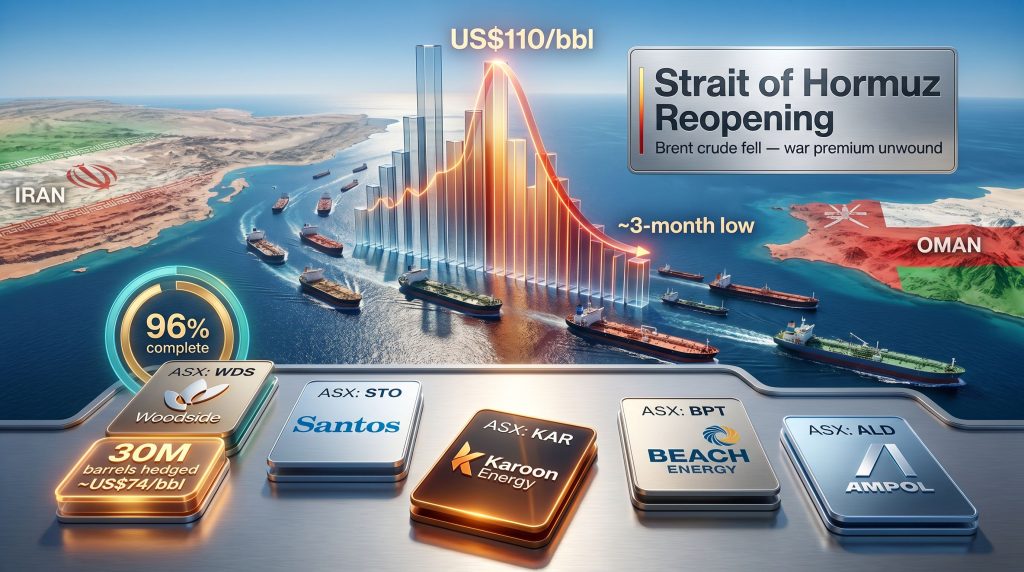
When tanker traffic through the Strait was disrupted earlier in 2026 as Middle East conflict escalated, Brent crude surged above US$110 per barrel. This price level was not a reflection of the world suddenly needing more oil. It was a reflection of traders embedding a substantial risk premium into futures contracts to account for potential supply continuity failure.
| Phase | Brent Crude Level | Primary Driver | Demand Signal |
|---|---|---|---|
| Pre-conflict baseline | Below US$80/bbl | Fundamentals | Stable |
| Hormuz disruption peak | Above US$110/bbl | War risk premium | Unchanged |
| Post-reopening | ~3-month low | Sentiment reversal | Unchanged |
| Risk status | Fragile | Interim deal only | No change |
The Mechanics of a War Premium
A war premium is an additional margin built into commodity futures pricing when geopolitical events threaten supply continuity. Critically, it exists independently of actual physical shortages. Markets do not wait for tankers to actually stop moving before pricing in the possibility that they might.
When the US-Iran interim peace agreement was announced and tanker movement through Hormuz resumed, that premium collapsed with notable speed. Brent crude fell to its lowest level since early March 2026, a decline of approximately one-third from its peak, within a compressed timeframe. The speed of the fall was proportional to how rapidly the fear narrative dissolved, not to any change in global oil consumption patterns. Understanding these oil volatility trends is essential for any investor navigating the energy sector.
"War premiums in crude oil can inflate and deflate within days. Investors who mistake the premium for a fundamental demand signal are exposed to sharp capital loss when diplomatic resolution occurs."
The Backlogged Supply Problem Most Investors Miss
Why Reopening Is Not the Same as Restoring Equilibrium
One underappreciated consequence of a prolonged chokepoint closure is the accumulation of stranded supply. When tankers cannot move, crude that would normally flow continuously into global markets accumulates in floating storage, in offshore terminals, or simply remains unshipped in originating ports. This creates what analysts refer to as a supply overhang.
Reuters analysis has indicated that a sustained reopening of the Strait of Hormuz could release a significant volume of backlogged Middle Eastern crude into global markets simultaneously, which has the potential to amplify downward price pressure well beyond what the geopolitical resolution alone would imply. In other words, the market does not simply return to where it was before the disruption. It temporarily overshoots to the downside as delayed supply floods back in.
This supply overhang effect deepens what traders call a contango structure in regional oil benchmarks, where near-term futures trade at a discount to longer-dated contracts because the market anticipates temporary near-term oversupply. For ASX energy producers, this translates into weaker realised prices precisely at the moment when the geopolitical fear that supported valuations has already dissipated.
Is the Hormuz Deal Built to Last?
The US-Iran agreement that triggered the reopening is explicitly interim in nature, a detail that carries significant investment implications. Scheduled follow-up diplomatic discussions were reportedly cancelled shortly after the initial deal was struck, introducing genuine uncertainty about whether open tanker access will persist over a sustained period.
Three scenarios investors should actively model:
-
Full and sustained reopening – Backlogged crude enters global markets, Brent remains under structural pressure, ASX upstream producers face a sustained earnings headwind with no near-term catalyst for relief
-
Partial or unstable reopening – Intermittent access is maintained, geopolitical risk premium is partially preserved, ASX energy names remain highly volatile and driven by headline flow rather than fundamentals
-
Diplomatic breakdown and re-escalation – Follow-up talks collapse entirely, Hormuz access is threatened again, the war premium re-enters crude pricing rapidly, and ASX energy names recover sharply from current levels
How ASX Energy Stocks Responded to the Oil Shock Cycle
The Sector's Singular Behaviour During the Spike
At the peak of the oil price surge, the ASX energy sector occupied a remarkable position: it was the only sector trading in positive territory across the broader market, which was declining across virtually every other industry classification. This performance isolation confirmed the degree to which Australian energy equities had absorbed the war premium into their valuations. Furthermore, the ASX commodity pressure during this period underscored just how deeply sentiment-driven the broader market had become.
The subsequent selloff was equally concentrated. As Brent crude retreated, ASX energy stocks fell in near-lockstep, with the magnitude of individual stock declines broadly proportional to each company's exposure to spot crude pricing.
Comparing ASX Energy Stocks Across Risk and Structural Protection Dimensions
| ASX Stock | Crude Price Sensitivity | Key Structural Buffer | Primary Downside Risk |
|---|---|---|---|
| Woodside (ASX: WDS) | High | Hedging + LNG weighting | LNG project execution timing |
| Santos (ASX: STO) | High | Production growth ramp | No M&A floor; oil-dependent earnings |
| Karoon Energy (ASX: KAR) | Very High | None significant | Operational guidance cuts; pure oil |
| Beach Energy (ASX: BPT) | Moderate | Dividend yield; domestic gas | Domestic gas price dynamics |
| Ampol (ASX: ALD) | Indirect | Refining margin exposure | Structurally different from upstream |
Woodside Energy (ASX: WDS): Structural Defensiveness in a Volatile Sector
Why Hedging and LNG Create a Meaningful Cushion
Woodside occupies a categorically different position from its ASX energy peers when it comes to downside protection. As Australia's largest listed oil and gas producer, it carries institutional-grade balance sheet resilience and revenue diversification that smaller producers cannot replicate.
The most immediately relevant buffer is Woodside's hedging position: approximately 30 million barrels of 2026 production locked in at around US$74 per barrel. With Brent crude now trading well below its peak, this hedge transforms what would otherwise be direct earnings destruction into a more manageable shortfall. Producers without comparable hedging programs are exposed to every dollar of crude price decline on an unprotected basis.
Key Woodside metrics for 2026:
- Approximately 30 million barrels hedged at ~US$74/bbl for 2026 output
- Scarborough LNG project reported as more than 96% complete as of mid-2026
- First LNG cargo from Scarborough targeted for late 2026
- Share price declined approximately 3.6% to around A$29 during the initial post-reopening selloff
The Scarborough Transition: Why the Revenue Mix Matters
The near-completion of the Scarborough LNG development is strategically meaningful beyond its headline production numbers. Once operational, Scarborough shifts a portion of Woodside's revenue base toward long-term contracted LNG, which is typically priced against oil indices but with a significant time lag, often six to nine months behind spot crude movements.
This pricing structure provides a natural smoothing mechanism. Short-term crude volatility passes through to LNG contract revenues more slowly, giving Woodside a degree of earnings stability that pure crude-weighted producers cannot access. Over the medium term, as Scarborough's contribution to total output grows, Woodside's sensitivity to spot crude swings will progressively diminish.
"The shift from spot-crude-weighted to LNG-contract-weighted revenue is one of the most underappreciated dimensions of Woodside's investment case. It represents a structural change in earnings quality, not merely a volume increase."
Santos (ASX: STO): Production Growth Leverage With Meaningful Downside Exposure
The Production Ramp That Changes the Earnings Trajectory
Santos presents a compelling production growth narrative, but one that carries material oil price dependency. The company's Barossa LNG project delivered its first cargo in January 2026, a significant operational milestone. Combined with the Pikka oil project in Alaska, Barossa is projected to drive total output growth of approximately 30% by 2027.
In a high or stable oil price environment, this growth trajectory creates powerful earnings leverage. In a declining oil price environment, however, the margin expansion that investors were pricing in during the spike period faces compression from both directions simultaneously: higher volumes against lower realised prices.
The ADNOC Bid Collapse and Its Valuation Implications
A critical and often underweighted context point for Santos investors relates to the proposed acquisition by Abu Dhabi National Oil Company. The ADNOC bid, which was priced at A$8.89 per share, collapsed in 2025 without reaching completion. This removed a meaningful valuation floor from the stock.
In practical terms, a credible takeover bid anchors a stock's price around the offer level while the deal is active, because the market prices in the probability-weighted value of the offer being completed. When that bid collapses, the anchor disappears entirely. Santos must now be valued purely on its operational fundamentals, in an environment where those fundamentals are being pressured by declining crude prices.
Santos risk factors in the current environment:
- No strategic acquirer providing a valuation floor following ADNOC bid collapse
- Earnings uplift from Barossa and Pikka ramp-up potentially offset by lower oil realisation
- Stock performance during the oil spike was partly tied to geopolitical premium now unwinding
- Production growth thesis remains intact but requires sustained oil prices to fully materialise
The next major ASX story will hit our subscribers first
Karoon Energy (ASX: KAR): Maximum Leverage, Maximum Risk
Understanding Pure-Play Oil Exposure in a Volatile Market
Karoon Energy operates with concentrated upstream oil exposure and limited structural buffers. Unlike Woodside, it has no significant LNG base to partially insulate earnings from spot crude movements, and no hedging program of comparable scale. This configuration makes Karoon among the highest-beta names to crude price movements on the ASX.
The stock was among the hardest hit during the post-reopening selloff, which is precisely what pure-play crude exposure implies: amplified participation in both the upside and the downside of commodity price cycles.
Adding operational complexity to the macro headwind, Karoon has recently cut its calendar year 2026 production guidance, with output from the Who Dat field now slipping into the second half of 2027. This creates a compounding effect: a commodity price headwind layered on top of a delayed production ramp, simultaneously depressing both near-term volumes and the price at which those volumes will eventually be realised.
Risk-Return Matrix for Karoon in Different Oil Scenarios
| Oil Price Scenario | Likely Karoon Outcome |
|---|---|
| Recovery above US$90/bbl | Significant upside; pure-play leverage fully activated |
| Stabilisation near current levels | Modest recovery possible; guidance risk persists |
| Continued decline below US$70/bbl | Compounding downside; operational setbacks amplify losses |
| Middle East re-escalation | Sharp spike; war premium returns to pure-play names first |
Beach Energy and Ampol: Differentiated Exposure for Different Investment Objectives
Beach Energy (ASX: BPT): The Domestic Gas Buffer
Beach Energy's exposure to Australian domestic gas markets provides a partial insulation mechanism that its pure crude-weighted peers lack. Domestic gas pricing in Australia is partially decoupled from international crude benchmarks, particularly for contracted supply, which reduces the amplitude of Beach's response to global oil price swings.
- Lower share price volatility relative to Woodside, Santos, and Karoon
- Dividend support provides an income floor for longer-term holders during commodity downturns
- Still participates in the broader energy sector cycle, but with reduced directional magnitude
- Domestic gas supply tightness in eastern Australia provides a structural demand tailwind independent of crude
Ampol (ASX: ALD): Why a Downstream Refiner Responds Differently
Ampol's business model is structurally distinct from every other name discussed here. As a downstream refiner and fuel retailer, its earnings are primarily driven by refining margins, specifically the spread between crude oil input costs and the retail price of refined petroleum products.
This creates a counterintuitive dynamic worth understanding clearly: when crude prices fall sharply, Ampol's input costs decline. If refined product retail prices do not fall as quickly or as deeply, the refining margin actually expands. This is why Ampol's share price behaviour during a crude oil selloff can diverge meaningfully from upstream producers.
"Refining margin dynamics are distinct from crude price dynamics. Investors seeking energy sector participation with a partial hedge against crude price weakness may find Ampol's business model worth examining in the context of a post-Hormuz oil price environment."
The Headline Sensitivity Problem and Why Positioning Discipline Matters
Why the Current Market Environment Demands Caution
ASX energy stocks that rallied strongly during the oil price spike are now priced in a market that is acutely aware of geopolitical risk in both directions. This creates a structural condition where sector pricing is more sensitive to news flow than to fundamental earnings analysis. For context, the broader trade war impact on oil prices has further complicated the macro environment in which these stocks are trading.
A single development — whether a breakdown in diplomatic talks, a tanker incident in the Strait, or an unexpected OPEC+ production decision — can trigger sharp intraday price movements in either direction. In this environment, entry point discipline, position sizing, and stop-loss frameworks become more important than stock selection alone. Consequently, monitoring OPEC's market influence alongside geopolitical developments is essential for any serious energy investor.
Key geopolitical and macro triggers worth monitoring:
- Status of US-Iran follow-up diplomatic negotiations after initial cancellation
- Any tanker incident or maritime security event in or near the Strait of Hormuz
- OPEC+ production policy decisions, which could partially offset Hormuz reopening price pressure
- US sanctions policy on Iranian oil exports and enforcement intensity
- Chinese and US demand data as indicators of whether fundamental oil consumption is softening
- Australian domestic gas export tax policy, which represents a separate regulatory headwind for LNG producers
- US dollar strength, which typically pressures USD-denominated commodity prices while Australian producers carry partial AUD cost bases
Frequently Asked Questions
Why did ASX energy stocks fall when the Strait of Hormuz reopened?
The reopening removed the geopolitical risk premium that had been embedded in crude oil futures since the Hormuz disruption began. Because ASX energy producers' revenues are directly tied to crude and LNG prices, a sharp decline in the commodity immediately flows through to lower projected earnings, which equity markets price in without delay. ASX trading insights confirm that this pattern of rapid repricing has been consistent across recent commodity-driven market events.
Is the current oil price decline a demand signal?
In the current context, no. The decline is primarily the mechanical reversal of a sentiment-driven spike. Global oil consumption fundamentals have remained broadly stable throughout this period. The price movement reflects the unwinding of speculative positioning, not a deterioration in underlying demand. As reported in the Sydney Morning Herald, optimism around the Iran deal has been a dominant driver of the recent oil price moves.
Which ASX energy stock carries the most downside protection right now?
Woodside carries the most structural downside protection, with approximately 30 million barrels of 2026 production hedged at around US$74 per barrel and the near-complete Scarborough LNG project set to shift its revenue mix toward contracted long-term pricing over the coming quarters.
Could oil prices recover sharply from current levels?
Yes, and potentially within a very compressed timeframe. The US-Iran agreement is interim, follow-up talks have already stalled once, and the Strait remains a fragile corridor. Any re-escalation of conflict, tanker disruption, or Iranian policy shift could restore the war premium rapidly, pushing Brent crude materially higher within days.
How does Ampol's position differ from upstream ASX energy producers?
Ampol is a refiner and fuel retailer, not an upstream crude producer. Its earnings are driven by refining margins rather than crude prices directly. A crude price decline can reduce Ampol's input costs, potentially supporting margins if retail fuel prices adjust more slowly, making its response to oil price movements structurally different from Woodside, Santos, or Karoon.
Positioning for What Comes Next
The current situation facing ASX energy stocks after the oil price crash and Strait of Hormuz reopening is not a simple binary between recovery and further decline. It is a multi-scenario environment where the probability distribution of outcomes spans a wide range, and where the appropriate portfolio response differs materially depending on an investor's risk tolerance, time horizon, and view on diplomatic durability.
Scenario-based positioning summary:
- Capital preservation in a lower-oil environment: Woodside's hedging program and LNG transition provide the most structural downside protection. Beach Energy adds dividend-supported defensiveness.
- Positioning for oil price recovery or re-escalation: Karoon offers the highest upside leverage but carries the greatest operational and commodity risk. Santos provides a middle ground with production growth catalysts.
- Differentiated energy sector exposure: Ampol's refining margin dynamics may provide partial insulation against crude price weakness while maintaining energy sector participation.
What is clear across all scenarios is that the war premium unwind reflects a sentiment reversal, not a fundamental deterioration in the global energy outlook. The structural case for oil and LNG demand remains intact. The question for investors is not whether to have energy exposure, but how to size and structure that exposure in an environment where geopolitical headlines continue to drive more price action than earnings models. Kalkine's analysis of ASX energy stocks following the US-Iran agreement reinforces that this repricing dynamic is being closely watched across the market.
Disclaimer: This article is for informational and educational purposes only and does not constitute financial advice. All data, figures, and projections referenced are based on publicly available information as of the time of writing. Past performance is not indicative of future results. Always conduct independent research and consult a licensed financial adviser before making investment decisions. Forecasts and scenario projections involve inherent uncertainty and should not be relied upon as definitive predictions of future market outcomes.
Want to Stay Ahead of the Next Major ASX Resource Discovery?
While geopolitical risk premiums and oil price cycles dominate energy sector headlines, significant mineral discoveries on the ASX can offer entirely different return profiles — and Discovery Alert's proprietary Discovery IQ model delivers real-time alerts the moment those discoveries are announced, turning complex data across 30+ commodities into clear, actionable insights. Explore historic examples of what major discoveries have returned and begin a 14-day free trial to ensure you are positioned before the broader market takes notice.