August 24, 2026
The Gravity Shift in Global Mining Capital
The world's largest mining companies are no longer asking whether London remains the right home for their capital market ambitions. That question has already been answered. The more pressing issue today is how quickly the Australian Securities Exchange can absorb the flood of institutional interest now redirecting itself toward Sydney, and what that shift means for the long-term architecture of global mining finance.
Glencore's pursuit of a Glencore secondary listing in Australia is arguably the most significant signal yet that this transition has moved beyond isolated case studies and into structural reality. The decision to target ASX admission as early as October 2026 reflects years of strategic deliberation, a careful review of alternative venues including New York, and a fundamental conviction that the world's most sophisticated and fastest-growing pool of mining-focused institutional capital now resides in Australia, not Europe.
When big ASX news breaks, our subscribers know first
Understanding the CDI Mechanism: How the Listing Actually Works
Before analysing the strategic rationale, it helps to understand the technical architecture. Glencore's ASX listing will not involve the creation of new shares, a capital raise, or any restructuring of its corporate domicile. Instead, the vehicle is CHESS Depositary Interests (CDIs) — a mechanism that allows foreign-listed companies to mirror their existing equity on the ASX in Australian dollars. The underlying CHESS settlement system provides the infrastructure that makes this possible.
Here is how the structure operates in practice:
- CDIs represent beneficial ownership of underlying shares held in an overseas registry
- They trade on the ASX like any domestic security, quoted in Australian dollars
- No new equity is created — existing London Stock Exchange shares are effectively replicated through a depositary intermediary
- The cost and complexity of implementation is substantially lower than a full primary listing or a dual-listed corporate structure requiring separate shareholder meetings and governance regimes
Glencore's primary listing remains on the London Stock Exchange (LON: GLEN), with a pre-existing secondary listing in Johannesburg. The ASX listing would be its third exchange but its second secondary venue. This matters because it clarifies investor expectations: Glencore is not relocating, restructuring, or diluting. It is opening a new access point for a capital pool that has, until now, faced structural friction in participating.
Australia's Superannuation System: The A$4.4 Trillion Opportunity
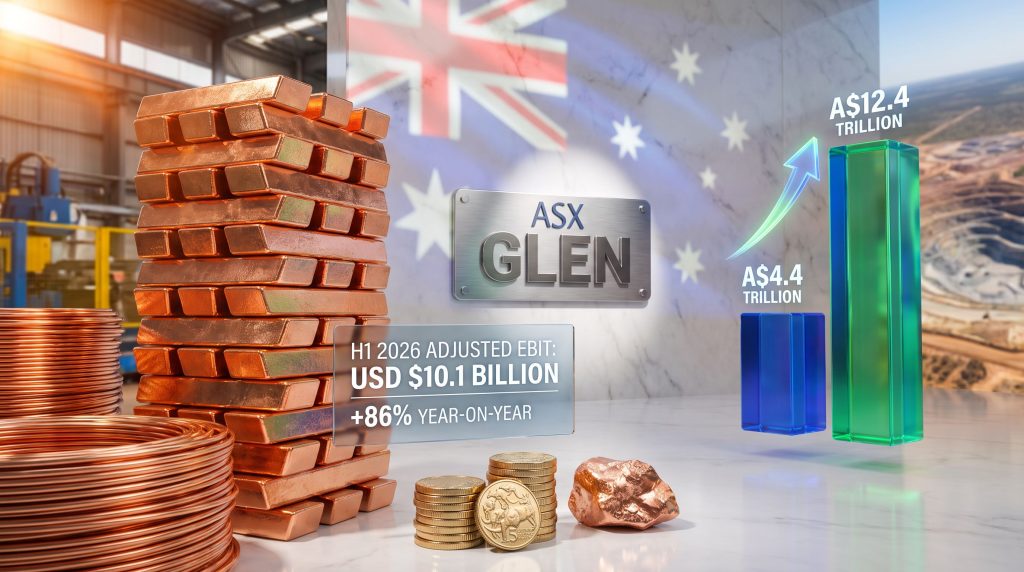
To understand why Glencore is making this move, the scale of what it is pursuing needs to be appreciated in full. Australia's compulsory superannuation system has grown into one of the most concentrated pools of institutional capital anywhere in the world. Total assets under management currently stand at approximately A$4.4 trillion (roughly USD $3.1 billion), and Deloitte projects that figure will nearly triple to A$12.4 trillion by 2045.
| Metric | Current (2026) | Projected (2045) |
|---|---|---|
| Total Australian Super Assets | A$4.4 trillion | A$12.4 trillion |
| Approximate USD Equivalent | ~USD $3.1 trillion | ~USD $8.7 trillion |
| Growth Multiple | Baseline | ~2.8x |
That growth trajectory places Australia on a path to rival sovereign wealth funds in Norway and the Gulf states as one of the top three largest concentrations of institutional capital globally. Critically, unlike many sovereign wealth funds, Australian superannuation is structurally biased toward equities and has a long track record of deep engagement with the resources sector.
Why Structural Mandates Block Access Today
A less commonly understood dimension of this opportunity relates to how Australian superannuation funds manage their investment mandates internally. Many large funds operate under domestic allocation caps — trustee policies or investment guidelines that limit the proportion of assets held in overseas-listed securities. Because Glencore currently trades only in London and Johannesburg, Australian funds seeking meaningful exposure face genuine structural constraints.
An ASX listing denominated in Australian dollars eliminates this barrier entirely. Once Glencore trades as a CDI on the ASX, it becomes a domestic investment for mandate purposes, regardless of where the underlying company is domiciled. This is not a minor administrative convenience — it is a material unlocking of latent demand. CEO Gary Nagle has noted directly that existing Australian shareholders in Glencore face constraints on overseas investment allocations, making a local listing an effective mechanism to convert that latent interest into active capital.
AustralianSuper, the country's largest pension fund with over A$350 billion in assets, publicly signalled its support for a potential Glencore ASX listing as early as May 2026, indicating the move would benefit both the exchange and the company. Separately, Solaris Investment Management's chief investment officer Michael Bell indicated his firm would welcome another major mining company joining the ASX. These are not passive endorsements — they represent the leading edge of institutional demand that the listing is designed to activate.
Index Inclusion: The Passive Inflow Catalyst
Beyond active fund interest, the index inclusion pathway represents a potentially self-reinforcing liquidity mechanism. Glencore's management has outlined a specific timeline and threshold framework:
| Index | Approximate Market Cap Threshold (AUD) | Expected Timeline |
|---|---|---|
| ASX 200 | ~A$1.5 billion | Within ~12 months of listing |
| ASX 100 | ~A$5.5 billion | Subject to trading volume development |
ASX 200 inclusion matters because it is not discretionary. Once a security meets the eligibility criteria for the ASX 200 or ASX 100, passive index-tracking funds, ETFs, and superannuation mandates benchmarked to those indices are required to buy it. This creates structural demand that is independent of active investment conviction, and it can be substantial given the volume of assets tracking Australian equity benchmarks.
The practical implication is a potential flywheel effect: early active fund buying builds liquidity, which supports index eligibility, which triggers passive inflows, which further deepens the market for the CDI. Whether that flywheel actually turns depends heavily on whether sufficient initial liquidity can be established — a question several fund managers have raised as a legitimate concern.
The Liquidity Question: A Real Risk
Some institutional observers have pointed to a structural tension at the heart of the listing. Without a capital raise, a major share transfer to an Australian registry, or a significant Australian corporate transaction, building genuine two-sided trading volume in the CDI market may prove more difficult than the headline strategy implies.
The two scenarios investors are weighing:
- The constructive case: Active super funds with mining mandates begin accumulating positions from day one; index eligibility is achieved within the forecast window; passive inflows create the depth needed for institutional-scale trading
- The cautious case: Without a forcing event that creates an initial block of ASX-domiciled holders, CDI volumes remain thin; bid-ask spreads stay elevated; large institutions hesitate to build meaningful positions in an illiquid instrument
This is not a theoretical debate. The CDI market for other large foreign-listed companies on the ASX has historically produced variable liquidity outcomes. For Glencore, the resolution of this question will likely depend on whether AustralianSuper and peer funds move from verbal endorsement to active position-building in the months following admission.
Copper Growth Strategy: The Asset Narrative Glencore Is Selling
The Glencore secondary listing in Australia cannot be evaluated independently of the company's copper growth ambitions. Copper is the commodity around which the listing narrative is being constructed, and for good reason: the ASX investor base has some of the deepest copper-sector expertise anywhere in the world, cultivated through decades of exposure to BHP, Rio Tinto, OZ Minerals, and a large cohort of mid-tier and junior copper producers.
Glencore's Australian copper anchor is the CSA Mine in New South Wales, described as one of Australia's highest-grade copper operations. High-grade copper deposits are particularly valuable in the current market environment because they generate substantially better economic returns per tonne of ore processed, reducing unit costs and improving margins relative to bulk, lower-grade operations. The CSA Mine provides Glencore with a domestically recognisable, operationally credible asset that fund managers can physically reference when building an investment thesis.
The Structural Copper Demand Outlook
The macro case for copper is well understood in broad terms but is frequently underappreciated in its specific demand composition. Furthermore, the ongoing copper supply crunch adds additional urgency to the investment thesis. Key structural demand drivers include:
- Electric vehicle manufacturing: EVs require approximately three to four times more copper than conventional internal combustion engine vehicles, driven by motors, wiring harnesses, charging infrastructure, and battery management systems
- Grid infrastructure expansion: Renewable energy buildout at scale requires extensive copper deployment across transmission, distribution, and substation infrastructure
- Data centre proliferation: The rapid expansion of AI-driven data centre construction is emerging as a meaningful incremental demand source that was largely absent from copper demand models five years ago
- Defence and industrial electrification: Broader electrification trends across defence procurement and heavy industry are adding further baseload demand growth
Analysts broadly expect copper markets to face structural supply deficits through the late 2020s and into the 2030s. New mine development timelines of 10 to 20 years from discovery to production make rapid supply responses to demand growth essentially impossible, creating a prolonged pricing environment that favours existing large-scale producers.
This dynamic is precisely the investment thesis that Glencore wants ASX-listed Australian super funds to associate with its equity. The company is not merely seeking capital — it is seeking a re-rating from investors who understand the copper supply constraint in granular terms.
M&A Optionality: The Strategic Layer Beneath the Surface
Investment analysts at Jefferies have identified a second-order strategic benefit of the ASX listing that goes beyond direct capital access: enhanced M&A optionality. Specifically, an ASX listing would allow Glencore to deploy ASX-traded CDIs as scrip currency in any future acquisition involving an Australian-listed company. This is not a trivial capability — it can be the difference between a deal proceeding and stalling on shareholder mechanics.
The timing context adds a further dimension. The ASX listing announcement coincides with the expiry of a six-month standstill period that followed the breakdown of Glencore's merger discussions with Rio Tinto. Glencore's CEO has been explicit that organic copper growth is the immediate operational priority, and the standstill expiry does not automatically signal renewed dealmaking. However, analysts at RBC Capital Markets have observed that increased familiarity among Australian investors — built through an active ASX presence — would be a material consideration in any future large-scale transaction. The Rio Tinto listing structure remains a point of reference for how complex dual-listed arrangements can affect investor outcomes.
Key M&A-related dynamics for investors to monitor over the next 12 to 24 months:
- Whether Glencore pursues bolt-on copper acquisitions involving ASX-listed mid-tier producers using CDI scrip
- The evolution of the relationship with Rio Tinto now that the standstill has expired
- Whether CDI trading liquidity reaches levels sufficient to support scrip-based deal mechanics at institutional scale
The next major ASX story will hit our subscribers first
London's Mining Finance Ecosystem: A Structural Retreat
Glencore's move needs to be understood within a broader multi-year pattern of London losing its grip on the global mining finance landscape.
| Company | Development | Year |
|---|---|---|
| BHP | Moved primary listing from London to ASX | 2022 |
| Rio Tinto | Defeated Palliser Capital's dual-listing review campaign | 2025 |
| Glencore | Pursuing secondary ASX listing | 2026 |
BHP's departure in 2022 represented the most structurally significant blow. The removal of the world's largest miner from the FTSE 100 left a gap in London's mining ecosystem that has never been filled. Rio Tinto's successful resistance to Palliser Capital's activist campaign to collapse its dual-listed structure bought time but did not resolve the underlying question of London's long-term value proposition for the sector.
Several structural forces are driving this migration:
- London-listed mining companies have historically traded at a valuation discount to ASX-listed peers with comparable asset profiles — a persistent gap that management teams and boards can no longer easily ignore
- The ASX investor base carries deeper sector-specific expertise, particularly in base metals and bulk commodities
- The scale and growth trajectory of Australian superannuation creates structural buying pressure that London's institutional base simply cannot replicate
- ESG screening pressures applied by London-based institutions have created friction for diversified miners with thermal coal exposure — a dynamic that is particularly relevant for Glencore
In addition, Glencore's Australian operations provide further strategic grounding for this regional pivot, reinforcing the company's long-term commitment to the market it is now seeking to access more directly.
Obstacles and Friction Points: What Could Limit the Listing's Impact?
A balanced assessment requires acknowledging that the Glencore secondary listing in Australia faces genuine structural headwinds that go beyond the liquidity question.
Three friction points identified by market participants:
-
Franking Credits: Australian investors, particularly self-managed superannuation funds and retail participants, place significant value on fully franked dividends. Franking credits represent a tax offset that effectively eliminates double taxation on company profits distributed as dividends. As a Swiss-headquartered entity paying dividends from a London-listed structure, Glencore cannot offer franked dividends. This reduces its income attractiveness relative to domestically domiciled ASX miners like BHP and Rio Tinto, which can offer franked distributions.
-
Thermal Coal Exposure: Glencore remains one of the world's largest thermal coal producers. Many Australian superannuation funds have adopted ESG investment frameworks that explicitly exclude or underweight thermal coal positions. This creates a structural tension: the very capital pool Glencore is targeting contains a significant subset of investors who may be prohibited from holding its shares by their own governance commitments.
-
Workplace Safety Record: Four workplace fatalities recorded in the first half of 2026 represent a reputational and governance concern that ESG-focused Australian institutional investors will scrutinise carefully during any investment committee process.
These obstacles do not necessarily prevent the listing from achieving its core objectives, but they define the addressable investor universe more narrowly than the headline numbers suggest. The most natural buyers are active fund managers with commodity-positive mandates and superannuation funds operating under less restrictive ESG screens.
Financial Foundations: Glencore Arrives in Australia From a Position of Strength
The financial backdrop to the listing is unambiguously constructive. Glencore reported adjusted first-half 2026 earnings of USD $10.1 billion — an 86% increase year-on-year and the second-highest half-year result in the company's history. This performance was driven by elevated commodity prices and strong trading revenues generated from volatile energy markets.
| Financial Metric | H1 2026 | H1 2025 | Change |
|---|---|---|---|
| Adjusted EBIT | USD $10.1 billion | ~USD $5.4 billion | +86% YoY |
| Historical Ranking | 2nd highest ever half-year | N/A | N/A |
This matters for the ASX listing narrative because Glencore arrives not as a company seeking rescue capital or looking to rebase its investor register following operational difficulties. It arrives as a financially robust, cash-generative business posting near-record earnings — exactly the profile that institutional fund managers conducting initial due diligence want to see.
The Radiant World Disclosure: A Risk Monitoring Item
One disclosure from the half-year results warrants investor attention. Glencore confirmed it has ceased commercial dealings with Singapore-based iron ore trader Radiant World following concerns about allegedly fraudulent shipping documentation. The company has taken provisions against existing contract exposures, though the specific financial quantum has not been disclosed publicly. Radiant World has denied the allegations.
While this development is unlikely to materially affect the ASX listing timeline or Glencore's financial position given the scale of its broader business, it represents a due diligence item that institutional investors conducting risk assessments will want to understand more fully before committing capital. Investors seeking broader context may find it useful to review Glencore's corporate governance disclosures directly.
Frequently Asked Questions: Glencore's Secondary ASX Listing
What is the difference between a primary and secondary listing?
A primary listing is a company's principal exchange of record — the jurisdiction where it is regulated and where its shares are primarily traded. A secondary listing enables the same company's shares, or depositary instruments representing those shares, to trade on an additional exchange. Glencore's London listing remains primary; the ASX would be a secondary venue alongside its existing Johannesburg listing.
Will Glencore issue new shares through the ASX listing?
No. Glencore has confirmed that the listing will not involve a capital raise, new share issuance, or transfer of shares to an Australian registry. The mechanism is CHESS Depositary Interests, which mirror existing London-listed shares without creating new equity or diluting existing holders.
When does Glencore expect to list on the ASX?
The company is targeting ASX admission in October 2026, subject to regulatory approval and exchange requirements being satisfied.
Which ASX indices could Glencore qualify for?
Management expects the company to meet the approximate A$1.5 billion threshold for ASX 200 inclusion within 12 months of listing. Longer-term eligibility for the ASX 100, which requires approximately A$5.5 billion in Australian market capitalisation, would depend on the pace of trading volume and liquidity development. For further context, the ASX's index methodology outlines the specific criteria applied to these benchmark inclusions.
Why does an ASX listing matter specifically for Australian superannuation funds?
Many Australian super funds operate under internal investment mandates that place caps on overseas asset allocations. Because Glencore currently trades only on overseas exchanges, it falls within those overseas caps and can represent a constrained position for funds approaching their limits. An ASX CDI listing reclassifies Glencore as a domestic security for mandate purposes, removing that constraint and opening meaningful allocation capacity.
This article is intended for informational purposes only and does not constitute financial advice. Forecasts, projected figures, and index inclusion timelines discussed in this article are subject to market conditions, regulatory outcomes, and company-specific developments. Readers should conduct their own due diligence before making any investment decisions.
Want to Catch the Next Major ASX Mineral Discovery Before the Broader Market Does?
Whilst institutional capital realigns around commodity-driven opportunities like copper, Discovery Alert's proprietary Discovery IQ model scans ASX announcements in real time, instantly alerting subscribers to significant mineral discoveries and actionable investment opportunities — explore historic discovery returns on Discovery Alert's discoveries page and begin your 14-day free trial today.