August 25, 2026
When Accounting Profits Become a Distraction
For most of the past decade, the global energy investment community has operated under a relatively straightforward assumption: higher oil prices mean higher corporate profits, and higher profits mean stronger shareholder returns. This mental model works well for most listed energy companies. It breaks down, however, when applied to national oil companies operating under sovereign fiscal extraction models that bear little resemblance to standard corporate structures.
Saudi Aramco's second-quarter 2026 financial results have exposed a growing tension at the heart of this assumption. The Aramco cash flow crisis is not a crisis of profitability. It is a crisis of cash conversion, and understanding the difference between these two conditions is essential for anyone seeking to properly evaluate the world's largest energy producer.
When big ASX news breaks, our subscribers know first
The Number That Matters Most Is Not the One in the Headlines
Adjusted Net Income vs. Free Cash Flow: A Divergence That Cannot Be Ignored
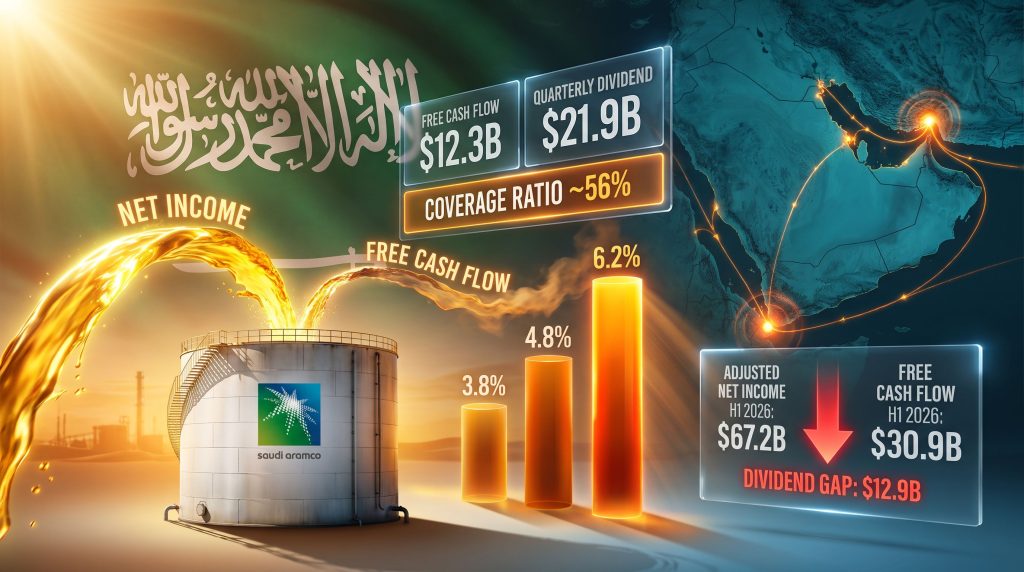
Aramco's adjusted net income reached $33.4 billion in the second quarter of 2026, pushing first-half adjusted earnings to $67.2 billion. Reported Q2 net income stood at $32.7 billion, approximately one-third higher than the same period a year earlier. By any conventional measure, these are extraordinary results that reinforce Aramco's standing as the most profitable energy company on the planet.
Yet the most strategically important figure in the entire results package is not any of these profit metrics. It is $12.3 billion: Aramco's Q2 2026 free cash flow.
| Metric | Q1 2026 | Q2 2026 | H1 2026 Total |
|---|---|---|---|
| Free Cash Flow | $18.6B | $12.3B | $30.9B |
| Quarterly Base Dividend | $21.9B | $21.9B | $43.8B |
| Coverage Ratio | ~85% | ~56% | ~71% |
| Dividend Shortfall | ~$3.3B | ~$9.6B | ~$12.9B |
When free cash flow of $12.3 billion is placed alongside a quarterly base dividend commitment of $21.9 billion, the result is a coverage ratio of approximately 56%. Taken across the full first half of 2026, cumulative free cash flow of $30.9 billion covered only around 71% of the $43.8 billion distributed to shareholders. Furthermore, the underlying financing gap exceeded $12.9 billion before any acquisitions, buybacks, or additional strategic investments were factored in.
Important distinction: This is not an insolvency event. Aramco retains an estimated cash buffer of approximately $53 billion following mid-2026 dividend payments and commands exceptional access to international debt markets. The concern is structural sustainability, not near-term liquidity.
How Oil Prices Rose While Cash Flow Fell: The Paradox Explained
A 40% Price Surge Produced a Declining Cash Outcome
The counterintuitive nature of Aramco's Q2 results deserves particular attention. The company's realized crude price climbed from $76.90 per barrel in Q1 2026 to $108.10 per barrel in Q2 2026, a gain of more than 40% driven primarily by geopolitical risk premiums associated with conflict dynamics across the Middle East. Downstream operations also performed strongly, with EBIT approximately doubling to around $6.2 billion on improved refining margins.
Under conventional corporate logic, this combination should have produced a significant surge in operating cash flow. Instead, operating cash flow declined from $30.7 billion to $25.4 billion quarter-over-quarter, while capital expenditure increased further to $13.2 billion in Q2. The broader oil price geopolitics driving these movements adds further complexity to what might otherwise appear to be a straightforward earnings story.
Three structural forces explain this divergence:
-
Working-capital timing mismatches – The gap between crude delivery, invoicing, and actual cash receipt can create substantial temporary drains on reported cash that do not appear in net income calculations.
-
Fiscal obligation scheduling – Aramco's tax and royalty payments to the Saudi government follow a schedule that may not align with the timing of cash actually received from international customers.
-
Intergovernmental receivables movements – Aramco has explicitly flagged unfavourable shifts in amounts due from the Saudi government as a direct factor reducing cash conversion efficiency, a disclosure that reveals the increasingly complex financial relationship between the company and its sovereign owner.
The Downstream Strength Illusion
The doubling of downstream EBIT is notable but insufficient to offset the upstream cash drag. When a refining division doubles its operating earnings yet the company's aggregate cash position deteriorates, it signals that the structural pressures on cash conversion are operating at a scale that downstream performance improvements cannot counter.
Aramco as Saudi Arabia's Financial Transmission Belt
The Fiscal Architecture That No Standard Corporate Model Can Capture
During the first half of 2026 alone, Aramco transferred the following to the Saudi state:
| Transfer Type | H1 2026 Amount |
|---|---|
| Income Taxes Paid to Saudi State | $25.3 billion |
| Royalties Transferred | $26.7 billion |
| Dividends Distributed | $35.7 billion |
| Total Government Receipts | ~$87 billion |
There are very few publicly listed corporations anywhere in the world operating under comparable fiscal extraction obligations. Aramco simultaneously funds government revenue streams, national infrastructure programs, and shareholder distributions from the same pool of generated cash. Standard corporate financial analysis frameworks were simply not designed to evaluate this type of entity.
According to analysis published by Reuters Breakingviews, Aramco's profit boom currently rests on a fragile status quo, with the company's financial architecture becoming increasingly dependent on conditions that may not persist.
This fiscal structure also explains an apparent contradiction in Saudi Arabia's macroeconomic data. The Kingdom's hydrocarbon economy actually contracted during this period due to lower production volumes, even as Aramco simultaneously reported record profitability. Reduced output lowers national GDP contribution, but each exported barrel generates substantially higher margins at elevated price levels.
The two dynamics coexist without conflict, but they do illuminate the vulnerability embedded in a model where volume and price must both perform to sustain fiscal targets. Saudi Arabia's resource strategy is, in many ways, inseparable from Aramco's capacity to generate surplus cash above domestic and dividend commitments.
The Capital Expenditure Treadmill
Where Is Aramco's Cash Actually Going?
Beyond government transfers, Aramco's internal capital commitments are absorbing an ever-larger share of generated cash. Major projects currently drawing capital include:
-
Jafurah Gas Field – Saudi Arabia's largest unconventional gas development, requiring sustained multi-year investment to reach full capacity.
-
Zuluf Field Expansion – An offshore crude capacity growth program intended to maintain Saudi Arabia's long-term production ceiling.
-
Fadhili Gas Plant – Downstream gas processing infrastructure critical to domestic energy security.
-
Downstream Petrochemicals – Domestic value-add manufacturing designed to reduce the Kingdom's dependence on crude export revenues.
-
International Acquisitions – Cross-border strategic asset accumulation aimed at diversifying Aramco's earnings base beyond the Gulf.
The compounding effect of rising capex on an already-strained cash conversion ratio is significant. Each additional dollar committed to long-cycle energy investments is a dollar unavailable to close the gap between free cash flow and dividend obligations.
Asset Recycling as a Strategic Pressure Valve
Aramco's divestment of its stake in PRefChem to Petronas is best understood not as routine portfolio housekeeping but as a deliberate capital recycling strategy designed to generate near-term liquidity while maintaining strategic optionality. If free cash flow coverage continues to fall short of dividend thresholds, this pattern of selective divestment is likely to accelerate across Aramco's broader international portfolio.
Maritime Chokepoints and the Hidden Cash Flow Variable
Export Route Exposure That Standard Valuation Models Ignore
A dimension of Aramco's risk profile that receives insufficient attention in conventional energy analysis is the direct relationship between maritime security and cash generation. Production costs are not the only variable that determines how much cash Aramco retains per exported barrel. Insurance premiums, freight rates, tanker availability, and the physical reliability of export corridors all carry direct cash-flow implications.
| Export Route / Chokepoint | Current Risk Factor |
|---|---|
| Strait of Hormuz | Tanker traffic at multi-month lows; ongoing Iran-related tensions |
| Red Sea / Bab el-Mandeb | Active Houthi missile and drone attacks on vessels |
| SUMED Pipeline | Indirect exposure via Suez Canal disruption risk |
| Suez Canal | Insurance premium escalation; routing disruptions |
| East-West Pipeline (to Yanbu) | Bypasses Hormuz but terminates at Red Sea, retaining exposure |
The East-West Pipeline is widely described as one of Saudi Arabia's most strategically valuable infrastructure assets because it allows crude to bypass the Strait of Hormuz. However, what is less frequently acknowledged is that the pipeline delivers oil to Yanbu on the Red Sea, which is itself subject to Houthi attack risk. The interconnected export chain of Yanbu, the Red Sea, Bab el-Mandeb, the SUMED pipeline, and the Suez Canal collectively faces active maritime threats. Geopolitical risk has not been eliminated from Aramco's export network; it has been redistributed across multiple chokepoints simultaneously.
The broader implication for investors is significant: Aramco is not simply exposed to oil market disruption risks. It is increasingly exposed to the resilience of global shipping corridors, a variable that does not appear in standard discounted cash flow models or earnings per share calculations.
The next major ASX story will hit our subscribers first
Gearing Trajectory and Balance Sheet Stress Signals
Conservative Today, But Moving in One Direction
| Period | Gearing Ratio |
|---|---|
| End of 2025 | 3.8% |
| End of Q1 2026 | 4.8% |
| End of Q2 2026 | 6.2% |
Aramco's gearing ratio of 6.2% remains exceptionally conservative by the standards of international oil majors. The concern is not the absolute level; it is the direction and velocity of change. Bloomberg has reported that Aramco's net debt has reached a three-year high, and the trajectory of the gearing ratio across the past three reporting periods illustrates a consistent one-way movement.
Unless free cash flow improves relative to dividend commitments, or unless capital spending moderates, continued increases in gearing are the arithmetically inevitable outcome. The question for long-term investors is not whether Aramco can sustain this trajectory for another quarter, but at what gearing level the company's financial flexibility becomes meaningfully constrained relative to its sovereign obligations.
The geopolitical risk landscape adds a further layer of complexity here, given that the same tensions inflating oil prices are simultaneously threatening export volumes and escalating operational costs.
Scenario Analysis: Two Pathways, Both Uncomfortable
The Structural Vulnerability of Geopolitical Risk Premium Dependence
Aramco's current financial performance depends on a very narrow set of simultaneously favourable conditions. Examining the two most probable scenario paths reveals why this is particularly challenging to manage:
| Scenario | Oil Price Outlook | Export Volume Risk | Cash Flow Impact |
|---|---|---|---|
| De-escalation / Peace | Significant price retreat from geopolitical premium | Low | Dividend coverage worsens on lower revenue |
| Escalation / Conflict | Elevated price premium sustained | High (physical disruption) | Revenue supported but volumes threatened |
| Base Case (moderate tension) | $75-$85/bbl range | Moderate | Dividend shortfall persists; borrowing increases |
The base case scenario is arguably the most challenging for Aramco's financial architecture. At sustained oil prices in the $75 to $85 per barrel range over a two-year horizon, current dividend levels combined with rising capital expenditure would require either increased sovereign borrowing, a moderation of Vision 2030 investment pace, a reconsideration of dividend policy, or an acceleration of asset monetisation programs.
Vision 2030 and the Feedback Loop Investors Must Understand
The Financial Dependency Chain That Connects Oil Prices to National Ambition
Aramco's financial performance is not simply a corporate matter. It sits at the centre of a dependency chain that connects international crude markets to Saudi Arabia's most ambitious long-term policy objectives:
Oil Prices → Aramco Free Cash Flow → Government Revenue → Vision 2030 Funding
Hydrogen development, petrochemical expansion, international acquisitions, and domestic industrial diversification all rely, directly or indirectly, on Aramco's capacity to generate surplus cash above and beyond its own operational and dividend commitments. If that surplus shrinks, the Kingdom faces a set of difficult fiscal choices:
-
Option A: Increase sovereign borrowing to maintain Vision 2030 spending velocity.
-
Option B: Moderate the pace of non-oil economic diversification investments.
-
Option C: Revisit Aramco's dividend structure, either the base level or performance-linked components.
-
Option D: Accelerate Aramco asset monetisation and divestment programs to generate near-term liquidity.
None of these options is costless, and all of them carry downstream implications for Aramco's operational and strategic positioning.
Earnings Quality vs. Cash Quality: The Framework for Serious Analysis
A Dual-Lens Approach to National Oil Company Valuation
Standard oil major valuation frameworks were developed for companies whose primary obligation is to shareholders. Applying them without modification to a company whose obligations simultaneously include funding a sovereign state's fiscal requirements produces a distorted picture.
A more appropriate analytical framework applies two distinct quality tests:
Earnings Quality: Is net income being generated from durable operational performance, or is it inflated by temporary geopolitical price premiums that could reverse rapidly?
Cash Quality: Is reported profit actually converting into freely distributable cash, or is it being absorbed by working capital timing, government transfer obligations, and capital commitments before it can reach shareholders?
At Aramco today, earnings quality remains high. Cash quality is deteriorating. This divergence is the central analytical insight that separates a superficial reading of the headline results from a genuine understanding of the Aramco cash flow crisis. Independent analysis from AGSI confirms that high dividend payments continue to drain Aramco's liquid assets, reinforcing the structural nature of this challenge.
FAQ: Key Questions on the Aramco Cash Flow Situation
Is Aramco Facing Insolvency or a Liquidity Crisis?
No. Aramco retains one of the strongest balance sheets in global energy and maintains exceptional access to international debt markets. The issue is structural sustainability over the medium term, not near-term solvency.
Why Does Free Cash Flow Fall Short of Net Income?
Several factors compress cash conversion: working-capital timing differences, the scheduling of Saudi fiscal obligations, intergovernmental receivable movements, and rising capital expenditure requirements.
What Would Oil Prices Need to Be for Full Dividend Coverage?
Based on current capital expenditure levels and fiscal extraction rates, sustained prices materially above the $85-$90 per barrel range would likely be required for free cash flow to fully cover base dividend commitments without additional balance sheet drawdown.
How Does Aramco's Gearing Compare to Global Peers?
At 6.2%, Aramco's gearing remains far below the levels typical of Western majors such as BP, Shell, or TotalEnergies, which regularly operate with gearing ratios in the 15-30% range. The concern is trajectory, not absolute level.
What Is the Performance-Linked Dividend and Why Does It Matter?
Aramco's dividend structure includes both a fixed base component and a performance-linked element. The performance-linked dividend is explicitly tied to free cash flow generation. If free cash flow continues to undershoot base dividend levels, the performance-linked component faces obvious pressure, representing an additional downside risk to total shareholder distributions.
The Warning That Headline Earnings Cannot Conceal
The progressive widening between Aramco's reported profits and its freely distributable cash flow represents a genuine structural challenge that will intensify under the most likely oil market scenarios. Three simultaneous pressures are converging: the Saudi government's fiscal extraction demands remain at historically elevated levels; capital expenditure commitments across major development programs continue to rise; and the geopolitical risk premiums currently supporting oil prices are inherently unstable in both directions.
Aramco is without question the world's most profitable energy company by conventional earnings metrics. However, profitability and financial sustainability are different conditions. The data from the first half of 2026 makes clear that converting extraordinary profits into sustainable, distributable cash is becoming progressively more difficult, and that this difficulty is structural rather than cyclical.
For investors, policymakers, and energy analysts, the Q2 2026 results carry a message that extends well beyond the headline numbers. The Aramco cash flow crisis, as it currently stands, is a warning about the limits of a financial architecture that must simultaneously satisfy shareholder expectations, sovereign fiscal demands, and long-cycle capital investment programs, all from a single pool of commodity-linked cash generation.
This article is for informational and educational purposes only and does not constitute investment advice. Financial forecasts and scenario projections involve inherent uncertainty and should not be relied upon as predictions of future outcomes.
Want to Stay Ahead of the Next Major Resource Discovery?
While Aramco's cash flow dynamics illustrate the complexity of commodity-linked investing at scale, Discovery Alert's proprietary Discovery IQ model cuts through that complexity by delivering real-time alerts on significant ASX mineral discoveries — visit the Discovery Alert discoveries page to explore historic examples of exceptional returns, or start your 14-day free trial at Discovery Alert to position yourself ahead of the broader market.