July 21, 2026
Strategic Materials Independence: India's Path to Rare Earth Dominance
Global supply chain vulnerabilities in critical materials have exposed nations to unprecedented economic and strategic risks. The COVID-19 pandemic and subsequent geopolitical tensions revealed how dependencies on single-source suppliers can paralyze entire industries overnight. For strategic materials like India rare earth permanent magnets, this vulnerability becomes a national security concern that extends far beyond economic considerations.
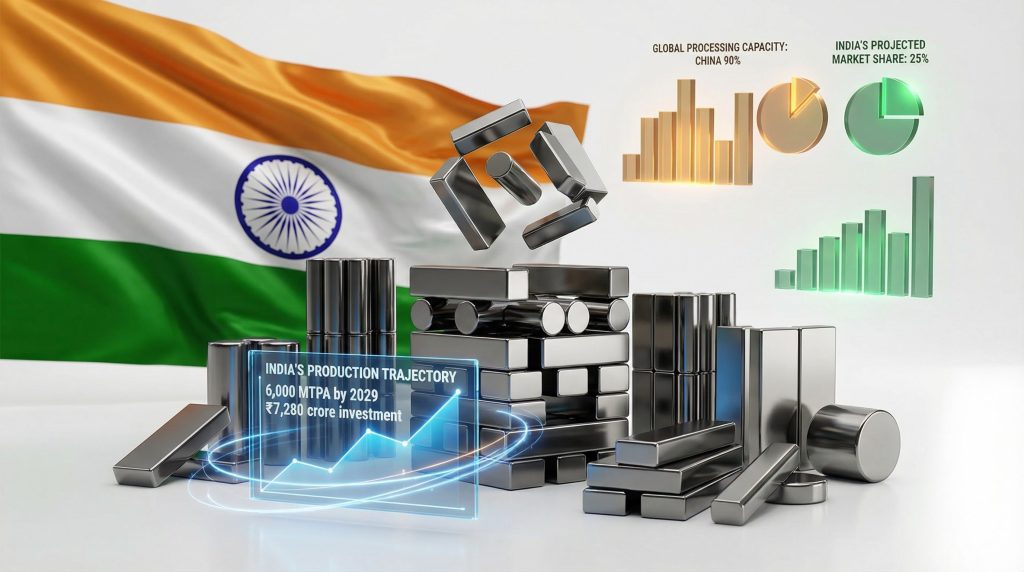
Furthermore, India's emergence as a potential challenger to established supply chains represents more than just another manufacturing initiative. With the world's third-largest rare earth reserves at 6.9 million tons and a rapidly expanding domestic market, India possesses the fundamental ingredients for transformative change in global materials strategy. The government's ₹7,280 crore ($802 million) commitment to establishing domestic production capabilities signals a comprehensive approach to strategic materials independence.
When big ASX news breaks, our subscribers know first
Understanding Critical Materials Vulnerability in Modern Industry
The strategic importance of India rare earth permanent magnets extends across multiple industrial sectors, each facing unique supply chain pressures and growth trajectories. Modern manufacturing increasingly depends on these specialized materials, creating concentrated points of failure that ripple through global value chains.
Industrial Demand Drivers:
• Electric vehicle motors requiring high-performance magnetic assemblies
• Wind turbine generators demanding consistent magnetic field strength
• Defense systems utilizing precision guidance and radar components
• Aerospace applications needing lightweight, powerful magnetic solutions
• Consumer electronics incorporating miniaturized magnetic components
Consequently, the automotive sector exemplifies this dependency most clearly. Electric vehicle production has surged 40% annually in key markets, but each vehicle requires approximately 1-2 kilograms of rare earth permanent magnets for motor assemblies and battery management systems. When China restricted rare earth exports in 2025, automotive manufacturers faced immediate production bottlenecks, with some assembly lines experiencing 2-3 week delays.
Current global consumption patterns reveal dangerous concentration risks:
| Supply Chain Element | Chinese Control | Global Impact |
|---|---|---|
| Rare Earth Processing | 90% | Critical bottleneck |
| Permanent Magnet Production | 85% | Manufacturing vulnerability |
| Refined Rare Earth Oxides | 95% | Raw material dependency |
| Downstream Integration | 70% | Value chain concentration |
However, India currently imports 4,000-5,000 metric tons annually of rare earth permanent magnets, representing nearly $800 million in annual foreign exchange outflow. With domestic consumption projected to double by 2030, this import dependency threatens both economic stability and industrial growth objectives, highlighting the urgent need for critical minerals energy security.
Geological Foundations of India's Strategic Advantage
India's rare earth mineral endowment provides the geological foundation for challenging existing supply chain configurations. Unlike many resource-rich nations that lack processing capabilities, India possesses both significant reserves and developing technological infrastructure.
Global Reserve Distribution Analysis:
| Country | Reserves (Million Tons) | Processing Share | Strategic Position |
|---|---|---|---|
| China | 44.0 | 90% | Dominant integrator |
| Vietnam | 22.0 | <1% | Potential challenger |
| India | 6.9 | <1% | Emerging producer |
| Russia | 21.0 | 2% | Constrained by sanctions |
| Brazil | 18.0 | <1% | Limited development |
India's 6.9 million tons of proven reserves concentrate primarily across four states: Odisha, Andhra Pradesh, Tamil Nadu, and Kerala. These deposits contain significant concentrations of neodymium, praseodymium, and dysprosium – the critical elements for high-performance permanent magnets.
Regional Deposit Characteristics:
• Odisha: Beach sand deposits with integrated heavy mineral extraction
• Andhra Pradesh: Monazite-rich concentrations suitable for large-scale processing
• Tamil Nadu: Established mining infrastructure with expansion potential
• Kerala: High-grade deposits requiring advanced separation technologies
Nevertheless, the key challenge historically has been private sector investment limitations. Despite substantial reserves, Indian companies have made limited investments in extraction and processing infrastructure, preferring to import finished products rather than develop domestic capabilities.
Comprehensive Manufacturing Strategy and Implementation Framework
The government's manufacturing strategy addresses the entire value chain from raw material processing through finished magnet production. This integrated approach differs significantly from previous initiatives that focused primarily on upstream mining activities.
Three-Phase Development Timeline:
Phase 1: Foundation Infrastructure (2026-2027)
- Rare earth oxide separation and purification facilities
- Quality control laboratories and testing capabilities
- Workforce development programs for specialised skills
- Environmental compliance systems for processing operations
Phase 2: Alloy Production Scaling (2027-2029)
- Neodymium-iron-boron alloy manufacturing lines
- Samarium-cobalt speciality production capabilities
- Advanced metallurgical research and development
- Supply chain integration with downstream manufacturers
Phase 3: Commercial Production Optimisation (2028-2030)
- Sintered magnet production at commercial scale
- Bonded magnet capabilities for specialised applications
- Surface coating and finishing operations
- Export market development and quality certification
Financial Allocation Structure:
| Component | Amount (₹ Crore) | Purpose | Implementation Focus |
|---|---|---|---|
| Capital Subsidy | 750 | Infrastructure development | Processing plant construction |
| Sales-Linked Incentives | 6,450 | Production scaling | Volume-based manufacturing support |
| Administrative Costs | 80 | Programme management | Coordination and oversight |
| Total Programme | 7,280 | Integrated development | Complete value chain |
In addition, the sales-linked incentive structure represents 88.6% of total allocation, demonstrating the government's focus on actual production outcomes rather than merely establishing facilities. This performance-based approach encourages efficiency and commercial viability from the outset.
Market Dynamics and Competitive Positioning Analysis
India's entry into global India rare earth permanent magnets production occurs during a period of significant demand expansion and supply chain restructuring. Multiple factors converge to create favourable conditions for new market entrants with sufficient scale and technological capabilities.
Demand Growth Projections by Sector:
• Electric Vehicles: 120% increase by 2030 driven by policy mandates
• Wind Energy: 85% expansion following renewable energy targets
• Industrial Automation: 60% growth from manufacturing digitalisation
• Defence Applications: 45% increase due to modernisation programmes
• Consumer Electronics: 30% steady growth from device proliferation
Meanwhile, current pricing dynamics favour diversified supply chains. Chinese producers have maintained premium pricing despite capacity advantages, creating opportunities for cost-competitive alternatives. Indian production costs, when fully scaled, could achieve 15-20% cost advantages through lower labour costs and integrated raw materials supply facility access.
Competitive Response Scenarios:
Scenario 1: Price Competition – Chinese producers reduce prices by 20-25% to maintain market share, potentially triggering trade disputes and forcing technological differentiation strategies.
Scenario 2: Technology Advancement – Accelerated research and development in next-generation magnet technologies, potentially creating new performance categories and market segments.
Scenario 3: Supply Chain Integration – Vertical integration strategies linking rare earth processing with downstream manufacturing applications, creating value chain advantages.
Geopolitical Implications and Strategic Alliance Opportunities
India's India rare earth permanent magnets initiative extends beyond domestic industrial policy to encompass broader geopolitical strategy. The timing aligns with global efforts to diversify critical material supply chains and reduce dependencies on single-source suppliers.
Multilateral Cooperation Frameworks:
Quad Partnership Integration
- Technology sharing agreements with Japan for advanced magnet designs
- Research collaboration with Australia on sustainable mining practices
- Market access facilitation with United States for defence applications
- Joint investment structures for processing infrastructure development
European Union Alignment
- Critical Raw Materials Act compliance for European market access
- Environmental standards harmonisation for sustainability certification
- Joint research initiatives on recycling and circular economy applications
- Supply security agreements for automotive and renewable energy sectors
Regional Leadership Positioning
- South Asian supply hub development for neighbouring countries
- Middle Eastern market penetration through strategic partnerships
- African cooperation on mineral resource development and processing
- ASEAN integration for electronics and automotive supply chains
These partnerships provide technological access, market opportunities, and financing mechanisms that accelerate development timelines whilst reducing implementation risks through comprehensive critical minerals strategy.
The next major ASX story will hit our subscribers first
Technical Challenges and Risk Assessment Framework
Successful implementation faces multiple technical, operational, and market challenges that require comprehensive risk management strategies. Understanding these constraints enables more realistic timeline expectations and contingency planning.
What Are the Critical Technical Challenges?
Manufacturing Precision Requirements
- Magnetic field uniformity tolerances of ±2% for automotive applications
- Corrosion resistance specifications for marine and offshore wind installations
- Temperature stability performance across -40°C to +180°C operating ranges
- Dimensional accuracy requirements within ±0.1mm for precision assemblies
Environmental Compliance Complexities
- Rare earth processing generates significant radioactive waste requiring specialised disposal
- Water treatment systems must handle acidic effluents with heavy metal contamination
- Air quality controls for dust and chemical vapour emissions
- Community impact mitigation in densely populated processing regions
Workforce Development Gaps
- Metallurgical engineers with rare earth processing expertise
- Quality control specialists familiar with magnetic property testing
- Environmental safety professionals trained in radioactive material handling
- Maintenance technicians for specialised processing equipment
Supply Chain Integration Risks:
| Risk Category | Probability | Impact Level | Mitigation Strategy |
|---|---|---|---|
| Technology Transfer Delays | Medium | High | Multiple sourcing partnerships |
| Equipment Import Restrictions | Low | High | Domestic manufacturing development |
| Skilled Labour Shortage | High | Medium | Accelerated training programmes |
| Environmental Approval Delays | Medium | Medium | Early stakeholder engagement |
Investment Framework and Market Entry Strategies
The evolving rare earth permanent magnet landscape creates multiple investment opportunities across the value chain. Understanding positioning strategies and risk-return profiles enables informed capital allocation decisions through effective investing strategies 2025.
Primary Investment Themes:
Upstream Integration Opportunities
- Rare earth mining companies with existing infrastructure
- Processing equipment manufacturers and technology providers
- Environmental services companies specialising in mining operations
- Logistics and transportation companies for material handling
Manufacturing Scale-Up Investments
- Magnet production facilities with automation capabilities
- Quality control and testing laboratory services
- Specialised coating and finishing operations
- Packaging and distribution infrastructure for industrial customers
Downstream Application Markets
- Electric vehicle component manufacturers
- Wind turbine assembly companies
- Defence contractor supply chain participants
- Electronics manufacturers requiring magnetic components
Financial Performance Projections:
| Investment Category | 2027 Revenue Potential | 2030 Market Size | Risk Assessment |
|---|---|---|---|
| Processing Infrastructure | ₹500-800 crore | ₹2,000-3,000 crore | Medium-High |
| Manufacturing Equipment | ₹200-400 crore | ₹800-1,200 crore | Medium |
| Downstream Applications | ₹1,000-1,500 crore | ₹5,000-8,000 crore | Low-Medium |
Performance Metrics and Success Indicators
Measuring progress requires comprehensive metrics spanning production capacity, market penetration, technological advancement, and strategic positioning. These indicators provide early warning systems for course corrections and optimisation opportunities.
Short-Term Milestones (2026-2027):
• Production Capacity: 1,200 metric tons annually by end-2027
• Quality Certification: Automotive industry approvals for domestic manufacturers
• Import Substitution: 20% reduction in foreign India rare earth permanent magnets purchases
• Employment Generation: 5,000 direct jobs in processing and manufacturing
• Technology Development: Indigenous processing capabilities for 3+ rare earth elements
Medium-Term Objectives (2028-2030):
• Domestic Self-Sufficiency: 6,000 metric tons annual production capacity
• Export Market Development: 2,000 metric tons annual export volume
• Value Chain Integration: 80% domestic content in finished magnets
• Research and Development: 5+ patent applications for advanced magnet technologies
• Strategic Partnerships: Formal cooperation agreements with 3+ international partners
Long-Term Strategic Impact (2030+):
| Success Indicator | Target Achievement | Strategic Significance |
|---|---|---|
| Global Market Share | 15-25% | Alternative supply source establishment |
| Technology Leadership | Indigenous R&D capabilities | Reduced foreign dependency |
| Export Revenue | $1-2 billion annually | Positive trade balance contribution |
| Industrial Ecosystem | Integrated value chain | Sustainable competitive advantage |
How Will This Impact the Global Market?
The transformation of India's position in rare earth permanent magnet production represents more than industrial policy – it exemplifies strategic materials independence in an interconnected global economy. Success requires sustained commitment, technological innovation, and adaptive management as market conditions evolve within the complex geopolitical mining landscape.
For instance, India's government has announced its commitment to achieving rare earth permanent magnet production by year-end, demonstrating the urgency behind this strategic initiative.
Disclaimer: This analysis involves projections and scenarios based on current market conditions, government policies, and technological trends. Actual outcomes may vary significantly due to factors including but not limited to geopolitical developments, technological disruptions, market demand fluctuations, environmental regulations, and competitive responses. Investment decisions should consider comprehensive risk assessments and professional consultation.
The foundation exists; execution will determine whether India emerges as a genuine alternative to concentrated supply chains or remains dependent on external sources for critical industrial materials.
Want to Stay Ahead of Critical Minerals Investment Opportunities?
Discovery Alert's proprietary Discovery IQ model delivers real-time alerts on significant ASX mineral discoveries, helping investors identify critical minerals opportunities before they hit mainstream attention. With rare earth and strategic materials driving the next wave of resource sector growth, position yourself ahead of the market by exploring Discovery Alert's discoveries page to see how major mineral discoveries have generated exceptional returns, then begin your 14-day free trial today.