July 20, 2026
The Global Race to Build a Rare Earth Supply Chain Outside China
The rare earth supply chain has one defining structural flaw: it runs almost entirely through a single country. China controls not just the mining of rare earth elements but the separation, alloying, and magnet manufacturing stages that sit downstream. For decades, this arrangement was commercially convenient for Western manufacturers seeking low-cost inputs. Today, it is increasingly viewed as a liability of strategic proportions. The USA Rare Earth Serra Verde merger CEO transition is one of the most significant responses to this structural vulnerability that the Western mining sector has produced.
Heavy rare earth elements (HREEs) sit at the sharpest edge of this vulnerability. Dysprosium and terbium, two elements essential for producing the high-coercivity permanent magnets used in electric vehicle motors, wind turbines, and defence systems, are almost exclusively processed in China. Unlike the light rare earths, where some ex-China production exists, the HREE segment has remained stubbornly concentrated in Chinese hands. That concentration is now the defining problem that the merger has been structured to address. Furthermore, China's export restrictions on rare earths have added considerable urgency to the search for alternative supply platforms.
When big ASX news breaks, our subscribers know first
A $2.8 Billion Bet on Vertical Integration Outside Asia
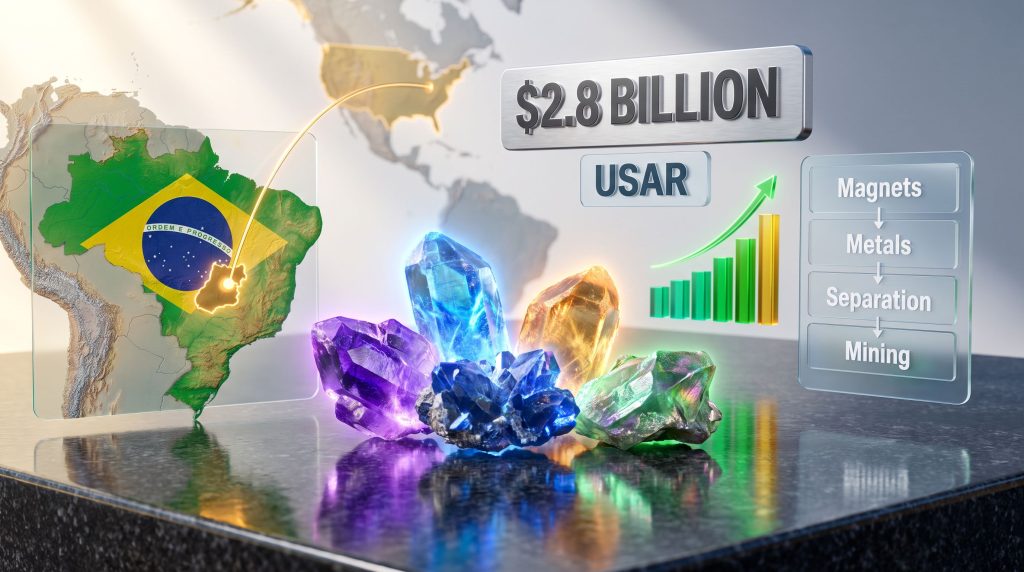
The transaction announced on April 20, 2026 carries a headline value of $2.8 billion, structured as a combination of cash and stock. It is one of the largest consolidation moves in the non-Chinese rare earth sector in recent memory, and its architecture reflects a deliberate attempt to build something that has rarely existed in the West: a mine-to-magnet platform operating entirely outside Chinese jurisdiction.
Legacy Serra Verde shareholders will retain a 34% equity stake in the combined company, preserving alignment between the two founding investor groups. This signals that the deal is a long-term strategic convergence rather than a straightforward acquisition. The combined company trades on Nasdaq under the ticker USAR, providing public market access and the capital flexibility that a vertically integrated operation at this scale demands.
What Each Party Contributes to the Platform
Understanding the merger requires recognising that both parties bring genuinely complementary capabilities rather than overlapping ones.
| Contributor | Strategic Asset | Role in Combined Platform |
|---|---|---|
| USA Rare Earth | North American processing infrastructure, magnet manufacturing, public market listing | Downstream integration and institutional capital access |
| Serra Verde Group | Pela Ema mine (Brazil), HREE production at commercial scale | Upstream feedstock and ex-China production base |
| U.S. International Development Finance Corporation | $565 million financing facility | Capital for Pela Ema mine expansion |
Serra Verde's Pela Ema mine in Brazil is the asset that gives this merger its strategic weight. It is one of the only operations globally, outside of China, producing all four magnetic rare earth elements at commercial scale. Those four elements are neodymium (Nd), praseodymium (Pr), dysprosium (Dy), and terbium (Tb), and their simultaneous production at a single site is a geological and operational distinction that very few deposits can claim.
According to Mining Outlook's analysis of the acquisition, Serra Verde's Pela Ema operation is projected to account for approximately 50% of global ex-China heavy rare earth production in the near term, making it arguably the most strategically significant HREE asset outside of Asia.
Why the Pela Ema Mine Is a Genuinely Rare Asset
Most rare earth deposits are light rare earth element (LREE) dominant. The Mountain Pass mine in California, for example, produces significant volumes of cerium and lanthanum alongside neodymium and praseodymium, but its HREE profile is comparatively modest. Chinese dominance in HREEs is partly geological: China's ionic clay deposits in southern provinces like Jiangxi are naturally enriched in the heavier elements, making them unusually suited to producing dysprosium and terbium at low cost.
Pela Ema's geology is therefore notable. Brazilian ionic clay deposits, while less well-known than their Chinese counterparts, share some of the same characteristics that make HREEs economically recoverable. The clay-hosted nature of the mineralisation allows for relatively low-cost heap leaching extraction methods, avoiding the energy-intensive and chemically complex processing steps required for hard rock rare earth ores.
This geological profile has practical implications for production economics. Lower processing costs mean the operation can remain competitive against Chinese producers even during periods of rare earth price softness. This has historically been one of the key vulnerabilities for Western rare earth projects attempting to challenge Chinese incumbency on cost alone. The broader rare earth processing challenges facing ex-China producers make Pela Ema's lower-cost clay-hosted mineralisation all the more strategically valuable.
The $565 million financing facility from the U.S. International Development Finance Corporation (DFC) secured earlier in 2026 is targeted at expanding Pela Ema's production capacity. The DFC's involvement reflects U.S. government interest in diversifying critical mineral supply chains, though the facility is a commercial financing instrument rather than a direct subsidy or formal strategic designation.
Comparative Positioning in the Global HREE Landscape
| Metric | Significance for Combined Company |
|---|---|
| Geographic location | Outside Chinese jurisdiction; qualifies under U.S. critical minerals ally-sourcing frameworks |
| Element coverage | All four magnetic rare earths produced at a single site |
| Projected ex-China market share | Approximately 50% of global non-Chinese HREE production |
| DFC financing secured | $565 million facility to fund expansion |
| Post-merger structure | Fully integrated into USAR's mine-to-magnet platform |
The Leadership Transition: From Transformation to Execution
Few aspects of a post-merger integration reveal more about strategic intent than the choice of CEO. The decision to install Thras Moraitis as chief executive of the combined company, effective October 1, 2026, is a deliberate signal that the combined entity is shifting from deal-making mode into operational delivery. Consequently, the USA Rare Earth Serra Verde merger CEO appointment reflects a phase-appropriate transition that investors should interpret carefully.
Barbara Humpton's Role in Building the Foundation
Barbara Humpton joined USA Rare Earth in October 2025, transitioning from her position as CEO of Siemens USA. Her tenure of less than twelve months was concentrated on a specific task: repositioning the company from a mining-focused entity into a vertically integrated supply chain participant capable of attracting institutional partners and government counterparts.
During that period, Humpton secured the public-private partnerships that expanded USA Rare Earth's capabilities across rare earth processing, metals production, and manufactured magnets. That groundwork is what made the Serra Verde acquisition strategically coherent rather than simply opportunistic. Her departure is structured as a retirement, reflecting an orderly planned succession rather than an abrupt change in direction.
Thras Moraitis: Operational Pedigree From Xstrata to Serra Verde
Moraitis brings a biography that is unusually well-suited to the combined company's next phase. He has led Serra Verde Group since January 2023, overseeing the company's transition from a development-stage project into a commercial rare earth producer at a time when HREE supply chain development was becoming a global policy priority.
Before Serra Verde, Moraitis co-founded X2 Resources, a mining investment vehicle that attracted significant institutional capital. His earlier career included a role on the executive committee of Xstrata, working under then-CEO Mick Davis during the period that culminated in Glencore's $29 billion acquisition of Xstrata in 2013. That transaction remains one of the largest mining deals in history, and Moraitis's proximity to it provided experience in navigating complex, multi-jurisdictional corporate transactions at the highest level of the industry.
The leadership transition timeline is structured to avoid disruption during the critical post-merger integration window.
| Date | Leadership Event |
|---|---|
| April 20, 2026 | Merger announced; Moraitis named incoming CEO |
| Immediate effect from announcement | Michael Blitzer assumes Executive Chairman role |
| Late August 2026 | Merger expected to close; Moraitis becomes President |
| October 1, 2026 | Moraitis officially assumes CEO role of combined company |
| October 1, 2026 | Barbara Humpton retires as CEO and exits the board |
Sir Mick Davis and the Governance Signal
Sir Mick Davis, former CEO of Xstrata and Chairman of Serra Verde, will join the board of directors of USA Rare Earth as a director following the merger close. His appointment alongside Moraitis creates an unusual governance dynamic: two executives who worked together at one of the defining mining companies of the 2000s are now positioned at the top of what aims to become the defining non-Chinese rare earth platform of the 2020s.
This depth of governance signals to institutional investors that the combined company has access to a network of relationships built over decades of large-scale mining operations, project finance, and multi-jurisdictional regulatory navigation. Denham Capital's commentary on the transaction further underscores the institutional confidence underpinning this governance structure.
The Mine-to-Magnet Model: Why Full Integration Changes the Strategic Calculus
The term mine-to-magnet refers to a company's ability to control every stage of the rare earth value chain, from ore extraction through to the finished permanent magnets installed in end-use products. Very few companies outside China have achieved this, and none at the scale that the merger is targeting. In addition, the rare earth supply chain complexities that have stymied earlier Western attempts make this level of integration particularly ambitious and consequential.
Breaking Down the Rare Earth Value Chain
-
Mining – Extraction of rare earth ore from the Pela Ema deposit in Brazil using ionic clay leaching methods
-
Separation – Processing ore into individual rare earth oxides (REOs) through solvent extraction circuits
-
Metals production – Converting REOs into rare earth metals and alloys through reduction processes
-
Magnet manufacturing – Producing neodymium-iron-boron (NdFeB) permanent magnets for defence, EV, and industrial applications
Each of these stages has historically been dominated by Chinese producers. Western companies that control only mining or only separation remain exposed to Chinese pricing power and, increasingly, Chinese export control decisions at every other point in the chain. A vertically integrated platform removes those intermediate dependencies entirely.
End Markets Driving Structural Demand
The commercial rationale for full integration is anchored in the demand trajectory across several high-growth sectors. The surge in critical minerals demand across defence, clean energy, and advanced manufacturing is central to the investment thesis underpinning this transaction.
-
Electric vehicles: NdFeB permanent magnets are used in the traction motors of battery electric vehicles. Each EV motor requires meaningful quantities of neodymium, praseodymium, dysprosium, and terbium, with HREE additions essential for maintaining magnet performance at elevated operating temperatures.
-
Defence and aerospace: Precision-guided munitions, radar arrays, sonar systems, and electric motors in military platforms all require high-performance rare earth magnets. The U.S. Department of Defence has identified HREE supply as a readiness issue.
-
Wind energy: Direct-drive wind turbines use large-format permanent magnet generators that require significant rare earth inputs, with offshore installations increasingly favouring permanent magnet designs over older induction generator architectures.
-
Advanced electronics: From medical imaging equipment to industrial robotics, the miniaturisation demands of modern technology continuously push toward higher-performance magnetic materials.
Geopolitical Context: Why This Merger Is More Than a Commercial Transaction
China demonstrated as far back as 2010, during a territorial dispute with Japan, that it is willing to use rare earth export restrictions as a geopolitical instrument. That episode sent shock waves through global supply chains and triggered the first wave of Western rare earth investment. Most of those projects ultimately failed to compete with Chinese production economics during the subsequent period of low rare earth prices.
The current environment is structurally different. Trade and technology competition between the United States and China has elevated critical mineral supply chains to a national security discussion, not merely a commercial one. China's periodic signals about restricting HREE exports in the context of broader trade tensions have added urgency to Western industrial policy responses. The broader role of energy transition minerals in national energy security further amplifies this strategic imperative.
Brazil's position as the host country for Pela Ema is strategically meaningful. Brazilian production qualifies under U.S. critical minerals ally-sourcing frameworks, allowing the combined company's output to meet domestic content and sourcing requirements that are increasingly embedded in defence procurement and clean energy incentive structures.
The convergence of private capital, U.S. development finance, and operationally experienced mining leadership in a single vertically integrated structure represents a maturation of the Western rare earth sector. Earlier attempts to build ex-China rare earth capacity largely failed at the processing and magnet stages, leaving mining assets stranded without downstream markets. The USA Rare Earth Serra Verde merger CEO structure is explicitly designed to avoid that outcome.
The next major ASX story will hit our subscribers first
Key Takeaways for Investors and Industry Observers
The broader strategic repositioning of the combined company deserves careful attention from anyone tracking the critical minerals sector. However, it is the operational detail beneath the headline figures that reveals the true ambition of this transaction.
-
The $2.8 billion transaction creates one of the most strategically differentiated non-Chinese rare earth platforms globally
-
Pela Ema's projected approximately 50% share of global ex-China HREE output makes it a genuinely scarce asset, not simply one of many aspiring rare earth projects
-
The leadership handover from Humpton to Moraitis reflects a planned, phase-appropriate transition from institutional deal-making to mine-level operational execution
-
Moraitis's direct familiarity with Serra Verde's assets, workforce, and ramp-up trajectory materially reduces post-merger integration risk
-
The DFC's $565 million financing facility for Pela Ema expansion provides capital certainty for the growth phase without requiring the combined company to rely solely on equity markets
-
Sir Mick Davis's board appointment and Michael Blitzer's Executive Chairman role create a governance architecture with genuine large-scale mining transaction experience at its core
-
The mine-to-magnet integration model positions Nasdaq: USAR to serve defence, EV, and renewable energy customers as a single-source, non-Chinese supplier across the full value chain
This article is intended for informational purposes only and does not constitute financial advice. Forecasts regarding production volumes, market share, and transaction timelines are based on publicly available company announcements and are subject to change. Investors should conduct their own due diligence before making investment decisions.
Want to Stay Ahead of the Next Major Critical Minerals Discovery?
Discovery Alert's proprietary Discovery IQ model scans ASX announcements in real time, instantly identifying significant mineral discoveries across rare earths and more than 30 other commodities — turning complex data into actionable opportunities for investors at every level. Explore how historic discoveries have generated extraordinary returns on Discovery Alert's dedicated discoveries page, and begin your 14-day free trial today to position yourself ahead of the broader market.