May 14, 2026
Strategic Mineral Dependencies Reshaping Global Energy Security
The global transition toward renewable energy and electric mobility has fundamentally altered the strategic importance of critical mineral reserves. Nations worldwide are reassessing their resource dependencies as supply chain vulnerabilities exposed during recent geopolitical tensions highlight the risks of concentrated mineral processing capabilities. This shift has created unprecedented opportunities for mineral-rich regions to transform from raw material exporters into integrated value chain participants, fundamentally altering the geopolitical mining landscape.
Traditional resource extraction models are giving way to sophisticated mineral-to-manufacturing ecosystems that capture multiple value creation stages within single geographic regions. This transformation requires coordinated policy frameworks, substantial industrial investment, and technological capabilities that extend far beyond conventional mining operations. Furthermore, the success of such integrated approaches depends on balancing rapid industrial development with environmental sustainability and community engagement whilst considering critical minerals energy security implications.
When big ASX news breaks, our subscribers know first
Understanding Odisha's Strategic Position in Global Critical Minerals
Odisha's critical mineral sector has emerged as a cornerstone of India's mineral security strategy, controlling reserves across more than 30 critical minerals essential for energy transition technologies. The state's mineral portfolio spans from established commodities like chromite and bauxite to emerging strategic materials including lithium and rare earth elements discovered through recent geological surveys.
Strategic Mineral Assets:
- Sukinda Valley Complex: Hosts 174 million tonnes of nickel reserves at 0.5% average grade
- Chromite Dominance: Controls 83% of India's total chromite reserves
- Bauxite Concentration: Represents 73% of national bauxite production capacity
- Heavy Mineral Sands: Contains rare earth element concentrations along coastal areas
- Recent Lithium Discovery: Nayagarh district findings potentially significant for battery material supply chains
The concentration of these resources within a single state creates unique opportunities for integrated processing and manufacturing development. Unlike regions where critical minerals are geographically dispersed, Odisha's mineral clustering enables coordinated industrial policy and infrastructure development across multiple value chains simultaneously.
Recent geological mapping has revealed additional strategic materials including vanadium deposits critical for grid-scale energy storage systems and cobalt co-located with nickel laterite formations. These discoveries expand Odisha's critical mineral sector potential role beyond traditional mineral exports toward participation in advanced technology manufacturing supply chains, particularly in areas where global cobalt production remains strategically important.
Economic Transformation Projections for Odisha's Critical Mineral Sector
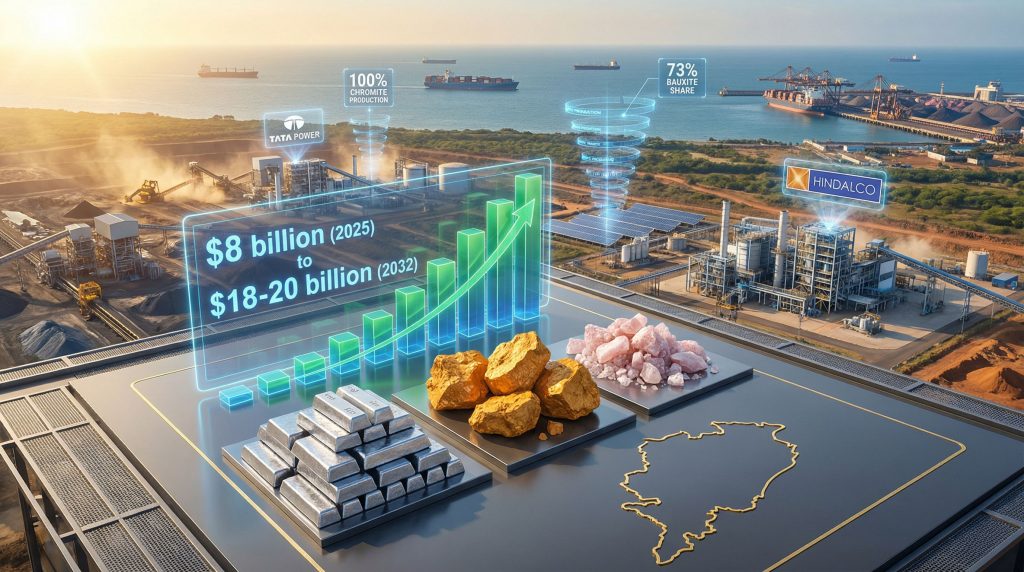
Analysis from the Net Zero Energy Transition Association indicates Odisha's critical mineral sector could grow from $8 billion in 2025 to $18-20 billion by 2032, representing growth of 125-150% over six years. This expansion reflects fundamental structural changes across the mining, processing, and manufacturing value chain rather than simple capacity additions.
Value Chain Evolution Framework:
| Sector Component | 2025 Share | 2032 Target | Strategic Transformation |
|---|---|---|---|
| Raw Mining Operations | 40% | 50% | Enhanced extraction efficiency and automation |
| Mineral Processing | 10% | 40% | Four-fold increase in value-added activities |
| Manufacturing Integration | 5% | 30% | Six-fold expansion in finished goods production |
This transformation model suggests a systematic shift from commodity extraction toward integrated mineral-to-manufacturing ecosystems. The projected increase in processing capabilities from 10% to 40% of sector value represents the most significant structural change, indicating substantial investment in beneficiation, smelting, and chemical processing technologies.
Manufacturing integration expansion from 5% to 30% reflects strategic positioning in battery materials, solar components, and advanced alloys rather than basic metal production. This evolution could reduce India's import dependency on processed critical minerals by an estimated 25-30%, assuming successful implementation of planned facilities and technology transfer agreements including battery lithium refinery India initiatives.
The growth trajectory depends on coordinated development across multiple industrial segments, requiring substantial capital investment, skilled workforce development, and environmental management capabilities. However, success metrics include not only revenue growth but also value capture retention within the state rather than raw material export.
Industrial Investment Landscape and Strategic Partnerships
More than 10 leading industrial groups have committed to manufacturing investments in Odisha's critical mineral sector, representing a coordinated approach to vertical integration and supply chain security. These commitments extend beyond traditional mining operations into sophisticated processing and manufacturing capabilities.
Major Industrial Commitments:
- Tata Power: Solar manufacturing integration with local mineral processing capabilities
- Hindalco: Aluminum-lithium battery material synergies leveraging existing smelting infrastructure
- Himadri Speciality Chemicals: Graphite processing focused on battery anode materials
- World Green Energies: Renewable energy equipment manufacturing with integrated supply chains
- Luminous: Energy storage system manufacturing utilising local battery materials
These investment patterns reflect sophisticated supply chain strategies where companies secure upstream critical mineral access while developing downstream manufacturing capabilities. This vertical integration approach creates resilient supply chains less vulnerable to international trade disruptions and price volatility.
The Global Cleantech Expo-Odisha 2026 featured over 75 exhibitors spanning the clean technology spectrum, including established manufacturers and emerging technology companies. This industrial ecosystem development suggests coordination between policy makers, established corporations, and innovative technology providers as part of India's broader critical minerals strategy.
Tata Power's solar manufacturing integration exemplifies the strategic approach, combining photovoltaic panel production with local silicon processing and aluminum frame manufacturing. Furthermore, Hindalco's aluminum-lithium battery material initiatives leverage existing aluminum refining capabilities while adding battery-grade lithium processing technologies.
What Investment Patterns Are Emerging?
Investment patterns demonstrate sophisticated supply chain strategies where companies secure upstream critical mineral access whilst developing downstream manufacturing capabilities. This vertical integration approach creates resilient supply chains less vulnerable to international trade disruptions and price volatility, reflecting lessons learnt from recent global supply chain challenges.
Geological Discoveries Transforming India's Mineral Security
Recent geological discoveries in Odisha extend the state's strategic mineral portfolio beyond traditional commodities into materials critical for advanced energy technologies. These findings could significantly alter India's mineral import dependencies and strategic positioning in global supply chains.
Breakthrough Discovery Portfolio:
- Lithium Deposits in Nayagarh: Potential to reduce India's battery material import dependency
- Enhanced Graphite Mapping: Natural graphite essential for electric vehicle battery anodes
- Vanadium Identification: Critical for vanadium redox flow batteries in grid storage applications
- Cobalt Co-location: Found alongside nickel in laterite formations, enabling integrated extraction
The lithium discovery in Nayagarh district represents a particularly significant development given India's complete reliance on lithium imports for battery manufacturing. While specific reserve estimates require additional geological assessment, initial findings suggest commercially viable concentrations that could supply domestic battery manufacturing requirements.
Enhanced graphite mapping has identified natural graphite deposits suitable for battery anode production, currently dominated by synthetic graphite from China. Natural graphite offers environmental advantages in battery manufacturing while providing supply chain diversification opportunities for electric vehicle manufacturers.
"These discoveries could potentially reduce India's lithium import dependency by 15-20% within a decade, assuming successful commercial development and processing technology deployment."
Vanadium identification adds grid-scale energy storage capabilities to Odisha's strategic mineral portfolio. Vanadium redox flow batteries provide long-duration energy storage essential for renewable energy integration, representing a growing market as solar and wind capacity expands.
The Ganjam Rare Earth Corridor's National Strategic Role
The Ganjam Rare Earth Corridor represents India's most comprehensive attempt to establish alternative rare earth processing capabilities outside Chinese control. This initiative spans the complete value chain from beach sand mineral processing to permanent magnet manufacturing.
Corridor Development Components:
- IREL's REEP Facility at Chhatrapur: Beach sand mineral processing for monazite separation
- Integrated Supply Chain Development: Mining to magnet manufacturing within single geographic region
- Strategic Industry Partnerships: Defence and renewable energy sector collaboration
- Export Market Positioning: Alternative supplier for allied nations seeking supply diversification
India Rare Earths Limited's Rare Earth Element Processing facility at Chhatrapur processes beach sand minerals containing monazite, the primary source of light rare earth elements. The facility's expansion could position India as a secondary global supplier of processed rare earth materials.
The corridor's strategic importance extends beyond domestic supply security toward export opportunities. Allied nations seeking alternatives to Chinese rare earth supplies represent substantial market opportunities, potentially enabling India to capture 8-12% of global processed rare earth market share by 2035.
Defence applications drive particular strategic interest, as rare earth permanent magnets are essential for advanced weapons systems, radar technologies, and military communications equipment. Consequently, domestic rare earth processing capabilities reduce strategic vulnerabilities in defence technology supply chains.
The next major ASX story will hit our subscribers first
Port Infrastructure Enabling Global Market Access
Odisha's coastal location provides substantial logistical advantages for both domestic mineral distribution and international export markets. The state's port infrastructure supports bulk commodity handling while enabling access to growing Asian markets for processed mineral products.
Strategic Port Connectivity:
- Paradip Port: Bulk mineral handling capabilities for raw material exports
- Dhamra Port: Private sector efficiency for processed materials and finished goods
- Gopalpur Port: Emerging hub for value-added product exports to Southeast Asia
Port infrastructure development enables participation in regional supply chains serving Southeast Asian manufacturing centres. As global companies diversify supply chains away from single-country dependencies, Odisha's port access positions it as an alternative supplier for critical mineral processing.
Export opportunities extend beyond raw materials toward processed minerals and battery materials. Southeast Asian electric vehicle manufacturing requires substantial battery material imports, creating market opportunities for Odisha's planned lithium and graphite processing facilities.
How Do Port Facilities Support Value Addition?
Port facilities enable the transition from bulk commodity exports to processed materials and finished goods, supporting higher value-added activities. This infrastructure capability underpins the projected shift from 5% to 30% manufacturing integration within the sector.
Policy Innovations Accelerating Sector Development
Odisha's policy framework demonstrates sophisticated understanding of critical mineral value chains and global market dynamics. The state's approach extends beyond traditional mining promotion toward comprehensive ecosystem development.
Strategic Policy Innovations:
- Dedicated Critical Mineral Auction Calendar: Over 35 mineral blocks scheduled for systematic auction
- Processing Incentives: Value addition encouragement through fiscal benefits
- Research Institution Partnerships: Technology development collaboration with academic institutions
- Environmental Clearance Streamlining: Expedited approvals for priority strategic projects
The "5J" vision framework encompasses Jal (water), Jungle (forest), Jami (land), Jiba Jantu (biodiversity), and Jana Sadharan (public welfare), demonstrating commitment to sustainable development models. This approach balances rapid industrial development with environmental protection and community engagement.
State MSME Minister Gokulananda Mallik emphasised that the government's commitment to the Net Zero goal by 2070 drives transformative progress for small and medium enterprises and startups within the critical mineral sector. This policy alignment creates coordinated incentives across multiple government levels.
Dedicated auction calendars provide predictable investment timelines for industrial planning whilst ensuring competitive pricing for mineral access rights. In addition, this systematic approach contrasts with ad-hoc auction processes that create uncertainty for long-term industrial investment planning.
Global Supply Chain Vulnerability Mitigation
Current global critical mineral supply chains exhibit dangerous concentration risks that Odisha's development could help address. Chinese dominance in processing capabilities creates strategic vulnerabilities for countries pursuing energy transition goals.
Supply Chain Risk Assessment:
| Critical Mineral | Current Concentration Risk | Odisha's Mitigation Potential |
|---|---|---|
| Rare Earth Processing | 80% China-controlled | Alternative processing hub development |
| Natural Graphite | 70% China-dominated | Domestic supply chain establishment |
| Cobalt Processing | 70% DRC-dependent | Nickel laterite co-production capabilities |
| Chromite Supply | Limited global suppliers | Dominant global market position |
Rare earth processing represents the most significant supply chain vulnerability, with China controlling approximately 80% of global processing capacity despite holding only 30% of global reserves. Odisha's rare earth corridor development could provide alternative processing capabilities for global supply chain diversification.
Natural graphite supply chains face similar concentration risks, with China dominating both mining and processing operations. However, Odisha's graphite discoveries and processing development could establish alternative supply sources for battery anode materials.
Cobalt processing vulnerabilities stem from both geographic concentration in the Democratic Republic of Congo and limited processing capabilities outside China. Consequently, Odisha's cobalt co-location with nickel laterites enables integrated extraction and processing development.
Manufacturing Integration and Economic Transformation
The projected expansion of manufacturing activities from 5% to 30% of sector value represents fundamental economic transformation beyond traditional resource extraction patterns. This shift requires substantial workforce development, technology transfer, and industrial infrastructure investment.
Manufacturing Transformation Indicators:
- Skilled Employment Creation: Processing and manufacturing require advanced technical capabilities
- Technology Transfer Agreements: International partnerships bringing advanced processing technologies
- Industrial Cluster Development: Integrated parks around mineral processing operations
- Export Value Enhancement: Processed goods command 3-5x higher export prices than raw materials
Battery material manufacturing represents the highest value manufacturing opportunity, with lithium carbonate, graphite anodes, and cobalt sulfate commanding substantially higher prices than raw mineral concentrates. This value capture requires sophisticated chemical processing technologies and quality control systems.
Solar component manufacturing integration leverages Odisha's aluminum and silicon processing capabilities whilst adding photovoltaic cell production. This vertical integration reduces import dependencies while creating export opportunities in growing solar markets.
Advanced alloy production for aerospace and defence applications represents specialised manufacturing opportunities utilising Odisha's chromite and vanadium resources. These applications require precise metallurgical control and certification processes but offer premium pricing and strategic importance.
What Workforce Development Is Required?
The transformation from mining to manufacturing requires extensive workforce development across technical skills, quality control systems, and advanced metallurgical processes. This represents a fundamental shift from traditional extraction labour toward high-skilled manufacturing employment.
Environmental and Social Sustainability Framework
Odisha's approach to critical mineral development emphasises environmental protection and community engagement through comprehensive sustainability frameworks. The state's strategic development demonstrates commitment to balancing economic development with ecological preservation and social welfare.
Sustainability Implementation Areas:
- Water Resource Management: Critical for mineral processing operations and community needs
- Forest Conservation: Maintaining ecological corridors whilst enabling responsible mining development
- Community Benefit Sharing: Ensuring local populations participate in mineral wealth creation
- Biodiversity Protection: Preserving endemic species habitats in mining regions
Water management becomes particularly critical as processing operations require substantial water inputs for beneficiation, leaching, and cooling systems. Integrated water treatment and recycling systems reduce environmental impact while ensuring operational reliability.
Community engagement programmes ensure that local populations benefit from mineral development through employment opportunities, infrastructure development, and revenue sharing mechanisms. This approach reduces social tensions whilst building local support for industrial development.
Forest conservation efforts balance mining expansion requirements with ecosystem preservation through careful site selection, restoration programmes, and biodiversity offset mechanisms. These efforts maintain Odisha's ecological heritage whilst enabling economic development.
Strategic Scenario Modelling for 2032 Outcomes
Three primary scenarios emerge for Odisha's critical mineral sector development through 2032, each reflecting different combinations of policy implementation success, industrial investment realisation, and global market conditions.
Scenario 1: Accelerated Integration (40% Probability)
Full value chain development achieved by 2030, with India becoming a net exporter of selected processed critical minerals. Odisha captures 25% of India's total mineral sector value through successful technology transfer and manufacturing integration. International partnerships accelerate development timelines whilst maintaining environmental standards.
Scenario 2: Gradual Transformation (45% Probability)
Steady progress toward 2032 targets with significant import substitution achieved in key minerals. Regional leadership established in chromite and bauxite processing, with emerging capabilities in lithium and rare earth materials. Manufacturing integration proceeds systematically with proven technologies.
Scenario 3: Implementation Challenges (15% Probability)
Slower-than-expected infrastructure development due to environmental concerns, technical challenges, or global market shifts. Targets achieved by 2035 rather than 2032, with focus on sustainable development taking precedence over rapid expansion timelines.
The most probable outcome combines accelerated development in established minerals like chromite and bauxite with gradual progress in emerging areas including lithium and rare earth processing. This balanced approach enables Odisha to establish itself as India's critical mineral hub whilst maintaining environmental and social sustainability commitments.
Market psychology factors including investor confidence, global supply chain disruptions, and energy transition acceleration rates will significantly influence actual outcomes. Successful execution depends on coordinated policy implementation, industrial investment realisation, and technological capability development across multiple concurrent projects.
Could Mineral Exploration Investments Transform Your Portfolio?
Discovery Alert's proprietary Discovery IQ model delivers real-time alerts on significant mineral discoveries across the ASX, empowering subscribers to identify actionable opportunities ahead of the broader market. Understand why historic discoveries can generate substantial returns by visiting Discovery Alert's dedicated discoveries page, showcasing exceptional examples of major mineral finds and their market impact. Begin your 14-day free trial today to position yourself strategically as global mineral dependencies reshape investment landscapes.