May 18, 2026
Strategic Mineral Independence: The Evolution of Western Supply Chain Architecture
The transformation of global supply networks has reached a critical inflection point where traditional commodity trading models face fundamental restructuring pressures. Western economies increasingly recognise that strategic material dependencies create vulnerabilities extending far beyond typical market risk frameworks. This recognition drives systematic efforts to establish alternative production architectures, particularly in sectors where single-country dominance creates potential chokepoints for defence, technology, and clean energy applications.
Energy Fuels rare earth supply chain integration represents a microcosm of this broader economic realignment. The company's vertical integration strategy targets complete control over processing stages that traditionally remained fragmented across multiple jurisdictions and third-party processors. This approach contrasts sharply with conventional Western mineral sector models that emphasised raw material extraction for export to Asian processing centres.
The strategic imperative driving this shift extends beyond profit optimisation to encompass supply security considerations that carry premium valuations in defence and clean technology markets. Companies demonstrating reliable domestic processing capabilities increasingly command pricing advantages that reflect strategic scarcity rather than purely commodity-based economics.
When big ASX news breaks, our subscribers know first
Understanding Rare Earth Processing Economics Through Value Chain Analysis
Rare earth element processing involves multiple discrete stages, each adding incremental value while reducing dependency on external processors. The economic logic centres on margin stacking across sequential conversion steps, creating multiple revenue streams with different risk profiles and pricing dynamics.
Processing Stage Value Creation Framework:
| Processing Stage | Product Output | Typical Margin Premium | Strategic Control Level |
|---|---|---|---|
| Monazite Processing | Mixed Carbonate | 200-300% over raw sand | Moderate |
| Oxide Separation | Individual REE Oxides | 400-600% over concentrate | High |
| Metal Conversion | REE Metals | 200-300% over oxides | Very High |
| Alloy Production | Magnet-Grade Alloys | 300-500% over metals | Critical |
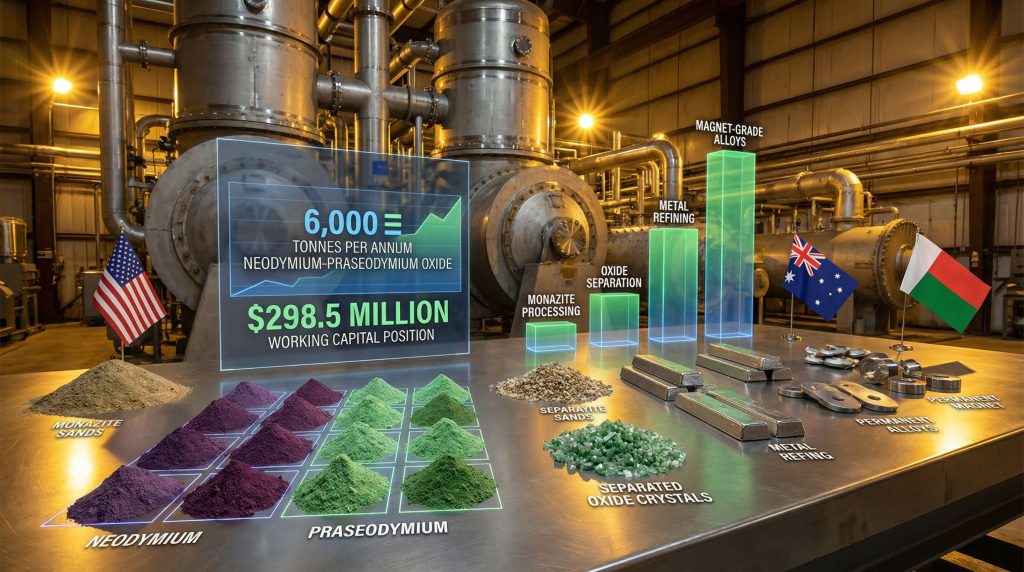
The White Mesa Mill facility represents the foundation of this value chain integration. Operating under established permits for over four decades, the facility provides regulatory and operational advantages that would require substantial time and capital to replicate elsewhere. The Phase 2 expansion targets demonstrate significant scale ambitions: 6,000 tonnes per annum of neodymium-praseodymium oxide, alongside 240 tonnes of dysprosium oxide and 66 tonnes of terbium oxide annually.
These production volumes position the facility among major Western rare earth processors, with the added capability of heavy rare earth separation – a technical competency that remains highly concentrated in Chinese operations. Furthermore, the critical minerals energy transition requires substantial Western processing capacity to support defence and renewable energy applications.
Heavy Rare Earth Separation: The Strategic Differentiator
Heavy rare earth elements, particularly dysprosium and terbium, represent the most strategically sensitive segment of global rare earth markets. These elements are essential for high-performance permanent magnets used in defence applications, wind turbines, and electric vehicle motors.
Current global production concentration reveals the strategic vulnerability:
- China: Over 95% of global separation capacity
- Rest of World: Less than 5% of separation capacity
- Energy Fuels Target: Commercial heavy REE production by Q4 2026
The scarcity of non-Chinese heavy rare earth processing creates pricing dynamics that extend beyond typical commodity frameworks. Defence contractors and renewable energy manufacturers face supply security requirements that justify premium pricing for Western-sourced heavy rare earths, particularly when integrated into domestic supply chains.
The Australian Strategic Materials Integration: Completing Downstream Capabilities
The planned acquisition of Australian Strategic Materials addresses the final gap in vertical integration by adding downstream metal and alloy conversion capabilities. ASM brings operational expertise through its Korean metals plant and the planned American Metals Plant (AMP) targeting 2,000 tonnes per annum of rare earth metal and alloy production capacity.
This transaction structure involves approximately 5.8% dilution for existing shareholders – a conservative approach compared to typical transformative mining acquisitions that often involve equity dilution exceeding 15%. The financial discipline reflected in this structure suggests careful consideration of shareholder impact relative to strategic scope.
ASM Integration Benefits:
- Existing rare earth metal and alloy production capacity in Korea
- Established customer relationships in advanced manufacturing sectors
- Technical expertise in downstream processing technologies
- Planned domestic production capability for security-sensitive applications
- Direct supply capability to US magnet manufacturers
In addition, this integration aligns with broader mining industry evolution trends towards vertical integration and supply chain control. The US critical minerals order emphasises domestic processing capabilities, creating additional policy support for such strategic acquisitions.
Geographic Feedstock Diversification Strategy
Energy Fuels' monazite supply strategy spans three continents, reducing single-source dependency risks that historically challenged Western rare earth projects. This geographic distribution provides supply chain resilience while leveraging cost advantages of monazite recovery as a byproduct of heavy mineral sands operations.
Multi-Jurisdictional Feedstock Portfolio:
| Project | Location | Status | Annual Monazite Potential |
|---|---|---|---|
| Donald Project | Victoria, Australia | Development | 15,000+ tonnes per annum |
| Toliara Project | Madagascar | Acquired via Base Resources | 20,000+ tonnes per annum |
| Bahia Project | Brazil | Exploration | Resource estimate expected 2026 |
The Toliara Project in Madagascar represents particularly significant potential, with management characterising it as potentially the lowest-cost undeveloped heavy mineral sand and monazite deposit globally. The long-life, large-scale nature of this deposit provides substantial feedstock security for decades of processing operations.
Monazite's natural composition offers advantages over primary rare earth deposits, particularly in heavy rare earth content. Unlike bastnäsite deposits that dominate primary rare earth mining, monazite sand carries naturally higher concentrations of neodymium, praseodymium, and heavy rare earth elements. The byproduct economics further enhance attractiveness – monazite recovery benefits from titanium and zirconium production economics, reducing full-cycle cost structures compared to primary rare earth mines.
Financial Architecture Supporting Strategic Transformation
Energy Fuels maintains a robust balance sheet that provides financial foundation for rare earth expansion without excessive equity dilution. As of September 30, 2025, the company held approximately $298.5 million in working capital alongside substantial commodity inventories including 2.1 million pounds of uranium and 905,000 pounds of finished vanadium pentoxide.
Capital Structure Advantages:
- $700 million convertible notes at 0.75% coupon
- Conversion price of $20.34 per share
- Strong uranium margins ($23-30/lb production costs vs. $70+ realised prices)
- Existing inventory providing cash flow buffer during expansion phases
The Pinyon Plain uranium operations generate substantial operating margins, with management targeting over 2 million pounds of U3O8 production in 2026. At current pricing levels, this uranium production underwrites rare earth development without requiring premature monetisation of REE assets or dilutive equity financing.
The convertible note structure reflects institutional confidence in the strategic transformation. The low coupon rate and institutional-grade terms provide access to capital markets at favourable conditions, reducing financing risk during expansion phases.
Operational Cash Flow Underpinning Development Strategy
Energy Fuels' uranium operations at Pinyon Plain demonstrate management-guided production costs of approximately $23 to $30 per pound of U3O8. With realised uranium sales of $72.38 per pound as of September 30, 2025, operating margins exceed $40 per pound on current production.
Multiplying these margins across projected 2026 production of over 2 million pounds generates substantial internal cash flow to fund rare earth expansion phases. This operating leverage reduces dependence on external financing during critical development periods, protecting existing shareholders from dilution while maintaining financial flexibility.
Consequently, the critical minerals demand surge creates additional opportunities for premium pricing across all product categories. Moreover, the company's strong financial position supports development of a strategic minerals reserve capability that could serve Western defence requirements.
Market Positioning Within Western Rare Earth Landscape
Energy Fuels rare earth supply chain integration contrasts sharply with the fragmented structure characterising most Western rare earth companies. Traditional approaches typically involve either mining-focused operations that extract concentrates for export to Asian processors, or processing-focused operations that rely on third-party concentrates with inherent supply security risks.
Competitive Positioning Analysis:
- Mining-Focused Competitors: Extract concentrates but surrender downstream value to Asian processors
- Processing-Focused Competitors: Process imported concentrates but face feedstock security risks
- Energy Fuels Model: Vertical integration from controlled feedstock through finished products
This positioning creates multiple competitive advantages including reduced third-party processing costs, improved supply chain control, enhanced customer relationships across the value chain, and diversified revenue streams across different market segments with varying risk profiles.
The heavy rare earth separation capability adds further differentiation. Very few Western facilities can commercially separate dysprosium and terbium at industrial scale, creating a strategic scarcity premium that extends beyond normal commodity pricing dynamics.
The next major ASX story will hit our subscribers first
Policy Environment and Regulatory Support
The strategic importance of rare earth supply chains has gained significant policy attention across Western governments, creating supportive regulatory frameworks that reduce project risk while improving access to capital.
Policy Support Mechanisms:
- US Defence Production Act funding for critical mineral projects
- Section 232 trade investigations highlighting supply vulnerabilities
- Australian Critical Minerals Strategy supporting downstream processing
- North American supply chain resilience initiatives
- Foreign investment review processes prioritising strategic mineral security
These policy frameworks provide both financial support mechanisms and regulatory certainty for Western rare earth development. Defence procurement policies increasingly emphasise domestic sourcing requirements, creating premium pricing opportunities for qualified Western suppliers.
The regulatory environment also supports consolidation activities that enhance supply chain resilience. Foreign investment review processes demonstrate increasing scrutiny of strategic mineral assets while supporting transactions that strengthen Western processing capabilities.
How Will 2026 Catalyst Timeline Impact Investment Opportunities?
The integration strategy features four discrete milestones that offer measurable progress indicators throughout 2026:
Q1 2026: Donald Project Final Investment Decision
Q2 2026: ASM shareholder scheme meeting and regulatory approvals
Q3 2026: Transaction close and integration commencement
Q4 2026: Commercial heavy rare earth production at White Mesa
Each milestone represents a potential de-risking event that could support valuation re-rating. The sequential nature of these catalysts provides multiple opportunities for market recognition of progress while maintaining execution accountability.
Execution risks remain concentrated around scaling downstream processing technology from pilot to commercial production, maintaining separation efficiency across different feedstock sources, and meeting magnet manufacturer specification requirements consistently.
Technical and Market Risk Assessment
The vertical integration strategy carries multiple categories of risk that require ongoing monitoring:
Technical Execution Risks:
- Scaling alloy conversion from pilot to commercial production volumes
- Maintaining separation efficiency across different monazite feedstock sources
- Meeting stringent magnet manufacturer specification requirements
- Integrating multiple processing technologies within single facilities
Market and Demand Risks:
- Rare earth price volatility affecting multiple revenue streams simultaneously
- Electric vehicle adoption rates influencing NdPr demand patterns
- Competition from recycled rare earth sources as volumes increase
- Defence procurement budget cycles affecting heavy rare earth demand
Jurisdictional and Regulatory Risks:
- Madagascar political stability and regulatory consistency
- Australian foreign investment approval processes and timelines
- US environmental permitting and compliance requirements
- International trade policy changes affecting cross-border operations
What Makes This Investment Framework Strategically Unique?
Energy Fuels rare earth supply chain integration represents convergence of strategic necessity with operational capability. The company leverages existing infrastructure, proven processing expertise, and strong financial positioning to construct what could become the Western world's most comprehensive rare earth supply chain.
Investment Thesis Components:
- Strategic Necessity: Western supply chain resilience requirements create premium valuation opportunities
- Operational Foundation: Existing White Mesa infrastructure reduces execution risk compared to greenfield alternatives
- Financial Strength: Strong balance sheet supports expansion without excessive dilution
- Technical Differentiation: Heavy rare earth separation capability addresses critical supply gap
- Policy Support: Favourable regulatory environment reduces development risk while supporting premium pricing
The transformation from uranium-focused producer to integrated critical minerals platform serves defence, renewable energy, and advanced manufacturing sectors with different demand drivers and risk profiles. Success in this integration would establish Energy Fuels as an essential supplier in the global competition for critical mineral security.
For institutional investors, the combination of defined production targets, conservative transaction structure, robust balance sheet, and supportive policy environment creates a compelling risk-adjusted opportunity within the strategic materials sector. The fundamental question centres on execution capability rather than market necessity – policy imperatives make Western rare earth supply chain development inevitable, but successful integration requires complex operational and financial coordination.
The key determinants of investment success include: maintenance of technical separation efficiency across multiple feedstock sources, successful scaling of downstream conversion technologies, effective management of multi-jurisdictional regulatory requirements, and consistent achievement of production targets that support financial modelling assumptions.
Risk-Adjusted Return Considerations:
The investment opportunity balances transformational potential against execution complexity. Multiple discrete milestones throughout 2026 provide measurable progress checkpoints while the strong financial foundation reduces forced sale risk during volatile market conditions. The strategic importance of the end products creates potential for premium valuations that extend beyond typical commodity sector multiples.
Success metrics should focus on achievement of production targets, maintenance of separation specifications, effective cost management across multiple processing stages, and establishment of long-term customer relationships that support stable pricing frameworks. These operational achievements would support transition from development-stage valuation to production-based cash flow multiples.
However, the Energy Fuels acquisition strategy demonstrates comprehensive planning for vertical integration across the entire rare earth value chain. Furthermore, industry analysis suggests this integrated rare earth approach positions the combined entity to control every critical processing step.
The convergence of strategic imperative, operational capability, and financial strength creates a unique positioning within the critical minerals sector, subject to successful execution of the complex integration strategy outlined across multiple jurisdictions and processing technologies.
Considering Strategic Investments in Critical Minerals Companies?
Discovery Alert's proprietary Discovery IQ model delivers real-time alerts on significant ASX mineral discoveries, empowering subscribers to identify actionable opportunities ahead of the broader market. Begin your 14-day free trial today and secure your market-leading advantage in the rapidly evolving critical minerals sector.