August 21, 2026
Strategic Mineral Partnerships Reshape Global Energy Security Dynamics
Critical mineral supply chains face unprecedented disruption as nations scramble to secure essential materials for the global energy transition. The race to control lithium, cobalt, and rare earth elements has intensified geopolitical competition while exposing dangerous vulnerabilities in traditional resource procurement models. Strategic bilateral partnerships now represent the primary mechanism for achieving supply chain resilience without compromising national sovereignty.
This evolution reflects a fundamental shift from market-driven commodity trading toward government-backed resource diplomacy. As electric vehicle adoption accelerates and renewable energy in mining infrastructure expands, countries with limited domestic mineral reserves must forge strategic alliances to avoid supply bottlenecks that could derail their energy transition goals.
When big ASX news breaks, our subscribers know first
Strategic Resource Diplomacy Transforms Bilateral Trade Relations
The India-Argentina lithium mining partnership exemplifies how complementary economic structures can address critical mineral security challenges. This relationship leverages Argentina's substantial mineral reserves against India's massive domestic demand, creating a framework for mutual benefit without traditional geopolitical pressures. Furthermore, argentina lithium brine insights demonstrate the significant potential for sustainable extraction methods.
Geographic and Economic Complementarity Drive Partnership Success
Argentina's position within the South American Lithium Triangle provides unique advantages for large-scale lithium extraction. The country controls approximately 19% of global lithium reserves while supporting only 48 million citizens, creating substantial surplus capacity for export markets.
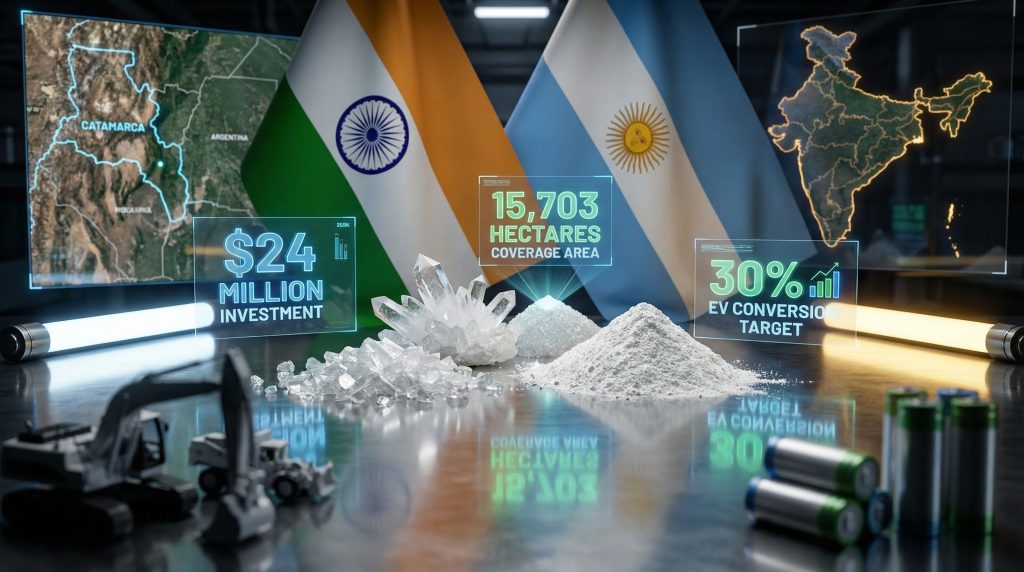
India's demographic and economic profile presents the perfect complement to Argentina's resource abundance. With 1.4 billion citizens and ambitious electric vehicle targets of 30% conversion by 2030, India represents one of the world's largest potential lithium markets. This population-to-resource dynamic eliminates the zero-sum competitive pressures that often complicate international mineral agreements.
The partnership gained strategic momentum following PM Modi's 2025 visit to Argentina, which established formal frameworks for resource cooperation. In addition, the critical minerals strategy has been instrumental in shaping bilateral engagement priorities. The relationship transitioned from general diplomatic engagement to focused mineral security collaboration.
Current bilateral trade volumes of $5 billion provide a foundation for expanded critical minerals exchange. The existing trade relationship creates established channels for regulatory compliance, payment systems, and logistical coordination that can be adapted for lithium trade scaling.
Reducing Chinese Supply Chain Dependencies
China currently controls approximately 60% of global lithium processing capacity, creating systematic vulnerabilities for countries pursuing independent energy transitions. The India-Argentina lithium mining partnership offers an alternative supply route that operates outside Chinese-dominated processing networks.
This diversification strategy extends beyond simple risk management. By establishing direct bilateral relationships with lithium-producing nations, India can negotiate long-term supply contracts, technology transfer agreements, and joint development projects that would be impossible within Chinese-controlled supply chains.
However, the India-Argentina strategic partnership explicitly provides energy and mining security without geopolitical pressure. This independence distinguishes it from traditional Western-controlled supply chains or Chinese dominance models, allowing both nations to pursue domestic policy objectives without external interference.
Argentina's Lithium Triangle Position Creates Unique Competitive Advantages
Geological Characteristics Support Large-Scale Production
The Lithium Triangle encompasses parts of Argentina, Bolivia, and Chile, containing approximately 58% of global lithium reserves. Argentina's portion of this triangle offers superior accessibility and political stability compared to neighboring countries' reserves.
Catamarca province, specifically targeted in the India-Argentina partnership, provides optimal conditions for lithium brine extraction. The high-altitude arid environment supports evaporation pond methodologies while offering established infrastructure connections to major Argentine ports.
| Country | Reserve Share | Annual Production | Export Capacity |
|---|---|---|---|
| Argentina | 19% of global reserves | 70,000 tonnes (2023) | High surplus available |
| Chile | 27% of global reserves | 290,000 tonnes (2023) | Limited export growth |
| Bolivia | 21% of global reserves | <30,000 tonnes (2023) | Underdeveloped infrastructure |
These comparative advantages position Argentina as the most reliable long-term partner for sustained lithium supply relationships. While Chile produces higher volumes currently, their limited export growth potential restricts partnership scalability. Consequently, Bolivia's underdeveloped infrastructure creates uncertainty around production scaling timelines.
Infrastructure Development Requirements and Opportunities
Large-scale lithium extraction requires substantial infrastructure investments across multiple domains:
- Transportation Networks: Enhanced rail and road connections from Catamarca mining sites to major Argentine ports
- Processing Facilities: On-site refinement capabilities for battery-grade lithium hydroxide and lithium carbonate production
- Quality Control Systems: International certification standards compatible with global battery manufacturing requirements
- Environmental Monitoring: Water usage optimization systems and ecosystem protection protocols
These infrastructure requirements represent opportunities for technology transfer and joint investment between Indian and Argentine companies. Indian mining expertise in high-altitude operations and environmental protection can complement Argentine geological knowledge and local regulatory experience.
Government-Led Investment Structures Provide Long-Term Security
KABIL's Strategic Acquisition Framework
KABIL's $24 million acquisition of five lithium brine blocks spanning 15,703 hectares in Catamarca province represents India's first government-led overseas lithium mining venture. This January 2024 investment established exclusivity agreements and local branch office requirements, demonstrating serious long-term commitment to the India-Argentina lithium mining partnership.
The KABIL structure combines three major Indian entities:
- NALCO (National Aluminium Company Limited): Provides extraction and processing expertise
- HCL (Hindustan Copper Limited): Contributes mineral processing technologies
- MECL (Mineral Exploration Company Limited): Offers geological survey and exploration capabilities
This tri-institutional approach ensures comprehensive technical capabilities while maintaining government oversight for national security considerations. The structure prevents purely profit-driven decision-making that might compromise long-term resource security objectives.
Diplomatic Framework Integration
The February 2025 MoU between India's MECL and Catamarca province, signed by Minister G. Kishan Reddy and Governor Raúl Jalil, established formal cooperation frameworks beyond simple commercial agreements. The lithium partnership developments showcase the diplomatic commitment to long-term cooperation.
Key MoU provisions include:
- Lithium exploration cooperation protocols
- Technology transfer mechanisms for sustainable extraction methods
- Policy alignment frameworks for regulatory harmonization
- Knowledge exchange programs for technical training and best practices
This governmental framework provides stability and continuity that private commercial agreements cannot guarantee. Political transitions in either country are less likely to disrupt agreements backed by formal ministerial-level commitments and institutional cooperation structures.
Private Sector Complementary Roles
Private companies like Greenko and World Metals Alloys complement government-led investments by providing operational expertise, capital acceleration, and market flexibility. This hybrid model distributes risks between public strategic objectives and private operational efficiency.
The private sector involvement offers several advantages:
- Accelerated Implementation: Private companies can move more quickly through operational decisions and capital deployment
- Technical Innovation: Commercial incentives drive technological advancement and cost optimization
- Market Responsiveness: Private firms can adapt production volumes and product specifications to market demand changes
- Risk Distribution: Shared investment responsibilities reduce government fiscal exposure while maintaining strategic control
Technology Transfer Mechanisms Drive Long-Term Partnership Success
Bidirectional Knowledge Exchange Programs
The India-Argentina lithium mining partnership emphasizes genuine bilateral technical exchange rather than unidirectional technology transfer. Argentine lithium extraction methodologies inform Indian domestic projects while Indian mining technologies enhance Argentine operational efficiency. Moreover, lithium industry innovations provide valuable insights for optimising extraction processes.
Critical technology domains include:
Brine Extraction Optimization: Evaporation pond design and management for lithium recovery in high-altitude arid environments, incorporating water conservation techniques and efficiency maximization protocols.
Processing Technologies: Advanced lithium hydroxide and lithium carbonate production methods that meet battery manufacturing specifications while minimizing environmental impact.
Environmental Monitoring Systems: Real-time water usage tracking, ecosystem impact assessment, and sustainable mining practice implementation across diverse geological conditions.
Quality Control Protocols: Battery-grade lithium certification systems that ensure consistent product specifications and international market acceptance.
Sustainable Mining Practice Development
Both nations prioritise environmental sustainability within their partnership framework. Sustainable mining practices serve dual purposes: protecting local ecosystems and ensuring long-term operational viability in environmentally sensitive regions.
Water usage optimisation represents a critical technical challenge in lithium brine extraction. The Lithium Triangle's arid environment requires careful water resource management to avoid ecosystem disruption while maintaining production volumes.
Renewable energy integration in mining operations offers additional sustainability benefits. Solar and wind power utilisation for lithium processing facilities can reduce carbon footprints while taking advantage of the region's abundant renewable energy resources.
Global Supply Chain Transformation and Market Dynamics
Alternative Supply Route Development
The India-Argentina partnership contributes to global supply chain diversification by creating alternative routes outside Chinese-controlled processing networks. This diversification reduces systematic vulnerabilities that affect multiple countries simultaneously. In addition, critical minerals energy security initiatives support this strategic independence approach.
Integration with the US-led Mineral Security Partnership (MSP) provides additional strategic benefits. Multilateral cooperation frameworks allow democratic nations to coordinate resource strategies while maintaining bilateral partnership flexibility.
The partnership aligns with broader BRICS initiatives for critical mineral independence, demonstrating how regional cooperation can complement bilateral relationships without creating conflicting obligations.
Market Price Stabilisation Effects
Increased India-Argentina lithium trade contributes to global price stability through diversified supply sources. Long-term contract structures reduce market volatility while providing predictable pricing for both producers and consumers.
The partnership's impact on global lithium market dynamics extends beyond direct bilateral trade:
- Competitive Pressure: Alternative supply sources force other producers to maintain competitive pricing and service levels
- Market Transparency: Bilateral agreements provide pricing benchmarks for broader market reference
- Supply Security: Diversified sources reduce the risk of supply disruptions affecting global battery manufacturing
- Investment Confidence: Stable long-term partnerships encourage additional investment in lithium extraction and processing infrastructure
The next major ASX story will hit our subscribers first
Economic Projections and Bilateral Trade Growth
Quantified Success Metrics Through 2030
Success measurement for the India-Argentina lithium mining partnership requires specific quantifiable targets across multiple dimensions:
Annual Production Volumes: Target lithium production from joint ventures should reach commercially viable levels by 2027-2028, with scaling toward industrial production levels by 2030.
Battery Manufacturing Support: Argentine lithium should support a measurable percentage of India's domestic battery manufacturing capacity, contributing to the 30% electric vehicle conversion target by 2030.
Bilateral Trade Value Growth: Critical minerals should represent an increasing percentage of the $5 billion bilateral trade relationship, demonstrating successful sectoral diversification.
Technology Transfer Implementation: Measurable improvements in extraction efficiency, environmental performance, and product quality resulting from bilateral knowledge exchange programs.
Strategic Independence Achievements
Long-term success ultimately depends on achieving meaningful strategic independence from single-source lithium suppliers. The partnership should demonstrably reduce India's dependency on Chinese processing networks while providing Argentina with diversified export markets.
Enhanced energy security through diversified supply chains represents the primary strategic objective. Success requires establishing resilient supply relationships that can withstand geopolitical disruptions, market volatility, and technological changes.
Technological advancement through knowledge transfer programs should benefit both nations' broader mining sectors. Sustainable mining practices developed through this partnership can be applied to other mineral extraction projects, multiplying the partnership's strategic value.
Risk Factors and Implementation Challenges
Regulatory and Political Stability Considerations
Argentine provincial government stability affects long-term project continuity. Catamarca province's political environment and policy consistency will significantly impact operational timelines and investment security.
Indian foreign investment approval processes require streamlined procedures for rapid project implementation. Bureaucratic delays could undermine competitive advantages and strategic timing objectives.
International trade agreement implications may affect partnership terms as global trade relationships evolve. Both nations must maintain flexibility to adapt to changing international regulatory environments.
Technical and Operational Implementation Challenges
Lithium brine quality variations across different extraction sites require adaptive processing technologies. Inconsistent mineral concentrations can affect production costs and product specifications.
Transportation infrastructure limitations in remote mining areas increase operational costs and logistical complexity. Developing reliable supply chains from extraction sites to processing facilities and export ports requires substantial coordinated investment.
Skilled workforce development needs in both countries must be addressed to support scaling operations. Technical training programs and knowledge transfer initiatives are essential for maintaining operational quality and safety standards.
"Strategic Partnership Success Framework: The India-Argentina lithium mining partnership demonstrates how complementary national strengths can address critical mineral security challenges. Argentina's abundant reserves and limited domestic demand pair effectively with India's massive market potential and technological expertise, creating a sustainable foundation for long-term resource cooperation."
Future Outlook and Global Strategic Implications
The India-Argentina lithium mining partnership represents a model for strategic resource diplomacy in the critical minerals era. By prioritising complementary economic structures, technology transfer, and long-term supply security, both nations demonstrate how bilateral cooperation can reduce geopolitical dependencies while advancing national energy transition objectives.
Successful implementation of this partnership will influence global lithium market dynamics, encourage similar bilateral resource agreements, and contribute to supply chain diversification beyond Chinese dominance. The framework established through government-led investment, private sector collaboration, and diplomatic cooperation provides a template for other nations seeking strategic mineral partnerships.
As global demand for lithium continues expanding with electric vehicle adoption and renewable energy infrastructure development, partnerships like India-Argentina's will become increasingly critical for nations lacking domestic mineral resources. The success or failure of this collaboration will significantly influence future strategic resource diplomacy and critical mineral security strategies worldwide.
Disclaimer: This analysis includes forward-looking projections and strategic assessments that involve inherent uncertainties. Lithium market dynamics, geopolitical relationships, and technological developments may differ from projected scenarios. Readers should consider multiple sources and expert opinions when evaluating strategic mineral investments and partnerships.
Ready to Invest in the Next Major Mineral Discovery?
Discovery Alert instantly alerts investors to significant ASX mineral discoveries using its proprietary Discovery IQ model, turning complex mineral data into actionable insights. Understand why historic discoveries can generate substantial returns by visiting Discovery Alert's dedicated discoveries page, and begin your 14-day free trial today to position yourself ahead of the market.