July 25, 2026
The European Union's Strategic Minerals Crisis and Portugal's Industrial Response
European industrial policy faces unprecedented challenges as supply chain vulnerabilities expose critical dependencies on non-EU mineral processing capabilities. The continent's transition toward energy independence requires sophisticated policy instruments that can rapidly deploy capital while maintaining competitive markets. This complex balancing act between strategic autonomy and economic efficiency has created new frameworks for state intervention in critical industries.
Portugal's recent announcement of substantial government support for lithium processing represents a crucial test case for how member states navigate these competing pressures. The Portugal lithium refinery grant decision reflects broader recognition that raw material extraction alone cannot secure strategic advantage without corresponding downstream processing capabilities.
When big ASX news breaks, our subscribers know first
Understanding the EU's Temporary Crisis and Transition Framework
The European Union's Temporary Crisis and Transition Framework represents a fundamental shift in state aid philosophy, allowing unprecedented government intervention in strategic sectors. This mechanism enables member states to provide direct financial support for projects deemed essential to the green and digital transitions, bypassing traditional competition policy constraints that previously limited such interventions.
Under this framework, Portugal has approved €180 million in non-refundable grants to support domestic lithium processing development. The funding structure demonstrates how EU policy makers are adapting state aid rules to address geopolitical supply chain risks while maintaining internal market integrity. This approach aligns with broader efforts to strengthen EU critical minerals supply across member states.
Key Framework Characteristics:
• Temporary authorization through 2025-2026 transition period
• Focus on green and digital technology acceleration
• Reduced bureaucratic approval timelines for strategic projects
• Enhanced flexibility for member state industrial policy coordination
This policy evolution reflects lessons learned from recent supply chain disruptions, particularly in semiconductors and critical minerals. The framework acknowledges that market forces alone cannot address strategic vulnerabilities within politically acceptable timeframes.
Portugal's Strategic Position in European Critical Minerals Policy
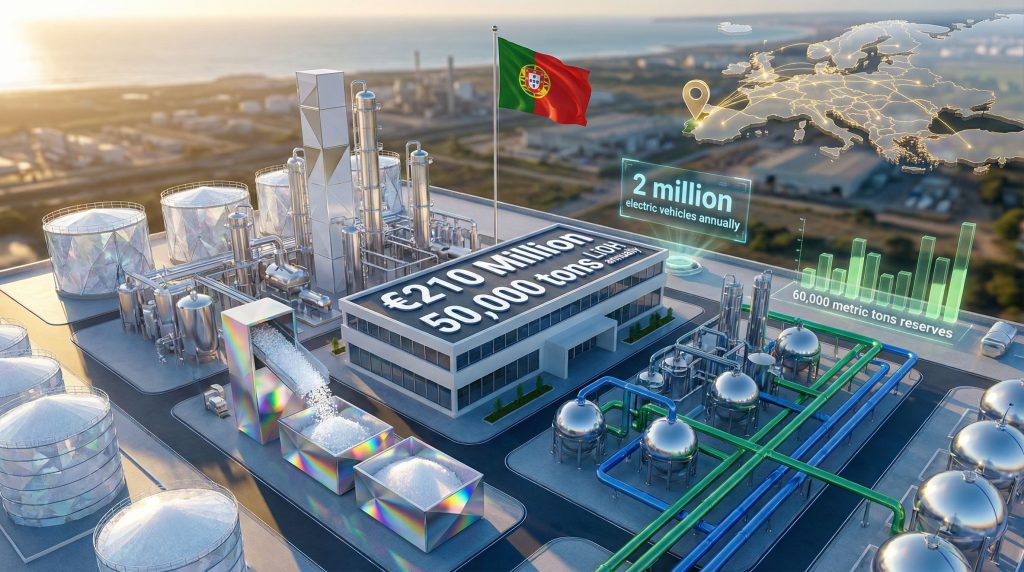
Portugal commands Europe's most significant lithium reserves, holding approximately 60,000 metric tons of confirmed deposits. This geological advantage positions the country as a potential cornerstone of European battery supply chain independence, yet historical focus on ceramic-grade production has limited value chain integration.
The transition from raw material exports to sophisticated processing represents a fundamental economic strategy shift. Rather than supplying bulk commodities to international markets, Portugal seeks to capture higher-value manufacturing segments that support domestic industrial development. Furthermore, this strategy complements other European initiatives, including Italy's geothermal lithium extraction projects.
Portugal's mineral endowment includes both spodumene and lepidolite deposits, primarily concentrated in northern regions near existing industrial infrastructure. This geographic clustering creates opportunities for integrated processing facilities that can leverage established chemical industry expertise.
Lifthium's Estarreja Refinery: Technical Specifications and Strategic Integration
The planned refinery in Estarreja will target annual production of 50,000 tons of lithium hydroxide, sufficient to supply batteries for approximately 2 million electric vehicles. This production scale positions the facility among Europe's largest planned lithium processing operations, addressing significant supply gaps in the regional battery manufacturing ecosystem.
Location selection reflects careful consideration of existing industrial infrastructure advantages. Estarreja, positioned 50 kilometers south of Porto, hosts established chemical processing facilities operated by Bondalti, Portugal's largest chemicals producer. This co-location strategy reduces capital requirements while leveraging existing workforce expertise in chemical processing operations.
Proprietary Processing Technology and Environmental Standards
Lifthium's approach emphasizes proprietary refining technology designed specifically for European environmental compliance standards. While detailed technical specifications remain confidential, the company indicates that processing methods will minimise environmental impact compared to conventional lithium extraction techniques.
The technology focus addresses growing regulatory pressure on lithium processing operations, particularly regarding water consumption and waste management. European environmental standards require sophisticated treatment systems that add complexity and cost compared to operations in less regulated jurisdictions. However, the complex mining permitting process remains a significant consideration.
Production Timeline and Milestones:
• 2026-2027: Final investment decision and strategic partner selection
• 2027-2028: Construction commencement and equipment procurement
• 2028-2029: Installation and commissioning phases
• 2030: Target operational startup
Expansion Potential and Regional Integration
Beyond the Estarreja facility, Lifthium has indicated potential development of additional refining capacity in Spain. This expansion strategy reflects recognition that European demand will require multiple processing centers to achieve supply chain resilience goals.
The Spain expansion concept suggests coordination with Spanish industrial policy initiatives, potentially creating an integrated Iberian lithium processing corridor. Such coordination would maximise economies of scale while distributing supply chain risk across multiple facilities and regulatory jurisdictions.
Market Dynamics Driving Portugal's €180 Million Investment Decision
European lithium processing faces fundamental competitive challenges that justify substantial government intervention. Asian producers, particularly Chinese refiners, maintain cost advantages through scale economies, lower labour costs, and less stringent environmental compliance requirements.
Current market conditions present both opportunities and risks for European lithium processing development. Lithium hydroxide prices have experienced significant volatility, with periodic oversupply conditions creating margin pressure for higher-cost producers. Consequently, the focus on energy transition minerals becomes increasingly strategic.
Supply Chain Security Versus Economic Efficiency
The investment decision reflects European policy makers' assessment that supply chain security justifies higher production costs compared to international alternatives. This strategic calculation prioritises resilience over short-term economic optimisation, recognising that geopolitical disruptions can impose costs far exceeding price premiums for domestic production.
European automotive manufacturers have expressed strong interest in securing domestic lithium supply chains, driven partly by regulatory requirements and partly by supply chain risk management considerations. This demand base provides foundation for economically viable European processing operations despite cost disadvantages.
Market Risk Factors:
• Lithium hydroxide price volatility affecting project economics
• Competition from established Asian processors with scale advantages
• Regulatory compliance costs reducing operational flexibility
• Technology development risks in proprietary processing methods
Strategic Partnership Requirements and Financing Gaps
Lifthium CEO Duarte Braga has emphasised that the Portugal lithium refinery grant represents partial project funding, with additional capital required from strategic partners and private investors. This financing structure reflects the substantial capital intensity of lithium processing operations.
The company's focus on securing strategic partnerships suggests recognition that technical expertise, market access, and additional capital all require external collaboration. Potential partners could include European automotive manufacturers, battery producers, or international mining companies seeking European market access.
Project financing complexity reflects broader challenges facing European critical minerals development. Traditional project finance models may prove inadequate for strategic industries where government policy objectives influence commercial viability. According to Mining.com, this funding represents a significant milestone in European lithium processing ambitions.
Regulatory Framework and Licensing Challenges
Portugal's lithium sector development depends critically on prospecting licence allocation, which has experienced significant delays. The government has indicated intentions to launch licensing tenders, but complex environmental assessment requirements and local community consultation processes create implementation challenges.
Licensing delays reflect broader tensions between mineral development objectives and environmental protection priorities. Lithium extraction operations require careful management of water resources and ecosystem impacts, particularly in environmentally sensitive regions where deposits are located.
EU State Aid Compliance and Competition Policy
The €180 million grant approval under the Temporary Crisis and Transition Framework demonstrates EU flexibility in strategic sector support, yet ongoing compliance requirements ensure that state intervention does not create unfair competitive advantages within the internal market.
Monitoring mechanisms will track project progress, employment creation, and environmental compliance to verify that public investment achieves stated policy objectives. These oversight requirements create accountability frameworks while allowing strategic industrial support.
Regulatory Compliance Areas:
• Environmental impact assessment completion
• Water usage and waste management permitting
• Local community consultation and approval processes
• EU state aid reporting and monitoring requirements
Economic Development and Regional Impact Assessment
The Estarreja refinery project represents significant economic development potential for northern Portugal's industrial corridor. Integration with existing chemical industry infrastructure creates opportunities for technology cluster development and specialised workforce training programmes.
Regional economic benefits extend beyond direct employment to include supply chain development, research and development collaboration opportunities, and export revenue generation. The project could establish Portugal as a centre of European lithium processing expertise. Meanwhile, lithium industry innovations worldwide continue to drive technological advancement.
Integration with National Industrial Strategy
Portugal's support for lithium processing aligns with broader industrial modernisation objectives outlined in the National Recovery and Resilience Plan. The country seeks to transition from traditional manufacturing toward higher-value technology sectors that can compete effectively in global markets.
Lithium processing represents a strategic opportunity to leverage natural resource advantages through sophisticated industrial capabilities. This approach contrasts with raw material export strategies that capture limited economic value from domestic mineral endowments.
The next major ASX story will hit our subscribers first
Investment Risk Analysis and Market Uncertainties
Despite substantial government support, the Lifthium project faces multiple risk categories that could affect commercial viability. Commodity price volatility remains the primary concern, as lithium hydroxide markets have demonstrated significant price swings based on supply and demand imbalances.
Technology risks associated with proprietary processing methods require careful evaluation. While environmental compliance advantages may justify higher costs, operational reliability and efficiency must meet commercial benchmarks to ensure long-term sustainability.
Competitive Landscape and Market Positioning
European lithium processing must compete with established international producers who benefit from scale economies and operational experience. Success requires not only cost competitiveness but also differentiation through quality standards, supply chain reliability, and environmental performance.
Market positioning strategies could emphasise European origin certification, environmental sustainability credentials, and integrated supply chain services that provide value beyond commodity price comparisons.
Success Factors:
• Achieving operational cost targets through technology optimisation
• Securing long-term supply contracts with European battery manufacturers
• Maintaining environmental compliance while optimising production efficiency
• Developing strategic partnerships for technology transfer and market access
Future Implications for European Critical Minerals Strategy
Portugal's lithium refinery grant establishes a precedent for strategic mineral processing support across the European Union. Other member states with critical mineral deposits may pursue similar integrated development strategies that combine extraction with domestic processing capabilities.
The project's success or failure will influence European industrial policy approaches to other critical minerals, including rare earth elements, cobalt, and nickel. Lessons learned from Portuguese lithium development could inform broader supply chain resilience strategies.
Geopolitical Considerations and Trade Relationships
European lithium processing development occurs within complex international trade relationships that include both cooperation and competition with traditional suppliers. China, Australia, Chile, and Argentina remain significant lithium producers whose policies and production decisions affect global markets.
Strategic autonomy objectives must balance domestic production development with maintaining beneficial trade relationships and avoiding protectionist policies that could invite retaliation. This diplomatic complexity requires sophisticated policy coordination across multiple government agencies. As reported by Reuters, Portugal remains committed to advancing its lithium sector despite these challenges.
The evolution of European critical minerals policy will influence international trade patterns and investment flows in ways that extend far beyond immediate project impacts. Portugal's lithium refinery grant represents an early test of how democratic societies can effectively respond to supply chain vulnerabilities while maintaining open market principles.
Disclaimer: This analysis contains forward-looking assessments of market conditions, regulatory developments, and investment outcomes. Actual results may differ significantly from projections due to market volatility, policy changes, and operational factors beyond current visibility. Investment decisions should consider comprehensive risk assessment and professional financial advice.
Ready to Capitalise on Critical Minerals Opportunities?
Discovery Alert's proprietary Discovery IQ model delivers real-time alerts on significant ASX mineral discoveries, instantly identifying actionable opportunities in lithium, rare earths, and other strategic commodities ahead of the broader market. Understand why major mineral discoveries can generate substantial returns by exploring Discovery Alert's dedicated discoveries page, showcasing historic examples of exceptional outcomes, and begin your 30-day free trial today to position yourself strategically in the evolving critical minerals sector.