June 11, 2026
Strategic Mining Sector Transformation Through Magnetic Component Manufacturing
Global supply chain vulnerabilities in critical mineral processing have catalyzed unprecedented policy responses across emerging economies. When dominant suppliers control over 90% of specialized manufacturing capacity, downstream industries face systemic risks that extend far beyond commodity price fluctuations. This structural dependency becomes particularly acute in sectors requiring high-performance magnetic materials, where technical specifications, geopolitical considerations, and industrial policy converge to reshape traditional procurement strategies.
India's approach to addressing these vulnerabilities represents a comprehensive industrial transformation initiative, targeting domestic production capabilities across the rare-earth permanent magnet value chain. The India domestic rare-earth magnet industry encompasses resource extraction, processing technology development, and end-use manufacturing integration, positioning indigenous capacity as both an economic opportunity and national security imperative. Furthermore, this strategic initiative aligns with broader critical minerals strategy developments across emerging markets.
When big ASX news breaks, our subscribers know first
Government Investment Framework and Industrial Policy Architecture
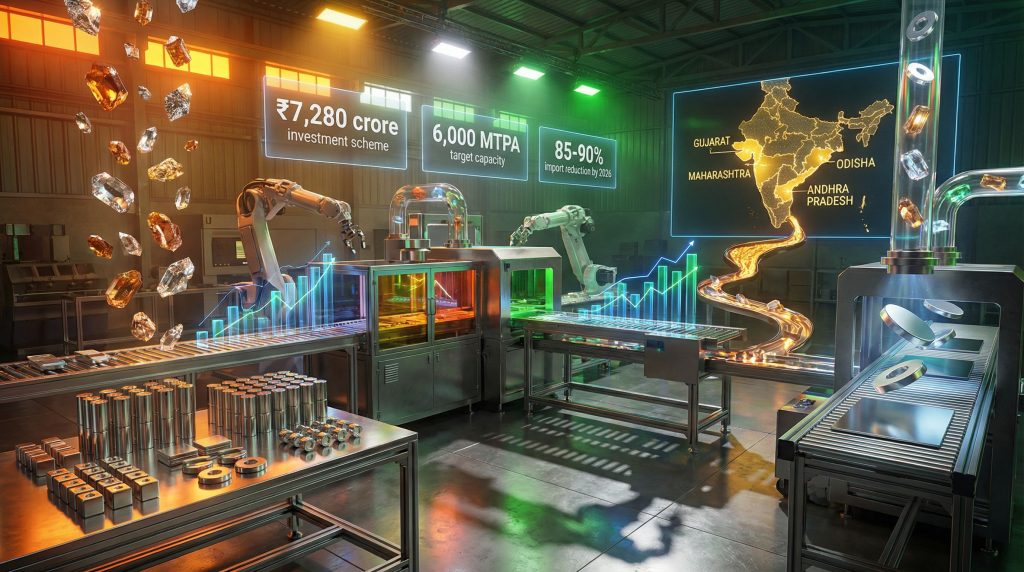
India's Cabinet approved a ₹7,280 crore investment scheme in November 2025, establishing the foundation for domestic rare-earth permanent magnet manufacturing capabilities. This financial commitment supports a target production capacity of 6,000 metric tonnes per annum, distributed across multiple manufacturing facilities through competitive allocation processes.
The funding structure balances immediate infrastructure development with sustained operational support through a bifurcated approach. In addition, this framework reflects broader mining transformation trends emerging across the global resources sector.
Capital Infrastructure Phase (2026-2028):
- Direct capital subsidies: ₹750 crore
- Facility establishment and equipment procurement
- Technology acquisition and transfer arrangements
- Environmental compliance and regulatory approvals
Production Incentive Phase (2027-2032):
- Sales-linked incentives: ₹6,450 crore
- Performance-based disbursements tied to production volumes
- Market penetration support for domestic manufacturers
- Export promotion and international competitiveness enhancement
This sequential framework addresses the dual challenges of high upfront investment requirements and uncertain early-stage revenue streams. By providing guaranteed capital support during facility development and volume-linked incentives during operational phases, the scheme reduces investor risk while maintaining performance accountability.
Union Minister G. Kishan Reddy emphasized that the initiative aims to expand domestic manufacturing capabilities while reducing reliance on external suppliers. According to Reuters reports, the timing aligns with broader disruptions in traditional supply networks, where export restrictions and geopolitical tensions have highlighted the strategic importance of indigenous production capabilities.
Regional Manufacturing Hub Development and Infrastructure Planning
The scheme designates four primary states as processing and manufacturing centers, each selected for specific logistical and industrial advantages. Consequently, this distributed approach enhances overall supply chain resilience whilst creating regional specialisation opportunities.
Gujarat Manufacturing Hub
Gujarat has initiated preparatory work for rare-earth magnet production facilities, leveraging the state's established industrial infrastructure and port connectivity. The western coast location provides optimal access to international markets while supporting domestic distribution networks.
Andhra Pradesh Coastal Processing
State government officials have expressed formal support for the initiative, with emphasis on coastal logistics advantages for raw material imports and finished product exports. The region's existing industrial base provides supporting services and skilled workforce availability.
Odisha Mining-Processing Integration
Proximity to India's primary rare-earth mining operations enables vertical integration opportunities, potentially reducing transportation costs and ensuring feedstock security. The state's mineral resource base supports both upstream and downstream value chain development.
Maharashtra Industrial Ecosystem
Integration with existing electronics and automotive manufacturing clusters creates natural demand centers for permanent magnet products. The state's established supply chain networks support component procurement and distribution efficiency.
This distributed manufacturing approach prevents geographic concentration risks while creating regional specialization opportunities. Each hub can develop specific technical expertise or application focus areas, enhancing overall system resilience and competitive positioning.
Domestic Resource Base and Processing Capacity Gaps
India maintains significant rare-earth mineral reserves, yet current domestic processing capabilities remain underdeveloped relative to resource endowments. Raw materials extracted domestically are typically exported for overseas processing, creating value addition opportunities that remain largely unrealized within Indian borders.
The existing supply chain structure reflects historical patterns where processing gaps limit value capture. However, the rare earth upgrade initiatives demonstrate growing recognition of these opportunities.
- Primary extraction occurs domestically through established mining operations
- Intermediate processing requires sophisticated separation and purification technologies
- Advanced manufacturing demands precision equipment and specialized technical expertise
- End-use integration spans multiple industrial sectors with varying specifications
Current import dependency levels indicate substantial substitution potential:
| Supply Category | Import Share | Substitution Opportunity |
|---|---|---|
| Raw Material Value | 60-80% | Domestic processing expansion |
| Volume Requirements | 85-90% | Indigenous manufacturing scale |
| Technology Access | High dependency | R&D and transfer partnerships |
The value-volume disconnect reflects the premium pricing associated with processed magnetic materials compared to raw mineral exports. Domestic processing capabilities would capture this value differential while providing supply chain security for downstream manufacturers.
State-owned Indian Rare Earths Limited (IREL) operates processing facilities in Visakhapatnam, demonstrating government commitment to indigenous technology development rather than pure licensing arrangements. This approach prioritizes knowledge transfer and capability building over short-term production solutions.
Private Sector Engagement and Technology Transfer Mechanisms
International manufacturers are evaluating Indian production opportunities, reflecting confidence in the market potential and policy framework stability. These assessments encompass facility location, raw material sourcing strategies, and domestic market penetration approaches.
Japanese Investment Interest
Proterial, backed by Bain Capital, is exploring NdFeB magnet manufacturing facilities within India. The evaluation process includes local rare-earth oxide sourcing assessments versus imported feedstock procurement strategies, indicating flexibility in supply chain configuration.
Chinese Manufacturing Expansion
TOPMAG has established Indian operations targeting neodymium magnet production across multiple application segments including wind power systems, aerospace components, and motor applications. This investment demonstrates foreign manufacturer confidence in India's industrial environment and market growth trajectory.
Domestic Industry Foundation
Existing Indian manufacturers including Kumar Magnet Industries and Jaykrishna Magnetics provide foundational production capabilities, though current scale remains limited relative to projected demand expansion. These companies represent potential expansion partners for larger international players seeking local manufacturing presence.
The technology transfer landscape encompasses both equipment procurement and knowledge development components. Rather than simple turnkey facility installation, the initiative emphasizes capability building that supports long-term competitive positioning and innovation capacity.
End-Use Application Demand Drivers and Market Segments
Permanent magnet demand growth spans multiple industrial sectors, each with distinct technical requirements and procurement patterns. For instance, these developments reflect broader industry evolution insights across manufacturing sectors.
Electric Vehicle Manufacturing
Motor production represents the fastest-expanding application segment, supported by India's automotive electrification policies and domestic manufacturing incentives. EV motors require high-performance magnetic materials that meet efficiency, durability, and cost specifications simultaneously.
Renewable Energy Infrastructure
Wind turbine generators demand specialized permanent magnets capable of reliable operation under variable environmental conditions. India's renewable capacity expansion targets create sustained demand for these components, supporting domestic manufacturing scale economics.
Defense and Aerospace Applications
Strategic sectors prioritize supply chain security over pure cost optimization, creating premium market opportunities for domestic producers. These applications often involve specialized performance requirements and extended qualification processes.
Consumer Electronics Production
Smartphone manufacturing, appliance production, and electronics assembly require miniaturized, high-efficiency magnetic components. India's electronics manufacturing growth creates substantial volume opportunities for permanent magnet suppliers.
Market projections indicate domestic demand doubling by 2030, driven by:
- Accelerated clean energy adoption across residential and commercial sectors
- Electric vehicle penetration in personal and commercial transportation
- Industrial automation and precision equipment deployment
- Consumer electronics manufacturing expansion and export growth
This demand trajectory supports the scale economics necessary for competitive domestic production while providing market absorption capacity for initial facility output.
The next major ASX story will hit our subscribers first
Global Supply Chain Dynamics and Import Dependency Response
Recent export restrictions from dominant suppliers have disrupted traditional procurement networks, prompting policy responses designed to ensure supply continuity. In October 2025, India issued import licenses to four companies – Continental India, DE Diamond, Hitachi, and Jay Ushin – with specific conditions governing re-export activities.
The licensing framework includes restrictions on:
- Re-export to United States markets
- Defense application transfers
- Third-country distribution arrangements
These controls reflect the strategic nature of permanent magnet supply chains, where access restrictions can impact entire industrial sectors. The timing coincides with broader geopolitical tensions affecting critical mineral trade flows and traditional supplier relationships.
China's dominance of approximately 90% of global rare-earth processing capacity creates systemic vulnerabilities for downstream manufacturers worldwide. As highlighted in Channel NewsAsia analysis, this concentration enables supply manipulation through export quotas, pricing mechanisms, or direct trade restrictions affecting strategic competitors.
India's domestic manufacturing initiative aligns with Aatmanirbhar Bharat objectives, reducing strategic vulnerabilities while capturing higher value-added manufacturing segments within the critical minerals value chain. The approach emphasizes indigenous capability development rather than simple supply source diversification.
Technical Infrastructure and Production Technology Development
Domestic technology development prioritizes indigenous capability building over pure licensing arrangements. IREL's Visakhapatnam facility serves as a primary research and development center, focusing on processing methodologies suitable for Indian mineral compositions and market requirements.
Processing Technology Framework
The India domestic rare-earth magnet industry development encompasses:
- Separation and purification techniques adapted to domestic ore characteristics
- Alloy development optimized for specific end-use applications
- Quality control systems meeting international specifications
- Environmental compliance integrated throughout production processes
Waste Stream Recovery Integration
Electronic waste recycling presents additional raw material sourcing opportunities, particularly from mobile phone and consumer electronics disposal. This circular economy approach supports both environmental objectives and supply security goals.
Recovery potential includes:
- Rare-earth elements from permanent magnets in discarded devices
- Precious metals from electronic components
- Strategic material recapture from industrial waste streams
The technical challenge involves developing cost-effective recovery processes that can compete with primary extraction economics while meeting environmental standards. Success in this area would position India as a leader in sustainable critical mineral recovery technologies.
Investment Opportunities and Market Development Timeline
The structured incentive framework provides clear investment horizons for private sector participation, with two-year facility development periods followed by five-year production incentive phases. This timeline balances infrastructure development requirements with revenue generation expectations, reflecting comprehensive investment strategy insights for the sector.
Capital Deployment Phases
| Phase | Duration | Focus Areas | Investment Support |
|---|---|---|---|
| Setup | 2026-2028 | Facility construction, equipment | Capital subsidies |
| Ramp-up | 2027-2029 | Production scaling, market entry | Sales-linked incentives |
| Expansion | 2029-2032 | Capacity optimization, export | Performance bonuses |
The sales-linked incentive structure reduces early-stage revenue risks by guaranteeing government support during market penetration phases. This approach addresses investor concerns about demand absorption and pricing competition from established international suppliers.
Market Size Projections
Doubling domestic demand by 2030 creates substantial revenue opportunities, particularly as global clean energy adoption accelerates and manufacturing sectors expand. The scale provides sufficient market absorption capacity for multiple domestic facilities while supporting export development initiatives.
Private sector interest extends beyond pure manufacturing to include supporting services such as testing laboratories, certification facilities, and specialized equipment suppliers. This ecosystem development creates additional investment opportunities while strengthening overall industry competitiveness.
Strategic Positioning in Global Supply Networks
India's integrated value chain approach contrasts with single-point manufacturing strategies employed elsewhere, potentially establishing the country as a comprehensive alternative to concentrated supply sources. This positioning encompasses raw material access, processing capabilities, and end-use manufacturing integration.
Regional Supply Chain Integration
The strategy supports broader Indo-Pacific supply chain diversification efforts, offering regional partners alternative sourcing options while building India's advanced manufacturing credentials. This approach aligns with multinational corporations seeking supply network resilience and risk mitigation.
Competitive Differentiation Strategy
Rather than competing solely on cost, the India domestic rare-earth magnet industry emphasizes reliability, quality consistency, and strategic partnership development. This positioning targets customers prioritizing supply security over marginal cost advantages, particularly in defense, aerospace, and critical infrastructure applications.
The initiative positions India to capture market share not through undercutting existing suppliers, but by offering comprehensive solutions that address supply chain vulnerabilities exposed by recent global disruptions. Success in this approach would establish India as a preferred partner for countries and companies seeking supply network diversification.
Disclaimer: This analysis includes projections and market assessments based on current policy announcements and industry trends. Actual outcomes may vary significantly due to technological developments, market conditions, regulatory changes, or geopolitical factors. Investment decisions should incorporate comprehensive due diligence and risk assessment beyond the scope of this overview.
Could the Next Major Discovery Transform Your Portfolio?
Discovery Alert's proprietary Discovery IQ model delivers real-time alerts on significant ASX mineral discoveries, instantly empowering subscribers to identify actionable opportunities ahead of the broader market. Understand why historic discoveries can generate substantial returns by exploring Discovery Alert's dedicated discoveries page, showcasing exceptional outcomes from major mineral finds.