August 6, 2026
Understanding Strategic Oil Reserves in Global Energy Markets
Strategic petroleum reserves represent one of the most sophisticated mechanisms for maintaining global energy security, evolving from simple storage facilities into complex international coordination systems. These emergency stockpiles serve multiple functions beyond basic supply buffering, acting as psychological anchors during market volatility and diplomatic tools for collective energy security. The IEA oil stock release mechanism involves calculating optimal storage levels based on import dependencies, typically requiring member nations to hold 90+ days of net oil imports according to International Energy Agency standards.
The economic framework surrounding strategic reserves operates on principles of market stabilisation through coordinated supply injection. When emergency releases occur, they create immediate price ceiling effects while simultaneously signalling international cooperation to speculative traders. This dual mechanism proves particularly effective during geopolitical crises when psychological factors can amplify physical supply disruptions far beyond their actual market impact.
Emergency Response Architecture Across IEA Nations
The International Energy Agency's emergency response system distinguishes between government-controlled strategic petroleum reserves and industry-obligated stockholding requirements. This layered approach creates redundant security buffers, with public stocks providing immediate political credibility while obligated industry reserves preserve government capacity for subsequent emergencies.
The 2026 emergency response demonstrates unprecedented scale with 426 million barrels committed across multiple stock categories:
- Public stocks: 280 million barrels (65.7%)
- Obligated industry stocks: 119 million barrels (27.9%)
- Production increases: 28 million barrels (6.4%)
Member countries maintain sophisticated withdrawal capabilities from strategically positioned facilities, enabling initial volume flows within 15-30 days of authorisation. The technical infrastructure supporting these systems includes specialised pipeline networks, marine terminals, and quality control mechanisms ensuring released stocks meet regional fuel specifications.
Economic Impact Framework of Coordinated Releases
Strategic reserve releases function through multiple economic transmission mechanisms. Primary effects include immediate supply augmentation to offset physical disruptions, while secondary effects involve futures market stabilisation and consumer confidence restoration. Furthermore, the announcement effect often proves as significant as physical volumes, with coordinated international action signals preventing panic-driven speculative behaviour that historically amplifies crisis impacts.
Consumer protection mechanisms operate through complex price transmission pathways. Emergency releases help establish price ceilings rather than dramatically reducing existing fuel costs, with benefits typically materialising 2-4 weeks after implementation through retail fuel markets. This timeline reflects the logistical realities of moving crude oil from strategic facilities through refinery processing to consumer distribution points.
When big ASX news breaks, our subscribers know first
Governance Mechanisms in IEA Collective Actions
The International Energy Agency's emergency governance operates through consensus-building protocols among 31 member countries plus accession nations. The 2026 action achieved unanimous participation without abstentions, demonstrating the maturation of coordination mechanisms since the organisation's 1974 establishment following the oil price crash factors crisis.
Decision-Making Process and Implementation Timeline
Emergency collective actions require rapid consensus among diverse national interests, balancing individual energy security concerns against collective stability objectives. The March 2026 response timeline illustrates this efficiency: agreement reached on March 11th, Governing Board review on March 18th, with initial volumes flowing immediately after authorisation.
The legal frameworks enabling rapid deployment operate under standing executive authorities in most member countries, preventing delays from case-by-case legislative approval requirements. This pre-positioned authorisation structure proves essential during acute supply disruptions requiring immediate market intervention.
Coordination Across 35+ National Systems
The 2026 release spans geographic coverage from Australia's 4.8 million barrel contribution to Luxembourg's 0.1 million barrel commitment, requiring coordination across distinct national storage and distribution systems. Each country's contribution reflects its strategic reserve capacity and regional supply role:
Americas Regional Strategy:
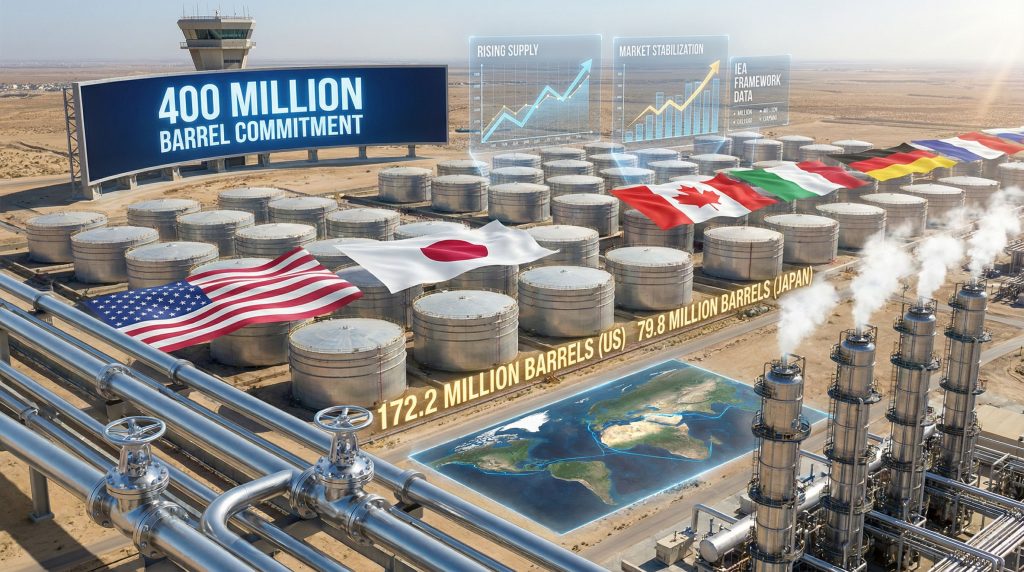
- United States: 172.2 million barrels (40.4% of total)
- Canada: 23.6 million barrels via production increases
- Mexico: 3.9 million barrels additional production
European Approach:
- Germany: 19.5 million barrels from public stocks
- Japan: 79.8 million barrels (54.0 MB public, 25.8 MB industry)
- Focus on refined products due to downstream infrastructure
Technical Implementation Challenges:
Quality specifications present ongoing coordination complexity, particularly for refined product releases requiring adherence to regional fuel standards. European EN standards differ from US ASTM specifications, creating technical barriers to rapid inter-regional product transfers during emergency periods.
The notation of "details not yet available" for several countries in official contribution tables indicates ongoing technical discussions regarding terminal availability, pipeline capacity, and blending requirements extending beyond initial announcement dates.
Historical Significance of the 2026 Emergency Response
The March 2026 IEA oil stock release represents the sixth collective action in the organisation's history, surpassing all previous emergency responses in both scale and coordination complexity. At 426 million barrels total commitment, this action exceeds the combined magnitude of earlier interventions during the 1991 Gulf War, 2005 Hurricane Katrina aftermath, 2011 Libya disruption, and dual 2022 Russia-Ukraine conflict responses.
Scale Analysis and Market Impact
Historical Comparison Framework:
| Release Year | Trigger Event | Volume (MB) | Duration |
|---|---|---|---|
| 1991 | Gulf War | ~450 | 6 months |
| 2005 | Hurricane Katrina | ~60 | 30 days |
| 2011 | Libya Conflict | ~60 | 30 days |
| 2022 | Russia-Ukraine (1st) | ~120 | 180 days |
| 2022 | Russia-Ukraine (2nd) | ~180 | 180 days |
| 2026 | Middle East Disruption | 426 | Immediate |
The 2026 release distinguishes itself through immediate commitment availability rather than extended drawdown periods. Previous actions often involved gradual release schedules over months, while the current response provides upfront market assurance of massive volume availability.
Strategic Response to Critical Shipping Infrastructure
The Middle East supply disruption creating the 2026 emergency specifically targets Strait of Hormuz transit capabilities, affecting approximately 21% of global petroleum liquids movements. This chokepoint vulnerability necessitated the largest emergency response in IEA history due to the mathematical relationship between disrupted flows and required strategic reserve replacement volumes, as detailed in the IEA's latest oil market report.
Geographic Distribution Strategy:
The Americas contributed 199.7 million barrels (46.8% of total), emphasising production increases alongside strategic reserve withdrawals. This approach leverages North American spare production capacity while preserving long-term strategic inventory for potential extended disruptions.
European contributions totalled approximately 114.5 million barrels (26.8%), with emphasis on refined products addressing immediate downstream supply needs. This regional specialisation reflects integrated refinery infrastructure enabling rapid product delivery to consumer markets.
Asia-Pacific nations provided 107.1 million barrels (25.1%), led by Japan's substantial 79.8 million barrel commitment representing significant reserve depletion for an island nation dependent on maritime supply chains.
Country-Specific Contributions and Strategic Approaches
The 2026 emergency response reveals distinct national approaches to strategic reserve management and emergency contribution strategies. These differences reflect geographic constraints, infrastructure capabilities, and long-term energy security philosophies across IEA member nations, particularly given recent oil trade war impact concerns.
Major Contributor Analysis
United States Leadership:
The US commitment of 172.2 million barrels (entirely crude oil from public stocks) represents the largest single-country contribution in IEA history. This volume leverages the Strategic Petroleum Reserve's 714 million barrel capacity while maintaining substantial reserves for potential extended crisis scenarios.
Japan's Comprehensive Response:
Japan's 79.8 million barrel commitment demonstrates sophisticated reserve portfolio management, combining 54.0 million barrels from public stocks with 25.8 million barrels from industry-obligated reserves. This split approach preserves government reserve flexibility while utilising private sector stockholding capabilities.
Canada's Production-Focused Strategy:
Canada's entire 23.6 million barrel contribution comes through production increases rather than strategic reserve depletion. This approach leverages spare production capacity in oil sands operations while preserving inventory-based emergency capabilities for future disruptions.
Regional Distribution Patterns
Table: Continental Response Strategies
| Region | Total Volume (MB) | Primary Approach | Key Characteristics |
|---|---|---|---|
| Americas | 199.7 (46.8%) | Production increases + SPR | Spare capacity utilisation |
| Europe | 114.5 (26.8%) | Refined products focus | Downstream infrastructure |
| Asia-Pacific | 107.1 (25.1%) | Mixed crude/products | Maritime supply security |
Infrastructure and Capacity Considerations
Storage facility locations and withdrawal capabilities vary significantly across member nations, influencing contribution strategies and implementation timelines. The United States maintains the world's largest strategic reserves in salt caverns along the Gulf Coast, enabling rapid large-volume withdrawals through existing pipeline infrastructure.
European countries typically operate smaller, regionally distributed facilities emphasising refined product storage near consumption centres. This approach prioritises immediate consumer market supply over large-scale crude oil stockpiling, reflecting different infrastructure optimisation strategies.
Notable Contribution Characteristics:
- Italy: 10.0 million barrels entirely from obligated industry stocks
- Spain: 11.6 million barrels all refined products
- Germany: 19.5 million barrels completely from public stocks
- Turkey: Split between 3.6 MB crude and 8.1 MB products
Global Oil Market Dynamics and Emergency Releases
Emergency strategic reserve releases create complex market dynamics extending beyond simple supply addition calculations. The psychological impact of coordinated international action often proves as significant as physical volume effects, influencing futures markets, regional price differentials, and long-term investment decisions across the global petroleum complex.
Price Stabilisation Mechanisms
Market sentiment responds to emergency release announcements through multiple transmission channels. Immediate effects include futures market volatility reduction as speculative positions adjust to increased supply availability expectations. The announcement of 426 million barrels creates a psychological price ceiling, limiting upward speculation during crisis periods.
Regional Price Differential Effects:
Emergency releases affect crude oil benchmarks differently based on quality specifications and geographic accessibility. West Texas Intermediate (WTI), Brent, and Dubai crude prices typically converge during major IEA actions as arbitrage opportunities diminish through increased supply availability across regions.
Consumer fuel price transmission mechanisms operate with typical 2-4 week delays between emergency release implementation and retail price impacts. This timeline reflects the physical movement of crude oil through refinery processing, distribution systems, and inventory turnover at retail locations.
Supply Chain Resilience Building
Callout: Transportation Sector Stability During Supply Disruptions
Emergency reserve releases provide critical stability for transportation fuel markets, preventing supply disruptions that could cascade through logistics networks, commercial aviation, and freight movement systems essential to economic continuity.
Long-term market confidence restoration requires coordination between immediate supply provision and longer-term infrastructure resilience investments. However, the 2026 release demonstrates international capability to respond to major disruptions, but sustained market stability depends on addressing underlying geopolitical vulnerabilities affecting critical shipping routes.
Economic Multiplier Effects
Energy-intensive industries benefit disproportionately from strategic reserve actions through stabilised input costs during crisis periods. Manufacturing sectors dependent on petrochemical feedstocks, transportation companies managing fuel cost volatility, and agricultural operations requiring diesel fuel inputs all experience secondary benefits from emergency release programmes.
Strategic reserve replenishment strategies post-release typically occur over 12-24 month periods, depending on market conditions and budgetary considerations. This extended timeline creates ongoing market support as governments return to crude oil purchasing, providing demand floors during potential price weakness periods.
Refined Products vs Crude Oil Strategic Considerations
The 2026 emergency response emphasises a sophisticated approach to product vs. crude oil deployment, with 301 million barrels (70.6%) released as crude oil and 125 million barrels (29.4%) as refined products. This split reflects regional infrastructure capabilities and immediate market needs during supply disruptions.
European Refined Product Strategy
European contributions primarily emphasise gasoline, diesel, heating oil, and aviation fuel releases rather than crude oil volumes. This approach addresses several strategic considerations:
Refinery Capacity Constraints:
During crisis periods, refinery utilisation rates often approach maximum capacity, creating bottlenecks between crude oil availability and finished product delivery. Direct refined product releases bypass these processing limitations.
Regional Product Demand Variations:
European markets show distinct seasonal patterns in heating oil demand, transportation fuel requirements, and industrial product needs. Strategic refined product releases can target specific regional shortages more precisely than crude oil additions.
Quality Specifications and Blending:
Refined products released from strategic reserves must meet strict regional specifications including sulphur content, octane ratings, and additive requirements. European storage facilities typically maintain products meeting EN standards, enabling immediate market delivery.
Distribution Network Optimisation
Terminal Storage and Blending Capabilities:
- Primary distribution terminals strategically positioned near major consumption centres
- Blending facilities enabling quality adjustment for specific regional requirements
- Pipeline and barge transportation networks optimised for refined product movement
- Aviation fuel security systems protecting critical transportation infrastructure
Priority Allocation Systems:
Emergency refined product releases typically prioritise essential services including medical facilities, emergency responders, public transportation, and critical infrastructure operations. These allocation protocols ensure societal continuity during supply disruptions.
The next major ASX story will hit our subscribers first
Production Increases Complementing Stock Releases
The Americas' production-focused contribution strategy provides 28 million barrels (6.4% of total) through enhanced output rather than strategic reserve depletion. This approach leverages North American spare production capacity while preserving inventory-based emergency capabilities for extended disruption scenarios, particularly given ongoing US production decline factors in certain regions.
Americas Production Response Strategy
Canada's Enhanced Output Approach:
Canada's 23.6 million barrel contribution entirely through production increases demonstrates oil sands operational flexibility during emergency periods. This strategy avoids depleting strategic reserves while contributing substantially to collective action objectives.
Mexico's Coordinated Production:
Mexico's 3.9 million barrel production increase complements its accession country status within IEA frameworks, demonstrating integration between formal membership obligations and regional cooperation mechanisms.
US Shale Oil Production Flexibility:
While the United States contributes primarily through Strategic Petroleum Reserve withdrawals, underlying shale oil production provides additional flexibility for sustained higher output if crisis conditions persist beyond initial reserve release periods.
Global Production Capacity Analysis
Table: Production Response Capabilities
| Country/Region | Spare Capacity (MB/day) | Crisis Response Time | Sustainability Period |
|---|---|---|---|
| US Shale | 0.5-1.0 | 30-60 days | 6+ months |
| Canada Oil Sands | 0.2-0.4 | 15-30 days | 12+ months |
| Mexico Conventional | 0.1-0.2 | 7-14 days | 3-6 months |
Strategic Coordination Benefits:
Combining stock releases with production increases provides both immediate market supply and sustained higher output capability. This dual approach addresses short-term crisis response while maintaining longer-term supply security during extended disruptions.
Long-Term Implications for Energy Security
The 2026 emergency response establishes new precedents for international energy security cooperation while highlighting evolving challenges in strategic reserve management. These developments influence optimal reserve size calculations, technology improvements, and integration with renewable energy transition planning, as seen in recent oil price rally analysis.
Strategic Reserve Evolution
Optimal Reserve Size Calculations:
Traditional strategic reserve sizing based on 90+ days of net imports requires reconsideration as global supply chains become more complex and vulnerable to multiple simultaneous disruptions. The 426 million barrel 2026 release suggests current reserve levels may prove insufficient for extended multi-region crises.
Technology Improvements:
Storage and withdrawal systems continue evolving with automated monitoring capabilities, predictive maintenance systems, and enhanced crude oil quality preservation technologies. These improvements reduce operational costs while improving emergency response capabilities.
Climate Policy Integration:
Strategic petroleum reserves must balance energy security objectives with climate transition goals. Long-term reserve strategies increasingly consider integration with renewable energy storage capabilities and alternative fuel emergency planning.
Market Structure Adaptations
Table: Emergency Response Lessons Learned
| Improvement Area | 2022 Experience | 2026 Enhancement |
|---|---|---|
| Coordination Speed | 30-45 days | 7-15 days |
| Private Sector Integration | Limited | Substantial |
| Regional Cooperation | Bilateral | Multilateral |
| Communication Protocols | Fragmented | Unified |
Future Crisis Preparedness
Geopolitical Risk Assessment:
Modern energy security requires sophisticated modelling of multiple simultaneous disruption scenarios including cyber attacks on infrastructure, climate-related supply interruptions, and cascading geopolitical conflicts affecting multiple supply routes.
Supply Chain Diversification:
Strategic reserve policies increasingly emphasise supply source diversification, alternative transportation route development, and regional production capacity enhancement to reduce dependence on vulnerable chokepoints.
International Cooperation Framework Evolution:
The success of 2026 coordination suggests potential expansion of IEA-style mechanisms to additional commodities, broader geographic participation, and integration with international climate policy frameworks.
Investment Implications of Emergency Oil Actions
Strategic petroleum reserve releases create significant investment signals across energy markets, influencing equity valuations, commodity trading strategies, and long-term infrastructure development priorities. The 2026 emergency action provides multiple analytical frameworks for understanding these market dynamics, particularly considering the OPEC production impact on global supply.
Market Signal Analysis
IEA Action Timing and Psychology:
The March 2026 release timing demonstrated sophisticated market psychology understanding, with announcement occurring during peak uncertainty but before panic-driven speculation could establish sustained upward price momentum. This timing maximised stabilisation benefits while minimising market disruption from intervention.
Oil Company Stock Performance:
Emergency releases typically create mixed equity market effects. Integrated oil companies benefit from inventory revaluation as crude oil prices stabilise at higher levels, while independent refiners gain from improved crack spreads as refined product supplies increase relative to crude oil prices.
Energy Sector Investment Implications:
The scale of 2026 emergency response signals potential policy acceleration for energy infrastructure resilience investments. Strategic petroleum reserve modernisation projects, alternative supply route development, and enhanced regional cooperation frameworks represent emerging investment themes.
Strategic Investment Considerations
Energy Infrastructure Resilience:
The 426 million barrel release highlights vulnerabilities in existing energy infrastructure, creating investment opportunities in pipeline redundancy projects, enhanced storage capabilities, and cybersecurity protection systems for critical energy facilities.
Alternative Energy Acceleration:
Large-scale strategic reserve deployments often accelerate alternative energy investment as policymakers seek to reduce dependence on volatile petroleum markets. In addition, the 2026 crisis may catalyse additional renewable energy infrastructure funding and energy storage technology development.
Regional Energy Security Enhancement:
Investment opportunities emerge in regional energy security projects including local refinery capacity expansion, strategic reserve facility upgrades, and enhanced interconnection infrastructure enabling rapid emergency supply redistribution, as reported by the Wall Street Journal's analysis of IEA emergency oil stock releases.
Frequently Asked Questions
How quickly can emergency oil stocks reach the market?
Emergency oil releases typically begin flowing within 15-30 days of IEA oil stock release collective action decisions, with initial volumes available almost immediately from strategically positioned facilities. The 2026 release achieved faster implementation, with volumes flowing within one week of agreement, though full market impact requires 2-4 weeks for consumer price transmission.
What triggers an IEA emergency stock release?
Major supply disruptions affecting 7% or more of global oil supply, significant price volatility threatening economic stability, or coordinated requests from multiple member countries can trigger emergency consultations. The 2026 action responded to Middle East disruptions creating the largest supply interruption in global oil market history.
How are emergency oil stocks replenished after release?
Replenishment occurs through a combination of market purchases, domestic production allocation, and gradual rebuilding over 12-24 months, depending on market conditions and budgetary considerations. Strategic reserve refilling typically provides ongoing demand support during potential price weakness periods.
Do emergency releases actually lower consumer fuel prices?
Emergency releases help prevent price spikes rather than dramatically reducing existing prices, with consumer benefits typically appearing 2-4 weeks after implementation through retail fuel markets. The primary benefit involves price ceiling establishment and volatility reduction rather than sustained price decreases.
What happens to global oil markets after strategic reserves are depleted?
Strategic petroleum reserves represent buffer capacity rather than permanent supply sources. Post-release market dynamics depend on resolution of underlying supply disruptions, alternative supply source activation, and production capacity adjustments. The 2026 release's effectiveness ultimately requires Strait of Hormuz shipping resumption and adequate tanker insurance restoration.
Further Exploration:
Readers interested in learning more about international energy security mechanisms can explore related educational content through official government energy agencies and international energy organisations, which provide comprehensive analysis of global oil market dynamics and emergency preparedness systems.
Disclaimer: This article contains analysis of emergency energy policies, geopolitical developments, and market forecasts that involve inherent uncertainty. Strategic petroleum reserve policies, international energy agreements, and crisis response mechanisms may change based on evolving geopolitical conditions and policy decisions. Readers should consult official government sources and qualified energy analysts for investment and policy guidance.
Seeking Exposure to Energy Sector Opportunities?
Discovery Alert's proprietary Discovery IQ model provides real-time notifications on significant ASX mineral discoveries, including critical energy transition metals and commodities that could benefit from strategic oil market dynamics. With instant alerts covering over 30 commodities and proven success tracking discoveries like De Grey Mining and WA1 Resources, subscribers gain actionable insights to capitalise on emerging opportunities before broader market recognition.