August 12, 2026
Strategic Positioning in the Energy Transition Metal Supply Chain
The accelerating global shift toward renewable energy infrastructure has fundamentally altered industrial metal requirements, creating unprecedented supply-demand dynamics in precious metals markets. As decarbonisation initiatives expand across developed economies, traditional commodity frameworks prove inadequate for understanding how gold and silver function within next-generation energy systems. Furthermore, this transformation represents more than cyclical demand fluctuation—it reflects structural economic realignment where energy security directly correlates with critical minerals energy transition availability.
The demand for gold and silver in green economy applications now encompasses multiple interconnected technology platforms, from photovoltaic installations requiring specific electrical conductivity properties to battery management systems demanding thermal stability across extreme operating conditions. Unlike historical precious metals consumption patterns driven primarily by financial investment and jewellery manufacturing, contemporary demand emerges from engineering requirements where material substitution remains technically or economically unfeasible.
Table: Critical Metal Integration Across Clean Technology Platforms
| Technology Sector | Silver Requirements | Gold Applications | Supply Chain Risk Level |
|---|---|---|---|
| Solar Photovoltaics | Conductive grid networks, cell interconnects | Microprocessor control systems | High |
| Electric Vehicle Systems | Battery thermal management, sensor networks | Advanced driver assistance chips | Medium-High |
| Smart Grid Infrastructure | Power conditioning equipment | Communication processors | Medium |
| Energy Storage Arrays | Inverter components, monitoring systems | Control electronics, safety circuits | High |
This technological integration creates compound supply pressures as deployment scales accelerate beyond traditional market absorption capacity. Manufacturing specifications for renewable energy components require precise metallurgical properties that alternative materials cannot consistently deliver across operational lifespans exceeding 25 years.
When big ASX news breaks, our subscribers know first
Silver's Technological Indispensability in Photovoltaic Systems
Silver's exceptional electrical conductivity—achieving 63.0 × 10⁶ siemens per metre at room temperature—establishes its central role in photovoltaic cell efficiency optimisation. Modern solar panel manufacturing depends on silver's unique combination of electrical performance, thermal conductivity, and oxidation resistance to maintain energy conversion rates across diverse environmental conditions.
Advanced Cell Architecture Requirements
Contemporary photovoltaic technologies utilise increasingly sophisticated cell designs that amplify silver consumption per panel. High-efficiency PERC (Passivated Emitter and Rear Cell) architectures require 18-22 grams of silver per panel, while emerging TOPCon (Tunnel Oxide Passivated Contact) cells demand 20-25 grams to achieve conversion efficiencies exceeding 24%.
The technological progression toward bifacial solar panels—capable of generating electricity from both front and rear surfaces—necessitates additional silver loading for rear-side electrical connections. Industry analysis indicates bifacial installations, which represent approximately 85% of new solar projects globally, require 15-20% more silver per unit of installed capacity compared to conventional monofacial panels.
Critical Market Insight: Despite ongoing research into silver-reduction paste technologies, including copper-plated alternatives and nano-silver formulations, manufacturing yield rates and long-term reliability concerns have prevented widespread commercial adoption of substitute materials.
Supply-Demand Imbalance Dynamics
Global solar installation capacity additions reached 346 gigawatts in 2024, representing a 73% increase from 2023 levels. Each gigawatt of solar capacity requires approximately 800,000 ounces of silver, translating to industrial consumption of 276.8 million ounces for new installations alone—equivalent to nearly 27% of total global silver mine production.
The demand for gold and silver in green economy applications creates structural market tension as solar deployment accelerates under policy frameworks including the U.S. Inflation Reduction Act, European Green Deal mandates, and China's carbon neutrality commitments. These regulatory environments establish deployment trajectories that mechanically generate precious metals requirements independent of market price considerations.
Key Consumption Factors:
- Conductive paste applications: Silver nanoparticle formulations achieving optimal current collection efficiency
- Grid finger technology: Multi-busbar designs requiring increased silver content for reduced electrical resistance
- Contact formation: High-temperature firing processes necessitating silver's thermal stability properties
- Corrosion resistance: Long-term performance requirements in marine and desert environments
Electric Vehicle Integration and Precious Metal System Dependencies
Electric vehicles transformation introduces complex precious metal requirements spanning battery management, autonomous systems, and vehicle-to-grid communication technologies. Unlike conventional automotive applications, EVs integrate multiple sophisticated electronic systems requiring precious metal components for reliability and performance optimisation.
Battery Management System Architecture
Modern EV battery management systems operate in extreme thermal environments, with component temperatures ranging from -40°C to +85°C depending on climate conditions and operational demands. Silver's superior thermal conductivity (429 W/m·K) and electrical stability across temperature ranges make it essential for:
Temperature Monitoring Networks:
- Platinum resistance temperature detectors with silver lead wires for precise thermal measurement
- Silver-palladium thermocouples providing rapid response times for safety applications
- Thermal interface materials incorporating silver particles for heat dissipation
Voltage Regulation Systems:
- Silver-oxide contact materials in high-current switching applications
- Precision resistors utilising silver-palladium alloys for stable voltage references
- EMI shielding components requiring silver's conductive properties
Safety Disconnect Mechanisms:
- Silver-tungsten contact materials for high-energy disconnect switches
- Arc suppression systems utilising silver's electrical characteristics
- Emergency isolation systems requiring reliable precious metal contact performance
Autonomous Vehicle Technology Requirements
Advanced driver assistance systems and autonomous vehicle capabilities introduce additional precious metal consumption through sensor technologies and processing systems. LIDAR sensors, which enable precise distance measurement for autonomous navigation, incorporate gold-plated optical components to minimise signal reflection and maintain calibration accuracy over operational lifespans exceeding 10 years.
Critical System Components:
- Optical sensor assemblies: Gold plating prevents oxidation in laser measurement systems
- High-frequency radar units: Gold wire bonding in millimetre-wave communication circuits
- Processing unit interconnects: Gold-plated connectors ensuring signal integrity in safety-critical applications
- Communication systems: Silver-enhanced antennas for vehicle-to-infrastructure connectivity
Industry projections indicate that autonomous vehicle technologies will require 2-4 grams of gold and 8-12 grams of silver per vehicle by 2030, representing substantial increases from current conventional automotive precious metal content of less than 1 gram combined.
Supply Chain Vulnerability and Production Constraints
The precious metals supply chain faces unprecedented challenges in meeting accelerating demand for gold and silver in green economy applications, with traditional mining operations constrained by geological, economic, and operational limitations.
Mining Production Dynamics
Silver Supply Structure:
- Primary silver mines contribute only 28% of global production
- 72% originates as byproduct from lead, zinc, and copper operations
- Byproduct production cannot respond independently to silver demand increases
- Mine production growth averaging 1.2% annually versus green economy demand growth of 15-20%
Gold Supply Constraints:
- Exploration discoveries declining 85% over past decade in terms of contained ounces
- Average ore grades falling 3-5% annually across major producing regions
- New mine development requiring 12-18 years from discovery to production
- Capital requirements exceeding $1.5 billion for major new gold operations
Geological Resource Depletion Indicators
Mining industry analysis reveals systematic depletion of high-grade precious metals deposits, with remaining resources increasingly located in geologically complex or geopolitically challenging regions. The phenomenon of "Peak Gold" reflects not absolute scarcity but the economic threshold where extraction costs exceed market pricing for marginal deposits.
Resource Quality Degradation:
- Average gold ore grades: Declined from 12 g/t in 1970s to 1.2 g/t currently
- Silver ore grades: Decreased from 450 g/t to 150 g/t over similar timeframe
- Energy intensity: Increased 40% per ounce of metal recovered since 2010
- Water requirements: Expanded 65% per unit of production due to lower-grade processing
Supply Chain Warning: The combination of declining ore grades and expanding green economy applications creates potential for sustained precious metals deficits beginning in the late 2020s, with silver particularly vulnerable due to its byproduct supply structure.
Recycling Technology Innovation and Circular Economy Integration
Advanced recycling technologies represent critical components of precious metals supply chain resilience, though current recovery infrastructure remains insufficient for projected demand growth in renewable energy applications. Consequently, mining reclamation innovation becomes increasingly vital for sustainable resource management.
Urban Mining and Electronic Waste Recovery
Electronic waste streams contain significant precious metal concentrations, with smartphones containing approximately 0.3 grams of silver and 0.03 grams of gold per device. However, collection rates and processing efficiency limit recoverable volumes:
Recovery Rate Analysis:
- Gold recovery: Achieving 95-98% efficiency in specialised facilities
- Silver recovery: Limited to 70-85% due to dispersion in electronic components
- Collection rates: Only 25% of electronic waste enters formal recycling channels globally
- Processing capacity: Current facilities handle less than 40% of available electronic waste
Renewable Energy Technology Recycling Challenges
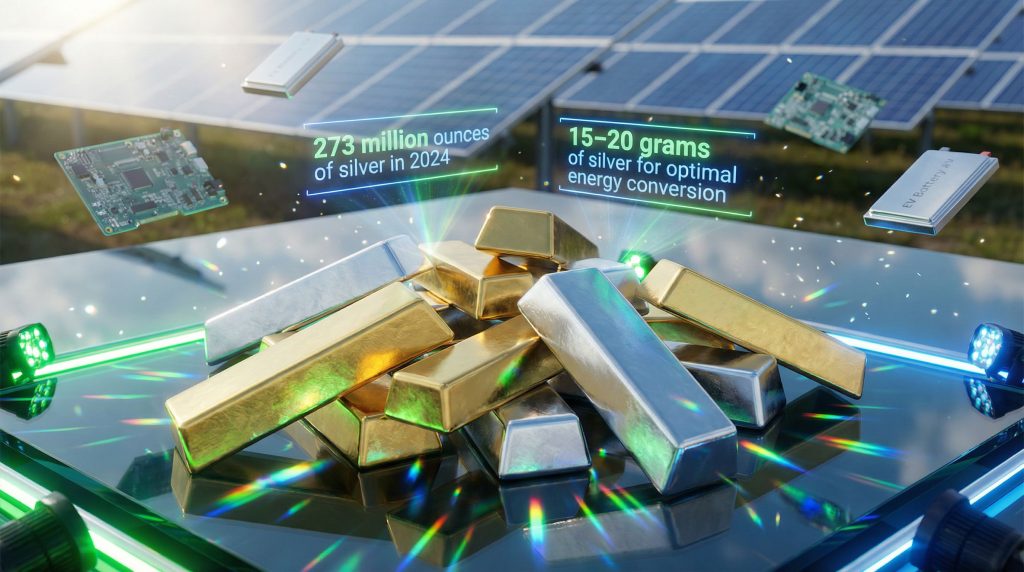
Solar panel recycling presents unique challenges as first-generation installations approach end-of-life phases. Each photovoltaic panel contains 15-20 grams of recoverable silver, but specialised processing facilities remain limited globally. Furthermore, battery recycling breakthrough technologies are essential for addressing growing EV battery waste streams.
Technical Recovery Constraints:
- Panel disassembly: Requires specialised equipment to separate glass, silicon, and metal components
- Silver extraction: Demands chemical processing to recover silver from conductive paste applications
- Economic thresholds: Processing costs exceed silver value recovery except at industrial scale
- Infrastructure gaps: Fewer than 50 commercial solar recycling facilities operate worldwide
Investment Strategy Framework for Precious Metal Supply Chain Exposure
The structural transformation in precious metals markets creates multifaceted investment opportunities across mining, technology, and supply chain segments as demand for gold and silver in green economy applications reshapes traditional market dynamics.
Mining Sector Strategic Positioning
Mining companies with diversified precious metals production portfolios gain competitive advantages as green economy demand growth outpaces supply expansion. Companies operating both primary precious metals mines and byproduct operations achieve portfolio stability while benefiting from secular demand trends.
Investment Criteria Assessment:
- Resource quality: Ore grade stability and reserve life exceeding 15 years
- Geographic diversification: Operations across multiple jurisdictions reducing political risk
- Technology integration: Adoption of automation and digitalisation improving extraction efficiency
- ESG compliance: Environmental and social governance standards meeting institutional investment requirements
Junior mining companies focused on precious metals exploration in proven geological districts attract premium valuations as resource scarcity concerns intensify. However, development timelines and capital requirements create execution risks that require careful evaluation.
Supply Chain Integration Opportunities
Vertical integration strategies between precious metals producers and renewable energy technology manufacturers create supply security advantages while capturing value across multiple processing stages. Additionally, trade war impact on metals pricing must be considered in strategic planning.
Strategic Partnership Models:
- Long-term supply agreements: 10-15 year contracts securing metal availability at predetermined pricing
- Joint venture operations: Shared investment in mining projects by technology companies
- Strategic stockpiling: Government and corporate reserves ensuring supply chain continuity
- Technology development: Collaborative research into silver-reduction technologies and recycling optimisation
Market Timing and Price Discovery Mechanisms
Precious metals pricing increasingly reflects industrial demand fundamentals rather than traditional financial market correlations. Silver demonstrates particularly strong correlation with renewable energy deployment rates, while gold maintains broader economic sensitivity alongside growing technology sector demand.
Price Driver Analysis:
- Solar installation growth: Direct correlation with silver price movements exceeding 0.7 coefficient
- EV production volumes: Emerging influence on both gold and silver demand patterns
- Mining supply responses: Lagged 3-5 years behind demand acceleration due to development timelines
- Recycling capacity expansion: Gradual impact on supply availability beginning late 2020s
The next major ASX story will hit our subscribers first
Technological Innovation Trajectories and Future Demand Patterns
Emerging technologies continue expanding precious metals applications while driving efficiency improvements that could moderate consumption growth rates across specific technology platforms.
Next-Generation Solar Technology Requirements
Perovskite-silicon tandem cells represent the next significant advancement in photovoltaic efficiency, potentially achieving 35% conversion rates compared to current silicon cells at 22-24%. However, tandem cell architectures require 25-30% more silver per panel due to additional electrical interconnection requirements.
Advanced Technology Applications:
- Concentrated solar power: Silver-enhanced reflective surfaces improving thermal collection efficiency
- Building-integrated photovoltaics: Expanding installation opportunities in urban environments
- Agrivoltaics: Dual-use applications combining agriculture with solar generation requiring specialised panel designs
- Floating solar arrays: Marine installations demanding enhanced corrosion resistance properties
Grid Modernisation and Energy Storage Expansion
Smart grid infrastructure deployment creates additional demand for gold and silver in green economy applications through advanced monitoring, communication, and control systems required for renewable energy integration.
Infrastructure Requirements:
- Smart inverters: Power conditioning equipment containing silver-enhanced components
- Grid-scale batteries: Energy storage systems requiring precious metals in control electronics
- Communication networks: 5G and fibre-optic systems supporting grid modernisation
- Sensor networks: Monitoring equipment utilising precious metal contacts for reliability
Energy storage system expansion, driven by renewable energy intermittency management, requires precious metal components in inverter technologies and battery management systems. Grid-scale battery installations are projected to reach 358 GWh annually by 2030, with each GWh requiring approximately 450 ounces of silver in associated power electronics.
Long-Term Market Evolution and Strategic Material Classification
The integration of precious metals into critical infrastructure positions gold and silver as strategic materials essential for energy security and economic competitiveness rather than purely financial assets.
Government Strategic Reserve Considerations
National governments increasingly recognise precious metals as critical materials for renewable energy deployment, with potential implications for strategic reserve policies and trade regulations. For instance, the Silver Institute's supply-demand analysis provides valuable insights for policymakers assessing strategic material requirements.
Policy Development Indicators:
- Critical materials lists: Inclusion of silver alongside lithium and rare earth elements
- Strategic stockpiling: Government accumulation programmes similar to petroleum reserves
- Import dependency analysis: Assessment of foreign supply chain vulnerabilities
- Domestic production incentives: Mining sector support policies ensuring national supply security
Trade Policy and Supply Chain Resilience
International trade policies affecting precious metals markets evolve to address supply chain security concerns as renewable energy deployment accelerates globally. Countries with limited domestic precious metals production face strategic decisions regarding import dependency and alternative supply arrangements.
Geopolitical Considerations:
- Export restrictions: Potential limitations on precious metals exports by producing countries
- Bilateral agreements: Trade partnerships securing critical material access
- Technology transfer: Agreements balancing resource access with technology sharing
- Regional cooperation: Multilateral frameworks addressing shared supply chain vulnerabilities
Market Structure Transformation and Price Discovery Evolution
The fundamental shift toward industrial applications transforms precious metals price discovery mechanisms, moving beyond traditional investment and jewellery demand patterns toward technology-driven market dynamics.
Industrial Demand as Primary Price Driver
Silver markets demonstrate accelerating transition toward industrial price discovery, with renewable energy demand growth creating sustained upward pressure independent of financial market conditions. This structural shift differentiates silver from gold, which maintains broader economic sensitivity while experiencing expanding technology sector integration.
Volatility Pattern Changes:
- Seasonal demand cycles: Correlation with solar installation seasons in major markets
- Technology deployment announcements: Price responses to renewable energy policy changes
- Supply disruption sensitivity: Increased market reactions to mining operational issues
- Inventory management: Strategic stockpiling affecting available market supply
Investment Market Adaptation
Traditional precious metals investment vehicles adapt to accommodate industrial demand themes, with exchange-traded funds and commodity indices incorporating green economy exposure metrics alongside conventional precious metals tracking. Moreover, according to Kitco's green economy analysis, the green energy economy is expected to exceed $7 trillion annually by 2030, highlighting silver's critical role.
Investment Product Evolution:
- Green economy-focused ETFs: Investment vehicles targeting renewable energy materials exposure
- Industrial demand indices: Commodity tracking emphasising technology sector consumption
- Supply chain investment: Funds targeting vertical integration across precious metals value chains
- ESG integration: Investment criteria incorporating sustainability metrics in mining operations
Future Scenario Analysis and Risk Assessment
Multiple scenarios emerge for precious metals market evolution as demand for gold and silver in green economy applications intersects with supply constraints, technological innovation, and policy developments.
Accelerated Transition Scenario
Under accelerated renewable energy deployment driven by aggressive climate policies, precious metals demand could exceed supply capacity by 30-40% beginning in 2028. This scenario creates sustained price appreciation and potential supply allocation systems prioritising critical infrastructure applications.
Scenario Characteristics:
- Policy acceleration: Enhanced renewable energy mandates and fossil fuel restrictions
- Technology breakthrough: Improved battery storage and grid integration capabilities
- Investment mobilisation: Massive capital deployment in green infrastructure projects
- Supply chain stress: Precious metals shortages constraining deployment rates
Technology Substitution Scenario
Alternative material development could moderate precious metals demand growth, particularly in solar applications where ongoing research focuses on reducing silver content while maintaining efficiency levels.
Substitution Pathways:
- Copper-based alternatives: Conductive paste formulations reducing silver requirements by 40-60%
- Nano-material innovations: Advanced particle technologies improving conductivity per unit of precious metal
- Cell architecture optimisation: Design improvements minimising conductor requirements
- Hybrid approaches: Combination materials balancing performance with cost considerations
Disclaimer: This analysis presents forward-looking projections based on current market trends and technological developments. Actual market outcomes may vary significantly due to technological innovations, policy changes, economic conditions, and unforeseen supply or demand disruptions. Investment decisions should incorporate comprehensive risk assessment and professional financial advice.
The transformation of precious metals from primarily financial assets to essential industrial inputs supporting global decarbonisation represents a fundamental shift in commodity market structure. As renewable energy deployment accelerates and electric vehicle adoption expands, successful navigation of this evolving landscape requires understanding both technological demand drivers and supply-side constraints limiting availability. Investment strategies, policy frameworks, and corporate planning must account for the long-term structural changes reshaping precious metals markets within the context of the global energy transition, recognising that traditional market analysis frameworks may prove inadequate for understanding these dynamic industrial applications.
Ready to Capitalise on Energy Transition Metal Opportunities?
Discovery Alert's proprietary Discovery IQ model delivers real-time alerts on significant ASX mineral discoveries across critical energy transition metals, instantly empowering subscribers to identify actionable precious metals opportunities ahead of the broader market. Understand why historic discoveries can generate substantial returns by exploring major mineral breakthroughs, then begin your 14-day free trial today to position yourself strategically in the evolving green economy metals landscape.