June 16, 2026
Strategic Vulnerabilities Drive Innovation in America's Critical Materials Landscape
America's quantum computing ambitions face a critical bottleneck that extends far beyond semiconductors or artificial intelligence algorithms. The race for technological supremacy increasingly depends on securing reliable access to ultra-rare materials that exist in quantities measured in kilograms rather than tons. This scarcity creates profound strategic vulnerabilities, particularly when supply chains traverse geopolitically unstable regions or depend on adversarial nations.
The helium-3 discovery in Minnesota represents more than a geological curiosity. It signals a potential shift in America's critical minerals policy, where domestic production capabilities could replace dangerous import dependencies. Unlike traditional mining discoveries measured in millions of tons, this find involves materials so rare that a single kilogram commands prices exceeding most precious metals by orders of magnitude.
The timing proves particularly significant. As quantum computing transitions from research laboratories toward commercial applications, the intersection of national security concerns and technological advancement has created unprecedented demand for materials that were previously academic curiosities. Minnesota's geological formations now hold strategic importance comparable to semiconductor fabrication facilities or rare earth deposits.
When big ASX news breaks, our subscribers know first
Quantum Computing's Material Dependencies Transform Global Competition
The Critical Role of Ultra-Cold Operations
Quantum computing systems require operational temperatures approaching absolute zero, creating extraordinary material requirements that conventional industries never encounter. At these extreme temperatures, only specific isotopes maintain the necessary properties for optimal quantum processor performance. Traditional cooling systems prove inadequate for commercial-scale quantum operations, where even microscopic thermal fluctuations can destroy quantum states.
The helium-3 discovery in Minnesota addresses this technical challenge through terrestrial availability rather than exotic alternatives. Current helium-3 sources derive primarily from nuclear weapons maintenance programs and specialised nuclear reactors, creating supply constraints that limit quantum computing development. Federal laboratories have verified that Minnesota's concentrations match or exceed those found in lunar surface samples, providing a terrestrial alternative to proposed space-based extraction.
| Technology Sector | Current Helium-3 Usage | Projected Growth | Strategic Impact |
|---|---|---|---|
| Quantum Computing | Laboratory-scale cooling | Commercial deployment | Critical enabler |
| Nuclear Fusion | Research applications | Energy production | Long-term potential |
| National Security | Detection systems | Border security expansion | Immediate need |
| Medical Imaging | Specialised diagnostics | Hospital deployment | Healthcare security |
Terrestrial vs. Lunar Extraction Economics
The economic comparison between terrestrial and lunar helium-3 extraction reveals stark contrasts in feasibility and timeline. Lunar mining proposals require decades of development, billions in capital investment, and dependence on space launch capabilities. Minnesota's deposits offer immediate accessibility through conventional drilling techniques, eliminating the technological and financial barriers associated with extraterrestrial mining.
Capital Requirements Analysis:
- Terrestrial extraction: Millions in initial investment
- Processing infrastructure: Conventional gas separation technology
- Transportation costs: Domestic distribution networks
- Regulatory framework: Existing mining and gas production laws
Lunar Mining Challenges:
- Space launch dependencies: Mission-critical supply chains
- Technology development: Unproven regolith processing methods
- Timeline uncertainty: 15-20 year minimum development period
- Capital intensity: Multi-billion dollar infrastructure requirements
Commercial Scale Development Barriers
The transition from laboratory-scale helium-3 separation to commercial production presents significant technical challenges. Six known separation methods exist, but none have been scaled beyond research applications due to historical scarcity. The helium-3 discovery in Minnesota creates the first opportunity to develop commercial-scale separation infrastructure, potentially establishing American technological leadership in ultra-rare isotope processing.
Current separation technology limitations include:
- Processing capacity: Laboratory-scale equipment insufficient for commercial demand
- Energy efficiency: Cryogenic separation requires substantial power input
- Purity requirements: Quantum computing applications demand ultra-high purity levels
- Cost optimisation: Economic viability depends on separation efficiency improvements
Regional Economic Transformation Through High-Value Extraction
Iron Range Industrial Heritage Meets Advanced Technology
Minnesota's Iron Range region faces potential economic renaissance through the transition from traditional iron ore extraction to high-value gas production. Unlike conventional mining operations that require extensive surface disturbance, helium extraction presents minimal environmental impact while generating substantially higher per-unit revenues.
The geological characteristics that historically supported iron mining create favourable conditions for helium accumulation. Furthermore, multiple stacked gas horizons suggest extensive reserve potential, with seismic surveys indicating possible resource corridors extending over 100 miles. This geological continuity supports long-term production scenarios that could sustain regional economic development for decades.
Operational Advantages:
- Natural flow rates: No hydraulic fracturing required
- Year-round production: Weather-independent operations
- Minimal water usage: Dry gas production eliminates disposal concerns
- Compact footprint: Wide well spacing reduces surface impact
Supply Chain Localisation Benefits
Domestic helium production addresses critical vulnerabilities across multiple industrial sectors currently dependent on imported supplies. Semiconductor manufacturing, medical equipment production, and aerospace operations require continuous helium availability, making supply disruptions potentially catastrophic for these industries.
The helium-3 discovery in Minnesota provides strategic value beyond immediate commercial applications. Current import sources in Qatar, Algeria, and Russia present geopolitical risks that domestic production eliminates. Transportation losses during international shipping compound supply challenges, as helium's molecular properties create significant leakage during extended transit periods.
Industry Impact Assessment:
- Semiconductor fabrication: Critical process gas for chip manufacturing
- Medical device production: Essential for MRI scanner operation
- Space launch operations: Rocket fuel pressurisation requirements
- Fiber optic manufacturing: Protective atmosphere during production
Geological Factors Supporting Long-Term Viability
Reservoir Characteristics and Pressure Dynamics
The geological formations hosting Minnesota's helium reserves demonstrate several characteristics that support sustained commercial production. Bottom-hole pressures increase with depth, indicating robust reservoir drive mechanisms that enable natural flow without artificial lift requirements. Multiple gas-bearing horizons occur at predictable depths, suggesting systematic geological controls that extend beyond initial discovery areas.
Pressure Performance Data:
- Increasing pressure with depth confirms reservoir integrity
- Natural flow rates eliminate stimulation requirements
- Multiple stacked horizons expand recoverable resource potential
- Predictable zone placement reduces drilling risk
Recent drilling programmes have consistently encountered helium-bearing zones within 100 feet of anticipated depths, demonstrating geological model accuracy. However, five consecutive successful wells confirm lateral continuity across significant distances, supporting development scenarios that could incorporate widely spaced wells to minimise environmental impact.
Resource Distribution and Continuity
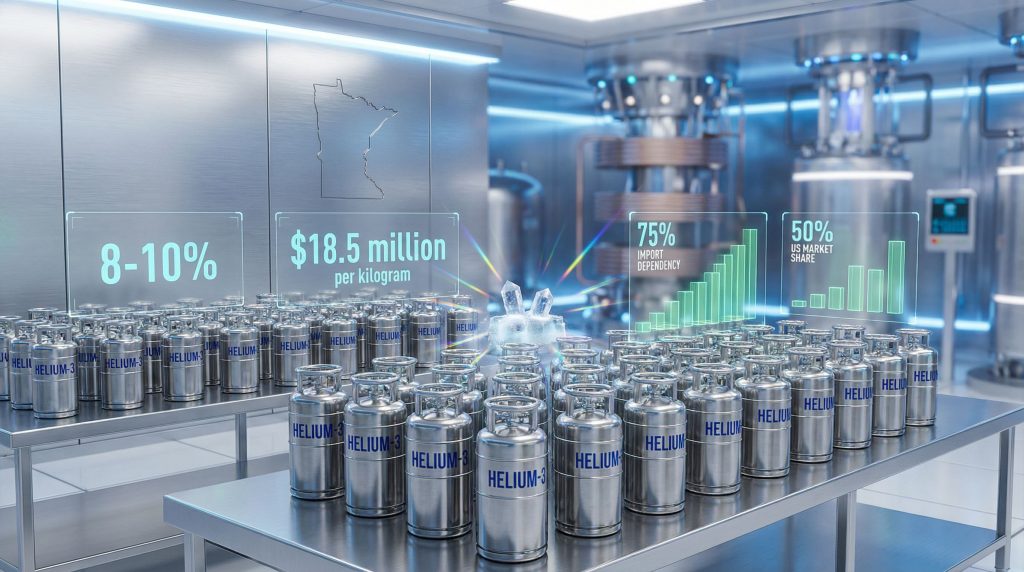
Geological modelling suggests helium-bearing formations extend across substantial areas of Minnesota's subsurface. Initial concentration measurements of 8-10% helium significantly exceed the 2% threshold typically considered economic for helium production. This concentration differential provides substantial economic margins that can absorb processing costs and transportation expenses.
Gas Stream Composition:
- 85% marketable content: Helium, helium-3, and carbon dioxide
- High-value components: Multiple revenue streams from single wells
- Processing efficiency: Established separation technology for conventional helium
- Co-product credits: Carbon dioxide sales offset operating costs
The discovery's unique characteristics include gaseous helium-3 rather than solid-phase extraction required from lunar materials. Consequently, this physical state simplifies processing requirements and enables immediate application of existing gas separation technologies. Scientists note the significance of this find as a potential game-changer for quantum computing applications.
Investment Dynamics and Market Timing Convergence
Strategic Material Pricing Frameworks
The intersection of extreme scarcity and critical applications creates unique pricing dynamics for helium-3 that differ fundamentally from conventional commodities. At $18.5 million per kilogram, helium-3 represents one of the most valuable materials on Earth, with pricing based on strategic necessity rather than traditional supply-demand economics.
Market Pricing Factors:
- National security premium: Government willingness to secure domestic supply
- Technology enablement: Quantum computing development requirements
- Supply scarcity: Limited global production capacity
- Transportation advantages: Domestic production eliminates shipping risks
The helium-3 discovery in Minnesota occurs during a critical window when quantum computing transitions toward commercial viability. Federal government interest in quantum technologies for defence and security applications suggests potential long-term offtake agreements that could guarantee market demand regardless of commercial sector development. This aligns with broader critical minerals strategy initiatives that prioritise domestic supply chains.
Risk Assessment and Mitigation Strategies
Technical Development Risks:
- Separation technology scaling challenges require R&D investment
- Commercial-scale processing remains unproven at current production levels
- Quality control standards for quantum applications demand ultra-high purity
Market Development Risks:
- Quantum computing adoption rates may develop slower than projected
- Alternative cooling technologies could reduce helium-3 demand
- Federal policy changes might affect strategic material priorities
Geological and Operational Risks:
- Reservoir performance uncertainty until flow testing completion
- Processing infrastructure capital requirements not yet fully defined
- Environmental permitting timelines could extend development schedules
"The convergence of geological opportunity, technological necessity, and strategic timing creates a unique investment scenario where material scarcity intersects with national security priorities."
Competitive Positioning in Critical Materials
The helium-3 discovery in Minnesota establishes potential American leadership in ultra-rare isotope production during a period when technological competition increasingly focuses on quantum computing capabilities. This first-mover advantage in terrestrial helium-3 extraction could influence global quantum computing development patterns and establish processing technology standards.
Strategic Positioning Elements:
- Domestic supply security: Eliminates import dependency for critical applications
- Technology development: Drives innovation in separation and processing methods
- Economic clustering: Attracts quantum computing research and development investment
- Export potential: Supplies international quantum computing development programmes
The next major ASX story will hit our subscribers first
America's Critical Minerals Strategy Transformation
The Minnesota helium discovery demonstrates how innovative geological exploration can identify domestic alternatives to strategically vulnerable import dependencies. This success model applies beyond helium to broader critical materials challenges, where technological advancement creates demand for previously overlooked domestic resources. In addition, the broader minerals energy transition underscores the importance of securing reliable domestic supplies.
Strategic Implications Framework:
- Technology Independence: Reduced reliance on adversarial nations for quantum computing materials
- Innovation Catalyst: Domestic supply security enables accelerated quantum technology development
- Regional Revitalisation: High-value extraction transforms traditional mining regions
- Supply Chain Resilience: Domestic production eliminates geopolitical supply disruptions
The timing convergence of geological discovery, technological advancement, and strategic necessity positions the helium-3 discovery in Minnesota as potentially transformative for American advanced manufacturing capabilities. Unlike traditional mining projects measured by tonnage and conventional pricing, this discovery involves materials so strategically important that availability matters more than cost. This development exemplifies the broader mining industry evolution toward high-value, strategically critical materials.
Current global helium supply challenges, combined with quantum computing development acceleration, create market conditions where domestic production provides strategic advantages that extend beyond immediate economic returns. The intersection of national security concerns, technological advancement requirements, and geological opportunity suggests this discovery represents more than a mining project – it potentially anchors America's quantum computing material supply security.
Federal laboratory verification of helium-3 concentrations comparable to lunar surface samples establishes technical credibility for the most demanding applications. The gaseous state of Minnesota's helium-3 provides immediate processing advantages over proposed lunar extraction methods, enabling near-term commercial development rather than decades-long technology development programmes. Furthermore, the development of specialised raw materials facility infrastructure will be crucial for processing these ultra-rare isotopes.
As America's quantum computing capabilities become increasingly critical for national defence, economic competitiveness, and technological leadership, securing reliable access to enabling materials like helium-3 transcends traditional mining economics. The helium-3 discovery in Minnesota represents a convergence of geological fortune and strategic necessity that could influence America's position in the global technology competition for decades to come.
Interested in the Next Strategic Mineral Discovery?
Discovery Alert's proprietary Discovery IQ model delivers instant notifications on significant ASX mineral discoveries that could transform entire sectors, just as critical materials like helium-3 are reshaping quantum computing. Understanding why major mineral discoveries can generate substantial returns enables investors to position themselves ahead of transformative technological shifts. Begin your 14-day free trial today and gain the market-leading advantage needed to capitalise on tomorrow's strategic materials discoveries.