
August 14, 2026
Strategic Vulnerabilities in Global Energy Architecture
The interconnected nature of global energy systems creates cascading vulnerabilities that extend far beyond immediate supply disruptions. When critical maritime passages face closure threats, the ripple effects expose structural weaknesses in international energy security frameworks that have developed over decades of relative stability. These vulnerabilities emerge not merely from geographic constraints, but from the complex interplay of concentrated production, limited transport alternatives, and interdependent market mechanisms that amplify localised disruptions into global crises. Furthermore, the recent oil price rally demonstrates how geopolitical tensions can rapidly escalate energy market volatility.
When big ASX news breaks, our subscribers know first
Understanding the Strategic Chokepoint's Critical Role
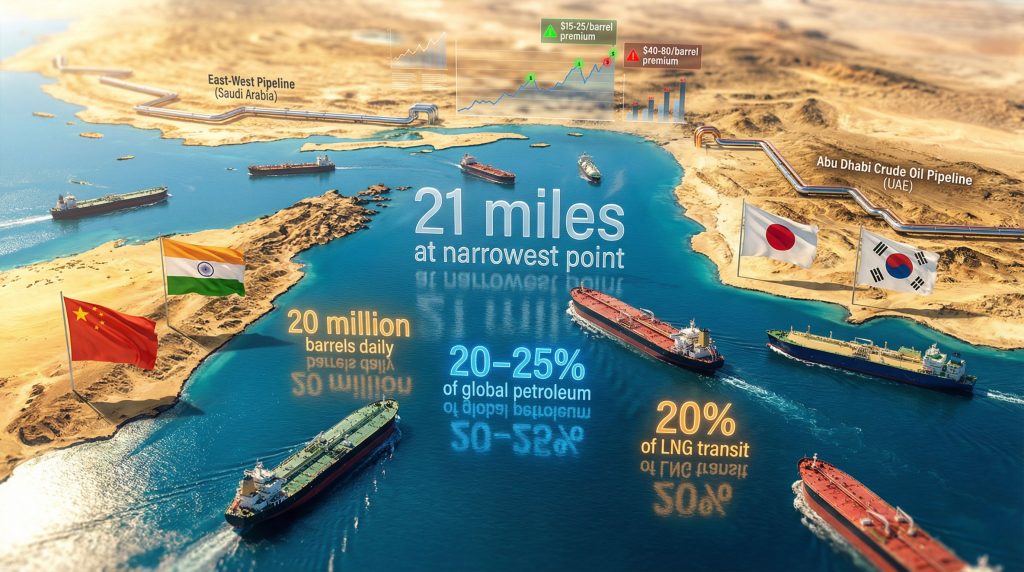
The Strait of Hormuz functions as the world's most critical energy transit bottleneck, handling approximately 20 million barrels of crude oil daily alongside nearly 20% of global liquefied natural gas shipments. This narrow waterway, measuring just 21 miles at its narrowest point, serves as the primary export route for Gulf producers including Iran, Iraq, Kuwait, Saudi Arabia, Qatar, Bahrain, and the United Arab Emirates.
Current market disruptions demonstrate the immediate vulnerability of this system. With the strait effectively closed for seven days due to ongoing regional conflict, approximately 140 million barrels of oil equivalent to about 1.4 days of global demand has been unable to reach international markets. This disruption drove West Texas Intermediate crude to $90.90 per barrel, representing a 12.21% increase or $9.89 in a single trading session, while Brent crude reached $92.69 per barrel, up 8.52% or $7.28.
Geographic Constraints and Maritime Complexity
The strait's configuration creates inherent operational challenges even during peaceful periods. Designated traffic separation schemes divide the narrow passage into one-way shipping lanes that accommodate vessels with limited beam width. During high-traffic periods, these constraints create queuing effects that slow transits and increase collision risks, while the concentration of multiple vessel types navigating simultaneously generates complex coordination requirements.
Key Transit Metrics:
• Daily oil transit: 20 million barrels representing 20-25% of global petroleum liquids
• LNG shipments: 20% of global flows, primarily from Qatar
• Shipping lane width: 21 miles at narrowest point with further restrictions for navigation channels
• Alternative export capacity: Limited to 3-4 million barrels per day via existing pipeline infrastructure
The strategic significance extends beyond volume metrics to encompass the technical specifications of vessels transiting the passage. Ultra Large Crude Carriers (ULCCs) and Very Large Crude Carriers (VLCCs) operating through the strait carry between 2-3 million barrels per vessel, meaning that disruption affects not just individual shipments but entire cargo loads that cannot be easily redistributed to alternative transport modes.
What Makes the Strait of Hormuz So Vulnerable to Disruption?
Multiple converging factors create systemic vulnerability within this critical passage, extending beyond simple geographic constraints to encompass technical, economic, and strategic dimensions that amplify disruption impacts.
Concentrated Regional Production Dependencies
The Persian Gulf region concentrates massive hydrocarbon production within a geographically constrained area, creating single-point-of-failure vulnerabilities for global energy supply chains. Saudi Arabia alone exports 8-10 million barrels daily through the strait, while combined exports from Iraq, Iran, Kuwait, UAE, Qatar, and Bahrain add substantial additional volume with minimal alternative routing options. In addition, Saudi exploration licenses continue to expand regional production capacity, further concentrating global energy flows through this chokepoint.
This concentration reflects decades of investment in production infrastructure optimised for Persian Gulf export terminals, refineries, and loading facilities. The technical specifications of these facilities, including pipeline networks, storage capacity, and port infrastructure, are designed specifically for Strait of Hormuz transit routes rather than alternative export pathways.
Insurance and Operational Risk Escalation
War risk insurance premiums serve as immediate market indicators of Strait of Hormuz closure threats, with premium increases of 500-1000% during elevated conflict periods. These cost escalations directly impact delivered crude prices to distant markets, creating pricing volatility that extends beyond simple supply-demand calculations to encompass risk premium adjustments across global energy markets.
Current disruption scenarios demonstrate how insurance market responses create secondary amplification effects. As war risk premiums spike, shipping companies implement route diversions that increase transit times and operational costs, while refiners adjust procurement strategies to account for supply uncertainty and elevated transport costs.
Technical Blockade Mechanisms and Clearing Requirements
Physical closure of the strait could theoretically occur through multiple mechanisms, each presenting different clearing timelines and technical requirements:
Potential Disruption Methods:
• Mine placement: Requires extensive clearing operations before shipping resumes
• Sunken vessel placement: Creates navigation hazards requiring removal or channel rerouting
• Active naval interdiction: Prevents vessel transit through military enforcement
• Coastal artillery threats: Creates insurance and operational barriers even without direct attacks
Each mechanism presents distinct challenges for restoration of normal shipping operations, with mine-clearing representing the most time-intensive restoration process potentially requiring weeks or months of specialised naval operations.
Which Countries Face the Greatest Energy Security Risks?
Strait of Hormuz closure impacts create asymmetric vulnerabilities across global markets, with certain economies facing disproportionate exposure based on import dependency patterns, alternative sourcing capacity, and strategic reserve holdings.
Asian Economic Vulnerabilities
Asian economies demonstrate the highest exposure to Strait of Hormuz closure disruptions due to geographical distance and concentrated import dependencies:
Critical Dependency Metrics:
| Country | Hormuz Import Dependency | Alternative Sources | Strategic Reserves |
|---|---|---|---|
| Japan | 80% of energy imports | Limited Pacific Basin supply | 150+ million barrels |
| South Korea | 70% of oil supplies | Minimal alternative capacity | Regional coordination required |
| India | 60% of crude imports | Domestic production insufficient | Limited strategic capacity |
| China | 40% of oil requirements | Domestic/Russian alternatives | 500+ million barrels estimated |
These dependency levels reflect structural characteristics of Asian energy markets, including limited domestic hydrocarbon production, high energy consumption per capita, and integrated refinery operations designed for Gulf crude specifications. Japan's 80% dependency particularly highlights vulnerability given limited domestic energy resources and concentrated import requirements for industrial and power generation sectors.
European Market Exposure
European markets face more diversified but still significant exposure through LNG import dependencies and refined product supply chains:
• Germany: 15% of energy imports transit Hormuz, primarily through LNG and refined products
• Italy: 25% of natural gas supply via Qatari LNG shipments through the strait
• Netherlands: Functions as major European LNG distribution hub for Qatari exports
European vulnerability differs from Asian exposure due to diversified supply sources including North Sea production, Russian pipeline gas (where accessible), Norwegian supplies, and North African imports. However, LNG import infrastructure specifically designed for Qatari supplies creates targeted vulnerabilities within broader supply portfolios. Moreover, the broader energy transition challenges facing European nations add complexity to managing these dependencies.
Producer State Reverse Vulnerabilities
Gulf producing states face inverse vulnerability where export disruption directly impacts government revenues and economic stability. For oil-dependent economies like Saudi Arabia, UAE, Kuwait, and Qatar, Strait of Hormuz closure translates immediately to lost export revenues that fund government operations and economic development programs.
Qatar's energy leadership explicitly acknowledges this vulnerability, with expectations that all Gulf energy producers would shut down exports within weeks if current regional conflicts escalate further. This scenario could drive oil prices to $150 per barrel according to official government assessments, representing unprecedented price levels that would trigger global economic adjustments.
How Do Market Mechanisms Respond to Closure Scenarios?
Energy markets exhibit predictable but amplifying response patterns during Strait of Hormuz closure events, with immediate price volatility followed by structural adjustment mechanisms that reshape global supply and demand dynamics.
Immediate Market Response Patterns (0-7 days)
Current disruption data provides quantified evidence of immediate market mechanisms:
Price Impact Analysis:
• WTI crude: Rose 35.63% over one week, the largest weekly gain since the COVID-19 pandemic in Spring 2020
• Brent crude: Climbed 27% over the same period, reaching $92.69 per barrel
• Price divergence: WTI increased more than Brent due to refinery margin dynamics and European arbitrage opportunities
• LNG spot prices: Increased 20-40% in Asian markets within the first week of disruption
Market analysts emphasise that refiners and trading houses worldwide actively search for alternative crude supplies, with the United States representing the primary alternative source as global traders scramble to address Middle East supply gaps. This substitution process creates secondary market effects as alternative crude grades command premium pricing due to increased demand concentration.
Extended Disruption Adjustments (1-4 weeks)
Prolonged closure scenarios activate multiple market stabilisation mechanisms designed to address supply shortfalls:
Strategic Response Activation:
• Strategic petroleum reserve releases: Coordinated deployments from major consuming nations
• Alternative supply mobilisation: Increased production from non-affected regions
• Production adjustments: Enhanced output from North American unconventional sources
• Demand destruction: Price-sensitive sector adjustments in developing economies
Industry analysis indicates that every day the strait remains closed creates cumulative price pressure, with market expectations initially anticipating policy reversals but gradually adjusting to sustained disruption scenarios as political resolution timelines extend beyond immediate diplomatic interventions. Consequently, US-China trade tensions could further complicate global supply chain adjustments during such scenarios.
What Alternative Supply Routes Can Mitigate Disruptions?
Alternative transportation infrastructure provides limited but crucial backup capacity during Strait of Hormuz closure, though existing systems cannot fully replace normal transit volumes without significant supply adjustments and price premiums.
Existing Pipeline Bypass Systems
Current alternative infrastructure offers partial mitigation capacity but falls substantially short of normal strait transit volumes:
Pipeline Capacity Analysis:
| Pipeline System | Daily Capacity | Current Utilisation | Spare Capacity |
|---|---|---|---|
| Saudi East-West Pipeline | 5 million b/d | Variable seasonal | 2-3 million b/d potential |
| UAE-Fujairah Pipeline | 1.5 million b/d | Regular operations | Limited expansion |
| Iraq-Turkey Pipeline | Minimal operational | Political constraints | Uncertain availability |
| Iran-Central Asia Routes | Negligible current | Sanctions limitations | Future potential only |
The Saudi East-West Pipeline represents the most significant alternative capacity, connecting Persian Gulf production to Red Sea export terminals and bypassing the strait entirely. However, even maximum utilisation of existing pipeline infrastructure can handle only 6-7 million barrels daily compared to normal strait transit of 20 million barrels daily.
Emergency Alternative Sources
Non-Gulf production regions provide substitution capacity but require significant logistical adjustments and pricing premiums:
• North American production ramp-up: Shale oil production can increase within weeks but requires pricing incentives
• West African supply chains: Enhanced exports from Nigeria, Angola, and emerging producers
• North Sea production acceleration: European and UK offshore production increases
• Strategic reserve deployments: Coordinated releases from International Energy Agency member countries
These alternative sources cannot immediately replace Gulf crude specifications that global refineries are designed to process, creating temporary technical constraints alongside logistical challenges in redirecting global shipping patterns and supply contracts.
The next major ASX story will hit our subscribers first
How Do Different Closure Scenarios Impact Global Markets?
Strait of Hormuz closure scenarios create varying degrees of market disruption depending on closure mechanism, duration expectations, and international response coordination, with each scenario triggering distinct market adjustment patterns.
Partial Disruption Scenarios (30-50% capacity reduction)
Limited closure scenarios typically result from insurance-driven shipping delays, selective vessel harassment, or navigation hazard creation rather than complete physical blockade:
Market Response Characteristics:
• Price premiums: $15-25 per barrel above baseline pricing
• Shipping adjustments: Increased transit times and convoy operations
• Alternative routing: Enhanced pipeline utilisation without emergency protocols
• Strategic reserve activity: Limited deployments to stabilise spot markets
Partial disruptions often create manageable market adjustments as existing alternative infrastructure can handle reduced volumes while elevated pricing incentivises production increases from non-affected regions.
Complete Closure Scenarios (90%+ disruption)
Full strait closure creates systemic market disruption requiring comprehensive international response coordination:
System-Wide Impact Analysis:
• Price escalation: $40-80 per barrel premiums triggering recession concerns
• Alternative route saturation: Pipeline and shipping alternatives operating at maximum capacity
• Strategic reserve activation: Coordinated releases from major consuming nations
• Production adjustments: Emergency increases from spare capacity globally
Complete closure scenarios stress global energy systems to their operational limits, revealing the extent to which normal energy security depends on uninterrupted Strait of Hormuz operations. Furthermore, such disruptions highlight the importance of critical energy security planning for essential supply chains.
Extended Closure Scenarios (30+ days)
Prolonged disruptions create structural market adjustments that reshape global energy trade patterns:
Long-term Adjustment Mechanisms:
• Production shut-ins: Gulf state producers halt operations due to export constraints
• Supply chain reconfiguration: Permanent adjustments to global energy trade routes
• Demand destruction: Economic slowdown in import-dependent developing markets
• Recession triggers: Macroeconomic impacts in energy-import dependent economies
Extended closure scenarios potentially drive oil prices to $150 per barrel according to regional government assessments, creating economic conditions that fundamentally alter global energy consumption patterns and accelerate alternative energy adoption timelines.
What Strategic Adaptations Could Emerge Long-Term?
Sustained or repeated Strait of Hormuz closure risks would likely accelerate structural changes in global energy infrastructure, supply chain diversification, and energy security strategies across consuming and producing regions.
Enhanced Pipeline Network Development
Long-term strategic adaptation would prioritise expanded pipeline infrastructure to reduce maritime chokepoint dependencies:
Infrastructure Development Priorities:
• Expanded trans-Arabian systems: Enhanced capacity from Persian Gulf to Red Sea and Mediterranean terminals
• Central Asian export routes: New pipeline networks connecting regional production to alternative export terminals
• Cross-regional integration: Enhanced pipeline connectivity between producing regions and consuming markets
• LNG export diversification: Alternative liquefaction and export terminal development outside Persian Gulf
These infrastructure investments require substantial capital commitments and multi-year development timelines but would provide structural resilience against future chokepoint vulnerabilities.
Supply Source Diversification Acceleration
Repeated disruption risks would incentivise accelerated development of alternative production sources and enhanced strategic reserve systems:
• Unconventional resource development: Enhanced shale oil and tight oil production in North America and other regions
• Strategic reserve expansion: Increased storage capacity in major consuming nations
• Regional refining enhancement: Reduced dependency on specific crude grades through enhanced refinery flexibility
• Renewable energy acceleration: Faster adoption of alternative energy sources to reduce hydrocarbon dependency
How Do Insurance and Shipping Markets Adapt?
Insurance and shipping sectors implement rapid adjustments during Strait of Hormuz closure events, with risk management protocols and operational procedures evolving to address heightened threat environments.
War Risk Insurance Evolution
Insurance markets provide immediate pricing signals that reflect real-time risk assessment and influence shipping industry operational decisions:
Insurance Premium Adjustments:
• Premium escalation: 500-1000% increases for strait transit during conflict periods
• Alternative route coverage: Enhanced insurance products for longer alternative shipping routes
• Vessel tracking requirements: Mandatory monitoring and communication systems for high-risk transits
• Government backstops: Emergency insurance schemes backed by consuming nation governments
Shipping Industry Operational Responses
Maritime transport companies implement immediate operational adjustments to manage elevated risk environments:
• Fleet repositioning: Vessel redeployment to alternative routes and supply regions
• Enhanced security protocols: Increased vessel security measures and crew training
• Convoy operations: Coordinated group transits to enhance collective security
• Technology upgrades: Advanced communication and tracking systems for threat detection
These adaptations create additional operational costs that are ultimately reflected in delivered energy prices, contributing to market volatility beyond simple supply-demand calculations.
What Role Do Strategic Petroleum Reserves Play?
Strategic petroleum reserves serve as critical buffer systems during Strait of Hormuz closure, providing market stabilisation capacity and emergency supply access for major consuming nations.
Global Reserve Coordination Systems
International coordination mechanisms enable synchronised reserve releases to maximise market stabilisation impact:
Major Reserve Holdings:
| Country/Region | Reserve Capacity | Release Capability | Coordination Framework |
|---|---|---|---|
| United States | 650+ million barrels | 4+ million b/d maximum | IEA coordination lead |
| China | 500+ million barrels estimated | Variable undisclosed | Bilateral agreements |
| Japan | 150+ million barrels | Regional coordination | IEA member protocols |
| European Union | 90+ days import coverage | Coordinated releases | Regional frameworks |
Release Coordination Mechanisms
Strategic reserve deployments require careful coordination to avoid market oversupply while providing adequate supply security:
• International Energy Agency protocols: Coordinated release triggers and volume calculations
• Bilateral release agreements: Direct cooperation between major consuming nations
• Market stabilisation timing: Strategic timing to maximise price impact during peak volatility
• Regional coordination frameworks: Area-specific cooperation arrangements for enhanced effectiveness
Strategic reserve effectiveness depends not only on absolute volume capacity but on coordination mechanisms that prevent market destabilisation through excessive supply injections during recovery periods.
How Could Technology Reshape Hormuz Vulnerabilities?
Technological solutions offer potential pathways to enhance Strait of Hormuz security and reduce vulnerability impacts through enhanced monitoring, alternative energy infrastructure, and supply chain optimisation systems.
Enhanced Maritime Security Technology
Advanced monitoring and security systems could provide early warning capabilities and enhanced threat response:
Technology Implementation Areas:
• Satellite-based traffic management: Real-time vessel tracking and navigation optimisation
• AI-powered risk assessment: Predictive analytics for threat detection and response planning
• Automated response protocols: Rapid deployment of security measures during elevated threat periods
• Enhanced communication systems: Secure coordination between vessels, authorities, and emergency response teams
Alternative Energy Infrastructure Acceleration
Technology-driven energy alternatives could reduce long-term dependency on Strait of Hormuz transit:
• Accelerated renewable deployment: Enhanced solar, wind, and energy storage systems
• Hydrogen production and transport: Alternative energy carriers for international trade
• Enhanced battery storage: Grid-scale storage systems for renewable energy integration
• Regional energy independence: Localised energy production reducing import dependencies
These technological pathways require substantial investment and development timelines but could fundamentally alter global energy security dynamics over decade-long timeframes.
What Investment Implications Emerge from Closure Risks?
Strait of Hormuz closure vulnerability creates distinct investment themes across energy infrastructure, technology solutions, and regional development opportunities that could benefit from enhanced energy security focus.
Energy Infrastructure Investment Opportunities
Infrastructure development addressing chokepoint vulnerabilities represents significant capital deployment opportunities:
Strategic Investment Categories:
• Pipeline development projects: Trans-regional pipeline systems bypassing maritime chokepoints
• Alternative export terminals: LNG and crude export facilities outside Persian Gulf region
• Enhanced storage facilities: Strategic reserve capacity expansion in consuming regions
• Regional refining capacity: Enhanced processing capability in consuming regions to reduce crude import dependency
Technology and Risk Management Solutions
Technology companies providing maritime security, supply chain optimisation, and alternative energy systems could benefit from enhanced security focus:
• Maritime security technology: Vessel tracking, threat detection, and automated response systems
• Alternative energy systems: Renewable energy, battery storage, and grid optimisation technologies
• Supply chain platforms: Optimisation software for alternative routing and supply source management
• Risk management software: Advanced analytics for energy security and market volatility management
Regional Development Opportunities
Geographic regions offering alternatives to Strait of Hormuz closure dependencies could experience enhanced investment flows:
• Non-Gulf energy projects: Production and export infrastructure development outside Persian Gulf region
• Diversified supply chain investments: Regional energy infrastructure reducing single-point dependencies
• Energy efficiency technologies: Solutions reducing overall energy consumption and import requirements
• Strategic reserve projects: Storage and distribution infrastructure for emergency supply systems
Investment considerations must account for multi-year development timelines and substantial capital requirements while balancing immediate security needs against long-term structural changes in global energy markets.
How Do Geopolitical Dynamics Shape Future Scenarios?
The intersection of regional power dynamics, international energy governance, and technological capabilities will determine long-term Strait of Hormuz security and global energy system resilience against chokepoint vulnerabilities.
Regional Security Architecture Evolution
Future Strait of Hormuz security depends on evolving regional power balance and international cooperation mechanisms:
Strategic Security Considerations:
• Naval presence and deterrence: International maritime security cooperation and patrol coordination
• Diplomatic engagement mechanisms: Multilateral frameworks for conflict prevention and resolution
• Economic interdependence factors: Trade relationships that incentivise stability and cooperation
• International law enforcement: Maritime security protocols and international legal frameworks
Global Energy Governance Framework Development
International cooperation mechanisms for energy security could evolve to address systemic chokepoint vulnerabilities:
• Multilateral security arrangements: Enhanced international coordination for maritime energy security
• Emergency response protocols: Standardised procedures for supply disruption management
• Market stabilisation mechanisms: Coordinated reserve releases and production adjustments
• Technology sharing agreements: International cooperation on security and alternative energy technologies
The Strait of Hormuz closure scenario reveals fundamental vulnerabilities in global energy architecture while highlighting both immediate response capabilities and long-term adaptation requirements. Understanding these dynamics enables enhanced preparation for potential disruptions and emphasises the critical importance of diversified energy infrastructure, robust international cooperation mechanisms, and strategic investments in alternative supply systems that reduce dependency on single critical chokepoints. Additionally, reports indicate that sustained closure scenarios could fundamentally reshape global energy trade patterns over the coming decade.
Important Note: This analysis involves market forecasts and geopolitical scenarios that contain inherent uncertainties. Energy market conditions, geopolitical developments, and infrastructure investment outcomes may differ materially from projections discussed. Readers should conduct independent research and consider professional advice before making investment decisions based on energy security scenarios.
Looking to Capitalise on Energy Market Disruptions?
Discovery Alert's proprietary Discovery IQ model delivers real-time alerts on significant ASX mineral discoveries, including critical energy transition and strategic minerals that become increasingly valuable during global supply chain disruptions. Subscribers gain immediate insights into actionable opportunities across energy-related commodities, positioning themselves to benefit from market volatility and resource security themes. Begin your 14-day free trial today to access Discovery Alert's market-leading intelligence and secure your competitive advantage in energy and resources investing.