Strickland Metals Ltd
Strickland Metals Advances on Multiple Fronts at Its 8.6Moz Rogozna Project as Pre-Feasibility Study Gets Underway
ASX: STK | 22 May 2026
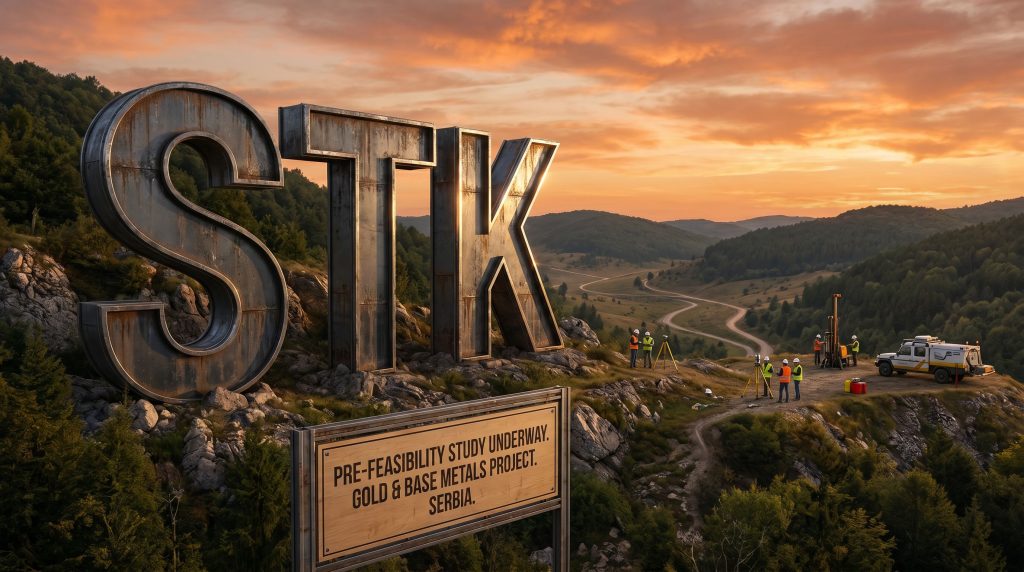
The Strickland Metals Rogozna project pre-feasibility study and Gradina resource update represent a defining moment for the company's evolution. Strickland Metals (ASX: STK) has released a workstream pipeline update for its 100%-owned Rogozna Gold and Base Metals Project in Serbia, signalling a clear step-up in project maturity. With an updated Mineral Resource Estimate (MRE) imminent, Pre-Feasibility Study (PFS) workstreams now formally commenced, and a strong cash position of $81 million, the company is moving from pure exploration into the early stages of project development whilst continuing to pursue resource growth at one of the more compelling gold and base metals systems in Europe.
When big ASX news breaks, our subscribers know first
A Project That Has Grown Quickly and Has Further to Go
To understand why this update matters, it helps to appreciate the scale and pace of growth at Rogozna. Since Strickland acquired the project in April 2024, the total resource base has grown substantially, now sitting at 8.60 Moz AuEq across four deposits. That growth has come through a disciplined drilling campaign that has consistently returned resource upgrades at each turn.
The current Rogozna resource base, broken down by deposit, is as follows:
| Deposit | Tonnes (Mt) | AuEq Grade (g/t) | AuEq (Moz) | Classification |
|---|---|---|---|---|
| Shanac (April 2026) | 160 | 1.04 | 5.35 | Indicated + Inferred |
| Gradina (December 2025) | 12 | 3.0 | 1.20 | Inferred |
| Medenovac (February 2025) | 21 | 1.9 | 1.28 | Inferred |
| Copper Canyon (October 2021) | 28 | 0.9 | 0.81 | Inferred |
| Project Total | 221 | 1.2 | 8.60 |
Gradina stands out immediately. At 3.0 g/t Au, it carries the highest gold grade of any deposit across the project, and it is the subject of the most immediately anticipated news from Strickland.
The Gradina MRE Update: Why It's the Near-Term Focus
The Gradina deposit has been the subject of sustained drilling activity throughout the 2025 field season. The maiden MRE, released in December 2025, established 1.2 Moz Au at 3.0 g/t — a high-grade result that drew considerable attention given the grade is more than double the overall project average.
Subsequent drilling, with assay results released on 2 February and 18 February 2026, confirmed mineralisation extending outside the wireframes used to estimate the maiden resource. Critically, several of these holes targeted the "Gap Zone" — the corridor of ground sitting between Gradina North and Gradina South — a structural gap in the maiden estimate that represented an obvious opportunity for resource expansion.
"The team remains focused on advancing several key workstreams aimed at delivering further meaningful resource growth and advancing the Rogozna Pre-Feasibility Study."
— Paul L'Herpiniere, Managing Director, Strickland Metals
The updated MRE, expected in the coming weeks, will incorporate all additional drilling data into revised geological and resource models. Given the nature of the new holes — confirming mineralisation outside current wireframes and bridging the gap between two known zones — the update is widely anticipated to show resource growth, though the quantum remains to be seen.
Importantly, the Strickland Metals Rogozna project pre-feasibility study and Gradina resource update are directly linked, as the revised Gradina MRE will feed straight into the PFS workstreams now underway.
What Is a Mineral Resource Estimate (MRE)? A Plain-English Explainer
For investors less familiar with mining terminology, the MRE is one of the most important numbers to understand when evaluating a resource company.
An MRE is a formal, independent estimate of the amount of mineralised material within a deposit, expressed in tonnes and grade, and reported under a recognised reporting code — in this case, JORC 2012. It is the foundation upon which all subsequent economic studies are built.
Key Classifications Within an MRE
- Indicated Resource: Sufficient geological information exists to estimate tonnes and grade with reasonable confidence. This is the category required to underpin economic studies including Pre-Feasibility and Feasibility Studies.
- Inferred Resource: Geological evidence supports the existence of mineralisation, but data density is insufficient for the same level of confidence as Indicated. Furthermore, further drilling typically converts Inferred to Indicated.
Why it matters to investors: A growing MRE increases the potential economic scale of a project. Conversion of Inferred ounces to Indicated status unlocks the ability to include those ounces in formal economic studies, which is a prerequisite for mine development decisions.
Strickland's current Indicated resource sits at 1.25 Moz AuEq (entirely within Shanac), with the significant majority of the 8.60 Moz project resource still classified as Inferred — meaning there is a substantial conversion opportunity ahead.
Pre-Feasibility Study: The Project Enters a New Phase
The commencement of PFS workstreams is arguably the most structurally significant element of this announcement. It marks a formal transition: Rogozna is no longer being evaluated solely as an exploration asset but is now being assessed for its development pathway.
The key PFS workstreams currently underway include:
- Baseline environmental and social studies across the project area — a prerequisite for any permitting process and a component that typically requires multi-season data collection to complete.
- Engagement of specialist consultants to progress conceptual designs covering:
- Underground mining
- Geotechnical inputs
- Process plant design
- Infrastructure
- Water management
- Tailings management
- Preliminary mine design and process flowsheet development.
- Site layout planning.
The scope of these activities reflects a genuine step-up in study intensity. The involvement of consultants across multiple technical disciplines simultaneously — rather than sequentially — suggests Strickland is moving efficiently and in parallel across study workstreams. Consequently, this approach is consistent with the company's well-funded position.
Geophysics and Exploration: The Porphyry Upside Story
Whilst resource definition and study work dominate the near-term agenda, exploration continues in parallel — and this is worth paying close attention to.
The first phase of a magnetotelluric (MT) geophysical survey has been completed, with data processing now underway. MT surveying is a technique used to image subsurface geology at depth by measuring naturally occurring electromagnetic fields. In the context of Rogozna, the survey is specifically aimed at refining porphyry-related exploration targeting.
What Is a Porphyry System?
Porphyry deposits are large, bulk-tonnage copper-gold systems that form from magmatic-hydrothermal processes. They are typically characterised by lower grades but enormous scale, and they underpin some of the world's largest and most economically significant mines.
At Rogozna, the existing deposits are interpreted to be associated with porphyry-related mineralisation, and the MT survey is designed to identify additional blind porphyry systems — targets that may not have surface expression but could represent significant additional mineralisation at depth.
The implication is straightforward: Rogozna's 8.60 Moz AuEq may be the beginning of the story, not the end. If the MT survey identifies additional targets and subsequent drilling confirms porphyry mineralisation, the resource base could grow materially beyond its current scale.
Financial Position: Well-Funded to Execute
Strickland closed the March Quarter with cash and liquid investments of $81 million. This is a significant funding buffer that underpins the company's ability to:
- Progress PFS workstreams
- Complete the MT survey programme across multiple phases
- Continue drilling programmes when the next field season commences
- Manage environmental and baseline study activities without capital pressure
For investors, this is an important de-risking factor. Many junior resource companies face the challenge of balancing technical ambition against financial constraints. At $81 million, Strickland has the runway to execute meaningfully on its workstream pipeline without near-term equity dilution risk.
Near-Term Catalysts: What to Watch
Strickland has flagged a series of deliverables expected over the coming weeks and months. However, investors have a clear set of milestones to monitor in the near term:
| Catalyst | Expected Timing | Significance |
|---|---|---|
| Updated Gradina MRE | Coming weeks | Potential resource growth; feeds directly into PFS |
| MT survey data processing results | Coming months | Porphyry target refinement; new exploration pipeline |
| PFS workstream progress updates | Ongoing | De-risking development pathway |
| Environmental baseline study outputs | Ongoing | Permitting prerequisite; social licence building |
| Additional field-based exploration results | Coming months | Potential new targets and resource extensions |
The Gradina MRE update is the most immediate catalyst and will set the tone for market sentiment around the resource growth trajectory in the near term.
The Investment Thesis in Summary
Strickland Metals presents a multi-layered investment proposition at a stage when several value-creating activities are converging simultaneously.
Resource Scale: At 8.60 Moz AuEq, Rogozna is a project of genuine scale by any measure. The deposit suite includes a high-grade gold core (Gradina at 3.0 g/t), a large polymetallic system (Shanac at 5.35 Moz AuEq with an Indicated component), and an established exploration pipeline with porphyry upside.
Development Momentum: The commencement of PFS workstreams signals growing confidence in project economics and a clear intent to move through the study process in a structured manner. In addition, the engagement of consultants across underground mining, processing, and infrastructure reflects the genuine breadth of technical work now underway.
Resource Growth Upside: The pending Gradina MRE update, the ongoing conversion of Inferred to Indicated resources, and the early-stage MT survey all point to meaningful resource upside that has not yet been fully captured in the current estimate.
Financial Strength: With $81 million in cash and liquid investments, Strickland is in a strong position to fund its workstream pipeline without near-term capital market pressure.
Key Takeaway: The Strickland Metals Rogozna project pre-feasibility study and Gradina resource update mark a pivotal moment, with an 8.60 Moz AuEq resource base, a high-grade Gradina deposit poised for an imminent resource upgrade, and PFS workstreams now formally underway. Backed by $81 million in cash, the company is entering a period of high newsflow across multiple workstreams. With exploration upside from potential blind porphyry systems still to be tested, Rogozna has the scale and the funding to remain a compelling project to watch closely over the remainder of 2026.
The next major ASX story will hit our subscribers first
Glossary of Key Terms
- AuEq (Gold Equivalent): A method of expressing the combined value of multiple metals (gold, copper, silver, lead, zinc) as a single gold-equivalent figure, based on prevailing metal prices and metallurgical recovery assumptions.
- MRE (Mineral Resource Estimate): A formal estimate of mineralised material, classified under JORC 2012 as Inferred, Indicated, or Measured, based on geological data and modelling.
- PFS (Pre-Feasibility Study): A study conducted to assess the technical and economic viability of a mining project at a level of confidence sufficient to support a preliminary investment decision.
- JORC 2012: The Australasian Code for Reporting of Exploration Results, Mineral Resources and Ore Reserves, the standard to which Australian-listed mining companies must report resource estimates.
- Porphyry System: A large, typically low-to-moderate grade copper-gold deposit associated with igneous intrusions, often characterised by bulk-tonnage potential.
- Magnetotelluric (MT) Survey: A geophysical technique that uses naturally occurring electromagnetic fields to image subsurface geological structures, used here to identify potential blind porphyry targets at depth.
- Gap Zone: The area of ground between Gradina North and Gradina South that was not fully delineated in the maiden MRE and is a primary target for resource expansion.
- Wireframe: A three-dimensional geological model used to define the boundaries of mineralised zones within a resource estimate.
Want to Learn More About Strickland Metals and the Rogozna Project?
With an 8.60 Moz AuEq resource base, a high-grade Gradina deposit update imminent, PFS workstreams now formally underway, and $81 million in cash to fund execution, Strickland Metals is entering one of its most significant periods of newsflow to date. Investors looking to understand the full scope of the Rogozna project — including its development pathway, resource growth potential, and porphyry exploration upside — can find further information directly at stricklandmetals.com.au.