
June 8, 2026
The Hidden Bottleneck Inside the Green Energy Supply Chain
Long before copper reaches an EV battery pack or cobalt finds its way into a lithium-ion cathode, both metals must pass through a chemical gateway that most investors and policy analysts rarely consider. Across the oxide ore deposits of the Central African Copperbelt, sulphuric acid is not a secondary input or a logistical footnote. It is the agent that makes extraction chemically possible. Without it, heap leach pads stall, solvent extraction circuits run dry, and refineries fall short of production targets.
Understanding why Zambia eases sulphuric acid exports to Congo matters well beyond regional trade policy. It connects directly to global cobalt availability, copper output timelines, and the chemical supply chains underpinning the energy transition. The permit regime Zambia has introduced in 2025 reflects a new era of strategic thinking about industrial byproducts, one where what emerges from a smelter stack is treated with the same geopolitical seriousness as the metal it was processing.
When big ASX news breaks, our subscribers know first
Sulphuric Acid as a Critical Process Chemical, Not Just a Byproduct
How Leaching Chemistry Drives Copper and Cobalt Output
The dominant ore type across much of the DRC's copper and cobalt reserves is oxide ore, which requires a hydrometallurgical extraction route rather than the pyrometallurgical smelting used for sulphide ores. In the hydrometallurgical process, crushed ore is flooded with a dilute sulphuric acid solution. The acid dissolves soluble copper and cobalt compounds, producing a pregnant leach solution (PLS) that is then processed through solvent extraction and electrowinning (SX-EW) to recover pure metal.
This processing route has enabled rapid development of DRC copper and cobalt deposits because it requires less capital-intensive infrastructure than smelting. However, it creates a structural chemical dependency. Every tonne of copper cathode produced via SX-EW requires a continuous and reliable sulphuric acid supply. Cobalt recovery is similarly contingent on acid-intensive leach conditions.
- SX-EW processing is the dominant copper production method across many DRC operations due to the prevalence of oxide mineralisation.
- Sulphuric acid consumption per tonne of finished copper varies based on ore grade, gangue mineralogy, and circuit design but is typically measured in hundreds of kilograms per tonne of metal produced.
- Cobalt recovery at many DRC operations is a co-product of copper leaching, meaning cobalt output declines when acid availability constrains copper processing.
- There are limited viable chemical substitutes for sulphuric acid in oxide ore heap leach and tank leach circuits at commercial scale.
The Copperbelt's Cross-Border Chemical Dependency
What makes the Central African Copperbelt structurally unusual is the geographic mismatch between where sulphuric acid is produced and where it is consumed. Zambian smelters, operating on copper sulphide concentrates, generate sulphuric acid as a mandatory byproduct of the smelting process. Sulphur dioxide released during roasting must be captured to prevent air pollution, and the most cost-effective capture technology converts it directly into sulphuric acid.
Zambia's smelters generate approximately 2 million metric tons of sulphuric acid annually, according to Reuters. Domestic Zambian mines absorb the majority of this volume, but structural surpluses are routinely exported southward and westward. The DRC, by contrast, has limited domestic smelting capacity relative to its oxide ore processing requirements and relies heavily on Zambian exports to sustain chemical-intensive mining operations.
This creates a supply relationship that is neither a spot commodity market nor a simple bilateral trade agreement. It is a semi-captive chemical supply chain embedded within long-term mining operation planning.
Zambia's Standing as a Regional Sulphuric Acid Supplier
Production Scale and Export Economics
Zambia's annual sulphuric acid generation of roughly 2 million metric tons positions it as one of Africa's most significant producers of this industrial chemical. While the acid is primarily produced as a smelting byproduct rather than through dedicated sulphuric acid manufacturing, the scale is substantial enough to place Zambia among notable global exporters.
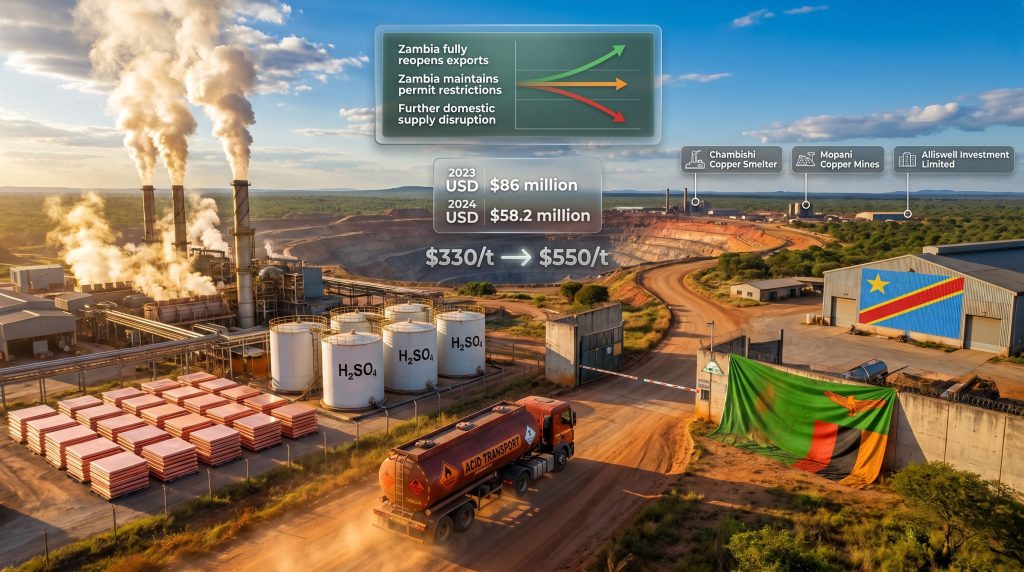
Trade flow data cited in the article outline shows that Zambia's sulphuric acid exports to the DRC were valued at approximately USD $86 million in 2023, placing it 10th globally among sulphuric acid exporters by value in that year. By 2024, reported export values declined to approximately USD $58.2 million, a reduction likely reflecting a combination of the September export ban, reduced export volumes, and possible price movements.
| Year | Zambia's Sulphuric Acid Export Value to DRC | Notable Policy Context |
|---|---|---|
| 2023 | USD $86 million | Standard trade flows |
| 2024 | USD $58.2 million | Progressive supply tightening and eventual September ban |
| 2025 | Partial resumption under permit system | Controlled export authorisations from March 2025 |
The Price Differential That Sustains Cross-Border Trade
A persistent price gap between Zambian domestic acid markets and DRC import prices underpins the economics of cross-border trade. Sulphuric acid in Zambia has been reported at approximately $330 per metric ton, compared with roughly $550 per metric ton in the DRC, representing a spread of around $220 per tonne before freight and logistics costs are factored in.
This differential reflects the DRC's chemical import dependency, the relatively higher cost of sourcing acid from alternative origins (such as South Africa or international chemical manufacturers), and the logistical constraints of road-based transport across central African terrain. For Zambian smelters, the export margin is commercially attractive during surplus periods, providing an additional revenue stream from what would otherwise be a waste management cost.
"The $220 per tonne price gap between Zambia and DRC sulphuric acid markets is not simply an arbitrage opportunity. It reflects the structural inability of DRC mining operations to source this input at competitive prices from any alternative supplier at comparable logistics cost."
The Policy Escalation That Created Regional Market Stress
Domestic Shortfalls and External Disruptions
Zambia's decision to restrict sulphuric acid exports was not a unilateral or sudden policy choice but the product of converging supply-side pressures. According to Reuters, weak domestic acid output combined with global supply disruptions, linked in part to the Iran conflict's effects on petrochemical and chemical supply chains, tightened the availability of leaching chemicals in the region.
When domestic acid inventories declined to levels that threatened supply continuity for Zambian mines, the government concluded that export volumes needed to be restricted to protect local industry. The priority structure is clear in the minister's own framing: domestic supply requirements are the primary policy anchor, and export authorisations are extended only when local inventories permit.
A Timeline of Progressive Policy Tightening
The sequence of policy interventions illustrates a government managing a genuine supply crisis in incremental steps rather than through a single decisive measure. Furthermore, Zambia's sulphuric acid export controls, as reported by Argus Media, described the situation as a "critical market imbalance" that required a structured regulatory response.
- September (prior year): A full export ban was imposed as domestic sulphuric acid stocks fell to levels that prompted official concern. This effectively halted Zambian acid shipments to DRC mining operations.
- March 2025: Zambia introduced a permit-based export control system. This framework allows selected producers to apply for export clearance rather than granting blanket market access.
- Mid-2025: Limited export authorisations were granted to Chambishi Copper Smelter, Mopani Copper Mines (pending permit delivery at time of reporting), and chemicals trader Alliswell Investment Limited.
This phased approach reflects the government's dual objective: protecting domestic mining operations while also allowing Zambian producers to monetise surplus stocks through export revenue. Commerce, Trade and Industry Minister Chipoka Mulenga confirmed that Zambia could widen export permissions if supply conditions continue to improve, signalling that the permit system is designed to be responsive to inventory conditions rather than fixed as a permanent trade barrier.
The DRC's Operational Response to Reduced Chemical Availability
Output Adjustments Across Congolese Mining Operations
The DRC's response to reduced sulphuric acid availability was immediate and operationally significant. Reuters reported that Congolese miners cut chemical usage and considered output reductions as a consequence of supply constraints. Data from commodities logistics and warehousing group Access World showed that Congo's imports of processing chemicals declined sharply in the first quarter of the reporting year.
This is a material operational constraint in a country that holds the world's largest cobalt reserves and ranks second globally in copper production. When chemical leaching capacity is reduced, the downstream effects ripple directly into cobalt and copper output volumes, which in turn affect global supply balances for both metals. The cobalt mining industry is consequently far more exposed to upstream chemical constraints than most market analyses acknowledge.
Localised Sourcing Responses
Some DRC mining operations responded to the Zambian supply shortfall by exploring domestic sourcing alternatives. Companies including Ivanhoe Mines investigated sulphuric acid procurement from within the DRC itself, although the availability and economics of this option are constrained by limited local production capacity. This behaviour demonstrates the structural vulnerability embedded in the region's current supply architecture: a single dominant external supplier, minimal local production alternatives, and limited ability to rapidly scale domestic sourcing.
The Cobalt Supply Chain Risk That Went Largely Unnoticed
Because cobalt is primarily recovered as a co-product of copper leaching across most DRC operations, any constraint on copper leaching throughput directly reduces cobalt volumes recovered. This transmission mechanism means that sulphuric acid availability effectively functions as an upstream production lever for global cobalt supply. This relationship is largely invisible in standard cobalt market analysis, which tends to focus on end-user battery demand rather than upstream processing chemical constraints.
Furthermore, the DRC cobalt export ban has compounded regional supply pressures, creating a dual constraint environment that is particularly challenging for downstream battery manufacturers.
"Investors monitoring cobalt supply fundamentals rarely track sulphuric acid availability in Zambia. Yet in periods of chemical supply stress, acid availability can become a more binding constraint on DRC cobalt output than ore grade, labour costs, or regulatory conditions."
What the Partial Export Resumption Actually Authorises
The Three Authorised Exporters
The current round of export authorisations covers three entities, each with distinct supply relationships in the DRC:
| Authorised Exporter | DRC Supply Destination | Status at Reporting |
|---|---|---|
| Chambishi Copper Smelter | Three Chinese-owned mines (unnamed) | Cleared to export |
| Mopani Copper Mines | Glencore operations in DRC | Authorised, permit receipt pending |
| Alliswell Investment Limited | Not specified | 5,000 metric ton allocation confirmed |
Mopani Copper Mines' supply relationship with Glencore's DRC operations is particularly notable given Glencore's scale as one of the world's largest cobalt producers. Chambishi's supply to Chinese-owned mines reflects the significant Chinese capital presence across DRC copper and cobalt operations. The volume authorised for Alliswell Investment Limited, at 5,000 metric tons, provides a concrete data point on the scale of individual export permits being issued.
The "Limited Quantity" Principle
Minister Mulenga explicitly framed the authorisations as involving a limited quantity to ensure that the local market does not suffer, according to Reuters. This language is significant because it signals that export volumes will be constrained below what the market might otherwise absorb, prioritising domestic supply security over full export resumption.
Importantly, Reuters previously reported that both Mopani and Chambishi Copper Smelter have planned smelter shutdowns in 2025. If these shutdowns reduce acid generation capacity, the effective surplus available for export may be lower than current inventory levels suggest, potentially tightening the supply balance again later in the year.
The next major ASX story will hit our subscribers first
Market Implications of a Permit-Based Supply Regime
Policy Uncertainty as a Price Driver
The structural difference between a full export ban and a permit-based system is significant for market participants. Under a complete ban, forward planning is straightforward: no Zambian acid is available, and operators must source alternatives at whatever cost. Under a permit system, supply availability becomes conditional, discretionary, and subject to political and inventory conditions that external buyers cannot fully observe or predict.
This uncertainty generates a risk premium in DRC acid pricing and complicates long-term processing contract structures. Mining operators cannot easily build permit-dependent Zambian supply volumes into multi-year operational plans, which may accelerate investment in domestic DRC acid production capacity over time.
Scenarios for Market Normalisation
| Scenario | Likely Market Outcome |
|---|---|
| Zambia fully reopens exports as inventory builds | DRC processing recovers; cobalt and copper output stabilises |
| Permit system maintained at current restrictive levels | Elevated DRC chemical prices persist; margin compression for operators |
| Smelter maintenance reduces Zambian acid generation | Risk of renewed tightening; potential for partial export ban reinstatement |
| DRC invests in domestic acid production | Structural reduction in cross-border dependency over 3-5 years |
Macro Supply Chain Implications for Green Energy Metals
An Invisible Bottleneck in the Energy Transition
The global energy transition depends on a steady and growing supply of copper for grid infrastructure, motors, and wiring, and cobalt for battery cathode chemistry. Both metals flow primarily through Central African processing circuits that depend on sulphuric acid as a foundational input. However, sulphuric acid rarely appears in energy transition supply chain risk assessments, which tend to concentrate on ore grade depletion, political instability, or downstream battery manufacturing capacity.
The 2024–2025 disruption demonstrates that a processing chemical whose production is tied to smelter operations in a neighbouring country can become a critical bottleneck across an entire regional mining ecosystem. This type of indirect supply chain risk is structurally similar to the semiconductor manufacturing dependency revealed during post-pandemic supply chain stress: an invisible input with no short-term substitute can halt an otherwise healthy production system. In addition, the role of critical minerals in the energy transition is increasingly being scrutinised for precisely these kinds of upstream vulnerabilities.
Geopolitical Risk Intersects With Smelter Maintenance Cycles
The confluence of Iran-linked global chemical supply disruptions, planned Zambian smelter maintenance shutdowns, and declining domestic acid inventories illustrates how multiple independent risk factors can align to create acute regional stress. No single event caused the Zambian export ban. Rather, a sequence of individually manageable pressures accumulated to the point where regulatory intervention became necessary.
This dynamic is characteristic of complex industrial supply chains and suggests that future stress events are unlikely to be predictable from any single market signal. Investors and analysts monitoring cobalt and copper supply should treat Zambian smelter operational status, sulphuric acid inventory levels, and DRC chemical import data as leading indicators rather than incidental trade statistics.
Structural Risks in the Copperbelt's Chemical Supply Ecosystem
Concentration Risk and Single-Supplier Dependency
The DRC's near-total reliance on Zambian sulphuric acid exports represents a concentration risk that is rarely quantified in mining company risk disclosures. If a diversified, resilient supply chain is the objective, the current structure is the opposite: a single dominant supplier whose domestic policy priorities will always take precedence over DRC operators' requirements.
Mitigating this concentration risk requires either: (1) developing domestic DRC sulphuric acid production from dedicated plants or integrated metallurgical facilities; (2) building strategic acid storage capacity within the DRC to buffer against supply interruptions; or (3) investing in alternative ore processing routes, including bacterial leaching technologies (bioleaching) that can reduce acid consumption per tonne of ore processed.
Smelter Maintenance Cycles as a Systemic Vulnerability
Both Mopani and Chambishi Copper Smelter have planned extended maintenance shutdowns in 2025, as previously reported by Reuters. When major Zambian smelters undergo scheduled maintenance, their acid generation capacity temporarily ceases, removing production from the regional supply balance. If maintenance schedules for multiple smelters overlap, the combined reduction in acid output can quickly shift the regional balance from surplus to deficit.
This maintenance-cycle risk is an underappreciated structural vulnerability that is difficult for DRC operators to hedge against, particularly when it coincides with broader global supply tightness, as occurred in the 2024–2025 period. Consequently, the copper market supply crunch of 2025 has been shaped in part by these very upstream chemical constraints.
Frequently Asked Questions
Why Is Sulphuric Acid So Important to Copper and Cobalt Mining in the DRC?
The DRC's copper and cobalt deposits are predominantly oxide ores, which require hydrometallurgical processing via sulphuric acid leaching rather than conventional smelting. Without a reliable acid supply, the solvent extraction and electrowinning circuits that produce copper cathode and cobalt intermediate products cannot operate at full capacity.
What Caused Zambia to Restrict Sulphuric Acid Exports?
A combination of weak domestic acid output, reduced smelter operating rates, and global supply chain disruptions linked to the Iran conflict tightened regional availability. When domestic inventories fell to levels that threatened Zambian mining operations, the government implemented an export ban to protect local supply security.
How Much Sulphuric Acid Does Zambia Export to the DRC Each Year?
Zambian exports to the DRC were valued at approximately USD $86 million in 2023 and USD $58.2 million in 2024. Annual production from Zambian smelters is approximately 2 million metric tons, with the surplus above domestic requirements available for export.
Which Companies Are Authorised to Resume Sulphuric Acid Exports from Zambia?
Chambishi Copper Smelter and Mopani Copper Mines have received government authorisation, with Mopani's export permit still pending at the time of reporting. Chemicals trader Alliswell Investment Limited has also been authorised to export 5,000 metric tons.
Could This Policy Shift Affect Global Cobalt Prices?
Potentially, yes. Because cobalt is largely a co-product of copper leaching in the DRC, any sustained constraint on sulphuric acid availability that reduces copper leaching throughput will also reduce cobalt recovery. The impact on Congo cobalt prices could be significant given the DRC's dominant share of global cobalt production.
Is the Zambia-DRC Sulphuric Acid Trade Relationship Likely to Stabilise?
The permit-based system introduced in March 2025 represents a conditional normalisation rather than a structural resolution. Stability depends on Zambian smelter output remaining at levels that sustain domestic surpluses. Planned maintenance shutdowns later in 2025 present a near-term risk of renewed supply tightening.
What Investors and Industry Analysts Should Watch
Key Monitoring Indicators
Tracking developments in Zambia's sulphuric acid supply conditions requires a set of leading indicators that are not typically included in standard mining equity research:
- Zambian smelter operational status: Monthly production reports from Mopani and Chambishi indicate whether acid generation is on track or impaired by maintenance or operational issues.
- DRC chemical import data: Access World's logistics data on DRC processing chemical imports is one of the few publicly available proxies for regional acid availability.
- Zambia permit system announcements: Communications from the Ministry of Commerce, Trade and Industry regarding export permit expansions or restrictions provide the clearest signal of official policy direction.
- Glencore DRC operational updates: As a permitted recipient of Mopani's acid exports, Glencore's DRC operations provide a high-profile lens through which to assess chemical supply normalisation.
- Regional sulphuric acid pricing: Price movements in the $330–$550 per tonne corridor indicate whether supply tightness is intensifying or easing.
A Controlled Reopening, Not a Full Reset
What the Permit System Signals About Resource Strategy
The transition from a full export ban to a permit-based system does not represent a return to open trade. It represents a deliberate decision to manage sulphuric acid as a strategic industrial resource, allocating export capacity based on domestic inventory conditions rather than pure market economics.
This approach has precedents in other resource sectors, from grain export restrictions to rare earth quota systems. In each case, the underlying logic is the same: domestic industrial security takes precedence over international market access, and export permissions are extended as a conditional privilege rather than a commercial right.
For companies operating in the DRC, this framework means that Zambian acid supply must be treated as inherently interruptible in long-term operational planning. The practical implication is a strong incentive to develop diversified sourcing strategies, invest in domestic DRC acid production, and build strategic acid storage buffers to manage the inherent volatility of this supply relationship.
The Long-Term Outlook for Sulphuric Acid in the Green Metals Economy
As global copper demand expands with electrification and cobalt demand evolves alongside battery chemistry trends, the Central African Copperbelt will remain central to supply. However, the productivity of that copperbelt is fundamentally constrained by access to processing chemicals. Sulphuric acid, for all its industrial ordinariness as a bulk chemical, will remain a strategic variable in the green metals economy for as long as oxide ore processing dominates DRC mining operations.
The events of 2024–2025 have brought that reality into sharp focus. Whether through policy evolution, infrastructure investment, or technological adaptation, the region's chemical supply architecture will need to mature alongside the growing strategic importance of the metals it helps to extract. Indeed, Zambia eases sulphuric acid exports to Congo as a measured step forward, but the structural work of building a resilient regional supply chain is only just beginning.
This article is intended for informational purposes only and does not constitute financial, investment, or commodity trading advice. Forecasts and scenario analyses represent analytical perspectives and not verified outcomes. Readers should consult independent financial and market advisors before making investment decisions based on information presented here. Trade data cited reflects figures as reported in the original source material and should be verified against current databases for time-sensitive applications.
Want To Stay Ahead of the Next Major Mineral Discovery?
Discovery Alert's proprietary Discovery IQ model delivers real-time alerts on significant ASX mineral discoveries, transforming complex commodity data — including the upstream chemical constraints shaping cobalt and copper supply — into actionable investment insights. Explore how historic discoveries have generated extraordinary returns on Discovery Alert's dedicated discoveries page, and begin your 14-day free trial today to position yourself ahead of the broader market.