
July 9, 2026
The Royalty Model at a Crossroads: Why Scale Is No Longer Optional
The precious metals royalty and streaming sector has never been a game of pure asset accumulation. Its fundamental economics reward efficiency: the fewer dollars spent on general and administrative overhead relative to cash flow generated, the more value flows through to shareholders. For decades, that logic favoured the Franco-Nevadas and Wheaton Precious Metals of the world, whose scale allowed them to source, evaluate, and close deals that smaller players simply could not compete for.
The junior royalty tier, however, has been evolving rapidly. Consolidation pressure has intensified throughout 2025 and into 2026, driven by a combination of rising institutional expectations, tighter deal origination competition, and the simple arithmetic that a portfolio of 10 royalties and a portfolio of 48 royalties are fundamentally different businesses. The Summit Royalties Star Royalties acquisition, which closed on July 3, 2026, is one of the clearest expressions of this dynamic in recent months.
When big ASX news breaks, our subscribers know first
What the Summit Royalties and Star Royalties Acquisition Actually Involved
Transaction Architecture and Key Metrics
The deal was structured as a plan of arrangement, meaning no cash changed hands at the company level. Star Royalties shareholders received 0.36 Summit shares for each Star share held, resulting in approximately 28.94 million new Summit common shares being issued. On a fully diluted basis, the transaction was valued at roughly C$51 million.
| Metric | Detail |
|---|---|
| Closing Date | July 3, 2026 |
| Exchange Ratio | 0.36 Summit shares per Star share |
| New Summit Shares Issued | ~28.94 million |
| Deal Value (Fully Diluted) | ~C$51 million |
| Post-Merger Summit Shareholder Ownership | ~72% |
| Post-Merger Star Shareholder Ownership | ~28% |
| Star Delisting Date | On or about July 7, 2026 |
| Combined Portfolio Size | 48 royalties and streams |
| Producing Assets at Close | 4 |
| Expected Producing Assets by 2027 | 6 |
The share-for-share structure was not accidental. It preserves Summit's balance sheet liquidity for future deal-making at a time when the company is actively evaluating additional acquisitions, while simultaneously aligning former Star shareholders with the long-term performance of the combined entity. Issuing shares rather than raising cash also avoids the dilutive equity placements that have historically frustrated royalty investors during periods of strong commodity sentiment.
Why a Newly Listed Company Pursued This Aggressively
Summit Royalties (TSXV: SUM, OTCQX: SUMMF) had been publicly trading for only approximately eight months at the time of closing. Its strategic emphasis from inception has been cash flow per share growth through disciplined, selective acquisitions rather than headline portfolio expansion for its own sake. The Star transaction fits this framework precisely because it added quality assets with near-term production catalysts, rather than a large number of speculative early-stage royalties.
The distinction matters: royalty companies that chase portfolio size without regard for asset quality tend to dilute their per-share metrics even as their total royalty count grows. Summit's stated framework prioritises accretion at the per-share level, which sets a higher internal bar for deal completion.
Furthermore, the broader context of mining industry consolidation throughout this period makes the timing of this transaction particularly strategic, as junior royalty companies increasingly recognise that scale is essential for institutional relevance.
Copperstone: The Asset That Changed the Deal's Risk Profile Mid-Flight
From PEA to Funded Construction Between Announcement and Close
The most consequential single asset in the Star Royalties portfolio is the Copperstone gold stream, a 4% gold stream on production from Mining Americas Inc.'s (formerly Minera Alamos) project in Arizona. What makes this asset particularly notable is the trajectory it followed between deal announcement on March 16, 2026, and closing on July 3, 2026.
At announcement, Copperstone sat at the Preliminary Economic Assessment (PEA) stage, the earliest point in a mine's engineering lifecycle at which broad economic parameters are estimated. By closing, Mining Americas had:
- Raised US$75 million in bank debt to fund construction
- Published a Preliminary Feasibility Study (PFS), the next engineering study tier above a PEA
- Made a formal construction decision and begun active site work
This progression represents a substantial compression of the risk profile for Summit as the royalty holder. Third-party institutional lenders conducting due diligence before committing US$75 million in debt financing provide independent validation of the project's economic viability, reducing the probability-weighted discount the market typically applies to development-stage royalties.
Understanding the PEA-to-PFS Risk Premium Compression
For investors unfamiliar with the various feasibility study stages in mining, the progression matters considerably:
- PEA (Preliminary Economic Assessment): Conceptual-level study, typically with capital cost accuracy of plus or minus 35–40%. Often uses inferred mineral resources that are not yet suitable for mine planning.
- PFS (Preliminary Feasibility Study): Greater engineering detail, tighter cost estimates (typically plus or minus 25%), and reliance on indicated resources. Sufficient for project financing decisions.
- Bankable Feasibility Study (BFS): The highest confidence tier, typically required by lenders for large-scale project finance.
The fact that Copperstone attracted US$75 million in bank debt at PFS stage is a clear indication of the project's perceived robustness in the current lending environment for Arizona-based gold mining operations.
Arizona as a Mining Jurisdiction
Arizona has an established track record as a stable, infrastructure-accessible mining jurisdiction within the United States. The state is home to some of the world's largest copper operations, and its regulatory environment for heap leach gold projects is well understood. Permitting completeness at the time of the Summit Royalties Star Royalties acquisition removes one of the key binary risks that typically weigh on development royalties.
Operator Quality: An Underappreciated Risk Factor in Royalty Investing
Why the Operator Behind the Asset Matters as Much as the Asset Itself
Royalty investors often focus on the royalty instrument itself — the stream percentage, the commodity, the jurisdiction, and the geology. However, the operator executing the underlying mining project is arguably the most critical variable in whether a royalty ever generates cash flow. A single-asset developer encountering its first complex permitting process is structurally different from a multi-mine operator with existing cash flow and proven construction management capability.
Summit's near-term production growth is anchored by two operators with meaningful operational track records:
- Mining Americas Inc.: Operates two existing heap leach gold mines in Nevada, giving it direct applicable experience for the Copperstone project's metallurgical approach. The company carries a market capitalisation well above US$500 million.
- Jaguar Mining: The operator behind the Pitangui royalty in Brazil's Minas Gerais state has maintained continuous mining operations in that state for over two decades. Pitangui sits approximately 30 kilometres from Jaguar's existing processing mill, meaning Summit's royalty benefits from infrastructure that is already built, financed, and operational.
This is a subtle but important distinction in royalty analysis. When the mill servicing your royalty asset already exists and is run by a profitable company, the infrastructure and commissioning risk that consumes capital during mine development simply does not apply to the same degree.
Growth Profile: How the ~47% GEO CAGR Compares to Junior Royalty Peers
Benchmarking Summit's Projected Growth Rate
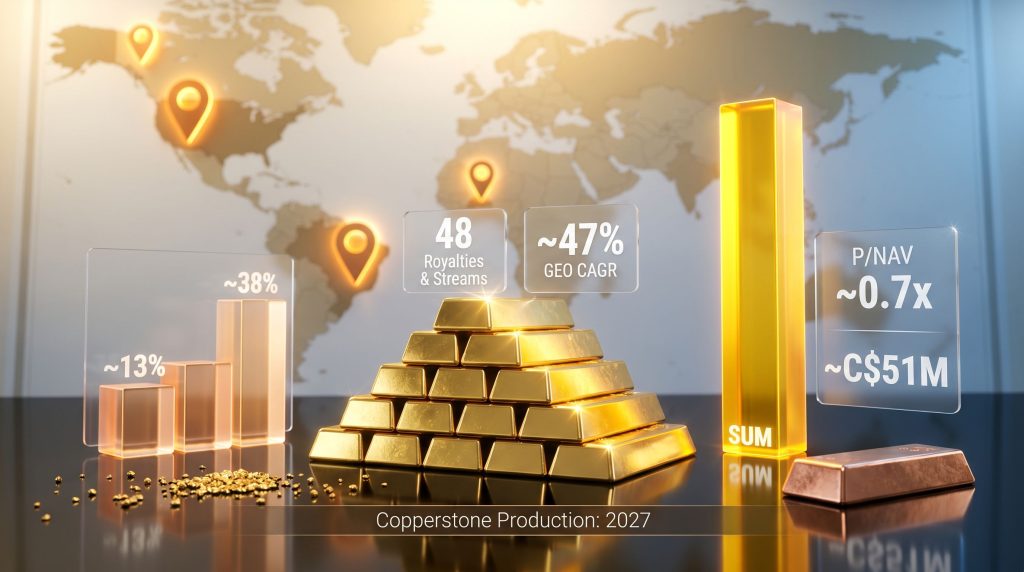
Management is guiding to a ~47% three-year gold equivalent ounce (GEO) compound annual growth rate, which it positions as the highest within the junior royalty and streaming peer group based on analyst consensus estimates as of mid-2026.
| Company | Approximate 3-Year GEO CAGR (Analyst Consensus) |
|---|---|
| Summit Royalties | ~47% |
| Peer Range (Gold Royalty, Metalla, Vox, Versamet, Evolve, Elemental) | ~13% to 38% |
The drivers of this growth rate are not speculative pipeline assets. They are two near-term production events — Copperstone and Pitangui, both expected in 2027 — combined with organic de-risking across the broader 48-asset portfolio. Consequently, the gold price impact on this trajectory cannot be understated, as prevailing gold prices directly influence the revenue value of each GEO produced.
The Doubling of the Cash Flow Target
One of the more striking data points to emerge from the deal's progression is how Summit's own forward cash flow guidance shifted between announcement and close. The company's projected run-rate cash flow once all current assets are producing approximately doubled during the deal period, moving from roughly US$10 million to approximately US$20 million. The primary driver was Copperstone's transition from PEA-stage development risk to funded construction reality.
The company's target run rate by 2028 is approximately 4,000 gold-equivalent ounces, which at gold prices prevailing in mid-2026 would represent more than US$15 million in annual revenue against a market capitalisation of approximately US$101 million at the time of closing.
Valuation: Why Summit Trades at a Discount and What Would Change That
The Current Valuation Gap
Despite the growth profile, Summit's pro forma valuation sits toward the lower end of its peer group across key metrics:
| Metric | Summit Royalties (Pro Forma) | Junior Royalty Peer Range |
|---|---|---|
| Market Capitalisation | ~US$121 million | Varies |
| P/NAV Multiple | ~0.7x | Up to 2.0x |
| P/2027E Cash Flow | ~8.8x | Up to 27.4x |
What Explains the Discount?
Several factors rationally explain why the market has not yet ascribed peer-level multiples to Summit:
- Listing age: Less than one year as a public company at closing, meaning minimal institutional track record to evaluate
- Integration risk: Combining two royalty portfolios introduces administrative complexity and consolidation execution risk
- Forward guidance credibility: Markets are appropriately sceptical of cash flow projections from companies that have not yet demonstrated them
- Asset concentration in development stage: Four producing assets out of 48 means most of the portfolio's value remains theoretical
What a Re-Rating Would Require
The conditions under which the valuation gap is most likely to compress are straightforward to identify, though not guaranteed to materialise:
- Copperstone entering production on schedule in 2027
- Pitangui achieving first production within the guided timeline
- Continued acquisition discipline against a benchmark of declining G&A as a percentage of cash flow
- Successful establishment of a revolving credit facility, demonstrating institutional banking confidence in the platform
- G&A cost management remaining competitive as the team scales
The next major ASX story will hit our subscribers first
Capital Discipline and Deal Origination: The Selective Acquirer Advantage
More Than US$250 Million in Deals Passed On
One of the less visible but analytically important aspects of Summit's track record is the volume of transactions it has evaluated and rejected. Since inception, management has indicated passing on a value exceeding US$250 million in potential acquisitions. For a company that has only completed deals totalling a fraction of that figure, this ratio speaks directly to the selectivity of the acquisition framework.
In the royalty sector, overpaying during commodity bull markets is one of the most reliable ways to destroy per-share value over a full cycle. Summit's willingness to walk away from the majority of opportunities it evaluates is a credibility signal that institutional investors in the sector have learned to weight heavily. Access to disciplined mining capital markets reinforces this approach, as well-structured capital relationships reduce the pressure to deploy funds indiscriminately.
The Third-Party Royalty Market: A Different Competitive Arena
Summit's deal origination focuses primarily on the third-party royalty market rather than on direct operator-created royalties. This is a meaningful distinction. When an operator creates a royalty directly, they typically have significant negotiating leverage. Third-party royalty acquisitions, where Summit buys existing royalties from other holders or investors, operate under different competitive dynamics — often with less auction-style pricing pressure.
Expanding the Toolkit: The Case for a Revolving Credit Facility
Summit is actively pursuing a revolving credit facility with a major bank. For a junior royalty company, access to debt financing changes the competitive calculus significantly. Rather than requiring equity raises ahead of each acquisition, a credit facility allows the company to move quickly on time-sensitive deals, then refinance through equity or cash flow at a more deliberate pace.
Beyond Gold: The Strategic Logic of Copper Exposure
The recent addition of a copper royalty on Newmont's Saddle North project in British Columbia's Golden Triangle for C$5.0 million in shares represents an early and deliberate step toward commodity diversification. The Golden Triangle is one of Canada's most prolific mining districts, hosting a concentration of world-class copper-gold deposits. Newmont as operator provides the same quality assurance logic discussed above in the context of Copperstone and Pitangui.
In addition, the copper demand outlook driven by electrification and grid infrastructure spending adds a non-precious metals growth vector to what has historically been a gold and silver-dominated royalty portfolio. For a deeper understanding of the copper demand outlook, the structural forces underpinning copper's long-term role in global energy transition are well documented. The modest size of the Saddle North royalty acquisition limits portfolio concentration risk while establishing a template for future copper royalty origination.
Near-Term Catalysts Across the Existing Portfolio
Beyond the two headline production additions in 2027, Summit's existing portfolio carries a series of incremental de-risking events scheduled across 2026 and 2027:
| Asset | Location | Expected Catalyst | Timeline |
|---|---|---|---|
| Copperstone | Arizona, USA | Production commencement | 2027 |
| Pitangui | Minas Gerais, Brazil | Production commencement | 2027 |
| AurMac Gold Project | Yukon, Canada | PEA publication | 2026 |
| Bomboré | Burkina Faso | Hard rock plant expansion | 2026 |
| Zancudo | Colombia | Mill installation | 2026 |
Each of these milestones represents value crystallisation within the existing portfolio, with no new capital deployment required from Summit. This is one of the structural advantages of the royalty model that is frequently underestimated: organic portfolio maturation generates value accretion without the dilution associated with new acquisitions.
Governance and Team Infrastructure for a Larger Platform
Key Appointments Following the Acquisition
Three additions to Summit's management and board signal deliberate preparation for a more complex, higher-capital organisation:
- Kevin MacLean, Chief Investment Officer: Expands deal origination capacity and portfolio management depth without salary compensation, reflecting the company's overhead discipline
- Kathy Lai, Vice President of Finance: Adds dedicated financial reporting and governance infrastructure, a hire made in direct response to institutional investor feedback that the previous team size represented an operational risk
- Jay Layman (former COO of Seabridge Gold), Board of Directors: Brings technical evaluation expertise relevant to the development-stage assets that now represent a meaningful portion of Summit's portfolio value
The VP Finance hire is particularly instructive. At least one prominent institutional investor explicitly flagged the lean finance function as a risk factor during engagement with Summit's management. The company's willingness to respond directly to that feedback — by making the hire — reflects a governance responsiveness that matters for long-term institutional capital retention.
Key Variables Investors Should Track Through 2027
The Summit Royalties Star Royalties acquisition is ultimately a thesis about realising the value embedded in a diversified, de-risking royalty portfolio. The full details of the transaction provide additional context for investors seeking to understand the deal's mechanics. The following are the highest-impact variables for investors monitoring that thesis:
- Copperstone production timing: The single highest-impact near-term catalyst for cash flow materialisation
- Pitangui first production: Adds a second production stream in 2027 from an established operator with proximate infrastructure
- Revolving credit facility execution: Institutional lending confirmation that would expand deal capacity and signal third-party balance sheet confidence
- G&A cost trajectory: The royalty model's economic logic depends on overhead remaining a small fraction of growing cash flow
- Acquisition selectivity continuity: The US$250 million in deals passed on is a historical reference point; future discipline must be demonstrated prospectively
Disclaimer: This article is provided for informational purposes only and does not constitute financial advice. Forward-looking statements, projections, and valuation comparisons involve material uncertainties and should not be relied upon as predictions of future performance. Investors should conduct their own due diligence and consult a licensed financial adviser before making investment decisions. All figures are sourced from publicly available company disclosures and analyst estimates as of mid-2026.
Want to Discover the Next Major ASX Mineral Announcement Before the Market Does?
Discovery Alert's proprietary Discovery IQ model delivers real-time alerts on significant ASX mineral discoveries, turning complex geological data into actionable investment insights for both short-term traders and long-term investors. Explore historic examples of exceptional discovery returns and begin your 14-day free trial at Discovery Alert to position yourself ahead of the broader market.