July 28, 2026
The Geometry of Discovery: Why Underground Access Changes Everything in Hard-Rock Exploration
Across the global mining industry, one structural reality consistently separates world-class discoveries from projects that stall at the surface: the geometry of drilling. Surface rigs, regardless of how many are deployed, are fundamentally constrained by angle. They approach ore zones from above, often missing the true geometry of steeply dipping or structurally complex mineralisation that characterises many of the world's most significant gold and antimony systems. When a project reaches the point where surface-only drilling can no longer efficiently interrogate the deposit at depth, the logical progression is to go underground.
That transition has now occurred at the Sunday Creek gold-antimony project underground decline in Victoria, approximately 60 kilometres north of Melbourne, where mining contractor PYBAR Mining Services executed the first blast in a new exploration decline in mid-2026. What makes this moment particularly notable is not just the technical milestone itself, but the broader context in which it sits: this is the first new underground decline to be developed in Victoria in roughly 20 years.
When big ASX news breaks, our subscribers know first
What an Exploration Decline Actually Does and Why It Matters
An exploration decline is a sloped underground tunnel, typically driven at a gradient of around 1:7 to 1:10, engineered specifically to provide subsurface access for drilling equipment. Unlike a production decline, which is designed for ore haulage, equipment movement, and long-term operational use, an exploration decline is a targeted investigative tool. Its primary purpose is to establish drill platforms at depth, enabling geologists to test ore zones from angles and positions that surface rigs physically cannot achieve.
The distinction between these two types of underground infrastructure is worth understanding clearly:
| Feature | Exploration Decline | Production Decline |
|---|---|---|
| Primary Purpose | Drill platform access | Ore haulage and extraction |
| Typical Depth | 100–300 m | 300 m+ |
| Infrastructure Scale | Moderate | Extensive |
| Timeline to Commission | 6–9 months | 12–36 months |
| Regulatory Pathway | Work plan approval | Full mining licence |
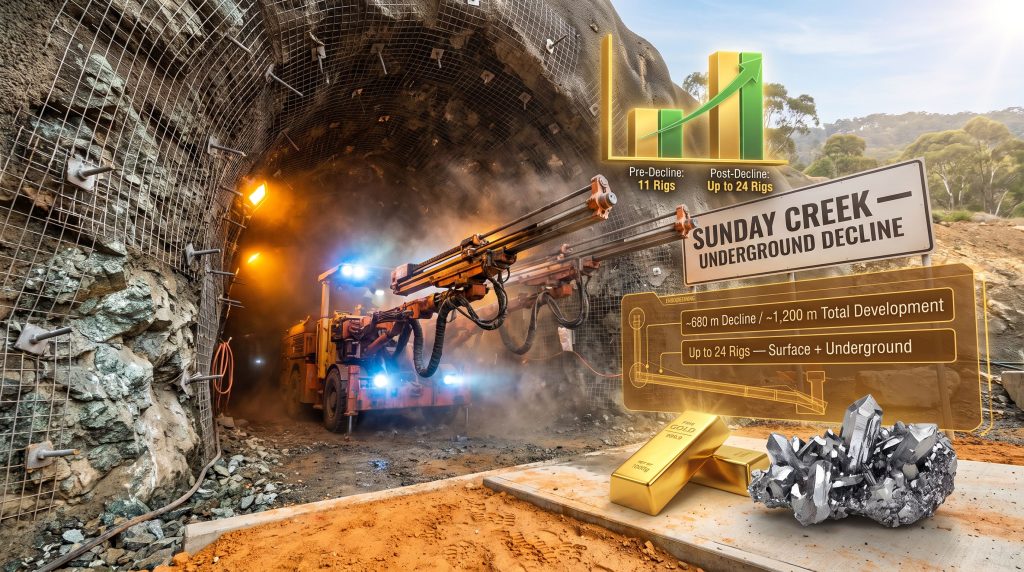
At Sunday Creek, the planned decline involves approximately 680 metres of primary decline with around 1,200 metres of total development including platforms, according to company-reported specifications. The tunnel is designed to reach drill platforms at roughly 115 metres below surface, a depth that unlocks entirely new angular approaches to the ore system. Construction duration is estimated at 6 to 9 months from first cut to operational readiness.
The construction sequence follows a well-established hard-rock protocol:
- Box cut excavation and earthworks preparation at surface
- Portal establishment with primary ground support installation
- Development jumbo mobilisation for primary decline driving
- Sequential establishment of underground drill platforms
- Integration of underground rigs into the broader exploration fleet
Technical Note: Ground support in an exploration decline typically involves a combination of rock bolts, mesh, and shotcrete applied progressively as the face advances. The methodology is engineered for long-term structural integrity throughout the life of the exploration program, not just initial access.
Furthermore, understanding drill results interpretation becomes increasingly important as the program scales up, since underground platforms generate data from angles that require careful geometric analysis to translate into meaningful resource models.
How the Sunday Creek Decline Received Regulatory Approval
Navigating underground work plan approval in Victoria requires engagement with Resources Victoria, the state's primary minerals regulator. The process involves technical assessment of the proposed works, environmental management commitments, and community consultation obligations, all of which precede any approval decision.
The work plan for the Sunday Creek exploration decline received approval from Resources Victoria in November 2025. From that approval date to the firing of the first underground cut in mid-2026, the project team completed all required surface infrastructure, including earthworks, box cut excavation, and portal ground support, before initiating the first blast. The compressed timeline between approval and first cut reflects both the preparedness of the project team and the operational urgency driving the underground program.
Victoria's regulatory environment for underground exploration has historically been characterised by complexity, reflecting the state's relatively limited recent history of hard-rock underground development compared to Western Australia or Queensland. The Sunday Creek approval therefore carries procedural significance beyond the individual project.
The Dual-Commodity Thesis: Gold and Antimony in the Same System
What makes the Sunday Creek gold-antimony project technically differentiated from a conventional gold exploration play is the co-occurrence of two commodities with fundamentally different market drivers.
Gold needs little introduction as a store of value and financial hedge, but antimony is a less familiar story for most investors. The antimony critical mineral uses span a remarkably broad range of industries, which is precisely what makes it strategically significant:
- Antimony is a metalloid used in flame retardants, lead-acid battery alloys, ammunition primers, and increasingly in next-generation sodium-antimony battery technologies
- It is classified as a critical mineral by Australia, the United States, the European Union, and the United Kingdom, given extreme supply concentration risks
- Approximately 48–50% of global antimony supply has historically been sourced from China, creating significant geopolitical exposure for western industrial supply chains
- China imposed export restrictions on antimony in late 2024, which sent spot prices sharply higher and intensified western-world interest in alternative supply sources
- There is currently no significant primary antimony producer operating in Australia or North America at scale
The antimony supply risks associated with this concentration have consequently elevated interest in projects like Sunday Creek that could offer a credible western-world alternative. In addition, the antimony price surge following China's export controls has materially strengthened the economic case for bringing new supply sources into production.
The absence of a formal JORC-compliant mineral resource at Sunday Creek as of mid-2026 means the project is still in the exploration and resource definition phase. The decline is specifically designed to accelerate the process of accumulating the drill data required for a maiden resource estimate. Conceptual exploration targets, which are not mineral resources and carry significant uncertainty, have been used to guide decline placement and platform positioning, a common and technically sound approach at this stage of project development.
Important Disclaimer: Conceptual exploration targets referenced in pre-resource stage projects involve inherent uncertainty. There is no guarantee that further exploration will result in the definition of a mineral resource that meets JORC reporting standards.
Drilling Capacity Expansion: From 11 Rigs to 24 Rigs
The fundamental operational argument for the exploration decline is one of drilling throughput. Surface rigs, while efficient for shallow to moderate-depth work, face geometric and logistical constraints that cap their capacity to test deep ore zones efficiently. By establishing underground platforms at approximately 115 metres depth, the project can direct drill holes upward, laterally, and at shallow angles into ore zones, vastly increasing the total volume of rock that can be tested per unit of time.
| Phase | Rig Configuration | Platform Type | Depth Access |
|---|---|---|---|
| Pre-Decline | 11 surface rigs | Surface only | Limited by angle |
| Post-Decline (Projected) | Up to 24 rigs | Surface + underground | ~115 m below surface |
| Net Capacity Increase | +13 rigs | Dual-platform | Significantly expanded |
The projected fleet of up to 24 concurrent rigs operating across surface and underground platforms would represent more than a doubling of drilling capacity from the current baseline. Underground drill platforms also support 24-hour continuous operations more effectively than surface rigs in certain settings, further compressing the timeline to resource definition.
Moreover, understanding true vs apparent widths becomes particularly critical when interpreting results from this expanded fleet, since underground drill holes approach ore zones from entirely different angles compared to surface-only programs.
Industry Perspective: Reaching 24 concurrent rigs at the pre-resource definition stage is an exceptionally rare achievement globally. The majority of exploration projects operating before a maiden resource declaration do so with fewer than 10 rigs. Projects of this drilling intensity at such an early stage are typically found only in the upper tier of globally significant exploration programs.
Why This is Victoria's First New Underground Decline in Approximately 20 Years
The significance of this milestone becomes clearer when placed in historical context. Victoria's underground mining heritage is substantial, rooted in the goldfield rushes of the 1850s and the deep lead alluvial systems that followed. However, the latter decades of the twentieth century and the early 2000s saw a pronounced withdrawal of underground hard-rock development activity from the state.
Several structural factors contributed to this dormancy:
- Regulatory complexity associated with underground work plan approvals in a densely populated and environmentally sensitive state
- High capital requirements relative to available project economics at the time
- A prolonged period of subdued gold and antimony prices that reduced incentive for underground investment
- Workforce migration toward Western Australia's more active hard-rock underground sector
The result is a generation of Victorian mining professionals for whom an underground first-cut event is genuinely unprecedented career experience. PYBAR fires first cut at Sunday Creek marked a moment many practitioners across the sector acknowledged they may never witness again, noting that entire careers can pass without participating in such a milestone.
The reactivation of underground development capability in Victoria also carries workforce and supply chain implications. Specialist underground contractors, jumbo operators, underground shotcrete crews, and ground support engineers are required skills that have atrophied in the Victorian ecosystem. Sustained underground programs of the scale planned at Sunday Creek could catalyse a meaningful recovery of this specialist workforce within the state.
The next major ASX story will hit our subscribers first
Environmental Advantages of Underground Exploration Over Surface-Intensive Programs
One aspect of the underground transition that is frequently overlooked in project commentary is its environmental footprint profile. A surface-based program of 24 drill rigs would require an extensive network of drill pads, access tracks, water supply infrastructure, and cleared areas spread across the project tenure. The noise and light impact of such an operation would be substantial, particularly given Sunday Creek's relatively proximate location to peri-urban communities north of Melbourne.
Underground drill platforms, by contrast, concentrate the operational footprint beneath a single surface portal entry point. Once the decline is established and platforms are operational:
- Drilling noise is substantially attenuated by the rock mass between underground operations and the surface
- Light pollution from night-shift operations is eliminated for the underground component of the fleet
- Surface disturbance from new access tracks and drill pads is minimised
- Community engagement requirements may be simplified given the reduced visible operational intensity
The trade-off is that the decline construction phase itself requires blasting, which generates ground vibration and noise at surface. This is a temporary condition bounded by the 6 to 9 month construction timeline, after which the quieter operational drilling phase commences.
Benchmarking Sunday Creek Against Global Pre-Development Drill Programs
In the global context of pre-resource exploration drilling intensity, Sunday Creek's projected scale is genuinely unusual. Most junior and mid-tier explorers conducting pre-maiden resource drill programs operate with between 3 and 8 rigs concurrently. Projects that reach double-digit rig counts before declaring a maiden resource are typically those with either extraordinary early-stage drill results or access to substantial capital reserves.
The capital efficiency argument for concentrated pre-resource drilling is compelling: establishing a robust, high-confidence maiden resource estimate in a compressed timeframe reduces the period of capital exposure during which no revenue is being generated. However, this strategy carries its own risks:
- Accelerated programs can outpace the geological interpretation process, generating data faster than it can be integrated into coherent resource models
- Drill contractor availability and consumable supply chains can become constrained at high rig counts
- Community and regulatory tolerance for high-intensity exploration programs requires active management
These are known variables in high-intensity pre-development programs and represent real risk considerations for observers monitoring the project's progression.
Frequently Asked Questions About the Sunday Creek Underground Decline
What is the Sunday Creek gold-antimony project?
Sunday Creek is a hard-rock gold and antimony exploration project located approximately 60 kilometres north of Melbourne in Victoria, operated by Southern Cross Gold Consolidated. The project is at the pre-resource definition stage and is focused on establishing the geological and economic case for what the company believes could become a significant western-world supplier of both metals.
Why was an underground decline chosen over continued surface drilling?
Surface rigs are geometrically limited in how they can approach steeply dipping or structurally complex ore zones at depth. An underground decline provides drill platforms that enable holes to be directed from angles impossible to achieve from surface, substantially expanding the volume of ore system that can be systematically tested.
When will the Sunday Creek exploration decline be completed?
Based on company-reported estimates, the decline development is expected to reach operational readiness within 6 to 9 months of the first cut, which was fired in mid-2026. Full underground drilling capability is anticipated by the end of 2026, subject to development progress.
What is antimony and why does it matter at Sunday Creek?
Antimony is a critical mineral with applications in flame retardants, battery alloys, ammunition, and emerging energy storage technologies. Its strategic importance has intensified following Chinese export restrictions imposed in late 2024. Sunday Creek's potential as a source of antimony in a western jurisdiction gives the Sunday Creek gold-antimony project underground decline a dual-commodity value proposition that distinguishes it from conventional single-metal gold plays.
Has Sunday Creek declared a formal mineral resource?
As of mid-2026, Sunday Creek has not declared a JORC-compliant maiden mineral resource. The exploration decline is specifically designed to accelerate the collection of drill data needed to support such a declaration. Any reference to exploration targets at this stage involves material uncertainty and should not be treated as equivalent to a defined resource.
Who is the mining contractor responsible for the decline development?
PYBAR Mining Services is the specialist underground contractor executing the exploration decline at Sunday Creek. PYBAR is an established Australian underground mining contractor with extensive hard-rock decline development experience across multiple jurisdictions.
What Comes Next After the First Cut
The first blast marks the beginning of a multi-month construction program, not its conclusion. The sequential milestones that follow are:
- Primary decline driving from portal to target depth of approximately 115 metres
- Establishment of underground drill platforms off the primary decline
- Mobilisation of underground diamond drill rigs to platforms
- Commencement of underground drilling to test ore zones from subsurface angles
- Integration of underground drill results with surface drilling data
- Progression toward a maiden JORC mineral resource estimate
The regulatory separation between an exploration decline and a future production decision remains significant. Completing an exploration decline and defining a mineral resource does not automatically progress a project toward mining. A separate, more extensive permitting process would be required before any production decision could be made.
For those monitoring the Sunday Creek gold-antimony project underground decline, the key indicators to track in the near term include the rate of underground advance measured in metres per week, the timing of first underground drill results, and the pace at which the combined rig fleet approaches the projected 24-unit capacity. These operational metrics will determine whether the compressed resource definition timeline the project is targeting can realistically be achieved.
This article is intended for informational purposes only and does not constitute financial advice. Exploration stage mining projects carry inherent geological, technical, and financial risks. Past exploration results and conceptual targets are not guarantees of future mineral resource declarations or project development outcomes. Readers should conduct their own due diligence before making investment decisions.
Further Exploration: Readers seeking additional context on underground exploration development in Australia's critical minerals sector can explore related industry reporting at Australian Mining, which covers project milestones across the Australian resources industry.
Want to Catch the Next Major ASX Mineral Discovery the Moment It's Announced?
Discovery Alert's proprietary Discovery IQ model scans ASX announcements in real time, instantly identifying significant mineral discoveries — including gold and critical mineral plays — and translating complex data into actionable opportunities for investors at every experience level. Explore historic discoveries and the returns they generated, then begin your 14-day free trial at Discovery Alert to position yourself ahead of the broader market.