
August 14, 2026
How Do Supply Chain Disruptions Create Oil Price Superspikes?
Energy markets operate on a delicate balance between physical supply realities and market psychology, where perceptions of future availability often drive price movements more dramatically than current inventory levels. The recent focus on oil price stagnation demonstrates how market uncertainty can create conditions for extreme $200 oil scenario outcomes when supply disruptions occur in critical global chokepoints. Furthermore, market participants must rapidly reassess not just immediate availability but the duration and severity of potential constraints.
The Critical Role of Global Chokepoints in Energy Markets
The Strait of Hormuz represents the most critical energy chokepoint globally, handling approximately 21% of global petroleum liquids transit according to the U.S. Energy Information Administration. This narrow waterway's strategic importance creates a concentration risk that amplifies market responses to any perceived threat to its operational capacity.
Historical analysis reveals that chokepoint disruptions create price premiums that extend well beyond the physical shortage duration. The market's forward-looking nature means that expectations regarding repair timelines, geopolitical escalation potential, and alternative supply activation all factor into pricing models simultaneously.
Market Psychology vs. Physical Supply Fundamentals
Energy price formation operates through two distinct mechanisms that can diverge significantly during crisis periods. Physical fundamentals establish baseline pricing based on current supply-demand balances, while market psychology incorporates uncertainty premiums that reflect perceived future risks.
Research from recent Middle East tensions demonstrates how expectation shifts create self-reinforcing cycles. When institutional participants begin pricing in extended disruption scenarios, their hedging activities and position adjustments can accelerate price movements beyond what immediate supply gaps would justify. An 8% gap in global energy supply, applying analytical frameworks that correlate 1% energy loss with 1% GDP impact, suggests potential economic contraction scenarios reaching 8% under prolonged disruption conditions.
Historical Context: Comparing Past Oil Crises to Current Risks
The 1973 oil embargo created price quadrupling within months, while the 1979 Iranian Revolution sparked prices from $15 to $40 per barrel. The 2008 oil spike reached $147 per barrel before the financial crisis triggered demand destruction. Each episode demonstrates how geopolitical events interact with market structure to create amplified price responses.
Current market conditions differ significantly from historical precedents due to:
• Increased financial speculation in commodity markets
• More complex derivative instruments amplifying volatility
• Tighter spare production capacity globally
• Greater interdependence between regional supply networks
The scale of potential Middle East disruptions exceeds previous supply shocks, as regional infrastructure attacks could require months of repair and reconstruction rather than weeks of political negotiation.
When big ASX news breaks, our subscribers know first
What Economic Sectors Face the Greatest Risk During Oil Price Shocks?
Energy cost transmission through economic sectors creates differential impact patterns that reflect each industry's sensitivity to input costs, pricing power, and demand elasticity. Sectors with high energy intensity and limited pricing flexibility face the most severe margin compression during oil price superspikes.
Energy-Intensive Industries and Margin Compression Analysis
Airlines represent the most vulnerable major sector, with jet fuel typically comprising 20-30% of operating costs. Legacy carriers with extensive route networks face particular pressure as they cannot quickly adjust capacity to match demand patterns under higher fuel costs. Their pricing power remains constrained by consumer price sensitivity and competitive dynamics.
Manufacturing industries experience dual pressure from elevated energy inputs and reduced consumer demand as households reallocate spending toward essential goods. However, the ongoing renewable energy transformation in heavy industry provides some companies with competitive advantages through reduced energy exposure.
Consumer Discretionary Spending Under Fuel Cost Pressure
Household budget reallocation patterns during energy price spikes follow predictable sequences. Initial responses include reduced discretionary travel, delayed purchases of energy-consuming durables, and substitution toward lower-cost alternatives. As fuel costs persist at elevated levels, deeper consumption adjustments occur across restaurant dining, entertainment, and non-essential retail categories.
Regional variations in energy cost burden create uneven economic impacts. Areas with longer commuting distances, limited public transportation, and energy-intensive economic bases experience more severe consumer spending contractions than urban centres with diversified service economies.
Transportation and Logistics Sector Vulnerability Assessment
Freight transportation companies face immediate margin pressure from higher diesel costs, though contract structures often allow for fuel surcharge adjustments. The timing lag between cost increases and surcharge implementation creates temporary profit compression, while long-term contracts without adequate fuel escalation clauses can create sustained losses.
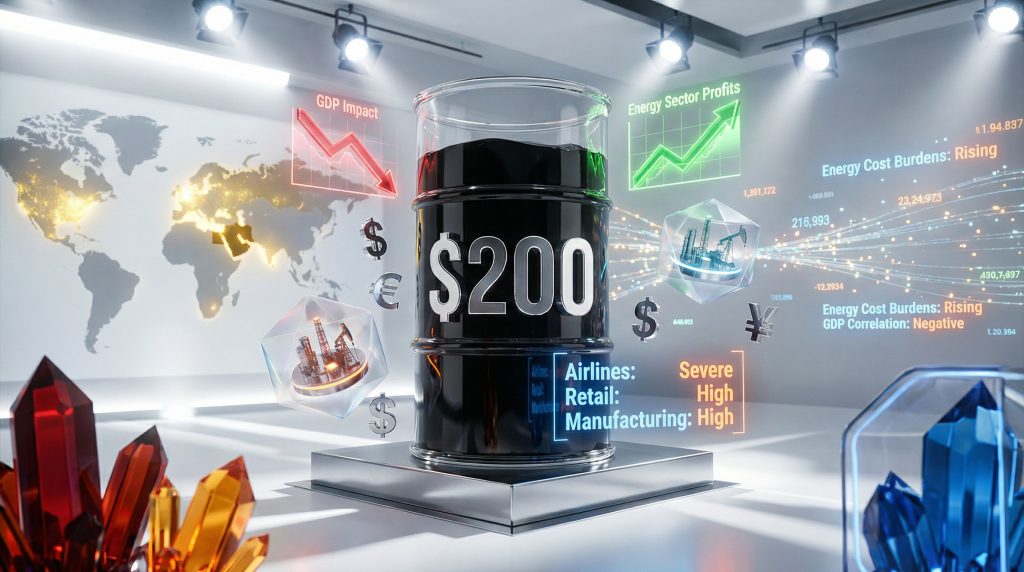
Sector Vulnerability Analysis at $200 Oil
| Sector | Impact Level | Key Risk Factors | Defensive Characteristics |
|---|---|---|---|
| Airlines | Severe | Fuel costs 25-30% of operations | Limited short-term pricing power |
| Retail | High | Consumer spending reallocation | Essential goods category protection |
| Manufacturing | High | Energy input cost inflation | Export market diversification potential |
| Energy Producers | Positive | Revenue multiplication effect | Production capacity constraints |
| Utilities | Moderate | Natural gas correlation | Regulated rate recovery mechanisms |
How Would Central Banks Navigate Stagflationary Oil Shocks?
Monetary policy faces its most complex challenge when energy-driven inflation coincides with growth-threatening economic conditions. Central banks must balance inflation targeting mandates against employment and financial stability objectives under circumstances where traditional policy tools create conflicting outcomes.
The Federal Reserve's Policy Dilemma at Extreme Energy Prices
Historical precedent from the 1970s demonstrates the difficulty of addressing energy-driven stagflation through monetary policy alone. The Federal Reserve's dual mandate creates particular tension when energy shocks simultaneously elevate inflation expectations and threaten employment through demand destruction mechanisms.
Current Fed policy challenges illustrate these complexities, with Australian bond yields reaching 5%, near decade-high levels, as the Reserve Bank of Australia implements consecutive rate increases to combat persistent inflation. Market expectations price in additional policy tightening that could push rates above previous cycle peaks, illustrating the policy response dynamic during inflationary episodes.
International Monetary Coordination During Supply Crises
Coordinated central bank responses become critical when energy shocks threaten global financial stability. The complexity increases when major economies face differential energy exposure, creating divergent policy needs across jurisdictions. Energy-importing nations may require more aggressive monetary tightening while energy exporters might need to manage currency appreciation and inflation from windfall revenues.
Inflation Targeting vs. Growth Protection Trade-offs
The transmission mechanism from higher oil prices operates through multiple channels simultaneously. Elevated energy costs directly increase consumer price indices while reducing household disposable income. This creates the policy challenge where tighter monetary policy might successfully anchor inflation expectations but exacerbate the growth-negative effects of reduced consumer spending power.
"Central banks face unprecedented challenges when energy-driven inflation threatens both price stability and employment simultaneously, requiring careful calibration of monetary responses to avoid amplifying economic contraction while maintaining credibility on inflation targets."
What Are the Macroeconomic Transmission Mechanisms of Oil Price Shocks?
Energy price shocks propagate through economies via interconnected pathways that affect consumer behaviour, business investment decisions, and government fiscal positions. Understanding these transmission mechanisms helps predict the timing and magnitude of economic adjustments during extreme $200 oil scenario conditions.
Consumer Spending Reallocation Patterns
Household responses to sustained energy price increases follow predictable patterns based on income levels and geographic factors. Initial adjustments involve discretionary spending reductions, followed by more fundamental lifestyle changes as higher costs persist.
The Australian economic context illustrates these dynamics, where elevated mortgage rates coincide with rising fuel costs to create compounded household financial pressure. This combination of higher borrowing costs and transportation expenses forces more dramatic consumption adjustments than either factor would create independently.
Regional analysis reveals that economies with extensive suburban development and limited public transportation infrastructure face more severe adjustment pressures. Areas dependent on long commutes or energy-intensive industries experience deeper consumption contractions than urban service centres.
Corporate Profit Margin Dynamics
Business responses to energy cost increases depend on their pricing power and cost structure flexibility. Companies with strong market positions and differentiated products can often pass through higher energy costs to customers with minimal demand impact. Commodity producers and highly competitive industries face more severe margin compression as they cannot easily adjust pricing.
Working capital requirements increase significantly during volatile energy price periods as businesses must finance higher inventory values and manage longer payment cycles. This creates additional financial pressure beyond the direct input cost increases, particularly affecting smaller companies with limited credit access.
Government Fiscal Response Frameworks
Fiscal authorities possess several tools for mitigating energy price shock impacts, though each carries trade-offs and implementation challenges. Strategic petroleum reserve releases can provide temporary market relief but deplete emergency stockpiles. Fuel tax reductions offer direct consumer relief while reducing government revenues during periods when fiscal support may be needed elsewhere.
Emergency economic support programmes typically focus on vulnerable populations and energy-intensive industries, though targeting mechanisms must balance assistance efficiency with administrative complexity. The timing of fiscal responses critically affects their economic impact, as delayed implementation reduces effectiveness while premature intervention might prove unnecessary if market conditions normalise quickly.
Which Investment Strategies Perform During Extreme Energy Price Volatility?
Historical analysis of oil price superspikes reveals consistent patterns in asset class performance and investment strategy effectiveness. Understanding these patterns helps investors prepare portfolios for extreme volatility scenarios while maintaining long-term return objectives.
Asset Class Performance During Historical Oil Crises
Energy sector equities typically outperform during oil price superspikes, though this outperformance often concentrates in companies with existing production rather than exploration-focused businesses. Integrated oil companies with refining operations face complex dynamics as crude oil cost increases can pressure refining margins even while upstream operations benefit.
Fixed income markets experience significant disruption as inflation expectations adjust to higher energy costs. Government bond yields rise as central banks signal policy tightening, creating capital losses for existing bondholders while offering higher prospective returns for new purchases. Corporate bonds face credit quality concerns in energy-sensitive sectors while energy company debt often outperforms.
Currency Market Implications of Energy Price Shocks
Currency markets reflect the differential impact of energy costs across economies. Energy-exporting nations typically experience currency appreciation as trade balances improve, while energy importers face depreciation pressure from deteriorating current accounts and capital outflows.
The U.S. dollar's role as the primary energy trading currency creates complex dynamics during oil price spikes. While higher energy costs can pressure the domestic U.S. economy, increased global dollar demand for energy purchases can support the currency's international value.
Fixed Income Market Dynamics Under Inflationary Pressure
Government bond markets face particular stress during energy-driven inflation episodes. Yields rise to compensate investors for higher inflation expectations, creating mark-to-market losses for existing holders. The Australian 10-year government bond yield reaching 5% illustrates this dynamic, with borrowing costs increasing across all economic sectors.
Duration risk becomes particularly acute during these periods, as longer-term bonds experience greater price volatility from yield changes. Inflation-protected securities often outperform nominal bonds, though their performance depends on the specific inflation indexing mechanisms and investor expectations regarding inflation persistence.
Investment Performance During Energy Crises
"Sharp selloffs during oil crises often create compelling long-term opportunities for investors with adequate liquidity and disciplined rebalancing frameworks, though timing entry points requires patience and risk management discipline."
Current market conditions suggest maintaining focus on balance sheet strength and cash flow resilience rather than growth metrics alone. When government bonds offer 5% yields, equity investments must demonstrate clear risk premium justification through superior return prospects or defensive characteristics.
How Do Different Economic Regions Respond to Oil Price Superspikes?
Regional economic responses to extreme energy prices reflect structural differences in energy dependence, policy frameworks, and economic diversification. These variations create investment opportunities and risks that require geographic analysis beyond simple energy import-export classifications. The impact of OPEC production impact varies significantly across regions based on their energy infrastructure and economic structure.
Energy-Importing vs. Energy-Exporting Nation Dynamics
Energy-importing economies face multiple adjustment channels during oil price superspikes. Current account deficits typically widen as energy import costs increase faster than other trade adjustments can compensate. This creates currency depreciation pressure and potential financing constraints for countries with limited foreign exchange reserves.
Energy-exporting nations benefit from improved terms of trade but face challenges managing sudden wealth increases. Currency appreciation can damage non-energy export competitiveness while domestic inflation may accelerate from increased government spending and wage pressures. Effective management requires countercyclical fiscal policies and sovereign wealth fund accumulation.
Emerging Market Vulnerability Assessment
Emerging market economies face particular vulnerability during energy price shocks due to their typically higher energy intensity, limited fiscal flexibility, and greater sensitivity to capital flow reversals. Countries with significant current account deficits and high foreign currency debt exposure experience compounded stress as energy costs rise and financing conditions tighten.
Policy response capacity varies significantly across emerging markets. Countries with well-developed institutions, diversified economies, and adequate foreign reserves can implement effective stabilisation measures. Those lacking these characteristics may require international financial assistance or face severe economic adjustment pressures.
Developed Economy Resilience Factors
Advanced economies typically demonstrate greater resilience to energy shocks through diversified economic structures, sophisticated financial markets, and extensive policy tool availability. However, this resilience varies based on specific energy dependence patterns and recent economic conditions.
Regional Impact Assessment Matrix
| Region | Energy Import Dependence | GDP Impact Estimate | Policy Response Capacity |
|---|---|---|---|
| United States | Moderate (40% imports) | -2.0% to -3.0% | High (fiscal/monetary coordination) |
| European Union | High (60% imports) | -2.5% to -4.0% | Moderate (coordination challenges) |
| Japan | Very High (95% imports) | -3.0% to -4.5% | High (institutional strength) |
| China | Moderate (70% imports) | -1.5% to -2.5% | High (state capacity) |
| Oil Exporters | Positive (net exporters) | +3.0% to +6.0% | Variable (institutional quality) |
The next major ASX story will hit our subscribers first
What Historical Precedents Exist for $200 Oil Scenarios?
Historical oil price superspikes provide valuable context for understanding potential $200 oil scenario developments, though each episode reflects unique geopolitical and economic circumstances that limit direct comparability to current conditions. Analysis of oil price movements during previous crises helps inform expectations for future extreme price episodes.
1970s Oil Crisis Comparative Analysis
The 1973 Arab oil embargo and 1979 Iranian Revolution created the most severe oil price shocks in modern economic history. The 1973 crisis saw prices quadruple from $3 to $12 per barrel, while the 1979 shock pushed prices from $15 to $40. In inflation-adjusted terms, these peaks approached $200 per barrel in current purchasing power.
Economic responses included severe recessions, persistent inflation, and fundamental changes in energy consumption patterns. The 1970s experience demonstrates how sustained high energy prices can trigger structural economic adjustments including energy efficiency improvements, alternative energy development, and industrial relocation to lower-cost regions.
2008 Price Spike Lessons and Differences
The 2008 oil price spike to $147 per barrel occurred during a global economic boom driven by emerging market demand growth. This episode differed from 1970s crises in that supply constraints were demand-driven rather than geopolitically imposed, and the spike resolved quickly as the financial crisis triggered severe demand destruction.
Key lessons include the role of financial speculation in amplifying price movements and the speed with which demand can adjust when prices reach extreme levels. The 2008 experience also highlighted how oil price spikes can contribute to broader economic instability through their impact on consumer spending and business investment.
Geopolitical Risk Premium Evolution
Modern oil markets incorporate geopolitical risk premiums differently than during previous decades due to changes in market structure, spare capacity levels, and global economic integration. Current spare production capacity runs significantly lower than during previous decades, reducing the system's ability to absorb supply disruptions.
Financial market development has increased the speed and magnitude of price adjustments to geopolitical events, while also providing more sophisticated hedging mechanisms for market participants. This creates both greater volatility and better risk management tools for managing extreme price scenarios.
How Should Investors Position Portfolios for Extreme Oil Price Scenarios?
Portfolio construction for extreme energy price volatility requires balancing defensive positioning with opportunity capture capabilities. Historical precedent suggests that severe market dislocations create compelling long-term opportunities for investors with appropriate preparation and risk management frameworks.
Defensive Asset Allocation Strategies
Quality bias becomes paramount during energy crisis periods as market participants rotate capital toward companies with demonstrated earnings stability and strong balance sheets. Cash positioning serves dual purposes of providing downside protection and maintaining flexibility for opportunistic purchases during market stress.
Current market analysis suggests focusing on businesses with resilient cash flow generation capabilities rather than growth metrics alone. When risk-free government bonds offer 5% yields, equity investments must demonstrate clear value propositions through superior return prospects or defensive business characteristics. Furthermore, investors should consider how extreme oil price scenarios could reshape entire sectors over extended periods.
Sector Rotation Opportunities
Energy sector investment during oil price superspikes requires careful differentiation between beneficiaries and potential value traps. Established producers with low-cost operations benefit most directly, while highly leveraged or exploration-focused companies may face operational constraints that limit their ability to capitalise on higher prices.
Consumer staples companies often demonstrate defensive characteristics during economic stress, though those with significant transportation costs or emerging market exposure may face earnings pressure. Technology companies with subscription-based revenue models typically show greater resilience than those dependent on hardware sales or advertising revenue.
Risk Management Framework Development
Volatility management strategies become crucial during extreme market environments. Position sizing discipline helps prevent individual security losses from materially impacting overall portfolio performance, while rebalancing triggers enable systematic responses to major market movements.
Liquidity preservation takes priority during crisis periods when market functioning may be impaired and investment opportunities emerge quickly. Maintaining adequate cash reserves and avoiding illiquid investments provides flexibility to respond to rapidly changing conditions.
"Successful navigation of extreme energy price scenarios requires preparation rather than reaction, with emphasis on balance sheet analysis, liquidity management, and systematic rebalancing approaches rather than market timing attempts."
What Are the Long-Term Structural Implications of Oil Price Volatility?
Extreme oil price episodes catalyse structural economic changes that persist long after prices normalise. These adjustments affect energy consumption patterns, industrial location decisions, and investment allocation across sectors and regions.
Energy Transition Acceleration Effects
High oil prices accelerate alternative energy adoption by improving the relative economics of renewable energy sources and electric vehicles. Previous oil shocks have triggered significant increases in energy efficiency investments and alternative energy research funding, effects that typically persist even after prices moderate.
Corporate energy strategies shift toward greater self-sufficiency and renewable energy procurement during high price periods. These changes often become permanent as companies recognise the risk management benefits of reduced fossil fuel dependence beyond immediate cost considerations.
Supply Chain Resilience Investment Trends
Extreme energy prices expose supply chain vulnerabilities and encourage reshoring or nearshoring initiatives to reduce transportation costs and improve supply security. These adjustments often prove lasting as companies value supply chain resilience even after energy costs normalise.
Manufacturing location decisions increasingly factor energy costs and supply security alongside traditional considerations like labour costs and market access. This trend accelerates during high energy price periods and typically persists due to the long-term nature of industrial investment decisions.
Monetary Policy Framework Evolution
Central banking approaches to energy price shocks continue evolving based on historical experiences and economic structure changes. Modern central banks demonstrate greater sophistication in distinguishing between temporary energy price effects and broader inflation pressures requiring monetary policy responses.
Financial stability considerations increasingly influence monetary policy during energy crises as policymakers recognise the systemic risks from extreme market volatility and sector-specific stress. This represents an evolution from earlier decades when monetary policy focused primarily on inflation and employment objectives.
How Do Markets Price Tail Risk in Energy Commodities?
Options markets and derivative instruments provide insight into how financial markets assess the probability and potential magnitude of extreme energy price scenarios. Understanding these mechanisms helps investors gauge market sentiment and position for outlier events. Recent analysis suggests that extreme price scenarios are becoming more plausible than previously assumed.
Options Market Volatility Indicators
Energy options markets typically exhibit significant skewness during geopolitical tension periods, with out-of-the-money call options trading at elevated premiums reflecting tail risk concerns. The OVX (oil volatility index) often reaches extreme levels during supply disruption fears, indicating heightened uncertainty about future price paths.
Implied volatility surfaces in energy options demonstrate the market's assessment of various price scenario probabilities. When markets price significant probability for extreme upside moves, it reflects genuine concern about supply disruption scenarios rather than routine volatility expectations.
Futures Curve Dynamics During Crisis Periods
Oil futures curves provide critical information about market expectations regarding disruption duration and supply restoration timelines. Steep backwardation (near-term prices above longer-term prices) typically indicates market belief that current high prices are temporary, while persistent contango suggests structural supply concerns.
The term structure of volatility also reveals market expectations about uncertainty resolution timelines. When short-term volatility significantly exceeds long-term measures, it suggests markets expect clarification of current uncertainties within specific timeframes.
Risk Premium Quantification Methodologies
Academic research on energy risk premiums suggests that geopolitical disruption scenarios command significant premium pricing beyond fundamental supply-demand modelling. These premiums reflect the asymmetric nature of supply disruption risks and the potential for cascading economic effects.
Market-based measures of tail risk include the pricing differential between physical energy markets and financial derivatives, credit default swap spreads for energy companies, and currency option positioning in energy-exporting nations. These indicators collectively provide insight into professional market participants' assessment of extreme scenario probabilities.
Frequently Asked Questions
How quickly can oil markets reach extreme price levels during supply crises?
Historical precedent suggests oil prices can double within 2-3 months during severe supply disruptions, with market psychology and speculative positioning potentially accelerating moves beyond fundamental justification. The 1979 Iranian Revolution saw prices rise from $15 to $40 within six months, while 2008 witnessed rapid acceleration to $147 before demand destruction set in.
Which economies face the greatest vulnerability to extreme oil prices?
Energy-importing nations with limited fiscal flexibility and high current account deficits face the most severe challenges. Emerging market economies with significant foreign currency debt and developed nations heavily dependent on energy imports experience the greatest adjustment pressures during sustained high price periods.
What timeframes typically characterise extreme oil price episodes?
Most historical oil price superspikes resolve within 6-18 months as supply adjustments, demand destruction, and policy responses restore market balance. However, geopolitical crises can extend these timeframes significantly, with the 1970s oil shocks persisting for several years due to ongoing regional conflicts and policy adjustments.
How do central banks typically respond to energy-driven inflation?
Modern central banks increasingly distinguish between temporary energy price effects and broader inflation pressures requiring monetary policy responses. The approach varies based on economic conditions, with greater tolerance for temporary energy price pass-through when unemployment is elevated versus aggressive responses during full-employment conditions.
This analysis incorporates publicly available market data and historical precedent to examine potential economic scenarios. Investment decisions should be based on individual financial circumstances and risk tolerance, with consideration of professional financial advice.
For current energy market developments and real-time price analysis, investors should consult financial news sources and energy market research platforms for up-to-date information on supply disruption scenarios and market conditions.
Disclaimer: The analysis presented contains forward-looking scenarios and speculative elements that involve significant uncertainty. Historical performance does not guarantee future results, and extreme market scenarios may produce outcomes that differ materially from historical precedents. Investors should conduct independent research and consider professional advice before making investment decisions based on extreme market scenarios.
Looking to Capitalise on Energy Market Volatility?
Discovery Alert's proprietary Discovery IQ model delivers instant notifications on significant ASX mineral discoveries, including energy and commodity sectors that often surge during oil price volatility periods. With energy markets facing unprecedented uncertainty and potential supply disruptions, subscribers gain critical insights into actionable trading opportunities that can help navigate extreme market conditions. Begin your 14-day free trial today to position yourself ahead of market-moving discoveries.