May 19, 2026
Supply Chain Fundamentals Drive Lithium Investment Returns
Battery metal demand dynamics present compelling investment opportunities through structural shifts in energy storage and transportation sectors. Furthermore, when you invest in lithium shares, production capacity constraints across global processing facilities create supply bottlenecks that support commodity price stabilisation after the significant declines experienced through 2024-2025.
The sector's investment appeal centres on limited geographic distribution of economically viable deposits and specialised processing capabilities. Hard-rock lithium extraction requires substantial capital investment and technical expertise, whilst brine operations demand multi-year development timelines and specific geological conditions found primarily in South America's lithium triangle.
Critical Market Drivers:
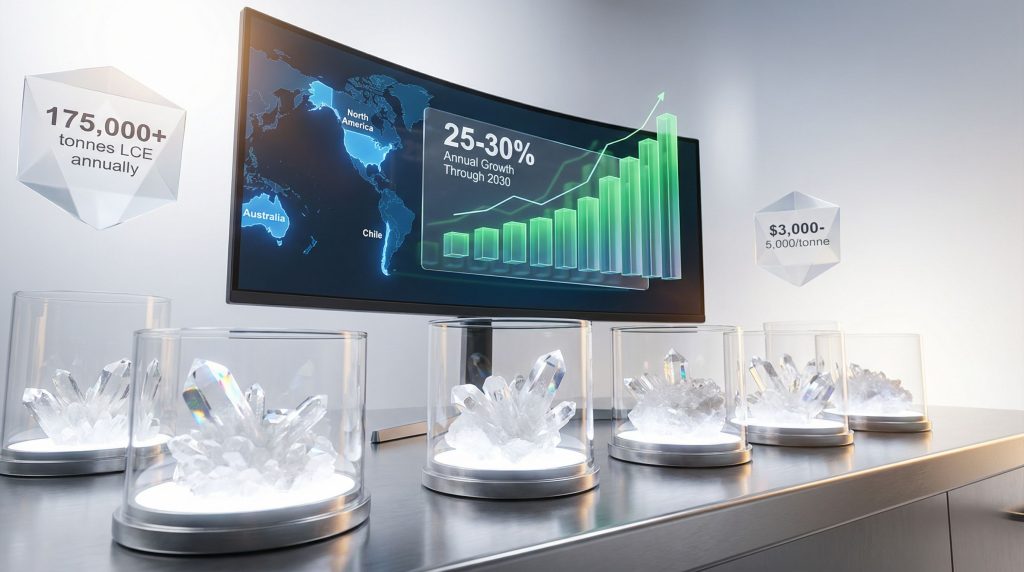
• Electric vehicle battery demand accelerating at 25-30% annually through 2030
• Energy storage installations expanding beyond utility-scale into residential applications
• Processing capacity concentrated in specific regions creating supply chain vulnerabilities
• Chinese demand patterns influencing global pricing despite recent uncertainty signals
Operational Economics Analysis Across Extraction Methods
Understanding production cost structures helps identify sustainable investment opportunities across different mining approaches. Each extraction method carries distinct capital requirements and operational timelines that directly impact investment returns.
| Mining Method | Typical Cash Costs | Production Timeline | Capital Requirements |
|---|---|---|---|
| Brine Operations | $3,000-5,000/tonne LCE | 18-24 months | Moderate |
| Hard Rock Mining | $8,000-12,000/tonne LCE | 6-12 months | High |
| Clay Extraction | $4,000-7,000/tonne LCE | 12-18 months | Moderate-High |
Hard-rock operations demonstrate faster production ramp-up capabilities but require higher initial capital expenditure. Processing represents 60-70% of total operational costs in spodumene conversion, making electricity pricing and processing efficiency critical factors for investment evaluation.
When big ASX news breaks, our subscribers know first
Strategic Investment Approaches for Market Positioning
Direct Equity Exposure versus Portfolio Diversification
Individual stock selection offers higher potential returns from successful operational execution but requires sophisticated commodity cycle timing. Recent market movements demonstrate this volatility, with major producers experiencing price swings exceeding 250% over nine-month periods.
Individual Stock Selection Benefits:
• Direct exposure to specific project development milestones
• Management team quality and operational execution capabilities
• Commodity cycle timing opportunities for entry and exit strategies
• Australian lithium tax breaks providing franking credit advantages for domestic investors
ETF Investment Strategy Advantages:
• Geographic and operational diversification across extraction methods
• Professional rebalancing reduces concentration risks
• Lower individual research requirements for retail investors
• Exposure to entire value chain from exploration to battery technology
Geographic Allocation Considerations
Australia-Focused Investment Strategy:
Australia hosts the world's largest hard-rock lithium reserves, with established mining infrastructure and regulatory frameworks supporting operational development. Western Australian operations benefit from existing port facilities and skilled mining workforces.
Global Exposure Benefits:
International diversification provides access to low-cost South American brine operations and integrated Chinese processing capabilities. Consequently, this approach reduces country-specific regulatory risks whilst accessing different extraction cost structures.
Operational Assessment Framework for Investment Decisions
Production Performance Indicators
Critical metrics for evaluating lithium mining operations include annual production capacity measured in lithium carbonate equivalent (LCE) tonnes, cash costs per tonne production, and processing recovery rates. Resource grade quality determines extraction economics, while reserve life indicates operational sustainability without requiring additional discovery or acquisition.
Key Performance Indicators:
• Annual production capacity (LCE tonnes)
• Cash cost per tonne production
• Resource grade and reserve life estimates
• Processing recovery rate optimisation
• Infrastructure access and logistics cost efficiency
Recent operational improvements at major Australian producers demonstrate the importance of process optimisation. Production guidance upgrades indicate either improved mine performance through higher grades, enhanced recovery rates, or capital efficiency improvements.
Environmental and Regulatory Risk Assessment
Environmental permitting status represents a critical investment risk factor, particularly for new project development. Water access rights and sustainability measures increasingly influence project viability, with hard-rock processing typically requiring 500-1,000 tonnes of water per tonne of lithium produced.
Operational Risk Framework:
• Environmental compliance and permitting timeline
• Water access security and sustainability requirements
• Power supply reliability and cost structures
• Transportation infrastructure and port access
• Community relations and social licence maintenance
Leading Investment Opportunities Analysis
Major Producer Market Position
Albemarle Corporation – Integrated Global Operations:
Market capitalisation ranging $16-22 billion supports its position as the global sector leader. Production capacity exceeding 175,000 tonnes LCE annually across Chile, Australia, and United States operations provides geographic diversification and established customer relationships with major battery manufacturers.
Sociedad Química y Minera – Brine Operations Specialist:
Market capitalisation in the $12-19 billion range reflects its dominant position in Chile's Salar de Atacama, home to some of the world's lowest-cost lithium production. Established infrastructure and processing expertise support long-term supply agreements with automotive manufacturers.
Development Stage Growth Opportunities
Lithium Americas Corporation – North American Development:
Market capitalisation ranging $2-5 billion reflects higher risk/reward profile suitable for growth-oriented portfolios. The Thacker Pass project in Nevada benefits from Inflation Reduction Act incentives and strategic automotive partnerships, though development stage operations carry execution risks.
Australian Market Leadership
Pilbara Minerals – Hard Rock Production Scale:
Pilgangoora operations demonstrate expansion capabilities with direct shipping ore and processing options. Joint venture partnerships reduce individual capital requirements whilst providing exposure to lithium price upside.
Mineral Resources – Diversified Operations Model:
Multiple lithium projects including Wodgina operations benefit from integrated business model spanning lithium, iron ore, energy, and mining services. Recent operational performance demonstrates the diversification advantages, with FY 2026 lithium volume guidance upgrades at both Wodgina and Mt Marion projects.
Production guidance increases from 380,000-420,000 dmt to 450,000-490,000 dmt combined represents 18-31% volume growth. Net debt reduction to approximately $4.9 billion as of December 31, 2025, indicates improved financial positioning despite commodity price volatility.
Portfolio Construction Strategies
Risk-Based Capital Allocation
Conservative Approach (60% allocation):
Focus on established producers with proven cash generation capabilities and dividend potential. Major operators with diversified geographic exposure and integrated processing capabilities provide stability during commodity price cycles.
Balanced Strategy (30% allocation):
Mid-cap developers approaching production milestones offer growth potential with managed risk profiles. In addition, geographic diversification across Australia, North America, and South America reduces country-specific regulatory exposure.
Growth-Oriented Allocation (10% allocation):
Early-stage exploration companies with high-grade resources and technology companies developing extraction innovations carry higher risk but significant upside potential. For instance, battery-grade lithium refinery and processing operations provide alternative exposure to lithium demand growth.
Market Cycle Timing Considerations
Lithium prices typically follow 3-5 year cycles driven by supply-demand imbalances and inventory adjustments. Current market positioning suggests mid-cycle recovery phase, though Chinese demand uncertainty creates near-term volatility risks.
Catalyst-Driven Investment Opportunities:
• Production milestone achievements and guidance upgrades
• Major supply agreement announcements with automotive manufacturers
• Regulatory approvals and environmental permitting progress
• Merger and acquisition activity in consolidating sector
Dollar-cost averaging strategies reduce timing risks whilst quarterly rebalancing based on production updates and price movements allows portfolio optimisation.
Risk Management and Market Monitoring
Commodity Price Volatility Assessment
Recent market movements illustrate significant price volatility risks. Lithium carbonate prices reached two-year highs in January 2026 before declining 15% within days due to Chinese demand concerns. This volatility demonstrates the importance of diversification across extraction methods and geographies.
Price Risk Mitigation Strategies:
• Diversification across different extraction methods and cost structures
• Focus on lowest-cost producers with sustainable long-term operations
• Monitor Chinese policy changes and EV adoption patterns
• Track global battery technology developments and substitution risks
Furthermore, regional market insights provide valuable context for investment decisions. The Argentina lithium insights reveal significant opportunities in South American brine operations.
Technology and Substitution Threats
Long-term competitive threats include alternative battery chemistries reducing lithium intensity requirements and recycling technology improvements affecting primary demand. However, the Chinese battery recycling breakthrough may actually support lithium markets through improved material recovery and circular economy development.
Sodium-ion battery development for specific applications and solid-state battery technology timelines present potential demand displacement risks. However, these technologies remain years away from commercial scale deployment.
Regulatory and Operational Risk Monitoring
Critical Risk Factors:
• Environmental permitting delays and escalating compliance costs
• Water access rights and sustainability requirement evolution
• Indigenous land rights and community consultation processes
• Government royalty and taxation policy modifications
• Currency fluctuation impacts on international operations
The next major ASX story will hit our subscribers first
Exit Strategy Development
Performance Deterioration Signals
Fundamental deterioration indicators include sustained production cost increases above industry averages, resource depletion without replacement reserves, and major environmental compliance failures. Management changes affecting operational execution and significant customer concentration risks materialising also warrant exit consideration.
Market Condition Exit Triggers:
• Lithium prices reaching historical peak valuations relative to production costs
• EV adoption rates significantly below long-term projections
• Major technological breakthroughs threatening lithium demand sustainability
• Macroeconomic conditions reducing discretionary spending on electric vehicles
Tax-Efficient Portfolio Management
Australian investors should consider capital gains tax implications for different holding periods and franking credit optimisation through dividend timing. Loss harvesting opportunities during market downturns and superannuation fund investment structures provide tax-advantaged long-term exposure.
For those seeking exposure to top lithium stocks, comprehensive analysis of operational metrics and market positioning remains essential for successful investment decisions.
Market Psychology and Investment Timing
Professional analyst assessments reflect current market sentiment regarding valuation levels. Recent commentary indicates that strong operational performance and earnings growth expectations are now reflected in share prices, suggesting fully valued conditions at elevated levels.
The 288% share price appreciation experienced by major producers from April 2025 lows to January 2026 highs demonstrates the sector's potential returns during favourable commodity cycles. However, subsequent 15% declines within days illustrate the importance of disciplined entry and exit strategies.
Investment Consideration: Lithium sector investments require careful timing and risk management due to commodity price volatility and evolving demand patterns. Investors should focus on operational excellence, cost leadership, and geographic diversification when selecting individual positions or portfolio allocation strategies.
Understanding extraction method economics, regulatory environments, and technology development timelines enables informed investment decisions in this rapidly evolving sector. Whether through direct equity exposure or diversified fund strategies, successful approaches to invest in lithium shares require balancing growth potential with inherent commodity cycle risks.
The sector continues evolving rapidly, with current market analysis providing regular updates on company performance and investment opportunities. Consequently, when you decide to invest in lithium shares, maintaining awareness of operational developments and market dynamics remains crucial for investment success.
Could You Profit from the Next Major Lithium Discovery?
Discovery Alert's proprietary Discovery IQ model delivers real-time alerts on significant lithium and mineral discoveries across the ASX, instantly empowering subscribers to identify actionable opportunities ahead of the broader market. Understand why historic discoveries can generate substantial returns by exploring Discovery Alert's dedicated discoveries page, showcasing exceptional outcomes from past mineral finds, and begin your 14-day free trial today to position yourself ahead of the market.