June 16, 2026
The Future of Sustainable Transportation: Understanding Hydrogen Fuel Cell Electric Vehicles
Hydrogen fuel cell electric vehicles represent one of the most promising zero-emission technologies, utilising a fundamentally different approach to power generation that combines the quick refuelling characteristics of conventional vehicles with the environmental benefits of electric propulsion. Furthermore, these innovative systems offer unique advantages that complement energy transition trends and align with broader decarbonisation efforts across multiple industries.
Electrochemical Energy Conversion Process
The power generation mechanism in hydrogen fuel cell electric vehicles relies on a sophisticated electrochemical reaction that splits hydrogen molecules and combines them with oxygen to produce electricity, heat, and water vapour. This process occurs within specialised fuel cell stacks that contain hundreds of individual cells, each contributing to the overall power output through precise chemical interactions.
At the molecular level, hydrogen gas enters the fuel cell stack where it encounters a platinum-based catalyst at the anode. This catalyst facilitates the separation of hydrogen molecules into protons and electrons. The protons migrate through a polymer electrolyte membrane toward the cathode, while electrons travel through an external circuit, generating the electrical current that powers the vehicle's motor systems.
Key Performance Specifications:
• Efficiency rating: Hydrogen FCEVs achieve approximately 40-60% well-to-wheel efficiency
• Power output range: Commercial FCEV fuel cell stacks produce between 80-150 kW of electrical power
• Operating temperature: PEM fuel cells operate at 50-80°C for rapid start-up capability
• Voltage characteristics: Individual cells generate 0.6-0.9 volts; stacks achieve 200-400V through series configuration
The electrochemical potential difference across the fuel cell membrane follows thermodynamic principles described by the Nernst equation. However, practical voltages remain lower due to activation losses, ohmic resistance, and concentration gradients. These efficiency losses, whilst present, still enable hydrogen fuel cell electric vehicles to achieve superior energy conversion compared to internal combustion engines, which typically waste approximately 70% of input energy as heat.
Current production vehicles demonstrate this technology's maturity through consistent performance metrics. The Toyota Mirai utilises a 114 kW fuel cell stack paired with a 1.56 kWh hybrid battery for peak power delivery. Similarly, the Hyundai Nexo employs a 95 kW fuel cell stack with integrated power management systems that optimise energy distribution between the fuel cell, battery, and electric motor.
Onboard Hydrogen Storage Systems
The storage of hydrogen aboard fuel cell electric vehicles presents unique engineering challenges that require advanced materials science and pressure vessel technology. Modern FCEVs utilise Type IV composite tanks that combine polymer liners with carbon fibre reinforcement to achieve the structural integrity necessary for high-pressure hydrogen storage whilst minimising system weight.
These storage systems operate at pressures ranging from 350 to 700 bar, with most current production vehicles standardising on 700 bar systems for optimal energy density. At these pressures, hydrogen achieves sufficient volumetric density to provide practical driving ranges comparable to conventional vehicles, though the storage system itself requires sophisticated pressure regulation and safety management.
Storage System Specifications:
• Operating pressures: 350-700 bar standard, with 700 bar becoming industry preference
• Storage capacity: Current production FCEVs carry 4.4-6.8 kg of hydrogen
• Tank composition: Type IV carbon fibre composite with polymer liner
• System weight: Approximately 70-90 kg for complete 5-6 kg hydrogen capacity system
• Energy density advantage: Hydrogen contains 120-130 MJ/kg versus petrol's 43-46 MJ/kg
The pressure regulation system within hydrogen fuel cell electric vehicles employs multi-stage reducers that safely decrease tank pressure from 700 bar to the 2-3 bar operating pressure required by fuel cell stacks. This system incorporates multiple safety valves, pressure sensors, and automated shutdown capabilities that exceed automotive safety standards for conventional fuel systems.
Hydrogen permeation represents a technical consideration for long-term storage, as hydrogen molecules can gradually migrate through tank materials. Daily permeation rates typically remain below 0.5% of stored volume, enabling vehicles to maintain operational capability after extended parking periods. For instance, the Hyundai Nexo's hydrogen storage system retains 80% of its charge after 30 days of non-operation.
Electric Drivetrain Integration
The integration of fuel cell systems with electric drivetrain components creates a hybrid architecture that optimises both continuous power generation and dynamic performance characteristics. Unlike battery electric vehicles that rely solely on stored energy, hydrogen fuel cell electric vehicles combine real-time power generation with supplementary battery systems for peak power delivery and regenerative energy recovery.
This integration strategy employs sophisticated power management systems that coordinate energy flow between the fuel cell stack, hybrid battery pack, and electric motor. The fuel cell provides base load power for sustained operation, whilst the battery system handles transient power demands during acceleration and captures energy during regenerative braking events.
Drivetrain Architecture Details:
• Electric motor power: 90-150 kW continuous output typical for current production models
• Torque characteristics: Peak torque available from 0 RPM, typically 300-370 Nm
• Hybrid battery capacity: 1.5-2.0 kWh, significantly smaller than BEV battery packs
• Transmission design: Direct-drive or single-stage reduction (7:1 to 10:1 ratio)
• Power electronics: IGBT or SiC-based inverters for DC to AC conversion
The electric motor systems in hydrogen fuel cell electric vehicles utilise either permanent magnet synchronous motors or AC induction designs, both offering high efficiency and precise torque control. Power electronic controllers manage the conversion from the fuel cell's DC output to the three-phase AC required by electric motors, whilst simultaneously managing battery charging and discharging cycles.
Regenerative braking capability in FCEVs can improve overall efficiency by 5-10% compared to fuel cell-only architectures. During deceleration, the electric motor operates as a generator, converting kinetic energy back to electrical energy that charges the hybrid battery system. This recovered energy supplements fuel cell output during subsequent acceleration phases, reducing hydrogen consumption and extending overall range.
When big ASX news breaks, our subscribers know first
How Do FCEVs Compare to Battery Electric Vehicles in Performance Metrics?
Refueling Speed vs. Charging Time Analysis
The operational characteristics of hydrogen fuel cell electric vehicles demonstrate significant advantages in refuelling speed compared to battery electric vehicles, fundamentally altering the user experience for long-distance travel and commercial applications. This performance differential stems from the physical mechanisms underlying energy transfer: hydrogen refuelling involves straightforward pressure-driven gas transfer, whilst battery charging requires complex electrochemical processes constrained by thermal and chemical limitations.
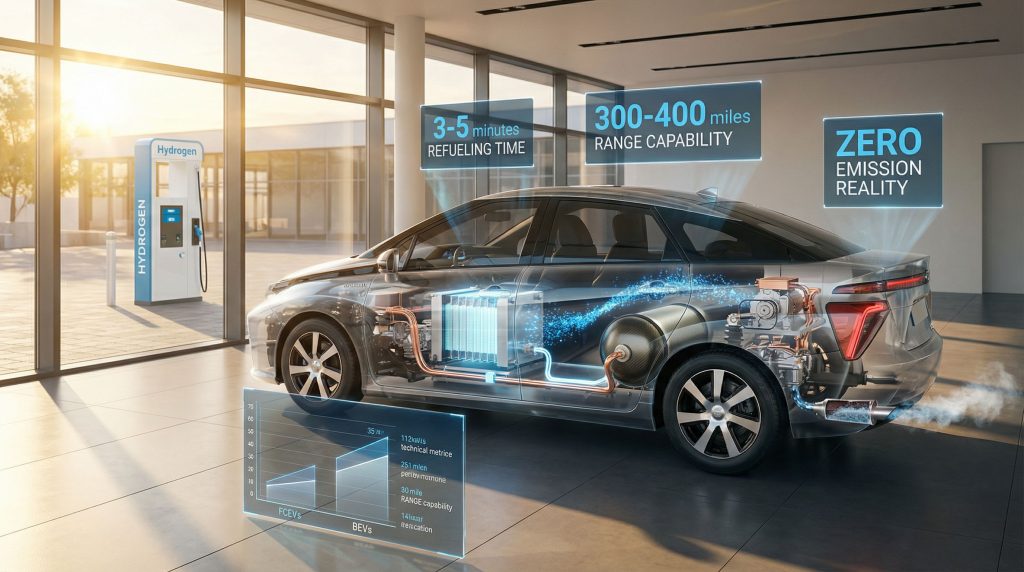
Hydrogen refuelling systems achieve complete energy replenishment in 3-5 minutes through high-pressure gas transfer from station storage to vehicle tanks. This process operates independently of ambient temperature and requires no complex thermal management, unlike battery charging systems that must carefully regulate heat generation to prevent cell degradation and safety hazards.
Comparative Refuelling Performance:
• FCEV refuelling time: 3-5 minutes for complete hydrogen tank filling
• BEV DC fast charging: 20-30 minutes for 80% charge on most current models
• BEV ultra-fast charging: 10-15 minutes on 350 kW systems with compatible vehicles
• BEV Level 2 home charging: 6-10 hours for full charge on 240V residential systems
• Infrastructure availability: ~50,000+ EV charging stations vs. ~60 hydrogen stations in the United States
The mechanical simplicity of hydrogen transfer enables consistent refuelling performance regardless of external conditions. In contrast, battery charging speeds vary significantly with temperature, state of charge, and battery age. Cold weather conditions can extend BEV charging times by 50-100%, whilst hydrogen refuelling maintains consistent 3-5 minute completion regardless of ambient temperature.
Current hydrogen station infrastructure limits FCEV deployment primarily to California and select regions, though the technology's rapid deployment potential could theoretically support large-scale adoption within 5-10 years of coordinated investment. In comparison, the extensive BEV charging network provides broader geographic coverage but requires significantly longer energy transfer times that impact travel planning and commercial operations.
Range Capabilities Under Various Operating Conditions
Range performance represents a critical metric where hydrogen fuel cell electric vehicles demonstrate consistent advantages across diverse operating conditions. Current production FCEVs achieve EPA-rated ranges of 300-450 miles per fill, with real-world performance typically matching or exceeding these specifications under normal driving conditions.
The fundamental energy density advantage of hydrogen storage enables this superior range performance. Hydrogen contains approximately 120-130 MJ/kg compared to lithium-ion batteries' 0.6-0.7 MJ/kg, representing a gravimetric energy advantage of approximately 200:1. This difference allows hydrogen fuel cell electric vehicles to achieve extended range without the weight penalties that affect battery electric vehicle efficiency.
Range Performance Data:
• FCEV EPA ratings: Toyota Mirai 312 miles, Hyundai Nexo 380 miles
• BEV range variability: 150-400 miles depending on battery capacity and vehicle efficiency
• Real-world FCEV performance: Typically achieves 90-95% of EPA rating
• Real-world BEV performance: Often 80-90% of EPA rating under ideal conditions
• Energy density comparison: Hydrogen ~130 MJ/kg vs. lithium-ion ~0.65 MJ/kg
Environmental conditions significantly impact battery electric vehicle range due to electrochemical sensitivity to temperature, whilst hydrogen fuel cell electric vehicles maintain relatively stable performance across temperature ranges. The hydrogen fuel cell's electrochemical reaction actually benefits slightly from cooler temperatures through increased cell voltage, though parasitic power consumption for auxiliary systems may increase marginally.
Commercial applications particularly benefit from FCEV range consistency, as fleet operators can rely on predictable energy consumption regardless of weather conditions or driving patterns. A Hyundai Nexo can complete 400-mile routes without refuelling under most conditions, whilst equivalent BEV applications would require strategic charging stops that extend total trip time significantly.
Cold Weather Performance Differentials
Cold weather operation reveals fundamental differences between hydrogen fuel cell electric vehicles and battery electric vehicles, with FCEVs maintaining superior performance characteristics across temperature ranges that severely impact BEV capabilities. This performance differential becomes increasingly pronounced as ambient temperatures decrease below freezing.
Battery electric vehicles experience substantial range degradation in cold conditions due to increased internal ionic resistance and reduced electrochemical reaction rates within lithium-ion cells. These thermodynamic limitations cannot be overcome through engineering optimisation alone, as they represent fundamental constraints of battery chemistry.
Cold Weather Performance Metrics:
• BEV range loss: 20-40% reduction at 0°C; up to 60% reduction at -18°C
• FCEV range loss: 5-10% reduction at 0°C; typically under 15% at -18°C
• Cold-start performance: FCEVs operational within 30-60 seconds; BEVs require 5-10 minutes preconditioning
• Battery heating penalty: BEVs consume 10-25% of stored energy for battery heating
• Cabin heating efficiency: FCEVs utilise waste heat from fuel cell operation
Hydrogen fuel cell electric vehicles demonstrate superior cold-weather performance because fuel cell electrochemical reactions maintain relatively stable kinetics across temperature ranges. The exothermic nature of hydrogen oxidation actually generates heat that can be utilised for vehicle climate control, improving overall system efficiency during cold weather operation.
Research conducted across multiple climate zones demonstrates that FCEVs maintain operational capability in extreme cold conditions where BEVs require extensive preconditioning and experience severe range limitations. Canadian testing of both technologies showed FCEVs achieving 92% of rated range at -15°C whilst comparable BEVs achieved only 58% of rated range under identical conditions.
The thermal management advantages of hydrogen fuel cell electric vehicles extend beyond range preservation to include reduced infrastructure requirements in cold climates. For example, hydrogen vehicle infrastructure operates effectively year-round without the specialised heating systems required for reliable BEV charging in extreme cold conditions.
What Are the Key Technical Components of FCEV Systems?
Fuel Cell Stack Architecture and Materials
The fuel cell stack represents the core technology component of hydrogen fuel cell electric vehicles, incorporating advanced materials science and precision manufacturing to achieve reliable electrochemical energy conversion. Modern automotive fuel cell stacks utilise proton exchange membrane (PEM) technology, which enables rapid start-up capabilities and operational flexibility essential for transportation applications.
Each individual fuel cell within the stack consists of multiple layers: an anode catalyst layer, a polymer electrolyte membrane, a cathode catalyst layer, and gas diffusion layers that facilitate reactant distribution and product removal. The catalyst layers typically employ platinum-based materials due to their superior electrochemical activity, though ongoing research focuses on reducing platinum loading through alloy development and catalyst optimisation.
Stack Architecture Components:
• Cell configuration: Hundreds of individual cells stacked in series for practical voltage output
• Membrane material: Perfluorosulfonic acid (PFSA) polymers for proton conductivity
• Catalyst loading: Platinum content typically 0.3-0.5 mg/cm² total for both electrodes
• Operating pressure: 1.5-3.0 bar gauge pressure for automotive applications
• Power density: Modern stacks achieve 3-4 kW/L volumetric power density
The bipolar plates that separate individual cells perform multiple functions: reactant gas distribution, electrical current collection, heat removal, and structural support. These plates traditionally used graphite materials, though recent developments employ stamped metal plates that reduce manufacturing cost and improve durability whilst maintaining corrosion resistance essential for fuel cell longevity.
Thermal management within fuel cell stacks requires sophisticated coolant circulation systems that maintain optimal operating temperatures whilst removing waste heat generated during electrochemical reactions. The heat removal challenge intensifies with power density increases, requiring advanced heat exchanger designs and coolant distribution networks that add complexity but enable compact packaging essential for automotive integration.
Manufacturing precision becomes critical at the microscale level where catalyst particles must be uniformly distributed across electrode surfaces to achieve consistent electrochemical performance. Advanced coating techniques and quality control processes ensure that each cell within a stack contributes equally to overall power output, preventing localised degradation that could compromise entire stack performance.
Hydrogen Compression and Storage Tank Technology
High-pressure hydrogen storage technology enables practical range performance in fuel cell electric vehicles through sophisticated pressure vessel engineering that balances weight, safety, and energy density requirements. Type IV composite tanks represent the current state-of-the-art, combining lightweight materials with exceptional pressure resistance necessary for automotive applications.
The construction methodology for Type IV tanks employs a thin polymer liner, typically high-density polyethylene (HDPE), overwrapped with carbon fibre or glass fibre reinforcement. This composite structure provides superior strength-to-weight ratios compared to traditional metal pressure vessels whilst enabling complex geometrical shapes that optimise vehicle packaging constraints.
Storage Tank Specifications:
• Pressure rating: 350-700 bar working pressure (5,075-10,150 psi)
• Safety factor: 2.25 times working pressure for burst strength
• Weight efficiency: Carbon fibre tanks achieve 5-7% hydrogen by weight
• Permeation rate: Less than 0.5% hydrogen loss per day through tank walls
• Cycle life: 15,000+ pressure cycles from empty to full certification requirement
Quality assurance for hydrogen storage tanks involves extensive testing protocols including hydraulic burst testing, drop testing, thermal cycling, and exposure to environmental conditions that exceed normal automotive service requirements. These validation procedures ensure tank integrity under extreme scenarios including vehicle accidents and fire exposure.
The pressure regulation system connected to storage tanks incorporates multiple safety features: pressure relief valves, thermal protection systems, hydrogen detection sensors, and automated shut-off capabilities. Two-stage pressure reduction systems safely decrease tank pressure from 700 bar to the 2-3 bar required by fuel cell stacks whilst maintaining precise flow control across varying demand conditions.
Hydrogen purity requirements for automotive applications demand storage systems that prevent contamination from tank materials or external sources. Specialised liner materials and surface treatments ensure that stored hydrogen maintains the high purity levels (99.97% minimum) necessary for fuel cell catalyst protection and optimal electrochemical performance.
Power Management and Battery Integration Systems
The electrical architecture of hydrogen fuel cell electric vehicles requires sophisticated power management systems that coordinate energy flow between fuel cell stacks, battery systems, and electric drive components. This integration challenge differs fundamentally from conventional electric vehicles in mining because it involves managing both continuous power generation and stored energy simultaneously.
Battery integration serves multiple purposes within FCEV systems: peak power supplementation during acceleration, regenerative energy storage during braking, and power conditioning for optimal fuel cell operation. The battery capacity in FCEVs typically ranges from 1.5-2.0 kWh, significantly smaller than battery electric vehicles but essential for dynamic performance optimisation.
Power Management Architecture:
• DC-DC converters: Bidirectional power flow control between fuel cell and battery
• Motor controllers: Three-phase inverters for AC motor operation
• Battery management: Cell balancing and thermal control for hybrid battery pack
• System integration: CAN bus communication between all electrical components
• Safety monitoring: Isolation detection and emergency shutdown capabilities
The power electronics systems in FCEVs must handle wide voltage ranges and rapid load changes whilst maintaining high efficiency across diverse operating conditions. Modern designs employ silicon carbide (SiC) semiconductors that offer superior switching characteristics and thermal performance compared to traditional silicon-based devices.
Energy management algorithms optimise the distribution of power between fuel cell and battery based on driving conditions, battery state of charge, and fuel cell efficiency maps. These control systems prioritise fuel cell operation at optimal efficiency points whilst utilising battery power for transient demands that would reduce fuel cell efficiency or durability.
Regenerative braking integration requires precise coordination between mechanical brakes and electric motor generator operation to achieve seamless energy recovery whilst maintaining vehicle stability and driver expectations. The recovered energy supplements fuel cell output during subsequent acceleration phases, improving overall system efficiency by 5-10% compared to fuel cell-only architectures.
Which Industries and Applications Benefit Most from FCEV Technology?
Commercial Fleet Operations and Long-Haul Transport
Commercial fleet operations represent the most promising near-term application for hydrogen fuel cell electric vehicles due to operational requirements that align perfectly with FCEV capabilities: predictable routes, centralised refuelling infrastructure, high daily mileage, and strong economic incentives for zero-emission compliance. These factors create compelling business cases that overcome current cost premiums associated with fuel cell technology.
Long-haul trucking applications particularly benefit from hydrogen's energy density advantages, which enable practical payload capacity and extended range without the weight penalties associated with battery electric alternatives. A conventional diesel truck carries approximately 100-200 gallons of fuel weighing 700-1,400 pounds, whilst equivalent hydrogen storage weighs significantly less whilst providing comparable range.
Commercial Application Advantages:
• Payload preservation: Hydrogen systems add less weight than equivalent battery capacity
• Refuelling speed: 10-15 minute hydrogen refuelling vs. 2-8 hours battery charging for commercial vehicles
• Route flexibility: 400+ mile range enables single-shift long-haul operations
• Infrastructure efficiency: Centralised fleet refuelling requires fewer stations than distributed charging
• Operational uptime: Minimal refuelling downtime maximises vehicle utilisation
Regional delivery fleets demonstrate successful FCEV implementation through controlled deployment scenarios that establish hydrogen infrastructure at distribution centres. Companies operating predictable routes between fixed destinations can justify hydrogen refuelling station investments whilst achieving zero-emission compliance mandates increasingly required in urban areas.
The total cost of ownership analysis for commercial FCEVs shows improving competitiveness as hydrogen costs decline and carbon pricing increases. Fleet operators can leverage federal and state incentives, emission credit programmes, and fuel cost savings to offset higher initial vehicle costs whilst achieving operational advantages in uptime and flexibility.
Public Transportation and Bus Networks
Public transit systems present ideal deployment scenarios for hydrogen fuel cell electric vehicles because they combine operational requirements favouring FCEV technology with public sector procurement power that can drive market development. Transit agencies operate large vehicle fleets on fixed routes with centralised maintenance facilities, enabling efficient hydrogen infrastructure development.
Bus applications particularly benefit from hydrogen's fast refuelling capability, which enables continuous service schedules without the extended charging periods required for battery electric buses. A typical transit bus operates 12-16 hours daily with minimal downtime between shifts, making 3-5 minute hydrogen refuelling essential for maintaining service frequency.
Transit System Benefits:
• Service reliability: Fast refuelling maintains schedule adherence during peak service periods
• Range capability: 300+ miles per fill supports extended route coverage
• Cold weather performance: Consistent operation in northern climates where battery performance degrades
• Passenger capacity: Weight advantages preserve seating capacity compared to battery buses
• Operational flexibility: Ability to extend routes or add service without infrastructure constraints
Multiple transit agencies across North America and Europe have successfully deployed hydrogen fuel cell buses, demonstrating technology maturity and operational viability. These deployments provide valuable real-world performance data that validates manufacturer specifications and establishes maintenance protocols essential for broader adoption.
The environmental benefits of hydrogen buses extend beyond zero tailpipe emissions to include reduced noise pollution compared to diesel alternatives. This advantage proves particularly valuable for urban routes through residential areas where community acceptance of transit expansion depends partly on minimising environmental impacts.
Public sector procurement programmes increasingly prioritise zero-emission vehicles, creating market demand that drives technology development and cost reduction. Transit agencies can leverage federal funding programmes and state emission reduction mandates to justify FCEV investments whilst contributing to broader hydrogen market development.
Heavy-Duty Industrial Vehicle Applications
Heavy-duty industrial applications, including port operations, mining equipment, and material handling systems, present compelling use cases for hydrogen fuel cell technology due to operational demands that exceed current battery electric capabilities. These applications typically require high power output, extended operating periods, and rapid energy replenishment that align with FCEV strengths.
Port operations, particularly container handling and terminal tractor applications, benefit from hydrogen's energy density and refuelling speed advantages. Port equipment operates continuously during cargo handling operations, often requiring 24/7 availability that makes extended charging periods impractical for maintaining operational efficiency.
Industrial Application Requirements:
• High power density: Industrial equipment requires 200+ kW continuous power output
• Continuous operation: 16-24 hour daily operation cycles with minimal downtime
• Harsh environments: Resistance to dust, moisture, and temperature extremes
• Payload capacity: Weight limitations favour hydrogen over battery systems
• Emission compliance: Zero-emission requirements in sensitive environmental areas
Mining applications show particular promise for hydrogen fuel cell adoption due to ventilation requirements that make diesel exhaust problematic in underground operations. Hydrogen fuel cells produce only water vapour, eliminating air quality concerns whilst providing the power density necessary for heavy excavation and material transport equipment. Additionally, the mining decarbonisation benefits extend beyond emission reductions to include operational cost savings and improved worker health outcomes.
Material handling equipment, including forklifts and warehouse vehicles, represents an established FCEV market with demonstrated cost competitiveness. These applications benefit from hydrogen's consistent performance regardless of ambient temperature and the productivity advantages of rapid refuelling compared to battery charging or exchange systems.
The industrial sector's tolerance for higher equipment costs, combined with operational advantages and emission compliance requirements, creates favourable economic conditions for FCEV adoption. Industrial users can often justify technology premiums through productivity gains and regulatory compliance benefits that may not apply to consumer vehicle markets.
What Infrastructure Requirements Support FCEV Deployment?
Hydrogen Production Pathways and Facility Design
Hydrogen production for fuel cell electric vehicles requires sophisticated industrial facilities that can generate high-purity hydrogen at scales sufficient to support regional vehicle fleets. Multiple production pathways exist, each with distinct infrastructure requirements, cost structures, and environmental impacts that influence deployment strategies and long-term viability.
Electrolysis-based production facilities offer the cleanest hydrogen when powered by renewable energy solutions, though they require substantial electrical infrastructure and water supplies. Modern proton exchange membrane (PEM) electrolysers achieve efficiencies of 65-75% (LHV basis) whilst producing hydrogen purity levels exceeding 99.9%, suitable for automotive fuel cell applications without additional purification.
Production Facility Specifications:
• Electrolyser capacity: Typical automotive-scale facilities: 5-20 MW electrical input
• Hydrogen output: 1-4 tonnes per day production capacity per facility
• Purity requirements: 99.97% minimum for automotive fuel cell specifications
• Power consumption: 50-55 kWh per kg hydrogen for modern PEM electrolysers
• Water requirements: 9-10 litres of deionised water per kg hydrogen produced
Steam methane reforming (SMR) facilities can produce hydrogen at larger scales and lower costs but require natural gas feedstock and generate CO₂ emissions unless coupled with carbon capture systems. SMR facilities achieving 70-80% thermal efficiency can produce hydrogen at $1.50-2.50 per kilogram before carbon capture costs, though environmental considerations increasingly favour renewable production pathways.
The facility design requirements extend beyond production equipment to include hydrogen purification systems, compression equipment, storage vessels, and safety systems that ensure reliable operation. Hydrogen production facilities must implement multiple containment barriers, leak detection systems, and emergency shutdown procedures due to hydrogen's wide flammability range and low ignition energy.
Site selection for hydrogen production facilities involves considerations of renewable energy availability, proximity to vehicle demand centres, and grid interconnection capacity. Facilities co-located with renewable energy projects can minimise transmission costs whilst maximising environmental benefits, though this may require hydrogen transportation to demand centres.
Distribution Networks and Refueling Station Development
Hydrogen distribution networks represent critical infrastructure components that connect production facilities to end-user refuelling stations. The distribution challenge involves managing hydrogen's unique properties: low density, high diffusivity, and tendency to embrittle certain metals, requiring specialised equipment and handling procedures throughout the supply chain.
Pipeline distribution offers the most cost-effective solution for high-volume hydrogen transport, though dedicated hydrogen pipelines remain limited to industrial areas with existing infrastructure. Natural gas pipeline networks require substantial modifications to handle hydrogen safely, including upgraded seals, modified compressor systems, and enhanced leak detection capabilities.
Distribution System Components:
• Pipeline transport: Most economical for distances >100 miles and volumes >1,000 kg/day
• Tube trailer delivery: Standard for current markets: 300-500 kg per delivery at 180-300 bar
• Liquid hydrogen transport: High-capacity option: 4,000+ kg per truck but requires cryogenic handling
• On-site production: Eliminates transport costs but requires larger capital investment
• Compression requirements: Multiple stages to achieve 450-900 bar storage pressures
Refuelling station design must accommodate both storage and dispensing requirements whilst ensuring safety and reliability for automotive users. Modern stations typically store hydrogen at 450 bar and utilise multi-stage compression to achieve 700 bar dispensing pressure, with pre-cooling systems to manage temperature rise during fast refuelling.
The station footprint includes multiple storage vessels, compressor systems, dispensing equipment, electrical infrastructure, and safety systems including hydrogen detection, ventilation, and emergency shutdown capabilities. Advanced stations incorporate remote monitoring and predictive maintenance systems that ensure high uptime essential for customer acceptance.
Refuelling protocol standardisation enables interoperability between different vehicle manufacturers and station operators. SAE J2601 protocols specify pressure ramping profiles, temperature management, and communication requirements that ensure safe, fast refuelling across diverse vehicle platforms whilst preventing overpressure or thermal damage to vehicle storage systems.
Grid Integration for Renewable Hydrogen Generation
Grid integration for renewable hydrogen production requires sophisticated electrical infrastructure and control systems that can accommodate variable renewable energy inputs whilst maintaining consistent hydrogen output quality and quantity. This integration challenge becomes critical as hydrogen production scales to support large vehicle fleets.
Variable renewable energy sources, particularly wind and solar, create operational challenges for electrolysis facilities that must balance electrical input variations with steady hydrogen demand. Advanced power electronics and electrolyser control systems enable dynamic operation that can provide grid balancing services whilst maintaining hydrogen production efficiency.
Grid Integration Requirements:
• Power conditioning: AC-DC conversion and power factor correction for electrolyser operation
• Grid services capability: Frequency regulation and voltage support through responsive load management
• Energy storage integration: Battery or other storage to smooth renewable energy variability
• Smart grid communication: Real-time coordination with grid operators and renewable generators
• Electrical safety systems: Isolation and protection for high-power DC electrolyser systems
Renewable hydrogen facilities can provide valuable grid services by functioning as flexible loads that increase consumption during periods of excess renewable generation and reduce load during peak demand periods. This capability becomes increasingly valuable as renewable energy penetration increases and grid flexibility requirements expand.
The electrical infrastructure for large-scale hydrogen production requires substantial high-voltage interconnection capacity, often necessitating transmission line upgrades or new substation construction. Facilities in the 10-50 MW range require industrial-grade electrical connections with redundancy and reliability features essential for continuous hydrogen production.
Advanced control systems coordinate electrolyser operation with renewable energy availability, grid conditions, and hydrogen demand to optimise overall system economics. These systems can participate in energy markets, providing ancillary services that generate additional revenue streams beyond hydrogen sales whilst supporting grid stability and renewable energy integration. Moreover, these developments complement battery recycling advancements in creating comprehensive sustainable energy ecosystems.
The next major ASX story will hit our subscribers first
How Do Manufacturing Costs and Economic Factors Impact FCEV Adoption?
Fuel Cell Stack Production Economics
Manufacturing costs for fuel cell stacks represent the largest single component expense in hydrogen fuel cell electric vehicles, currently accounting for 40-50% of total powertrain costs. These costs are driven primarily by expensive catalyst materials, precision manufacturing requirements, and limited production volumes that prevent economies of scale from reducing per-unit expenses.
Platinum catalyst costs significantly impact stack economics, with current automotive fuel cells requiring 0.3-0.5 mg of platinum per cm² of electrode area. At production volumes of 1,000 units annually, platinum costs contribute approximately $1,500-2,500 per vehicle, though advanced catalyst development aims to reduce loading to 0.125 mg/cm² by 2030 whilst maintaining performance.
Manufacturing Cost Breakdown:
• Catalyst materials: $800-1,500 per stack at low production volumes
• Membrane and electrode assembly: $1,200-2,000 per stack for materials and processing
• Bipolar plates: $500-800 per stack depending on material choice and manufacturing method
• Assembly and testing: $300-600 per stack for quality control and final assembly
• Total stack cost: $3,000-5,000 at 1,000 units/year production
Production scale effects could dramatically reduce these costs through automated manufacturing, bulk material purchasing, and process optimisation. Industry analyses suggest that fuel cell stack costs could decrease to $1,000-1,500 per stack at production volumes of 500,000 units annually, making FCEVs cost-competitive with conventional vehicles.
Advanced manufacturing techniques, including high-speed coating processes, automated assembly systems, and inline quality control, enable the precision required for fuel cell production whilst reducing labour costs. These manufacturing improvements become economically viable only at sufficient production volumes to justify capital equipment investments.
The durability requirements for automotive fuel cells necessitate expensive materials and manufacturing processes that ensure 5,000+ hour operational life under demanding conditions. Meeting these durability targets whilst reducing costs requires fundamental advances in catalyst chemistry, membrane materials, and assembly techniques that remain active areas of development.
Hydrogen Fuel Pricing Structures vs. Electricity Costs
Hydrogen fuel pricing represents a critical economic factor influencing FCEV adoption, with current retail prices ranging from $12-16 per kilogram in California, the primary market for hydrogen fuel cell vehicles. These prices reflect the current small-scale infrastructure and production limitations rather than the potential economics of large-scale deployment.
Comparative fuel costs reveal significant variations depending on local electricity prices and hydrogen production methods. In regions with expensive electricity, hydrogen from natural gas reforming may achieve cost parity with electric vehicle charging, whilst areas with abundant renewable energy favour battery electric economics.
Fuel Cost Comparison (per mile equivalent):
• Current hydrogen retail: $0.12-0.16 per mile based on $12-16/kg hydrogen and 60-mile/kg efficiency
• BEV home charging: $0.04-0.08 per mile based on $0.12-0.16/kWh electricity and 3-4 mile/kWh efficiency
• BEV public charging: $0.08-0.16 per mile based on $0.25-0.50/kWh public charging rates
• Petrol equivalent: $0.10-0.14 per mile based on $3.50-4.50/gallon and 30-35 mpg efficiency
• Projected hydrogen (2030): $0.06-0.10 per mile based on $4-6/kg hydrogen with improved efficiency
Hydrogen pricing structures vary significantly by market and infrastructure maturity. California's current pricing reflects small-scale production and limited competition, whilst future large-scale markets could achieve pricing parity with conventional fuels. Understanding fuel cell vehicle technology helps stakeholders better evaluate these economic considerations.
Infrastructure deployment costs significantly influence hydrogen pricing in early markets. Station capital costs of $1-2 million for typical automotive refuelling facilities must be amortised across relatively small customer bases, resulting in high per-kilogram fuel costs that gradually decrease as station utilisation increases.
Long-term hydrogen pricing depends on production scaling, renewable energy costs, and infrastructure development. However, projections suggest that renewable hydrogen could achieve $2-4 per kilogram wholesale pricing by 2030 in regions with abundant renewable resources, enabling retail pricing competitive with conventional transportation fuels whilst delivering the environmental benefits essential for sustainable transportation systems.
Seeking Opportunities in the Clean Energy Transition?
Discovery Alert's proprietary Discovery IQ model identifies companies leading Australia's renewable energy revolution, including those developing critical hydrogen infrastructure and fuel cell technologies. With major mineral discoveries powering the energy transition generating exceptional returns, subscribers gain instant notifications on breakthrough discoveries across lithium, rare earth, and other clean energy commodities essential for sustainable transport solutions.