July 23, 2026
The Strategic Context: Syria's Energy Renaissance Through International Alliances
Global energy markets increasingly recognise that economic reconstruction requires systematic infrastructure development rather than opportunistic resource extraction. Syria's positioning within the Eastern Mediterranean energy corridor reflects this broader trend, where offshore exploration partnerships serve as foundation elements for long-term regional supply chain integration. The Syria oil exploration deal with Chevron exemplifies this strategic approach to energy sector rehabilitation. Furthermore, the Mediterranean basin contains significant untapped hydrocarbon potential that could fundamentally alter Middle Eastern energy dynamics over the next decade.
Current production metrics reveal the scale of Syria's energy sector transformation requirements. Before 2011, Syrian oil output reached approximately 386,000 barrels per day, establishing the country as a meaningful regional producer. Today's production levels fluctuate between 80,000-100,000 barrels daily, representing a structural decline that offshore development partnerships aim to address through entirely new resource base development. However, understanding these trade war oil price dynamics remains crucial for evaluating long-term project viability.
Key Strategic Recovery Indicators:
- Pre-conflict peak production: 386,000 barrels/day
- Current stabilised output range: 80,000-100,000 barrels/day
- War-period production nadir: 20,000-40,000 barrels/day
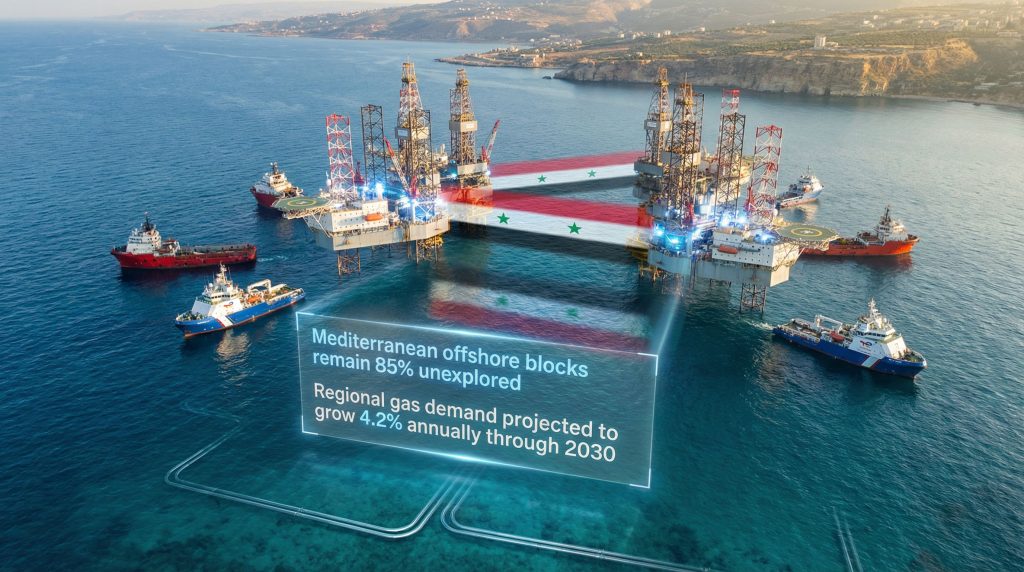
- Offshore blocks remain largely unexplored frontier territory
- Regional gas demand growth projections support long-term development planning
Technical Infrastructure Requirements
Modern offshore energy development in the Eastern Mediterranean demands sophisticated technical capabilities that distinguish frontier exploration from conventional onshore rehabilitation projects. These requirements include advanced deepwater drilling systems capable of operating in 1,000-2,000 metre water depths, floating production infrastructure for real-time gas processing, and subsea pipeline networks connecting offshore discoveries to onshore processing terminals.
The technical complexity extends beyond basic drilling operations to encompass integrated geological modelling systems, environmental compliance monitoring frameworks, and production optimisation technologies. Legacy seismic datasets from previous Syrian exploration activities require reprocessing and validation against current acquisition standards, creating additional technical integration challenges for international partnership structures.
When big ASX news breaks, our subscribers know first
What Makes Syria's Offshore Blocks Attractive to Major Energy Companies?
Geological Advantages in the Levant Basin
Syria's Mediterranean coastline positions the country within the prolific Levant Basin petroleum system, sharing fundamental geological characteristics with proven Israeli discoveries. The U.S. Geological Survey's comprehensive basin assessment estimates 122 trillion cubic feet of undiscovered technically recoverable gas resources alongside approximately 1.7 billion barrels of oil potential across the broader regional system.
This geological framework delivered major commercial discoveries including Israel's Tamar field (10 TCF reserves) and Leviathan field (22 TCF reserves), demonstrating the basin's capacity to support large-scale energy development projects. However, frontier exploration risk remains significant, as evidenced by Lebanon's recent drilling experience in adjacent blocks.
Comparative Regional Exploration Performance:
| Country | Exploration Wells Drilled | Commercial Discoveries | Success Rate |
|---|---|---|---|
| Israel | 12 | 8 | 67% |
| Cyprus | 8 | 3 | 38% |
| Lebanon | 2 | 0 | 0% |
| Syria | 0 | TBD | Frontier Status |
Levant Basin Petroleum System Characteristics
The underlying petroleum system demonstrates consistent source rock distribution across national boundaries, with Mesozoic and Palaeozoic organic-rich formations providing hydrocarbon generation capacity. Migration pathways through Oligo-Miocene sandstone carrier beds create connectivity between source areas and potential trap geometries in Tertiary structural sequences.
Technical System Components:
- Source Rocks: Palaeocene Senonian shale formations with proven generation capacity
- Reservoir Quality: Tertiary sandstone and carbonate sequences
- Trap Geometries: Structural anticlines and stratigraphic pinch-out configurations
- Seal Integrity: Aquitanian and Burdigalian clay-dominated formations
- Migration Systems: Fault-controlled and carrier bed pathways
However, Lebanon's recent Qana well results demonstrate that geological similarity does not guarantee commercial success. The TotalEnergies-Eni-QatarEnergy consortium encountered gas volumes that failed commerciality thresholds, illustrating the harsh realities of frontier exploration even within proven petroleum systems.
Deepwater Technical Environment
Eastern Mediterranean offshore development occurs within challenging technical environments that require specialised equipment and operational expertise. Water depths typically range from 1,000-2,000 metres, with potential ultra-high pressure regimes exceeding 20,000 psi at target depths in mature basin areas.
Platform selection depends on resource size estimates, environmental conditions, proximity to existing infrastructure, and cost tolerance parameters. Options include Floating Production Storage and Offloading (FPSO) systems, fixed platforms, or subsea tie-back configurations to onshore processing facilities.
Which International Players Are Positioning for Syria's Energy Future?
American Energy Majors: Strategic Market Entry
The recent Syria oil exploration deal with Chevron represents calculated risk assessment rather than opportunistic speculation. According to NBC News, the company signed a memorandum of understanding with Syria's state oil company and Qatar's Power International Holding in early February 2026, covering data access and technical assessment activities without drilling commitments or production timeline obligations.
This measured approach reflects frontier exploration risk management principles, where international operators conduct comprehensive technical evaluation before capital deployment. Chevron's involvement does not alter Syria's current oil output levels but establishes framework conditions for potential future development decisions.
Chevron's Regional Portfolio Context:
- Libya: Recent block awards following 20-year licensing hiatus
- Egypt: Established upstream operational presence
- Mediterranean: Emerging offshore technical expertise
- Syria: Frontier assessment and data evaluation phase
The Libya connection proves particularly relevant, as Chevron recently secured exploration blocks after two decades without new licensing rounds. This demonstrates the company's strategic interest in North African and Eastern Mediterranean resource opportunities within carefully structured risk parameters.
Gulf State Investment Patterns
Qatar's participation through Power International Holding brings sophisticated long-cycle capital deployment capabilities to Syrian offshore evaluation. Qatari involvement provides access to advanced LNG liquefaction technologies, established European gas marketing networks, and financial capacity for extended exploration timelines that characterise frontier basin development.
Qatar's Strategic Technical Assets:
- Advanced gas processing and liquefaction expertise from North Field development
- European market access through established trading relationships
- Long-cycle capital tolerance for frontier exploration programmes
- Technical integration capabilities for complex offshore projects
Qatar's approach differs fundamentally from conventional oil majors by emphasising gas monetisation strategies over crude oil development. This focus aligns with Syria's offshore potential, where gas discoveries appear more probable than large-scale oil accumulations based on regional exploration results.
How Do Geopolitical Factors Shape Investment Decisions?
Sanctions Architecture and Compliance Frameworks
Current U.S. sanctions relief mechanisms permit limited energy sector engagement under carefully defined conditions. Technical assessment and geological data evaluation activities receive authorisation, while drilling operations require additional licensing procedures and revenue sharing arrangements subject to Treasury Department oversight protocols. Moreover, understanding tariff economic implications becomes essential for evaluating project economics.
Compliance Risk Management Structure:
| Risk Category | Mitigation Strategy | Timeline Impact |
|---|---|---|
| Regulatory | Phased licensing approach | 12-18 months additional |
| Political | Multi-party partnership structures | Ongoing assessment |
| Technical | Staged exploration programmes | 24-36 months extended |
| Financial | Escrow and oversight arrangements | Project duration |
Equipment transfers and technical service provisions operate under case-by-case approval systems that create operational complexity but maintain compliance pathway availability. International partners structure agreements to minimise sanctions exposure while preserving development option value.
Regional Power Dynamics
Syria's energy development occurs within multilateral regional relationships that influence partnership structures and operational parameters. Turkey maintains focus on Kurdish territorial control rather than Syrian oil sector participation, while Iran provides downstream technical support without expansion of production capacity. Additionally, broader global trade disruption patterns affect regional energy market dynamics.
Regional Actor Positioning:
- Turkey: Infrastructure corridor control and Kurdish containment priorities
- Iran: Legacy downstream support and logistics network maintenance
- Russia: Military presence with limited commercial energy involvement
- Israel: Security monitoring focused on Iranian activity restrictions
- Saudi Arabia/UAE: Conditional engagement limited to offshore evaluation
Israel's activities remain calibrated toward degrading Iranian logistical capabilities rather than influencing Syrian production ownership structures. This creates operational space for international partnerships that avoid Iranian military supply route intersection.
What Are the Economic Implications for Regional Energy Markets?
Supply Chain Integration Opportunities
Syrian offshore gas development could integrate with existing regional infrastructure networks, creating supply diversification opportunities for European energy security planning. Potential connections include Arab Gas Pipeline linkages to Jordan and Egypt, Turkish distribution network access, and Mediterranean pipeline routes serving European demand centres. Consequently, investors must also consider oil price rally insights when evaluating project timing.
However, infrastructure investment requirements present significant capital deployment challenges. Industry estimates suggest $15-25 billion in total development costs for comprehensive offshore field development, processing facilities, and export infrastructure construction.
Market Integration Pathways:
- Arab Gas Pipeline network connections (existing infrastructure)
- Turkish natural gas distribution system integration (conditional)
- Mediterranean export pipeline development (new construction required)
- LNG export terminal possibilities (major capital requirement)
Competitive Market Positioning
Syrian gas faces established competition from Algeria, Egypt, and other Mediterranean suppliers currently serving European markets. Geographic proximity provides transportation cost advantages versus Central Asian pipeline supplies, while political diversification benefits support European energy security objectives.
Competitive Analysis Framework:
Strategic Advantages:
- Proximity to European demand centres reduces transportation costs
- Political diversification value for European supply security
- Integration potential with existing Middle Eastern pipeline networks
- Geological proven potential within established petroleum system
Development Challenges:
- Infrastructure investment requirements exceed $20 billion
- Regulatory approval timelines typically span 5-7 years
- Competition from established Mediterranean suppliers
- Technical risks inherent in frontier exploration programmes
How Will Production Timelines Affect Global Energy Security?
Development Phase Projections
Syrian offshore energy development follows extended timelines characteristic of frontier basin exploration and development programmes. Initial phases emphasise technical assessment and resource evaluation before capital-intensive drilling and infrastructure construction decisions.
Phase 1: Technical Assessment (2026-2028)
- Comprehensive seismic survey programmes and geological mapping
- Historical data reprocessing and integration with modern acquisition
- Environmental baseline studies and regulatory framework development
- Partnership structure finalisation and financing arrangements
Phase 2: Exploration Drilling (2028-2030)
- Initial exploration well drilling programmes in priority prospects
- Resource assessment and commerciality threshold evaluation
- Field development planning and infrastructure design optimisation
- Market access negotiations and export pathway establishment
Phase 3: Commercial Development (2030-2035)
- Offshore platform installation and subsea infrastructure construction
- Pipeline networks and onshore processing facility development
- Production ramp-up and initial gas processing operations
- Export market integration and long-term supply contract execution
These timelines assume continued political stability, sustained international partnership support, and successful navigation of complex regulatory approval processes. Technical delays or geopolitical complications could extend development schedules significantly. Furthermore, tariffs impact on investments could influence financing availability throughout these phases.
The next major ASX story will hit our subscribers first
What Investment Models Are Emerging for Syrian Energy Projects?
Public-Private Partnership Structures
Syrian energy development employs hybrid investment frameworks that balance state ownership requirements with international technical expertise and capital access needs. The state petroleum company retains majority ownership positions while international partners contribute specialised technologies and financing capabilities.
Investment Structure Comparison:
| Partnership Model | Capital Requirements | Risk Profile | Development Timeline |
|---|---|---|---|
| Traditional PSC | $20-30 billion | High | 15-20 years |
| Staged Development | $5-8 billion initial | Medium-High | 10-15 years |
| Technical Service | $2-3 billion | Medium | 7-10 years |
Revenue sharing mechanisms operate through production milestone achievement rather than upfront capital recovery, aligning international partner interests with successful field development outcomes. Risk allocation follows staged investment commitment structures that limit early-phase capital exposure while preserving development option value.
Technology Transfer Mechanisms
International partnerships facilitate comprehensive technology transfer across multiple technical disciplines essential for successful offshore development. These include advanced drilling and completion technologies, subsea production system expertise, gas processing and liquefaction capabilities, and environmental monitoring frameworks.
Technical Capability Transfer Areas:
- Deepwater drilling and completion technologies
- Subsea production and processing system integration
- Advanced reservoir management and optimisation
- Environmental compliance and safety system implementation
- Real-time geological modelling and production forecasting
Knowledge transfer extends beyond equipment provision to encompass operational training programmes, maintenance protocols, and long-term technical support arrangements that sustain project operations over multi-decade development cycles.
Conclusion: Syria's Strategic Energy Transformation
Syria's offshore energy partnerships represent a calculated approach to economic reconstruction through international collaboration rather than conventional resource extraction strategies. The combination of proven geological potential within the Levant Basin, strategic Mediterranean positioning, and carefully structured investment frameworks creates conditions for meaningful energy sector expansion. As reported by Petroleum Australia, Syria has enlisted major international partners for its first offshore development initiative.
Success depends on maintaining political stability across extended development timelines, securing sustained international partnership support through changing geopolitical conditions, and executing technically complex offshore projects within challenging regulatory environments. The Mediterranean's energy landscape increasingly incorporates Syrian participation as a significant variable in regional supply security calculations.
However, frontier exploration risks remain substantial. Lebanon's recent drilling experience demonstrates that geological proximity to successful fields does not guarantee commercial discovery outcomes. Multiple exploration wells across several years will be required to establish resource commerciality and development viability.
Critical Success Metrics for Monitoring:
- Initial exploration well results and resource volume confirmation
- International partnership stability and potential expansion
- Infrastructure development progress and financing milestone achievement
- Regional market integration advancement and export capacity establishment
- Regulatory framework evolution and sanctions relief sustainability
The Syria oil exploration deal with Chevron and Qatar represents early-stage positioning within a potentially transformative regional energy development programme. Commercial outcomes remain years away, but partnership structures now being established could determine Syria's role in Mediterranean energy markets for decades to come.
Investment Disclaimer: This analysis is for informational purposes only and does not constitute investment advice. Energy sector investments, particularly in frontier exploration and geopolitically sensitive regions, involve substantial risks including total loss of capital. Readers should conduct independent research and consult qualified financial advisors before making investment decisions.
Ready to Invest in the Next Major Mineral Discovery?
Discovery Alert instantly alerts investors to significant ASX mineral discoveries using its proprietary Discovery IQ model, turning complex mineral data into actionable insights. Understand why historic discoveries can generate substantial returns by visiting Discovery Alert's dedicated discoveries page, showcasing historic examples of exceptional outcomes, and begin your 14-day free trial today to position yourself ahead of the market.