
June 21, 2026
Why Distressed Coal Assets Keep Attracting Serious Buyers
The global metallurgical coal market operates on a fundamentally different logic than thermal coal. While power station coal faces an accelerating structural decline tied to the energy transition, coking coal — the higher-grade product used to make steel — remains deeply embedded in industrial supply chains that have no near-term substitute. Steel production still depends on metallurgical coal prices in the blast furnace process, and that dependency is not disappearing within the decade-long timeframes that matter to mine operators and asset buyers today.
This dynamic helps explain something that surprised many observers during the Tahmoor Colliery sale process: despite the mine sitting idle for more than 18 months, despite its former owner's empire collapsing under the weight of billions in global debt, and despite more than 500 workers losing their jobs in the chaos that followed, more than 20 parties expressed interest in acquiring the asset. That level of competitive tension for a mothballed, court-ordered liquidation sale reflects the underlying quality of the resource, not the circumstances surrounding it.
The Tahmoor Colliery sale to new owners is now complete in commercial terms, with the transaction pending state and federal government approvals. Understanding what this means for the mine's future requires looking beyond the headline and into the geology, the ownership structure, the economics of restart, and the human dimension that often gets lost in corporate announcements.
When big ASX news breaks, our subscribers know first
The Asset Itself: Why Tahmoor Retains Premium Value
Hard Coking Coal and Its Place in the Steelmaking Chain
Not all coal is equal, and Tahmoor's product sits near the top of the quality hierarchy. The mine produces hard coking coal, which is a critical input in the blast furnace steelmaking process. When iron ore is converted to steel, coking coal is transformed into coke — a carbon-dense material that acts simultaneously as a fuel and a chemical reducing agent inside the furnace. Hard coking coal produces coke with the high strength, low reactivity, and low sulphur characteristics that steelmakers require for efficient, high-volume production.
This quality distinction matters enormously in pricing terms. Hard coking coal typically commands a substantial premium over semi-soft coking coal and an even larger premium over thermal coal. Furthermore, when China steel demand strengthens globally, it is the hard coking coal producers who benefit most directly.
Geological Position and Infrastructure Access
Tahmoor sits in the NSW Southern Highlands, southwest of Sydney, within the Southern Coalfield — a geological basin that has produced high-quality coking coal for over a century. The mine operates as an underground operation, extracting coal from seams that have historically delivered product with the low-ash, low-sulphur characteristics demanded by international steelmakers.
Critically, the mine's proximity to Port Kembla provides a direct export pathway to Asian steel markets. Port Kembla handles coal exports from the Illawarra and Southern Coalfield regions and is less than 100 kilometres from the Tahmoor site — a logistical advantage that reduces handling costs and simplifies the supply chain.
The current mining lease provides approximately 9 to 10 years of remaining mine life under authorised boundaries, according to MEU South Western District secretary Andy Davey as reported by the ABC. For a well-capitalised operator, this represents a commercially viable horizon against which to justify restart project economics.
The Financial Collapse That Created the Opportunity
GFG Alliance's Structural Weakness Exposed
The story behind the Tahmoor Colliery sale to new owners begins not with the mine itself but with the peculiar corporate architecture of GFG Alliance, the conglomerate controlled by British billionaire Sanjeev Gupta. GFG built its empire through a model of acquiring distressed industrial assets and financing them through Greensill Capital's supply chain finance vehicles. When Greensill collapsed in March 2021, the liquidity mechanism that kept GFG's global operations functioning effectively seized up.
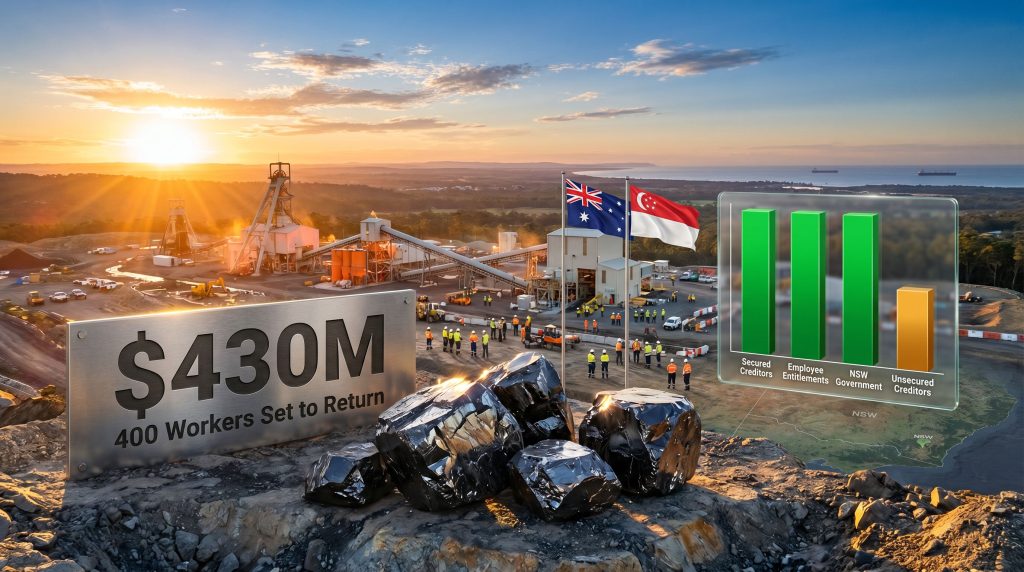
The consequences for Tahmoor were ultimately fatal. By the time the NSW Supreme Court ordered the mine into liquidation, total claims against the operation had reached $430 million. Of that figure, approximately $250 million represented related-party debt — money owed within GFG's own network rather than to independent commercial lenders. This internal debt structure is significant because it suggests the mine's operational performance was not necessarily the driver of its insolvency.
An asset can be economically viable while being financially unviable if the debt structure layered on top of it is unsustainable. This distinction was not lost on the market. The competitive interest from over 20 parties indicates that sophisticated buyers recognised the gap between the asset's intrinsic value and the distressed circumstances of its sale.
The Sequence of Collapse: A Compressed Timeline
The deterioration moved through distinct phases that ultimately left hundreds of workers without employment:
-
Pre-February 2026 — The mine had been inactive for over a year. Unions publicly called on Gupta to accept a reported $350 million offer, which remained unaccepted.
-
February 2026 — A last-minute voluntary administration was initiated, widely interpreted as an attempt to prevent a forced liquidation and preserve the former owner's influence over the sale outcome.
-
March 2026 — The NSW Supreme Court ordered the mine into formal liquidation. McGrathNicol was appointed as liquidator. Within days, 238 permanent employees received redundancy notices, following the earlier loss of more than 250 contractor roles in November 2025.
-
March to June 2026 — A formal competitive sale process attracted interest from over 20 parties before the GEAR and M Resources consortium emerged as the successful bidder.
The New Consortium: Operational Credibility as the Differentiator
Why Buyer Identity Matters in a Mining Restart
The identity of the acquirer in a distressed mine sale carries operational weight beyond the transaction price. A financial buyer with no mining experience faces months of additional delays sourcing management teams, establishing contractor relationships, and navigating regulatory frameworks. An experienced operator can move through the restart process substantially faster because the institutional knowledge, workforce relationships, and regulatory familiarity already exist.
This was a genuine concern during the Tahmoor sale process. The MEU publicly expressed worry that an inexperienced overseas owner could acquire the asset and struggle to execute a restart efficiently. The outcome addressed that concern directly.
Golden Energy and Resources (GEAR): The Strategic and Financial Backbone
GEAR is a Singapore-based resources group majority owned by the Widjaja family, one of Indonesia's most prominent industrial dynasties with extensive interests across commodities, infrastructure, and manufacturing. GEAR's coal sector credentials are substantial:
- Holds majority ownership of Stanmore Resources Ltd, a Queensland-based metallurgical coal producer with operations in the Bowen Basin
- Maintains a 50% interest in Ravenswood Gold in Australia, demonstrating multi-commodity operational experience
- Brings the balance sheet depth required to fund restart capital expenditure without relying on external financing that might delay operations
M Resources: Local Knowledge and Market Access
M Resources, wholly owned by Brisbane-based mining executive Matt Latimore, provides the consortium with a different but equally critical set of capabilities. The company specialises specifically in metallurgical coal investment and global marketing — meaning it understands both how to operate these assets and how to sell the product into international steelmaking markets.
M Resources operates across multiple international jurisdictions and brings domestic regulatory familiarity that an offshore-only buyer would lack. Latimore's existing relationship with GEAR through their GM3 joint venture also means the consortium governance and decision-making structures are already tested and functional. In addition, mining asset consolidation of this kind has become an increasingly deliberate strategy in Australia's coal sector.
The Illawarra Consolidation Pattern
The Tahmoor acquisition is not an isolated transaction. When viewed alongside the GM3 consortium's 2024 takeover of both the Appin Coal Mine and Dendrobium Coal Mine in the nearby Illawarra region, a deliberate geographic consolidation strategy becomes apparent.
| Asset | Location | Acquired By | Year |
|---|---|---|---|
| Appin Coal Mine | NSW Illawarra | GM3 (GEAR + M Resources) | 2024 |
| Dendrobium Coal Mine | NSW Illawarra | GM3 (GEAR + M Resources) | 2024 |
| Tahmoor Colliery | NSW Southern Highlands | GEAR + M Resources | 2026 (pending approvals) |
Controlling multiple underground metallurgical coal operations within a single geographic corridor creates potential operational synergies: shared maintenance contractors, coordinated logistics to Port Kembla, consolidated regulatory relationships, and cross-trained workforces. The consortium was also reported among bidders for the Whyalla Steelworks sale process, suggesting an appetite for integrated positions across the steelmaking supply chain.
What the Restart Actually Involves
The Hidden Complexity of Underground Coal Recommissioning
Surface mines can be restarted with relative speed. Underground coal operations are considerably more complex, particularly after an extended idle period. When a longwall or bord-and-pillar mine sits inactive for 18 months or more, several degradation processes occur simultaneously:
- Ventilation system integrity deteriorates as equipment sits idle, with seals and fans requiring thorough inspection before any personnel can safely enter the workings
- Gas accumulation must be assessed and managed, as methane and other gases can build to hazardous concentrations in unventilated sections
- Ground support in roadways and working areas may have shifted or degraded, requiring re-assessment before normal traffic can resume
- Water ingress can damage electrical infrastructure and compromise floor conditions in underground roadways
- Conveyor systems and surface infrastructure require mechanical inspection and certification after extended dormancy
These are not bureaucratic formalities. They are genuine safety requirements, and they take time regardless of how motivated all parties are to move quickly.
Realistic Timeline to First Coal
The MEU estimated a minimum of 12 to 16 weeks from commencement of the restart process before coal production could realistically resume. This estimate assumes regulatory approvals are obtained promptly and no significant infrastructure issues emerge during safety inspections.
| Restart Milestone | Estimated Duration |
|---|---|
| Government approvals secured | Weeks to months post-settlement |
| Initial workforce rehiring and inductions | Concurrent with approvals |
| Underground safety and gas inspections | 2 to 4 weeks after access |
| Equipment recommissioning and certification | 4 to 6 weeks |
| First coal production | 12 to 16 weeks minimum from commencement |
The 12 to 16 week estimate from the union assumes a best-case regulatory scenario. Any delays in approval processing extend this timeline directly, as no meaningful restart activity can begin until the required authorisations are in place.
Creditor Recovery and Worker Entitlements
Who Gets Paid What
One of the more significant outcomes of the sale process is the creditor recovery profile. Liquidator Shaun Fraser confirmed the following expected outcomes, as reported by the ABC:
| Creditor Category | Expected Recovery |
|---|---|
| Secured creditors | Full recovery |
| Employee entitlements | Full recovery |
| NSW government | Full recovery |
| Unsecured creditors | Partial recovery |
The full recovery of employee entitlements is particularly important. Workers who faced redundancy through no fault of their own — many of whom had long service with the mine — will receive their full statutory and contractual entitlements rather than the reduced recoveries that unsecured creditors often face in liquidations of this scale.
Worker Rehiring: What the Commitment Means in Practice
The new owners have formally stated their intention to prioritise rehiring from the former workforce. Practically, this means:
- Workers with existing competencies and site-specific experience avoid the weeks-long training and induction periods required for new hires
- The existing enterprise agreement remains in force, meaning returning workers resume under previously negotiated pay rates and conditions without renegotiation
- The major onsite contractor R-Star is expected to continue operating under the new ownership, providing additional continuity for the contractor workforce
- Workers who relocated to Mudgee, Newcastle, and Queensland to maintain employment during the shutdown would be in a position to return home
The MEU indicated that approximately 400 workers are expected to return to the area, with significant flow-on effects for local businesses, housing, and community services in the Tahmoor region.
The next major ASX story will hit our subscribers first
The Broader Signal for Distressed Mining Asset Markets
The competitive dynamics of the Tahmoor sale carry lessons that extend beyond this single transaction. When a court-ordered liquidation of a mothballed underground mine attracts bids from more than 20 parties, it demonstrates that institutional and strategic capital continues to see long-term value in high-quality metallurgical coal assets, even as policy narratives increasingly emphasise the transition away from coal.
The distinction that matters here is product quality. Thermal coal used for electricity generation faces genuine structural headwinds. Hard coking coal used in steelmaking occupies a different position in the energy transition debate, because no commercially viable alternative to coal-based coke has been deployed at scale in blast furnace steelmaking. Furthermore, green steel economics using hydrogen direct reduction exist and are advancing, but their cost curves and production volumes remain well below what would be required to displace conventional steelmaking within Tahmoor's remaining lease life.
For asset buyers and industry observers, the Tahmoor Colliery sale to new owners reinforces a clear pattern: distressed sales of quality metallurgical coal assets tend to attract experienced operators rather than financial buyers, the creditor recovery outcomes in these processes can be surprisingly strong when the asset fundamentals are sound, and regional economic impacts from workforce reinstatement can be substantial even for relatively small operations by global standards.
Disclaimer: This article is intended for informational purposes only and does not constitute financial advice. Projections, timelines, and recovery estimates referenced in this article are based on publicly available statements and third-party reporting. Readers should conduct their own due diligence before making any investment or business decisions related to the mining sector or assets discussed.
Want To Stay Ahead of Significant ASX Mineral Discoveries Before the Broader Market Reacts?
Discovery Alert's proprietary Discovery IQ model delivers real-time alerts on significant ASX mineral discoveries, transforming complex geological and market data into actionable investment insights for both short-term traders and long-term investors — explore historic examples of major discovery returns to understand the scale of opportunity, then begin your 14-day free trial at Discovery Alert to secure your market-leading edge.