
June 18, 2026
When Infrastructure Fails Underground: The Human Cost of Tailings Dam Collapse
Across the global mining industry, the most catastrophic losses of life rarely stem from the act of extraction itself. They emerge instead from the failure of the infrastructure built around it. Tailings dams, engineered to contain the fine-grained waste slurry generated during ore processing, represent one of the most consequential structural risks in all of resource extraction. When they fail, the consequences underground can be immediate, total, and irreversible.
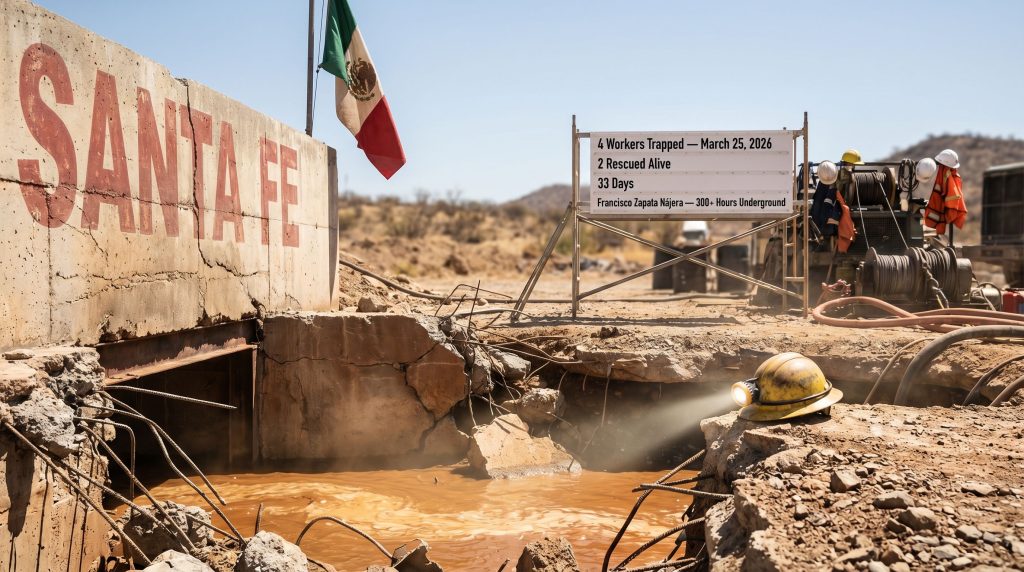
Consequently, this is the context in which four workers at the Santa Fe gold mine in El Rosario, Sinaloa, Mexico found themselves on March 25, 2026. What followed was a 33-day operation that became a measure of both the extraordinary endurance of the human body and the systemic vulnerabilities that continue to define underground mining in Latin America. When the fourth worker found dead at the Santa Fe mine was finally recovered on April 27, 2026, it brought a grim conclusion to one of Mexico's most closely watched mining rescue operations in recent years.
When big ASX news breaks, our subscribers know first
What a Tailings Dam Failure Actually Means Underground
To understand what happened at Santa Fe, it helps to understand what tailings dams are and why their failure is so uniquely dangerous to underground workers.
A tailings dam is not a conventional water dam. It is an engineered embankment constructed progressively over the life of a mine to hold the slurry left over after ore has been processed and valuable minerals extracted. This material, known as tailings, is a dense mixture of fine rock particles, process water, and residual chemicals. The dam raises in stages as the tailings volume grows, meaning the structure is continuously evolving and under constant pressure.
When structural integrity is compromised, whether through seepage, foundation instability, overtopping, or inadequate monitoring, the dam can release enormous volumes of material with very little warning. For underground workers operating beneath or adjacent to these structures, the result can be rapid, catastrophic flooding of working areas. Unlike surface workers who may have space to evacuate, underground miners face confined pathways, limited visibility, and the constant risk of tunnel collapse compounding an already dire situation.
Key factors that increase the danger in underground environments during a tailings dam failure include:
- Rapid displacement of breathable air by water and slurry in confined spaces
- Compromised communication infrastructure between underground workers and surface teams
- Blocked or flooded egress routes preventing escape
- Loss of structural ceiling and wall integrity in excavated tunnels near the failure zone
- Oxygen depletion over extended periods of entrapment
Understanding mine reclamation and risk is equally essential, as the long-term management of exhausted sites directly influences the structural pressures placed on active tailings infrastructure during a mine's operational life.
A Chronology of the Santa Fe Rescue Operation
The sequence of events at the Santa Fe gold mine unfolded over a period that tested the limits of both rescue technology and human biology.
| Date | Event |
|---|---|
| March 25, 2026 | Tailings dam failure floods underground workings; four miners trapped |
| March 30, 2026 | First miner successfully recovered alive, five days after the collapse |
| April 7, 2026 | Francisco Zapata Nájera, 42, rescued alive after more than 300 hours underground |
| Shortly after April 7, 2026 | Third miner located and recovered, confirmed deceased |
| April 27, 2026 | Leandro Isidro Beltrán Reséndiz, 54, recovered deceased, ending 33 days of operations |
The recovery of Francisco Zapata Nájera after more than 300 consecutive hours underground stands as a remarkable case of human survival under extreme physiological stress. Fox Weather's coverage of the rescue captured the moment Zapata Nájera was brought to the surface, highlighting the exceptional nature of his survival. Extended underground entrapment exposes individuals to oxygen-depleted atmospheres, hypothermia risk from ground water contact, psychological deterioration from sensory isolation, dehydration, and the cumulative physical toll of immobility in confined spaces.
Globally, the 2010 Copiapó rescue in Chile remains the benchmark case for extended underground survival, with 33 miners enduring 69 days below ground before all were extracted alive. The Santa Fe rescue of two survivors alongside two fatalities reflects a more common and grimmer statistical reality for smaller, less-resourced mining operations.
The confirmation that the fourth worker found dead at the Santa Fe mine was 54-year-old Leandro Isidro Beltrán Reséndiz closed a chapter that had kept communities in Sinaloa and across Mexico's mining regions watching anxiously for over a month.
The Broader Pattern: Tailings Dam Failures Are Not Isolated Events
The Santa Fe incident did not occur in isolation. Tailings dam failures represent a well-documented, statistically recurring category of infrastructure disaster within the global mining industry. The pattern over recent decades tells a clear story about what happens when monitoring, maintenance, and engineering standards are not consistently applied.
| Incident | Location | Year | Outcome |
|---|---|---|---|
| Mariana Dam Collapse | Brazil | 2015 | 19 fatalities, severe environmental damage |
| Brumadinho Dam Failure | Brazil | 2019 | 270+ fatalities |
| Mount Polley Breach | Canada | 2014 | Major environmental damage, no fatalities |
| Mina El Comal | Mexico | 2023 | 10 miners trapped, outcome unresolved |
| Santa Fe Mine | Mexico, Sinaloa | 2026 | 2 fatalities, 2 rescued alive |
A recurring characteristic across these incidents is the gap between the existence of internationally recognised safety standards and their actual implementation. The Global Industry Standard on Tailings Management, known as the GISTM, was developed following the Brumadinho disaster and published in 2020. It sets requirements across dam design, structural monitoring, emergency preparedness, and independent review. The International Council on Mining and Metals has also established comprehensive safety benchmarks for member companies. However, neither framework carries universal mandatory application, particularly for smaller operators and regional mines in developing jurisdictions.
Why Smaller Operations Face Higher Structural Risk
The risk profile of tailings dam failure is not evenly distributed across the industry. Several structural disadvantages disproportionately affect smaller and mid-tier operations:
- Under-investment in continuous structural integrity monitoring, particularly real-time sensor networks
- Limited access to satellite-based monitoring technologies such as InSAR (Interferometric Synthetic Aperture Radar), which can detect millimetre-scale ground deformation weeks before a visible failure
- Deferred maintenance cycles driven by thin operating margins
- Geographic isolation reducing access to qualified geotechnical engineering expertise
- Regulatory capacity constraints in the relevant state or national authority
Furthermore, the broader challenge of mining waste management at these smaller sites compounds the structural risk, as tailings volumes continue to grow while the engineering resources to manage them safely remain constrained.
Notably, tools now exist that are capable of flagging early structural deterioration in tailings facilities well ahead of critical failure. InSAR monitoring, when combined with real-time piezometer data and ground deformation modelling, can provide actionable early warning timelines measured in weeks, not hours. The limiting factor in many cases is not the technology's availability but the operator's commitment and financial capacity to deploy it consistently.
Mining Magazine's own reporting has highlighted technology claimed to predict tailings failures up to two months in advance, underscoring how far predictive capability has advanced relative to actual deployment rates in the field.
Mexico's Mining Safety Landscape: Systemic Pressures
Mexico is one of Latin America's largest producers of gold, silver, copper, and zinc, with hundreds of active mining operations spanning a wide range of scales and ownership structures. The regulatory authority responsible for worker safety at mine sites falls primarily under the Secretaría del Trabajo y Previsión Social, or STPS, with additional oversight from state-level authorities and the Comisión Nacional de Seguridad in emergency response scenarios.
Comparing Regional Mining Safety Outcomes
When placed alongside regional peers, Mexico's underground mining safety record reveals both the scale of the challenge and the distance still to travel:
- Chile has invested significantly in mine safety reform since the 2010 Copiapó disaster, resulting in improved refuge chamber requirements and rescue readiness protocols
- Peru has faced persistent enforcement challenges at artisanal and small-scale mine sites, though larger formal operators have adopted international safety benchmarks more consistently
- Brazil implemented sweeping regulatory changes following the Brumadinho collapse, including mandatory real-time monitoring and independent review for high-consequence dams
- Mexico has seen recurring incidents at regional and smaller operations, with enforcement capacity varying significantly by geography and operator size
The Pasta de Conchos disaster of 2006, in which 65 miners were killed in a coal mine explosion in Coahuila with the site never fully excavated, remains a defining moment in Mexican mining history. Two decades later, the structural conditions that enabled that tragedy, including enforcement gaps at isolated regional operations, have not been comprehensively resolved. In addition, the mining industry evolution occurring across Latin America has yet to translate into consistently improved safety outcomes at the smaller end of the operational spectrum.
What Follows a Fatal Mining Incident in Mexico
When a fatal incident occurs at a Mexican mine, a sequence of mandatory regulatory and legal processes is initiated. Federal and state authorities must be notified immediately. The site is typically suspended pending investigation, with the STPS leading the examination of circumstances, safety compliance history, and operator conduct.
Beyond the immediate investigation, operators face several categories of potential consequence:
- Criminal liability if negligence in maintaining structural safety infrastructure is established
- Civil compensation obligations to the families of deceased workers under Mexican labour law
- Operational suspension of the affected site, potentially extending to related operations
- Regulatory remediation orders requiring infrastructure upgrades before resumption of work
- Increased ESG scrutiny from investors and international partners who monitor safety performance as a governance indicator
The growing prominence of ESG frameworks in global mining investment has added a new dimension to safety accountability. International institutional investors increasingly evaluate safety incident records as a material risk indicator, creating financial incentives for operators to adopt higher standards voluntarily rather than wait for regulatory compulsion. Consequently, the mining sustainability transformation underway across the sector is beginning to reshape how boards and executives perceive the financial consequences of inadequate infrastructure investment.
The next major ASX story will hit our subscribers first
The Latin American Mine Rescue Comparison
Placing the Santa Fe incident within the regional landscape of mine disasters and rescue operations reveals a sobering pattern of disparity.
| Incident | Country | Year | Trapped | Fatalities | Rescue Duration |
|---|---|---|---|---|---|
| Copiapó Mine Rescue | Chile | 2010 | 33 | 0 | 69 days |
| Pasta de Conchos | Mexico | 2006 | 65 | 65 | N/A (unresolved) |
| Mina El Comal | Mexico | 2023 | 10 | 10 | Ongoing at time of reporting |
| Santa Fe Mine | Mexico, Sinaloa | 2026 | 4 | 2 | 33 days |
The Copiapó rescue succeeded in part because of substantial state-level resource mobilisation, international technical assistance, and the presence of pre-installed refuge chambers that provided survivors with an initial survival window. The contrast with outcomes at smaller Mexican operations where such infrastructure is absent or underfunded is stark.
Pre-installed refuge chambers, emergency oxygen supply caches, and hardened underground communication systems are widely recognised in mine safety literature as critical survival infrastructure. Their implementation rate across Latin American underground operations, particularly at smaller regional mines, remains inconsistently low.
The Push for Reform: Technology, Policy, and Accountability
Following every high-profile incident, calls for reform intensify. The pattern after the Santa Fe collapse followed a familiar trajectory: labour organisations demanded mandatory real-time tailings monitoring at all active Mexican mine sites, safety advocates renewed arguments for independent third-party structural audits, and legislators considered proposals to increase penalties for operators found negligent in maintaining safety infrastructure.
Whether these calls translate into durable regulatory change depends on factors that extend well beyond the incident itself, including political will, enforcement capacity, and the ability of affected communities to sustain pressure on decision-makers over time.
What the four workers at the Santa Fe mine experienced, and what the fourth worker found dead at the Santa Fe mine ultimately represents, is not simply a tragic industrial accident. It is a measurable consequence of choices made long before March 25, 2026, about what level of investment in structural safety is acceptable at a regional gold mine in Sinaloa. Furthermore, the growing emphasis on natural capital in mining is reshaping how the true cost of infrastructure failures is calculated, extending well beyond operational losses to encompass community, ecological, and reputational dimensions.
The technology to prevent many tailings dam failures already exists. The standards to guide their safe management have been written. What continues to determine outcomes is whether the gap between written standards and operational reality is taken seriously before the next failure, not after it.
The families of Leandro Isidro Beltrán Reséndiz and the other miner who did not survive, the communities of El Rosario and broader Sinaloa, and the workers who remain in underground mines across Mexico deserve an answer to that question that goes beyond condolence and extends into structural reform.
This article draws on publicly available information regarding mine safety standards, regional incident records, and industry regulatory frameworks. Information regarding specific incident details is based on verified reporting at the time of publication. Readers seeking further context on tailings management standards are encouraged to consult the Global Industry Standard on Tailings Management and publications from the International Council on Mining and Metals.
Want to Stay Ahead of Significant ASX Mineral Discoveries as They Happen?
Discovery Alert's proprietary Discovery IQ model delivers real-time alerts the moment significant ASX mineral discoveries are announced, transforming complex geological and commodity data into clear, actionable investment insights for traders and long-term investors alike — explore historic discovery returns on Discovery Alert's dedicated discoveries page to understand the scale of opportunity, and begin a 14-day free trial to position yourself ahead of the broader market.