July 25, 2026
Africa's Investment Architecture Is Being Redrawn From the Ground Up
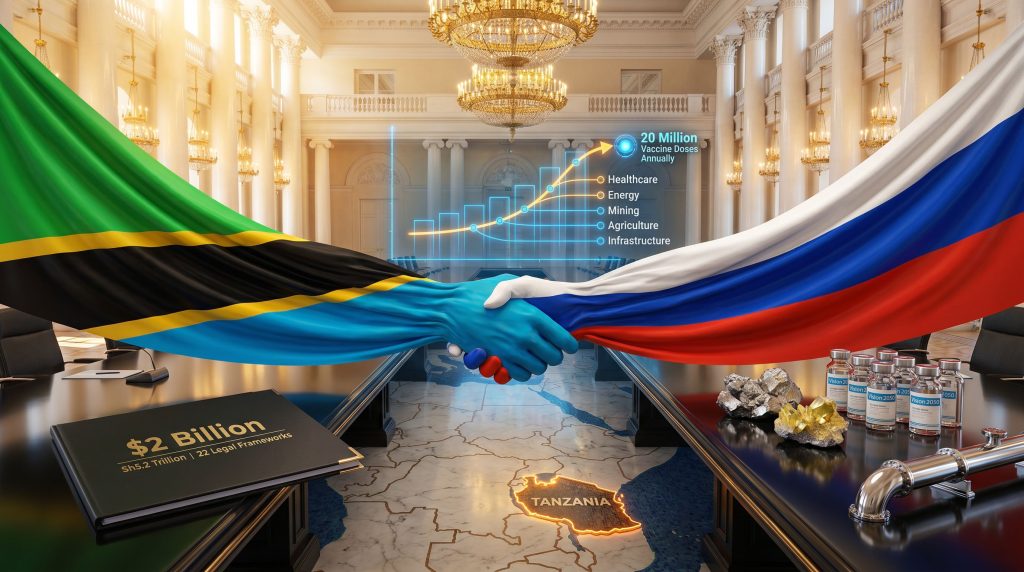
Across the African continent, a quiet but consequential shift is underway. Governments that once anchored their development financing strategies almost exclusively to Western multilateral institutions and bilateral aid frameworks are now actively constructing parallel investment pipelines through relationships with Russia, China, the Gulf states, and other non-Western partners. This is not opportunism for its own sake. It reflects a structural recognition that capital requirements of the scale demanded by Vision 2050-style national development agendas cannot realistically be met through any single channel. Tanzania's engagement with Russia, which has crystallised around the projected Tanzania Russia $2 billion investment deals, is one of the clearest and most consequential expressions of this continental trend.
Understanding this realignment requires looking beyond headlines and examining the underlying financial logic, geopolitical pressures, and sector-level dynamics driving the partnership forward. Furthermore, African mining finance trends provide important context for how this shift is reshaping capital flows across the region.
When big ASX news breaks, our subscribers know first
What the $2 Billion Figure Actually Represents
Before analysing the substance of the Tanzania-Russia engagement, it is worth establishing precisely what the $2 billion figure means in practical terms.
Analyst Note: The $2 billion estimate, equivalent to approximately Sh5.2 trillion in Tanzanian shillings, represents a projected pipeline of investments and business transactions expected to materialise across a three-to-five year horizon. It is not a confirmed capital commitment, a disbursed fund, or a signed contract. It is a structured expectation anchored in active sector-level negotiations and expressions of commercial interest.
This distinction matters enormously for investors and policymakers assessing the deal's real-world impact. Tanzania's ambassador and director of economic diplomacy at the Ministry of Foreign Affairs and East African Cooperation, John Ulanga, announced the estimate on June 7, 2026, during a briefing following President Samia Suluhu Hassan's participation in the St. Petersburg International Economic Forum (SPIEF). Ulanga indicated that, based on discussions covering trade and investment, Tanzanian officials were confident the country would attract investments and business worth more than $2 billion from Russia within the stated timeframe, positioning Russia among Tanzania's key development partners.
The pathway from expressed interest to deployed capital involves several intermediate steps:
- Ratification of bilateral legal frameworks by both governments
- Due diligence and feasibility assessments by participating Russian companies
- Regulatory approvals in Tanzania across relevant sectors
- Financing arrangements and project structuring
- Physical capital deployment and operational commencement
Tanzanian officials indicated that discussions are structured around at least 22 proposed bilateral legal frameworks, with several already executed during and around the SPIEF visit. The number and breadth of these frameworks suggest a relationship that is moving beyond symbolic diplomacy toward structured commercial architecture.
Sector-by-Sector Breakdown of the Investment Pipeline
The proposed Tanzania-Russia cooperation spans twelve broad areas, with varying degrees of advancement in each. The table below summarises the key sectors and their strategic significance.
| Sector | Russian Interest | Strategic Value for Tanzania |
|---|---|---|
| Healthcare and Pharmaceuticals | Local vaccine manufacturing; up to 20 million doses annually within five years | Reduces import dependency; regional export potential |
| Oil and Gas | Upstream exploration; infrastructure development (Gazprom noted) | Unlocks undercapitalised natural gas reserves |
| Nuclear Energy and Uranium | Research cooperation; engagement with the Mantra uranium project | Positions Tanzania in nuclear supply chains |
| Critical Minerals (Nickel, Uranium) | Resource extraction partnerships | Aligns with clean energy and defence supply demand |
| Agriculture and Agro-Processing | Value-addition partnerships; agro-industrial development | Strengthens food security and export diversification |
| Technology and Innovation | Start-up partnerships; digital infrastructure | Builds domestic tech capacity |
| Transport, Logistics, and Port Infrastructure | Port expansion; logistics network development | Enhances Tanzania's role as a regional trade corridor |
| Tourism and Aviation | Bilateral promotion; aviation connectivity | Expands foreign exchange earnings |
Healthcare as the Flagship Cooperation Pillar
Pharmaceutical manufacturing emerged as one of the most practically advanced areas of discussion. Russian companies expressed interest in partnering with Tanzania to produce up to 20 million vaccine doses per year domestically within five years, targeting both internal consumption and regional export markets. For a country that currently depends heavily on imported vaccines, local production capacity of this scale would represent a meaningful structural shift.
The regional dimension is particularly significant. Tanzania's geographic position at the heart of East Africa gives any domestic manufacturing facility potential access to landlocked neighbouring markets including Uganda, Rwanda, Burundi, the Democratic Republic of Congo, and Zambia. A vaccine production hub in Dar es Salaam, if realised, could serve a regional population of several hundred million people, creating export revenue streams that extend well beyond Tanzania's domestic health budget.
Similar pharmaceutical localisation initiatives have been pursued elsewhere on the continent, including in South Africa and Egypt. However, Tanzania's combination of central location and growing industrial base gives it a credible claim to regional hub status.
Critical Minerals: The Geopolitical Dimension
Tanzania's endowment of uranium, nickel, graphite, and other transition-critical minerals sits at the intersection of several competing global interests. The critical minerals demand driven by clean-energy supply chains, electronics manufacturing, and defence industries in North America, Europe, China, and now Russia has intensified sharply over the past decade.
The Mantra uranium project received specific mention in the context of Russian energy sector engagement. This is notable because uranium is not simply a commodity play. It sits within a broader nuclear energy infrastructure thesis that Russia has been actively pursuing across multiple African and Global South markets through Rosatom, its state nuclear energy corporation. Russia's interest in Tanzanian uranium aligns with its established strategy of securing upstream fuel supply relationships to support its downstream nuclear reactor export programme.
Uranium partnerships of this nature are rarely purely commercial. They typically carry long-duration strategic implications, as the buyer-seller relationship in nuclear fuel cycles spans decades rather than years.
Russian energy companies including Gazprom have also expressed interest in Tanzania's oil and gas sector, which remains underdeveloped relative to its estimated reserve base. Tanzania holds significant offshore and onshore natural gas resources that require substantial capital and infrastructure investment to commercialise.
The Political Catalyst: Tanzania's Disputed 2025 Election
The timing of Tanzania's pivot toward Russia is inseparable from the political fallout following the October 29, 2025 general election. President Hassan was declared the winner by a substantial margin, but opposition groups alleged fraud and challenged the exclusion of key challengers from the process. The post-election period was marked by civil unrest, a security response that resulted in reported civilian casualties, an internet blackout, and restrictions on political assembly.
The international response was unusually coordinated and pointed:
- The US State Department formally declared that Tanzania's post-election conduct had raised grave concerns about the direction of the bilateral relationship, announcing a comprehensive review citing restrictions on religious freedom, free speech, obstacles to US investment, and violence against civilians
- The European Union issued a statement expressing deep concern over the violence, the internet shutdown, and reported irregularities in the election process, describing reports of fatalities and injuries as being of extreme concern
- The foreign ministers of the United Kingdom, Canada, and Norway issued a joint statement on October 31 calling for restraint and the protection of freedom of assembly and expression
- The African Union election observation mission concluded that the 2025 Tanzania General Elections did not comply with AU principles, normative frameworks, and international obligations and standards for democratic elections
When multiple major Western donors simultaneously signal a relationship review, the practical consequence in development finance terms is well understood. Concessional financing pipelines tend to slow, project approvals face additional scrutiny, and budget support arrangements come under pressure. Consequently, this creates a structural incentive for the government in question to accelerate alternative partnership development, not as a symbolic gesture but as a financial necessity.
The Moscow Visit: Symbolism and Substance
President Hassan's attendance at SPIEF in June 2026 and her state visit to Moscow carried weight on multiple levels. According to reports, it was the first Tanzanian state visit to Russia in 57 years, a fact that underscores how significant a diplomatic reorientation the visit represented, regardless of how Tanzanian officials framed it publicly.
SPIEF functions as Russia's primary platform for projecting economic engagement with Global South nations. In 2026, the forum brought together heads of state including Russian President Vladimir Putin, Uzbek President Shavkat Mirziyoyev, and the Vice President of China, among others. For Tanzania, participating at this level signals a deliberate choice to engage Russia as a peer economic partner rather than a secondary relationship.
The business-level engagements conducted on the sidelines of the forum covered all twelve identified cooperation sectors. Furthermore, Tanzanian officials held structured negotiations with major Russian companies across healthcare, mining, energy, agriculture, and technology. The 22 bilateral legal frameworks under discussion represent the administrative architecture through which these sector-level interests would be formalised.
Russia's Africa Strategy: Where Tanzania Fits
Tanzania's engagement with Russia does not exist in isolation. It forms part of Russia's broader and accelerating drive to deepen economic relationships across the African continent. In terms of mining geopolitics, Russia has expanded its presence across multiple countries in recent years, deploying a combination of state-backed entities, private companies, and diplomatic forums to build relationships that serve both commercial and geopolitical objectives.
Tanzania's specific appeal within this strategy is multidimensional:
- Its geographic position as a gateway to landlocked East and Central African markets gives port infrastructure cooperation strategic value far beyond Tanzania's own trade volumes
- Its critical mineral endowment in uranium, nickel, and graphite aligns with Russian industrial and export interests
- Its large and growing consumer market provides a platform for Russian goods and services to access the broader East African region
- Its political trajectory following the 2025 election created a window of opportunity for Russia to deepen engagement at a moment when Western relationships were under strain
The competitive dynamic in East Africa now involves Russia, China, Gulf sovereign wealth funds, and Western partners all pursuing influence simultaneously. Tanzania's resource endowment, strategic location, and domestic market size give it genuine leverage to negotiate across multiple relationships rather than simply accepting terms from any single partner.
The next major ASX story will hit our subscribers first
Tanzania's Official Position: Diversification Without Defection
Tanzanian officials have been deliberate in framing the Russia engagement as an expression of investment diversification rather than a geopolitical alignment shift. Tanzania's Minister of State for Planning and Investment, Kitila Mkumbo, indicated that implementing Vision 2050 requires seeking investment opportunities across the world and that the Moscow visit had opened another important door contributing to economic growth.
Foreign Affairs Minister Mahmoud Thabit Kombo characterised the visit as positioning Tanzania within Russia's broader strategy of expanding cooperation with African countries across trade, investment, and development. This multi-vector foreign policy posture, maintaining simultaneous relationships with competing global powers, has become increasingly standard among African governments. Ethiopia, Senegal, South Africa, and others have all navigated variants of this balancing act.
In addition, the mineral wealth investment experience of other emerging economies demonstrates that the risks of this approach are real but manageable, provided the government maintains credible relationships on multiple sides and avoids actions that trigger secondary pressure from any single bloc.
Scenario Analysis: If the Pipeline Materialises
Disclaimer: The following scenarios are speculative projections based on publicly available information and should not be interpreted as investment advice or confirmed forecasts.
| Scenario | Timeline | Key Conditions |
|---|---|---|
| Best case | Legal frameworks ratified within 12-18 months; capital deployment begins 2027 | Rapid ratification; no sanctions complications; Russian company follow-through |
| Base case | Phased deployment across 2026-2030 with sector-specific milestones | Gradual progress; some frameworks stall; healthcare and mining advance first |
| Risk case | Diplomatic or sanctions-related friction delays or limits capital flows | Secondary pressure from Western partners; legal frameworks unsigned |
If Tanzania successfully converts the full projected pipeline into operational investments over a five-year window, the combined effect across healthcare manufacturing, gas infrastructure, and critical mineral extraction could meaningfully diversify Tanzania's export base. Furthermore, the Tanzania Russia $2 billion investment deals could reduce import dependency in the health sector and establish new foreign exchange earning streams. The vaccine manufacturing proposal alone, targeting 20 million doses annually, represents a potentially transformative addition to Tanzania's pharmaceutical and export economy. These strategic minerals deals demonstrate how resource-rich nations are increasingly leveraging their endowments to attract diversified global partnerships.
Key Data Summary
| Dimension | Key Data Point |
|---|---|
| Projected investment pipeline | Over $2 billion (Sh5.2 trillion) across 3-5 years |
| Bilateral legal frameworks discussed | 22 proposed agreements |
| Cooperation sectors identified | 12 areas |
| Vaccine production target | Up to 20 million doses annually within 5 years |
| Last Tanzanian state visit to Russia | 57 years prior to June 2026 |
| Western entities expressing formal concern | US, EU, UK, Canada, Norway, African Union |
| Tanzania's national development framework | Vision 2050 |
This article is based on publicly available reporting and official statements. Projected investment figures represent forward-looking estimates and have not been confirmed as committed or disbursed capital. Readers should exercise independent judgement when assessing geopolitical and investment risk. Further context on African market developments can be explored via Business Insider Africa, which provides ongoing coverage of investment trends and economic dynamics across the continent.
Want to Track the Next Major Mineral Discovery Before the Broader Market Does?
As Africa's investment architecture shifts and critical minerals like uranium, nickel, and graphite attract intensifying global interest, Discovery Alert's proprietary Discovery IQ model delivers real-time ASX alerts on significant mineral discoveries, transforming complex data across 30-plus commodities into clear, actionable insights — explore historic discoveries and their returns, then begin your 14-day free trial to position yourself ahead of the market.