May 23, 2026
Technology Infrastructure as the Foundation of Mining Innovation
The transformation of mining operations across Australia and New Zealand reflects a fundamental shift in how extractive industries approach technological modernisation. Rather than pursuing isolated technological solutions, regional operators have embraced comprehensive digital ecosystems that address multiple operational challenges simultaneously. This strategic approach positions Australasian mining technology investment as a model for integrated operational enhancement.
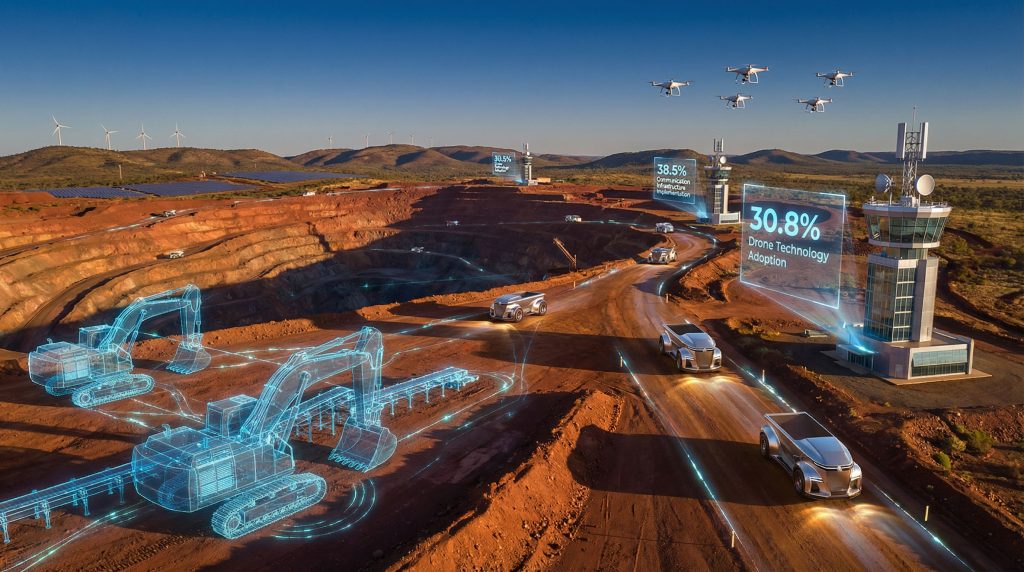
Communication networks serve as the architectural backbone for smart mining operations, connecting autonomous systems, drone fleets, and real-time monitoring platforms across vast geographic distances. With 38.5% of operators achieving full implementation of integrated communication systems, the region demonstrates leadership in establishing the technological foundation necessary for advanced mining operations.
The deployment of 5G Internet of Things (IoT) networks integrated with satellite technologies enables mining operations to maintain centralised control over equipment and processes located thousands of miles from headquarters. Furthermore, this connectivity architecture supports the coordination of complex operational activities including drilling optimisation, blast sequencing, and autonomous haulage systems whilst maintaining real-time visibility into safety and productivity metrics.
Management systems function as the operational command centre, processing data from multiple technological inputs to enhance forecasting accuracy, ensure regulatory compliance, and coordinate automated equipment instructions. One-third of surveyed operations report complete deployment of centralised management platforms, indicating substantial progress toward comprehensive operational digitisation.
The preference for complete site infrastructure upgrades rather than piecemeal technology integration reflects operational maturity and strategic recognition that legacy system compatibility challenges can compromise technological effectiveness. Consequently, this approach ensures that new digital capabilities can deliver maximum operational benefit without being constrained by outdated infrastructure limitations.
Drone technology adoption has achieved 30.8% implementation rates across surveyed operations, transitioning from experimental applications to essential operational tools. Geographic isolation and the scale of Australian mining operations create specific requirements for aerial monitoring, site surveying, and safety management that make drone technology particularly valuable for cost-efficient operational oversight.
When big ASX news breaks, our subscribers know first
Safety Technology Investment Driven by Regulatory Evolution
The relationship between safety technology adoption and regulatory compliance creates a dynamic investment environment where technological advancement serves both operational efficiency and legal requirement fulfilment. Australia's commitment to progressive safety standards drives sustained technology investment across multiple categories of worker protection and operational risk mitigation systems.
Over 60 mining safety standards received updates for 2025, representing a 15% increase in regulatory technology requirements that directly influence investment priorities across the sector. This regulatory evolution reflects Australia's position as maintaining stricter and more progressive safety frameworks compared to many global mining regions, creating competitive pressure for comprehensive safety technology adoption.
Fatigue detection systems represent mature technology within the Australian mining sector, with over 20 years of operational experience demonstrating long-term commitment to proactive safety management. These systems utilise wearable device integration and physiological monitoring to identify operator capability degradation before safety incidents occur, establishing intervention protocols that prevent accidents rather than merely responding to them.
The deployment of collision avoidance and proximity detection systems addresses critical safety challenges in mining environments where heavy equipment operates in close proximity to personnel. In addition, these technologies provide real-time hazard identification and automated warning systems that reduce the risk of vehicle-personnel accidents through continuous environmental monitoring and immediate threat communication.
Key Safety Technology Categories:
• Collision Avoidance Systems: Real-time proximity detection with automated warning mechanisms
• Proximity Detection Networks: Personnel protection systems alerting operators to nearby hazards
• Fatigue Detection Systems: Continuous physiological monitoring for operator capability assessment
• Gas Detection Drones: Automated atmospheric monitoring for hazardous conditions
• Ventilation Control Systems: Remote monitoring and management of air quality systems
The integration of safety technologies with broader operational systems creates synergistic benefits where safety enhancement simultaneously supports productivity improvement. Drone applications for gas detection and ventilation system management reduce both safety risks and operational downtime whilst providing more comprehensive monitoring coverage than traditional human-based inspection protocols.
Regional leadership in safety technology adoption reflects strategic recognition that comprehensive worker protection systems create operational advantages beyond regulatory compliance. Advanced safety monitoring enables operations in challenging environments whilst reducing insurance costs and maintaining social licence to operate in remote communities.
Autonomous Technology Leadership Through Early Adoption Strategy
Australia's position as a global leader in autonomous mining technology stems from strategic early adoption decisions that established operational capabilities before widespread industry implementation. This first-mover advantage created technological expertise and operational experience that continues to influence investment patterns and competitive positioning.
Over 1,000 autonomous or autonomous-ready surface mining trucks operate across Australian mining sites, representing the second-highest global deployment after China. This substantial fleet deployment demonstrates the operational viability and economic justification for autonomous technology investment at scale.
Rio Tinto's Yandicoogina and Nammildi mines achieved a significant industry milestone in 2016 by becoming the first mining operations globally to deploy fully driverless trucks for ore transportation. This pioneering implementation established operational protocols and demonstrated productivity benefits that influenced subsequent industry-wide adoption patterns.
The concentration of autonomous technology deployment among major operators including BHP, Rio Tinto, and Fortescue reflects the substantial capital investment requirements and operational scale necessary to justify autonomous fleet implementation. However, high infrastructure costs and complex integration requirements limit autonomous technology adoption primarily to tier-one operations with sufficient financial resources and operational volume.
Autonomous Technology Operational Benefits:
• Deep Extraction Capability: Enables operations in previously inaccessible hazardous locations
• 24/7 Operational Continuity: Eliminates human operator scheduling constraints
• Precision Operation: Consistent performance parameters reduce operational variability
• Remote Terrain Access: Supports extraction from difficult geographic locations
• Safety Risk Reduction: Removes human presence from high-risk operational environments
Lower current investment levels in autonomous technology reflect market maturity rather than reduced adoption interest. Australia's early deployment timeline means that major operators have already completed primary autonomous technology implementation, reducing active new investment whilst maintaining operational leadership in autonomous fleet management.
The strategic focus on autonomous technology enables deeper extraction operations in remote terrain that would be challenging or dangerous for human operators. This capability expansion supports access to higher-quality ore deposits and extends the operational lifespan of existing mining sites through improved resource recovery efficiency.
Future autonomous technology investment will likely focus on system optimisation and integration with emerging technologies rather than initial deployment. The established autonomous fleet provides a platform for incorporating AI in mining operations enhancements, predictive maintenance capabilities, and advanced safety systems that further improve operational performance.
Emerging Technologies Shaping Next-Generation Investment Strategies
The evolution toward Industry 4.0 principles in mining operations creates investment opportunities in technologies that enhance operational intelligence, reduce downtime risks, and improve decision-making capabilities through advanced data analytics and real-time monitoring systems.
Predictive maintenance technology receives the highest investment priority among surveyed operators for the next two years, reflecting the substantial costs associated with unexpected equipment failures and operational downtime. Furthermore, the integration of artificial intelligence capabilities enhances predictive accuracy and enables proactive maintenance scheduling that minimises production disruptions.
Global mining AI spending is projected to expand from $2.7 billion in 2024 to $13.1 billion by 2029, representing approximately 36.6% compound annual growth that indicates widespread industry recognition of AI's operational value. This investment trajectory reflects growing confidence in AI applications for mining-specific challenges and measurable return on investment from early implementations.
Digital twin technology creates virtual operational environments that enable scenario testing and risk assessment before implementing changes in physical mining operations. However, whilst current regional adoption rates lag global averages, surveyed operators indicate substantial planned investment in digital twin capabilities as major operators demonstrate technology potential and operational benefits.
Emerging Technology Investment Categories:
| Technology Category | Investment Priority | Primary Applications |
|---|---|---|
| Predictive Maintenance | Highest | Equipment failure prevention, downtime reduction |
| Digital Twin | High | Scenario testing, operational planning |
| Wearable Technology | Moderate | Health monitoring, safety enhancement |
| AI Integration | High | Process optimisation, decision support |
| Battery Electric Vehicles | Moderate | Emissions reduction, operational efficiency |
Wearable technology adoption addresses current investment gaps whilst supporting comprehensive worker safety monitoring through real-time health assessment capabilities. Devices including wristbands, smartwatches, and detection units monitor physiological indicators such as heart rate and posture changes to identify potential safety risks before incidents occur.
The integration of artificial intelligence across multiple operational systems creates synergistic benefits where individual technology deployments enhance overall operational capability. AI-powered fleet efficiency systems, predictive maintenance algorithms, and autonomous vehicle coordination demonstrate measurable improvements in safety performance and operational efficiency.
Artificial Intelligence Integration Transforming Operational Capabilities
The implementation of artificial intelligence across Australian mining operations demonstrates measurable improvements in productivity, safety performance, and operational cost management that justify sustained technology investment and expansion of AI applications across diverse operational functions.
Fortescue's AI implementation has achieved productivity improvements of approximately 30% through autonomous drilling systems and large autonomous fleet coordination, demonstrating the substantial operational benefits possible through comprehensive AI deployment across multiple operational systems.
Caterpillar's AI-powered systems deployed at BHP's Jimblebar mine in the Pilbara region have achieved 50% reduction in safety incidents and 20% reduction in operational costs through autonomous truck coordination and collision avoidance systems that enhance both safety performance and operational efficiency.
AI Application Areas in Mining Operations:
• Digital Twin Integration: Real-time 3D geological modelling for operational planning and monitoring
• Biodiversity Conservation: Machine learning applications for environmental protection initiatives
• Collision Avoidance Systems: AI-powered safety systems reducing vehicle-personnel accidents
• Autonomous Fleet Coordination: Optimised routing and scheduling for unmanned vehicle operations
• Predictive Analytics: Equipment failure prediction and maintenance optimisation
Rio Tinto's Gudai-Darri mine utilises AI-powered digital twin technology to create comprehensive 3D operational models that support real-time monitoring, work planning, documentation access, and interactive training capabilities. This integrated approach demonstrates how AI can enhance multiple operational functions through a unified technological platform.
Environmental applications of AI include biodiversity monitoring at Rio Tinto's Weipa mine, where machine learning pipelines detect, monitor, and support conservation efforts for protected species populations. In addition, this application demonstrates AI's capability to address regulatory requirements whilst supporting sustainable mining practices.
The economic justification for AI investment stems from quantifiable improvements in operational metrics including reduced downtime, enhanced safety performance, improved resource recovery rates, and optimised equipment utilisation. Consequently, these measurable benefits create compelling business cases for expanded AI deployment across additional operational functions.
Investment Scale and Market Dynamics Influencing Technology Adoption
The distribution of technology investment across different operational scales reveals patterns where major operators lead adoption timelines whilst mid-tier operations increasingly close technology gaps through strategic implementation of proven technologies and cost-effective deployment strategies.
$30 billion in technology investment between 2005 and 2022 by the Australian mining industry demonstrates substantial long-term commitment to technological advancement and operational modernisation across multiple technology categories and operational applications. This level of Australasian mining technology investment reflects the region's strategic approach to maintaining competitive advantages through comprehensive digital transformation.
Major operators including BHP, Rio Tinto, and Fortescue dominate technology spending and implementation timelines, establishing operational precedents that influence industry-wide adoption patterns and technology validation for broader market implementation.
The concentration of technology investment among large-scale operations reflects capital requirements and operational complexity that create barriers for smaller operators whilst establishing technology validation that enables subsequent broader market adoption as costs decrease and implementation complexity reduces.
Technology Adoption Stratification Patterns:
• Tier-One Operators: Early adoption, comprehensive implementation, technology development leadership
• Mid-Tier Operations: Strategic adoption of proven technologies, cost-effective implementation
• Smaller Operations: Selective adoption focused on highest-impact applications
The geographic distribution of 95,000 historic and active mineral extraction sites across Australia creates diverse technology implementation requirements based on operational scale, resource type, and geographic accessibility that influence technology selection and investment priorities.
Remote location characteristics common across Australian mining operations create specific technology requirements for communication systems, autonomous capabilities, and centralised monitoring that justify higher technology investment levels compared to operations with more accessible infrastructure.
Mid-tier and smaller operations increasingly adopt technologies validated by major operators, creating technology diffusion patterns where initial high-cost implementations by large operators enable broader industry adoption as technology costs decrease and implementation expertise develops.
The next major ASX story will hit our subscribers first
Geographic and Operational Factors Shaping Technology Investment Priorities
The unique operational characteristics of Australasian mining create specific technology requirements that differ from other global mining regions, influencing investment priorities toward solutions that address geographic isolation, communication challenges, and remote operational management capabilities.
Remote operational locations separated by thousands of miles from headquarters necessitate robust communication infrastructure and centralised control systems that enable real-time operational oversight and management coordination across vast geographic distances. Furthermore, the development of data-driven mining operations has become essential for managing these complex, distributed networks effectively.
The integration of IoT networks with satellite technologies addresses connectivity challenges inherent in remote mining operations whilst enabling comprehensive machine network coordination and data transmission for centralised operational management and real-time decision-making capabilities. The Australian mining industry's commitment to technological advancement is recognised globally, with significant investment flows supporting continued innovation and operational excellence.
Regional Technology Leadership Areas:
• Communication Systems: Global leadership in integrated mine communication network implementation
• Management Software: Advanced adoption of centralised operational control platforms
• Drone Applications: Leading deployment for surveying, gas detection, and ventilation management
• Autonomous Vehicles: Pioneer status in fully driverless mining operations
• Safety Technologies: Progressive regulatory framework driving comprehensive safety system adoption
Geographic isolation creates operational advantages for certain technology deployments where remote terrain access and deep extraction capabilities provide competitive benefits that justify substantial technology investment and infrastructure development.
The operational environment characterised by challenging terrain, extreme weather conditions, and vast distances between operational sites and support infrastructure influences technology selection toward robust, reliable systems capable of sustained performance in demanding conditions.
However, regulatory frameworks specific to Australian mining operations create compliance requirements that influence technology investment toward safety enhancement, environmental monitoring, and operational transparency capabilities that exceed global baseline standards.
Operational Downtime Mitigation Through Advanced Technology Investment
Recent operational disruptions across multiple Australian mining sites highlight the substantial economic impact of unexpected downtime and create urgency for predictive maintenance technology investment that can identify and address potential equipment failures before they result in operational suspensions.
Glencore's Mount Isa copper mine closure in July and Oaky Creek's operational suspension from April to July following water leak incidents demonstrate the substantial operational and financial risks associated with equipment failures and infrastructure problems that predictive maintenance technology can help prevent.
BHP's suspension of nickel operations into 2027 due to financing issues and market shifts illustrates how operational efficiency improvements through predictive maintenance and cost optimisation technologies become critical during challenging market conditions and operational transitions. These challenges underscore the importance of strategic technology sector developments in maintaining operational resilience.
Downtime Cost Mitigation Strategies:
• Real-Time Equipment Monitoring: Continuous assessment of operational performance parameters
• Predictive Analytics: Early warning systems for potential equipment failures
• Preventive Intervention Protocols: Proactive maintenance scheduling based on predictive insights
• Integrated Maintenance Platforms: Comprehensive monitoring across all operational systems
• AI-Enhanced Diagnostics: Machine learning algorithms for pattern recognition and failure prediction
The substantial costs associated with mining downtime create compelling economic justification for predictive maintenance investment, where technology deployment costs are significantly lower than lost production revenue and operational restart expenses.
Advanced analytics capabilities enhanced by artificial intelligence integration improve maintenance prediction accuracy and enable optimisation of maintenance scheduling to minimise operational disruption whilst maximising equipment reliability and operational continuity.
Industry-wide recognition of downtime risks drives sustained investment demand for predictive maintenance technologies that provide operational insurance against unexpected failures and support proactive operational management strategies. This focus on technology-driven solutions represents a key component of overall Australasian mining technology investment strategies for 2025 and beyond.
This analysis reflects current market conditions and technological adoption patterns. Future investment outcomes may vary based on market dynamics, regulatory changes, and technological developments. Readers should conduct independent research and consult with industry professionals for specific investment decisions.
Want to Discover the Next Major Mining Investment Opportunity?
Discovery Alert's proprietary Discovery IQ model delivers instant notifications on significant ASX mineral discoveries, empowering investors to identify actionable opportunities before the broader market recognises their potential. Start your 30-day free trial today and position yourself ahead of the curve as technology-driven mining operations continue to reshape the investment landscape.