June 5, 2026
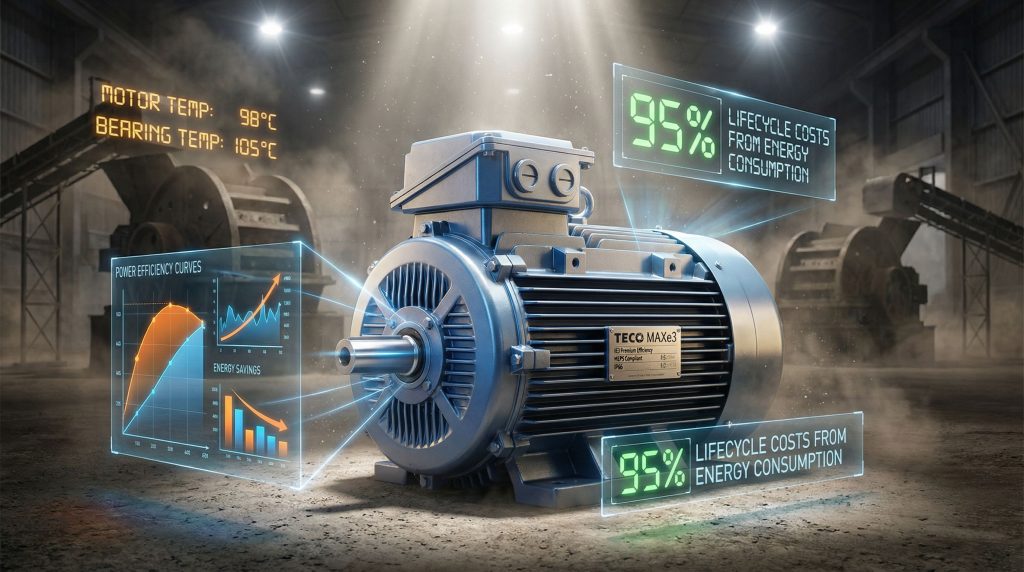
Mining operations face increasing pressure to optimise electrical systems for maximum efficiency and reliability. TECO MAXe3 Mining motors represent a strategic investment in advanced motor technology specifically designed for the demanding requirements of mining applications. These premium efficiency motors address the critical need for sustained performance in harsh industrial environments while delivering measurable economic benefits through reduced operational costs and enhanced productivity.
Understanding motor performance characteristics enables mining operations to optimise their electrical infrastructure while managing long-term operational expenses. The selection of premium efficiency motors can significantly influence total cost of ownership calculations, especially in applications requiring continuous operation over extended periods.
Energy Consumption Impact on Mining Economics
Energy consumption represents the dominant cost factor in motor lifecycle economics. According to industry analysis from TECO Australia, approximately 95% of a motor's total lifecycle costs stem from energy consumption rather than initial capital expenditure. This statistic emphasises the critical importance of selecting efficient motor technologies for mining applications.
Furthermore, the International Electrotechnical Commission (IEC) and International Energy Agency (IEA) recognise that operating costs over a motor's typical 15-20 year lifecycle significantly exceed initial purchase prices. Motor lifecycle cost structures typically break down as follows:
| Cost Component | Percentage of Total |
|---|---|
| Operating costs (energy) | 75-90% |
| Initial purchase cost | 5-15% |
| Maintenance and repairs | 5-15% |
| Installation and commissioning | 2-5% |
| Decommissioning | <1% |
Remote mining sites operating on diesel generation face amplified energy costs. These facilities represent approximately 15-20% of global mining operations and experience significantly higher per-kilowatt-hour costs compared to grid-connected operations.
Every efficiency improvement translates directly to reduced fuel consumption, lower emissions, and decreased operational expenses. This becomes particularly critical as mining companies face energy transition challenges across their operations.
Power Efficiency Correlation with Operational Profitability
The correlation between motor selection efficiency and operational profitability reflects fundamental energy management principles. Premium efficiency motors typically demonstrate 2-8% efficiency improvements over standard efficiency models, creating compounding savings over continuous operation periods.
Wilfred Krog, Sales Director at TECO Australia, emphasises that motor selection efficiency directly correlates with long-term operational profitability. This principle becomes particularly pronounced in applications operating 8,000-8,760 hours annually, where energy cost savings compound rapidly throughout the motor's operational life.
Mining operations utilising continuous-duty applications demonstrate the strongest return on investment for efficiency upgrades. The payback period for upgrading from less efficient motors often proves to be very short.
In addition, post-payback operational savings contribute directly to profitability whilst supporting broader industry evolution trends towards sustainable operations.
When big ASX news breaks, our subscribers know first
IE3 Efficiency Standards and MEPS Compliance
IE3 classification represents the third level of efficiency under IEC 60034-30-1:2014 standards, typically achieving efficiency levels between 87-97% depending on motor size and design specifications. This efficiency class forms part of the global framework for standardising motor performance across industrial applications.
The TECO MAXe3 Mining motors incorporate premium IE3 efficiency standards, with many motor sizes exceeding minimum efficiency performance standard (MEPS) levels required by regulatory frameworks. In Australia, MEPS regulations mandate minimum efficiency levels for motors sold domestically.
These regulations typically require IE2 or IE3 efficiency classes depending on motor specifications. Consequently, premium efficiency motors align with regulatory compliance whilst delivering operational advantages.
Comparative Performance Analysis
IE3 motors demonstrate approximately 2-3% efficiency improvement over IE2 motors in the 7.5-75 kW range, with variations based on motor construction and operating conditions. These improvements translate to measurable operational cost reductions across different duty cycles:
- Continuous duty applications: 1-3 year payback periods
- Intermittent duty cycles: 2-4 year payback periods
- Variable load applications: 1.5-3.5 year payback periods
The Department of Climate Change, Energy, Environment and Water (DCCEEW) requires compliance with Australian Standards AS 60034-30-1 for motor efficiency classification and performance verification. This regulatory framework supports the transition towards more efficient industrial equipment.
Power Factor Optimisation and Transmission Loss Reduction
Power factor in industrial motors typically ranges from 0.80-0.95 depending on design specifications and load conditions. Premium efficiency motor designs optimise power factor performance, reducing reactive power demand on electrical infrastructure.
This optimisation improves overall system efficiency whilst supporting data-driven operations through enhanced monitoring capabilities.
Transmission losses in mining distribution systems typically account for 5-10% of distributed electrical energy. Efficient motor operation with optimised power factor can reduce these losses by 2-4%.
Furthermore, this contributes to overall facility energy performance whilst supporting broader sustainability initiatives. Grid stability considerations become particularly important for large motor installations where multiple high-power motors operate simultaneously.
Power factor optimisation through premium efficiency designs helps maintain electrical system stability whilst reducing infrastructure stress.
Cast Iron Construction and Thermal Management
The TECO MAXe3 Mining motors utilise heavy-duty cast iron frame construction designed for extreme mining environments. Cast iron materials comply with ISO 286 dimensional standards and support operating temperatures up to 130°C for Class H insulation systems.
Krog notes that the heavy-duty cast-iron frame with cast cooling fins represents one of the heaviest designs available and proves most suitable for demanding mining applications. This engineering approach prioritises thermal management and mechanical durability over weight reduction.
Cooling System Design Benefits
Cast cooling fin geometry improves thermal transfer efficiency by 20-40% compared to standard motor designs. This enhanced heat dissipation capability enables consistent performance under sustained high-temperature ambient conditions.
The cooling system design incorporates:
- Increased surface area for heat dissipation
- Optimised air flow through fin geometry
- Enhanced thermal conductivity through cast iron construction
- Temperature rise management for Class H insulation systems
Class H insulation systems maintain maximum continuous operating temperatures of 180°C according to IEC 60085:2007 standards. This provides thermal safety margins for demanding applications whilst supporting extended operational life.
Protection Systems and Ingress Prevention
IP66 rating specifications provide protection against powerful water jets from any direction whilst ensuring complete dust ingress prevention. This rating complies with IEC 60529:2013 standards and addresses the harsh environmental conditions typical in mining operations.
The TECO MAXe3 Mining motors incorporate IP66-rated enclosures capable of withstanding dust, spray, and moisture exposure common in mining environments. This protection level proves essential for maintaining operational integrity in crusher circuits.
However, the protection extends beyond basic environmental resistance. The design addresses screening operations and material handling systems where contamination risks remain consistently high.
Labyrinth Seal Technology
Labyrinth seal systems function through multiple chambers that create centrifugal force barriers. These systems effectively prevent dust and moisture from reaching critical bearing surfaces whilst proving particularly effective in mining environments with high dust concentrations.
The sealing system incorporates:
- Multi-chamber design for progressive filtration
- Centrifugal force barriers for particle exclusion
- Non-contact sealing for reduced wear
- Maintenance accessibility for service requirements
Modern bearing protection systems utilise sealed ball bearings with lifetime lubrication, grease relief mechanisms for thermal expansion management, and temperature monitoring integration points.
Grease Relief Systems and Predictive Maintenance
TECO motors incorporate patented grease relief systems enabling bearing maintenance during operation, whether manually or through automatic lubricators. This design philosophy prioritises extended service life through maintainability rather than sealed-for-life configurations.
Effective bearing maintenance can extend bearing service life by 30-50% compared to sealed bearings without maintenance capability. In remote mining operations where replacement motor availability may be limited, maintainability represents a critical operational advantage.
Temperature Monitoring Integration
The TECO MAXe3 Mining motors include dual thermistor configurations as standard, providing both alarm and trip functions for motor protection. This dual-system approach complies with IEC 60034-11:2004 standards for thermistor protection systems.
For larger motors, resistance temperature devices (RTD) can be installed in stator windings or bearings to provide real-time condition monitoring. RTD-equipped motors demonstrate 15-25% reduction in unexpected failures compared to thermistor-only systems.
| Monitoring System | Temperature Accuracy | Response Time | Application |
|---|---|---|---|
| Thermistors | ±5°C | 2-5 seconds | Protection functions |
| RTDs | ±0.1°C | <1 second | Continuous monitoring |
The next major ASX story will hit our subscribers first
Load Handling Capabilities for Variable Demand Applications
Crusher motors typically operate under duty cycle S5 (intermittent periodic duty) or S4 (intermittent duty with starting and electric braking). Starting torque requirements typically range from 200-400% of rated torque depending on crusher type and material characteristics.
The TECO MAXe3 Mining motors design addresses variable load performance through robust construction capable of withstanding shock loads and thermal cycling. This capability proves essential for primary and secondary crushing applications.
For instance, material feed consistency varies significantly across different mining operations, requiring motors that can adapt to changing load conditions whilst maintaining efficiency.
Vibration Tolerance Specifications
Mining equipment generates substantial vibration levels that can impact motor performance and service life. The cast iron construction and mounting design of TECO MAXe3 motors provide enhanced vibration resistance compared to lighter-weight alternatives.
Vibration tolerance specifications address:
- Mechanical resonance avoidance through mass distribution
- Bearing protection under oscillating loads
- Frame structural integrity under sustained vibration
- Electrical connection reliability in dynamic environments
High Starting Torque Applications
Crushing circuit applications require motors capable of delivering high starting torque for material breakage initiation. The TECO MAXe3 design incorporates rotor and stator configurations optimised for high starting torque whilst maintaining efficiency under running conditions.
Primary crushing applications typically demand:
- 300-400% starting torque for jaw crushers
- 250-350% starting torque for gyratory crushers
- 200-300% starting torque for cone crushers
Secondary crushing systems generally require lower starting torque but must handle variable material feed rates and size distributions. High-efficiency mining motors provide the necessary performance characteristics for these demanding applications.
Continuous Duty Motor Specifications
Conveyor and material handling systems utilise continuous duty motors designed for S1 duty classification under IEC standards. These applications require consistent performance over extended operating periods without thermal cycling concerns.
Belt drive considerations include:
- Shaft design for coupling compatibility
- Mounting flexibility for belt tensioning
- Speed requirements for material handling rates
- Load factor calculations for variable material weights
Multiple motor synchronisation challenges arise in long conveyor systems where several motors must coordinate to maintain consistent belt speed and tension distribution. However, proper motor selection and control systems address these operational requirements effectively.
Total Cost of Ownership Analysis
Investment decisions for mining motor selection require comprehensive total cost of ownership analysis encompassing initial capital expenditure, operational savings, and maintenance cost reduction quantification. This analysis becomes increasingly important as operations seek to maximise decarbonisation benefits.
Payback period calculations for efficiency upgrades typically demonstrate favourable returns:
- Continuous operation facilities: 1-3 year payback
- High annual operating hours: 18-24 month payback
- Remote diesel-powered sites: 12-18 month payback
The calculation methodology incorporates energy cost differentials, maintenance interval extensions, and reduced failure rates associated with premium efficiency motor technology.
Remote Site Power Generation Economics
Diesel fuel consumption reduction calculations become critical for remote mining operations. Premium efficiency motors reduce generator load requirements, enabling:
- Reduced fuel consumption through lower electrical demand
- Generator capacity optimisation for facility planning
- Carbon footprint reduction through efficiency improvements
- Maintenance cost reduction through extended service intervals
These benefits align with broader industry initiatives focused on renewable energy transformations across mining operations.
Temperature Monitoring and Protection Systems
Dual thermistor configurations provide alarm and trip functions enabling both predictive maintenance capabilities and protective shutdown functionality. The alarm function supports condition monitoring programmes whilst trip protection prevents motor damage from overheating.
RTD integration enables real-time condition monitoring for predictive maintenance algorithms. Mining operations implementing RTD monitoring on crusher motors have reported:
- 40-60% reduction in unplanned motor failures
- 20-30% extension of bearing service intervals
- 18-24 month average ROI through reduced downtime costs
Stator Winding and Bearing Temperature Surveillance
Temperature surveillance systems monitor critical motor components including stator windings and bearing assemblies. This monitoring capability enables trending analysis for predictive maintenance scheduling and early fault detection.
Modern condition monitoring systems integrate with facility SCADA networks, providing centralised monitoring and alarm management for multiple motor installations across mining operations. Furthermore, this integration supports comprehensive asset management strategies.
Hazardous Area Certification Requirements
Mining environments often require motors certified for explosive atmospheres according to IECEX standards. The TECO MAXe3 series can be configured with appropriate certifications for different hazardous area classifications.
IECEX certification standards address explosive atmosphere requirements through multiple protection methods:
- Ex e (Increased Safety): Enhanced protection through construction
- Ex nA (Non-sparking): Normal operation without ignition capability
- Ex tD (Protection by Enclosure): Dust ignition protection
Installation requirements for explosive atmospheres include proper cable gland selection, earthing arrangements, and maintenance procedures to maintain certification compliance.
Energy Efficiency and Environmental Impact
Carbon emission reduction through improved motor efficiency supports mining industry sustainability objectives. Premium efficiency motors contribute to environmental compliance and reporting requirements through measurable energy consumption reductions.
The environmental impact calculation includes:
- Direct emission reductions from diesel generation
- Indirect emission reductions from grid electricity efficiency
- Lifecycle carbon footprint improvements through extended service life
- Material conservation through reduced replacement frequency
Equipment Longevity and Resource Conservation
Extended service life through robust construction reduces replacement frequency and associated resource consumption. The TECO MAXe3 design philosophy prioritises durability and maintainability to maximise operational life and minimise waste generation.
Resource conservation benefits include:
- Reduced raw material consumption through extended service life
- Decreased manufacturing energy through longer replacement intervals
- Material recycling opportunities at end-of-life
- Reduced transportation impact through fewer replacement shipments
The combination of efficiency improvements, durability enhancements, and maintenance optimisation positions premium mining motors as essential components for sustainable mining operations seeking to balance operational performance with environmental responsibility.
Ready to Optimise Your Mining Operations?
Discovery Alert's proprietary Discovery IQ model provides instant notifications on significant ASX mineral discoveries, empowering mining investors to identify actionable opportunities in exploration companies developing next-generation mining technologies. Begin your 14-day free trial today to gain the market-leading advantage needed for discovering tomorrow's mining innovations before the broader market catches on.